
In my last entry I wrote about choosing a painting class at Ghost Ranch, about my lack of experience, training, and skill in painting, about the teacher’s fairly non-directive teaching style, about the first project – painting a landscape plein air – and about the initial results of my first attempt. Of particular interest for me about this first endeavor was overcoming my neurosis about needing to master a thing before I can try it. Right next door to that neurosis is a saying from Aunt Marty (a family friend kind of aunt) that I think I internalized as a child. She would often say, “I seldom fail! But then, I seldom try.” The fear of failure is a remarkable hindrance to living an adventurous life. In fact, although Aunt Marty (and I) seldom failed, there are many ways in which a non-failing life is not successful.
Keep Going
So, as I said previously, I made up my mind to try with this painting business. In the course of the week, I worked on three paintings. Some of my classmates produced that many in a day! While I am somewhat envious of their skill and capacity, I am not they, and that is not where I am. See how good I’m getting at giving myself grace and not comparing myself to others? Anyway, my three were that first landscape of Pedernal, another of Kitchen Mesa, and a still life. At the end of that first plein air session, I thought I was done with my painting. I even put a “D2” in the corner, my signature. Well, when we had a round-robin discussion in the class where we looked at everyone else’s work and offered comments, I got supportive comments of how they liked this or that about it, and several questions and suggestions of what I might do with it next. Next? Isn’t it done? Perhaps not. That one could continue working on a painting may seem obvious, but I guess I have watched too many episodes of Bob Ross’s Joy of Painting wherein he completes a work every half-hour show. So this was another point of my growth as an artist. I allowed as how perhaps I could continue working on my Pedernal, if only I could figure out how.
Another Target
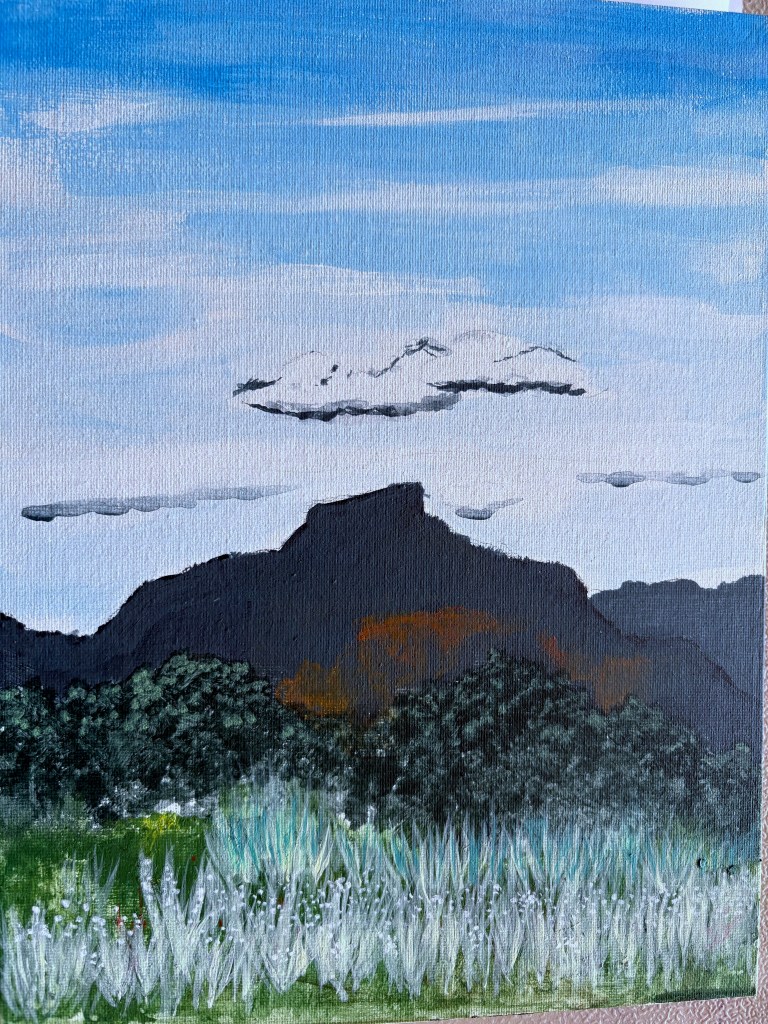
I had a similar issue with my second painting, Kitchen Mesa. I was working on it from a photo I had taken so I could be inside. On a 9×12″ canvas board I penciled in the structures of clouds, mountain, and trees, and started in on the painting, working from top down. Calling on my experience with painting icons, I started a section with a dark base color and added progressively lighter colors on top of it. In iconography, this is a theological decision as much as artistic, to move from the darkness to the light. I still have no idea if that is what is ordinarily done in other styles of painting, but after watching my classmates working, I’d say not. Further, when KB, the instructor, came around to look at what I was doing, she was curious about my progression in that manner. Being a firm practitioner of the non-directive school, she offered suggestions of other possible methods, but insisted that if it worked for me, I should follow my path. I appreciated the permission giving, but the truth is I didn’t know if it was working or not.
The mesa has several distinct zones of different geology. There is a fairly dark, apparently dense rock that makes a kind of cap on the mesa. Maybe it isn’t actually dense, as there isn’t that much of it, either in width or depth. The next layer down is a pale yellow sandstone, and below that is an orange-red zone, almost salmon colored. There is an area of loose rock fall down the face of the red, and then, from where I was standing taking the picture, the trees take over the foreground. I’ll try to write about the geology in another post. As for my painting of these zones, as I said, I started at the top and I worked from dark to light. So that top cap came first. It has a number of vertical divisions. I overheard one of my classmates talking about trying to paint them in an earlier class, and she referred to them as the “teeth,” so that’s how I thought of them and referred to them. It turns out that wasn’t an official name as I imagined, but too bad. Now they’re called the Teeth of Kitchen Mesa. Anyway, using the iconographic approach, I actually got them to look pretty good! It took a lot of close, very detailed work. Usually I’m not a fan of details, but I kind of got into it with my icon painting, and I found it strangely engaging here, too.
I worked down to the sandstone zone. Here I ran into my lack of expertise with mixing paint to make the color you want. I couldn’t quite get the right tones or hues or values. I thought I could with layering, but my layers weren’t right either. I kept at it and got something blocked in, but I didn’t like it. Wrong color, wrong brush strokes, wrong texture to the sandstone, wrong, wrong, wrong. Again, in our review discussions, lots of positive comments on the sky and the “teeth”, and then encouragement to block in the rest of the colors and keep going. No one said, “that looks like crap,” or made me feel totally gross or morally bankrupt. I was encouraged, but I was also getting frustrated with the chasm between my desire and my product. I set the project aside until I could figure out what I was doing.
All this was on the first day of class.
Still Life Walking
On Tuesday, we started with a hike into the “back country” behind the art center toward the box canyon, if you know Ghost Ranch at all. If you don’t that’s okay. Suffice it to say it’s beautiful country, and it was a beautiful morning, and it was pretty flat walking. More views of more mesas and some of the beings that live on and around them, like lizards, bugs, and vultures. The goal of the expedition was to collect natural items from which to compose a still life. Again, KB, not wanting to make anyone do something that felt unnatural, wanted us each to compose our own items rather than her setting up one arrangement for all of us to paint. So not only don’t I know how to paint, I don’t know anything about arranging a still life, either. This was going to be great.
I found a handful of objects: two rocks, some yellow flowers, a stem of juniper, and a piece of …. wood? Yeah, I think it was wood. It had a lot of texture and a weird sage green color, and it was very crumbly. Let’s say it was wood. That was the easy part. Then, returning to the art center, I started trying to imagine how to arrange these things. All I can think of is the Dutch masters’ still life paintings, so I figure I need a table, some linen, a bowl, and maybe a skull? I don’t have nearly enough dark brown paint. Before long, KB came by, and I told her I was at a loss. She suggested just picking maybe three items, and then arrange them individually. Not so much an arrangement as a composition. That was a huge relief, really. I imagined being able to paint three items on their own much easier than trying to figure how to show them interacting. KB also recommended doing a neutral tone color wash on the canvas to 1) reduce the tyranny of the white canvas, 2) provide a background that would make the items stand out, and 3) I forget what 3 was. That seemed like a good idea, too, except I didn’t know how to do a neutral wash or what neutral tone meant. I took her recommendation under advisement for future consideration.
As I mentioned in the previous post, pencil drawing has always been more my thing. Since I felt like I was floundering with the paint, I decided to start this still life project by drawing the items in my sketchbook first. This would give me a sense of what I was looking at in terms of proportion and texture, it would focus my attention so I would “get to know” the items a little better, and it would give me a way to do art in a way I was comfortable with, just for a break. Well, if I’m honest, I was starting to doubt that I could actually do the painting. Drawing was a way to keep participating in the class without …. oh, what’s the word… trying. Or failing. Gosh, that runs deep. Nevertheless, drawing was comforting and productive and just what I needed to do at that point. KB wanted me to find my process. Drawing was going to be part of my process, one way or another.
Try. Fail. Learn. Keep Going.
Having completed sketches of my five items, I narrowed the field to three, as KB had suggested: the yellow flowers, the juniper branch, and the smaller, rounder, striped rock. Part of our class fees went to providing things to paint on, canvases, canvas boards, paper of different sorts, and so on. Somehow, all the 9×12″ canvas boards were gone already. I guess there weren’t that many to start with. That’s a pretty comfortable size for me, so I was disappointed. I didn’t feel like I was up to using an actual stretched canvas. So of the various options that remained, I went with a 12×16″ canvas board. This is so much bigger than I wanted. It’s a lot of white space for a beginner to fill. My already shaky confidence blanched before this white monolith. But come on, now, David. This is what you came for. Just go for it. I did. I sketched where I wanted my three items, and I started on the one I thought would be easiest, the yellow flowers. I started trying to mix the right shade of green for the stem and leaves. It’s a war between what nature has lain before me, the paints I have, my ineptitude, and my frugality that won’t let me waste anything. Nature loses. My green is far too bright, too blue, but again, I hope I can bring it down to where it “should” be in future applications. Besides, I don’t even know how to paint stems and leaves, so what difference does the color make? And you can’t just throw the paint away and not use it!
The painting itself doesn’t go any better. Even with my thinnest liner brush, my lines are fat, crude, uneven, overflowing. This is a disaster, a nightmare. What am I even doing here? What made me think I could paint? What a waste of time and money! I should just stop right now.
And yet…
Remember that you are a beginner. No one is here to judge you. This isn’t a competition. You are here because you wanted to learn and to grow. It doesn’t have to be perfect. It doesn’t even have to be good. It just has to be yours. You have talent. You can learn skills. Keep going.
So I did.
I went back to my sketchbook and practiced some ideas about how to do different kinds of strokes, using the extra bright green paint I didn’t want to waste. I practiced how I might make the petals of the flowers, and it looked good. I practiced some ideas for my Pedernal foreground. It didn’t take very long, and some of what I tried didn’t work, and some of it did.
I worked on Pedernal again, adding highlights to the mid-ground trees and adding grasses and flowers in the foreground. It was better.
I mixed some yellow that matched my flowers pretty well and added the petals to my painting. They got lost on the white canvas so I diluted some red paint and washed over them. It didn’t help! So I tried again with blue over the red. It didn’t help either! I took straight cobalt blue and very carefully painted around the petals and around the stems, and they all just popped! I practiced drawing my rock in my sketchbook with colored pencils, and then I painted it to look just like that, and it looked good. I painted around the rock with the cobalt blue, and it popped! I noticed that the boundary between where I stopped with the red wash (right in the middle of the canvas) and where it was just blue wash (at the top of the canvas) looked like the shape of Pedernal against the sky. I painted a thick, cobalt-blue, Pedernal-shaped line over that boundary. I connected the pools of blue around the two objects to the horizon line and to each other. I practiced and then painted the cow skull Ghost Ranch logo (originally be Georgia O’Keeffe!) at the top of the canvas, in place of the juniper branch.
And it was good.

What I Learned
I ended up really enjoying my painting class. I still don’t have much knowledge or skill, but I found a process, a path for doing art. As I spoke with classmates about my experience of nearly despairing and quitting before giving myself permission to just go ahead and ending up with something I really liked, several said they have had similar experiences. We even speculated that it is the nature of art to emerge with a push through the place of failure.
I learned about myself, of course, that I still wrestle with my perfectionism, and that I’m getting healthier about it. To offer grace to oneself to be less than “ideal” (whatever that is) is a gift of grace itself that comes, I believe, from a higher source. For that I am deeply grateful.
 A Pilgrim of Earth and Heavens
still love ya, D2! (Sarah O)
LikeLiked by 1 person
Yay! Thanks, Sarah. Love back!
LikeLike