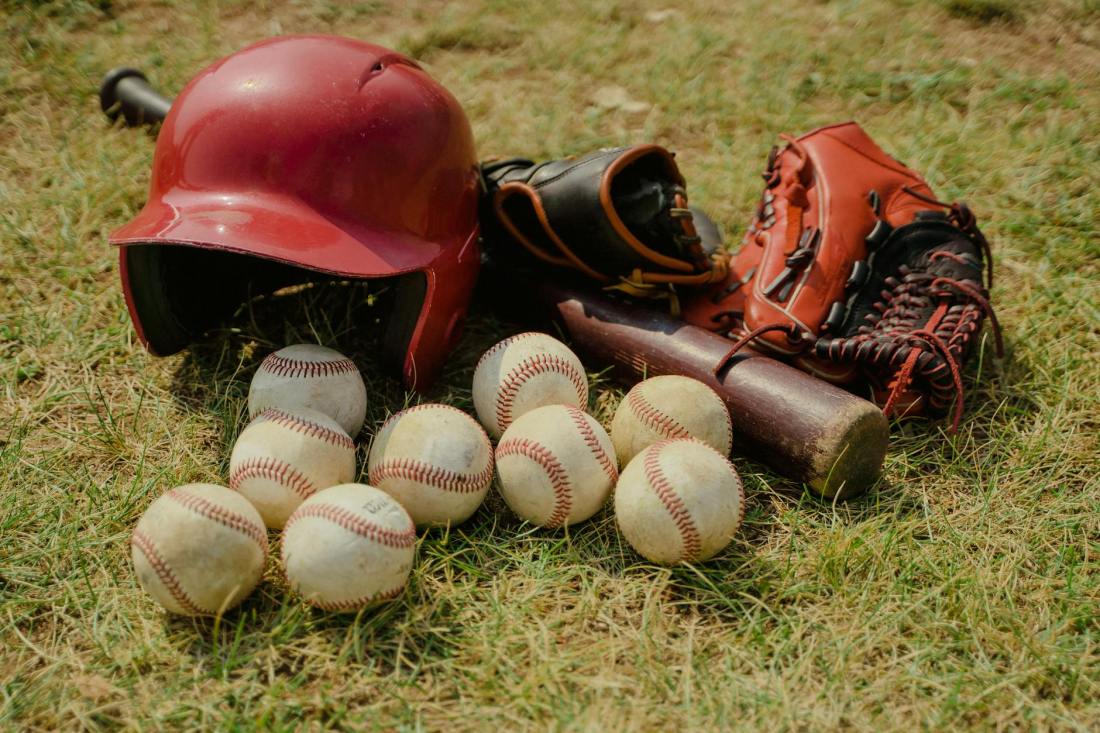
A Great American Pastime

I went to my first baseball game when I was four years old. It was at Forbes Field in Pittsburgh with my dad, almost certainly my brother (although I don’t remember), and I assume the Swedish exchange student who was living with us. I have only very faint, fragmentary memories of it, but I think it settled in pretty deep. Baseball has always been my favorite sport. Not that I ever played the game. Some softball here and there, but I think even as a kid I had a need to have mastered a thing before I could try it. So I never let myself join a little league team. I know, I know.

Anyway, I was still a fan, especially of the Pittsburgh Pirates. I knew all the players, the lineup, the stats (such as they were in the day), the standings. Of course, I collected baseball cards. In fourth grade I had stacks of hundreds of cards, but my prized possession was the complete collection of the whole 1971 Pirates team, which I still have. That was a lot of bubblegum.

Even at that, my baseball fandom pales compared to my son, Jacob. He started with tee-ball when he was little and went on to play Little League for several years. He opted for band when he got to high school but kept a love for the game. Through his college years our local team, the Washington Nationals, were actually playing some good ball, and Jake was all about it. He got the gene that skipped me that allows him to retain and recall all the stats of all the players of all the teams for decades worth of seasons. When his mom picked him up from college for spring break one year and asked, “What’s up with the Nats this year?” he talked for all of the three hour drive home. His passion has cooled some over the last couple years, just as the Nats have, but he still loves the game.

When I was planning my sabbatical for this year I wanted to include something that Jacob and I could do together. As you might guess by now, it occurred to me to do something related to baseball. We are within a day’s drive of Cooperstown, NY, and the National Baseball Hall of Fame. That seemed like a good idea. It got better when I realized the Little League World Series in Williamsport, PA, would be on the way and in the right timeframe. If it was going to be something of a pilgrimage, then it wouldn’t be that much more to go from Cooperstown to New York City to go to Yankee Stadium. Neither of us is a Yankees fan, but they are surely the most storied and iconic team in the majors. When I introduced the idea, Jake was immediately on board. I started mapping it out and looking for schedules, tickets, hotels, and whatnot. We both noticed that the basic track took us 3 1/2 hours from home to Williamsport, about 3 1/2 hours to Cooperstown, about 3 1/2 hours to New York, and about 4 hours home. It’s practically a baseball diamond! This was going to be great.

First Base: Little League World Series

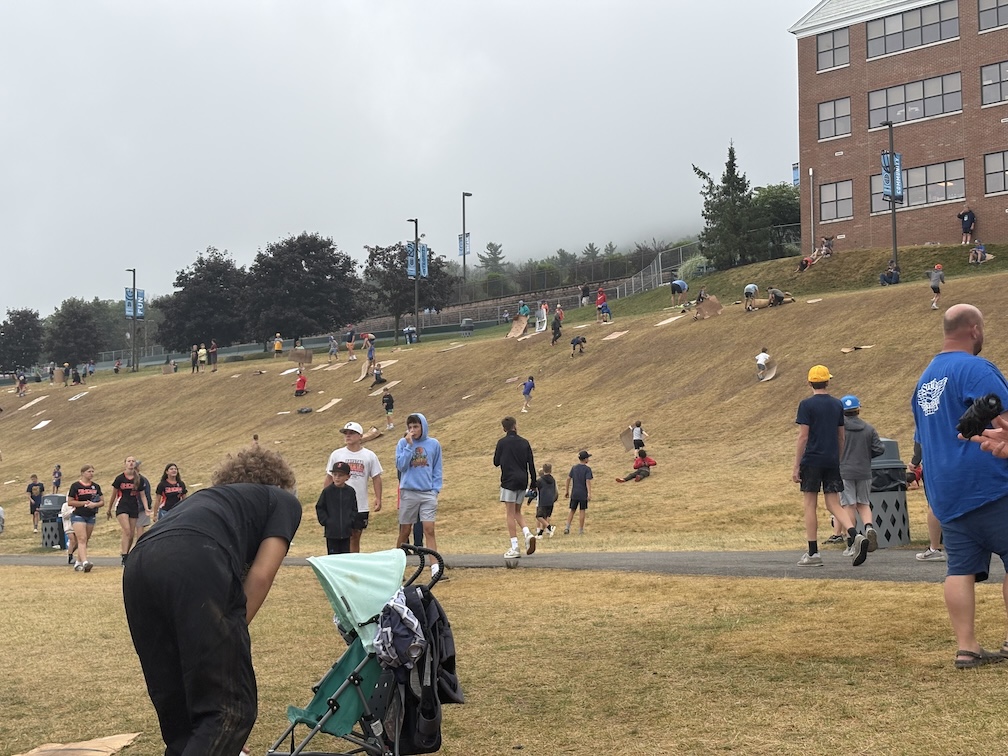
I’ve always wanted to go to the Little League World Series, so I was excited to start our tour this way. We got to Williamsport at about 1:00 p.m. on Wednesday, August 20, just as the first of four semifinal games for the day and the tournament was beginning. The Little League International Complex is a sizable venue with two large stadiums (in little league terms), several practice fields, food vendors, a dining pavilion, restrooms, first aid building, Little League headquarters, a museum, and of course a gift shop. The newer stadium, Volunteer Stadium, is the smaller of the two, and it is used for international teams, while the older LaMade (LAH-mah-dee) Stadium is where the U.S. regional games and the World Series final are played. Both have seating for several thousand spectators, although LaMade has seating on the grass hill in the outfield, which is a big part of the tradition. The hill is high enough that the top section is primarily used by kids with flattened cardboard boxes to sled down the grass without interfering with the majority of spectators. But I’m getting ahead of myself. When we arrived, all three large (free!) parking lots were already full, and townsfolk were making some coin by using their yards and spare properties to park cars. So for $10 we found a place that was reasonably close to the complex and away from the flow of crowds.

One of the amazing things about the Little League World Series is that admission is free. Free to enter the complex, free for all the games. It’s as if they consider it a public good that should be open to anyone and everyone, so it is. I think that’s awesome. Of course you pay for food and drinks, but honestly, the prices weren’t as bad as I expected. And they have a swag shop, as I said. We didn’t stop, and I suppose it isn’t cheap, but it is voluntary. You could go and not pay a thing if you work it right. So we just walked right in.
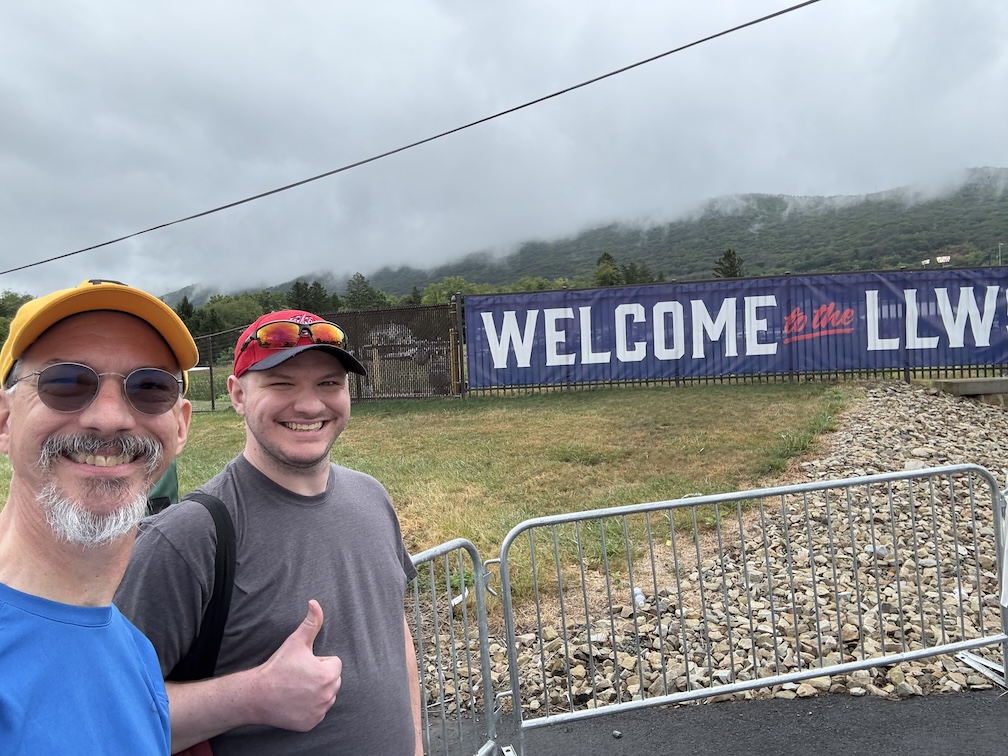
We arrived at the Little League World Series International Complex in Williamsport, PA

The weather was, as they might say in Scotland, “a bit of low cloud,” that is heavy clouds, misty, and spitting rain. It looked as though we had arrived just after a good storm, really. We made our way to Volunteer Stadium and found some open seats in the bleachers that weren’t too terribly wet. It was warm enough that we could sit on our jackets instead of wearing them, so that was good. Williamsport is hilly country, and the complex is built on a hill with some pretty steep peaks just behind. These were hung with misty clouds.

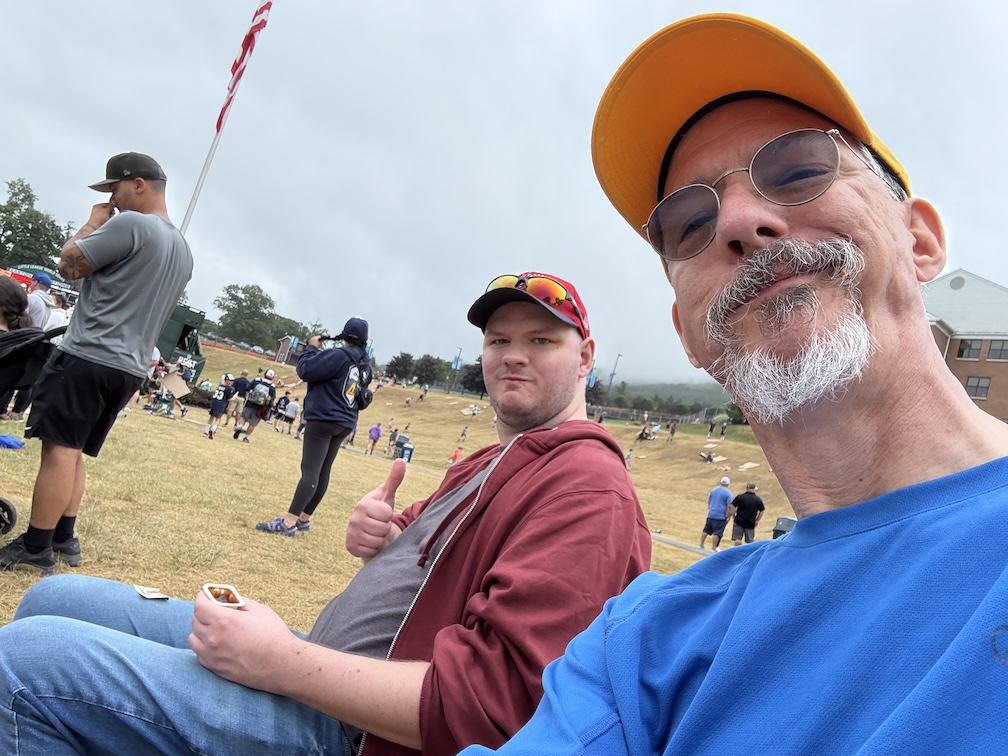
Notwithstanding, the game was on between Latin America (Venezuela) and Asia-Pacific (Chinese Taipei). The players appeared to be upper elementary to middle school age. Asia-Pacific had scored a couple runs before we got there, but after that it was kind of a slow game without much hitting. The pitching was really pretty good for both teams. Only a couple of balls got out of the infield, and they were all handled pretty easily. The announcers did (as far as I can tell) a really good job pronouncing all the kids’ names. I was impressed. After the fourth inning we both needed some food, so we went searching. It was still about an hour before the next game started in LaMade Stadium, but people were starting to move in that direction already. We decided to do the same. Jake wanted to sit on the hill, and that was fine with me. We went and set up our folding chairs behind right field, looking down the first base line, just at the brow of the hill, and ate our lunch. Meanwhile, at Volunteer Stadium, someone turned up the action meter after we left. Asia-Pacific beat Latin America 7-3. Oh well. [Recap video here]
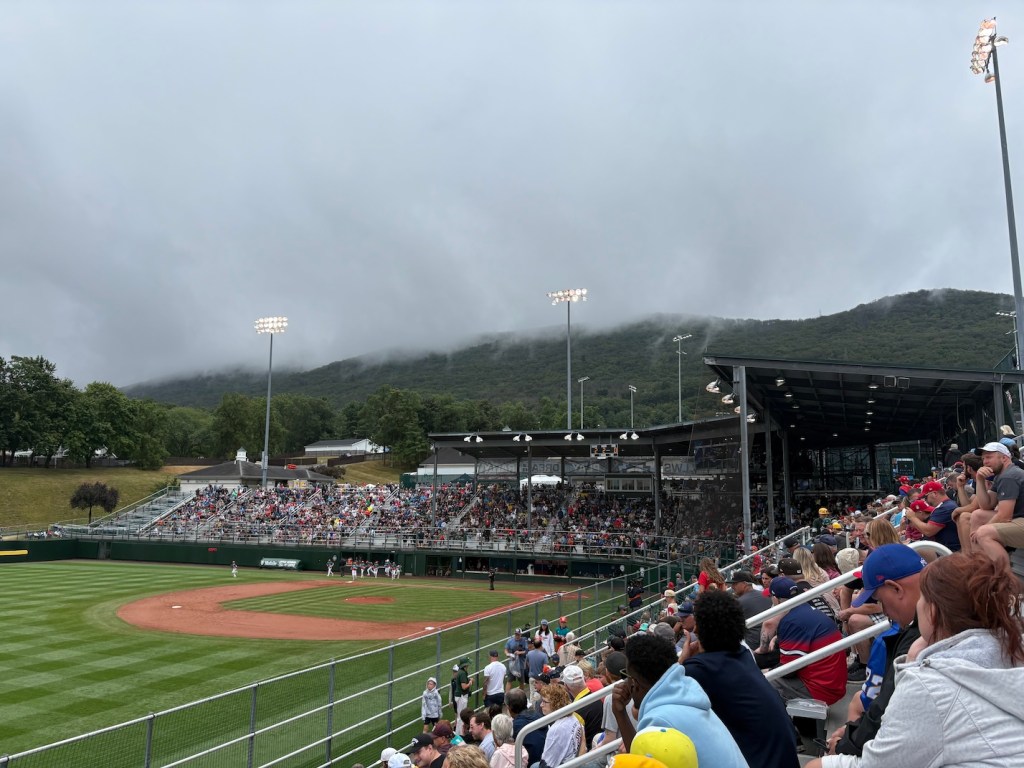
Volunteer Stadium, home of the International Regional games at LLWS

The second game of the day was Mountain (Nevada) vs. Metro (Connecticut). This was a much more energetic and aggressive game, with both teams getting lots of hits. The level of play was very good, especially having watched my share of Little League games back home when Jake was still playing. I mean, there were good and bad teams in our leagues, and they had good and bad days, but these teams were both playing really good baseball. There were some great fielding plays, a couple of home runs, besides some consistent pitching. When the dust settled, it was Metro on top, again by the score of 7-3, but this one was exciting from top to bottom. [Recap video here]
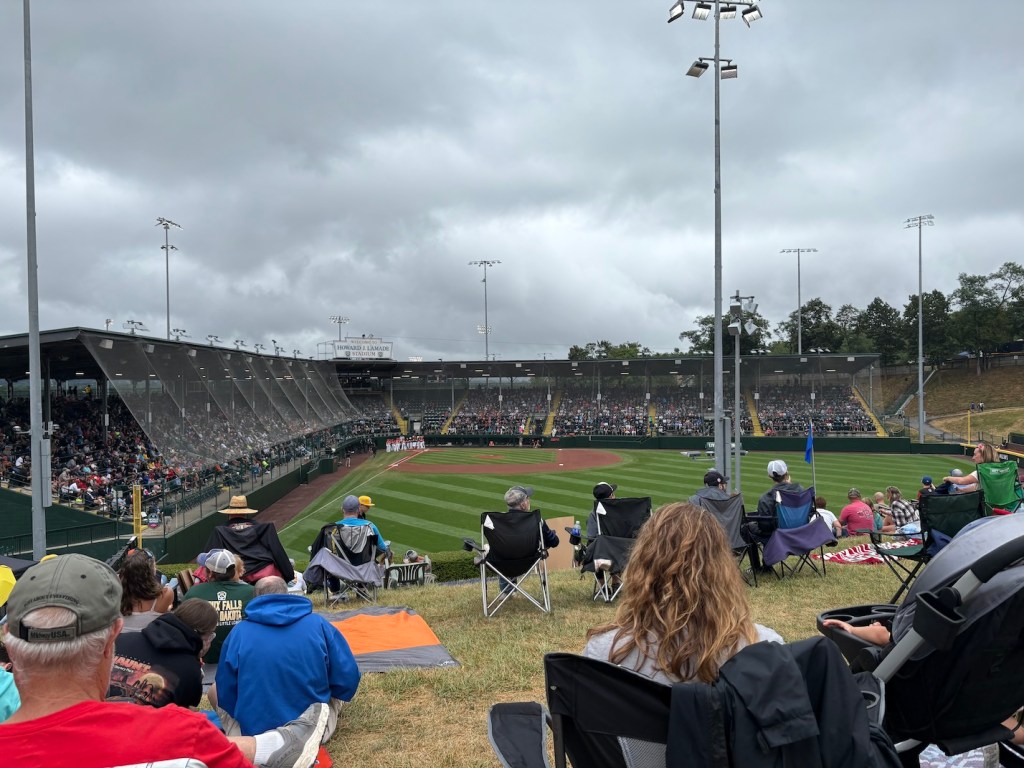
Game three for us (game 31 overall) was back at Volunteer Stadium, pitting Japan against Caribbean (Aruba). This one seemed more deliberate, like our first game. Jacob suspects there’s more attention paid to pitching and fielding in international teams while U.S. teams give more emphasis to aggressive hitting, which is a plausible theory. Japan is well known for its love of baseball, and as we would learn the next day, they have played baseball since the 1850s! But the Caribbean nations also love their baseball, sending a large number of players to the U.S. Major Leagues. Of course, these were just kids we were watching, so no pressure, right? The pitchers were definitely in control for the bulk of the game. Then Aruba broke it open in the fifth inning with back to back home runs! When it came their turn, Japan had no answer for them. Oh, the height and depth of human emotion displayed on the playing field! Half were leaping, yelling, laughing, and hugging, half were holding their heads, curling up or lying prone, in stunned silence or fighting back tears. Baseball is a lot like life. [Recap video here]

Back up to LaMade for the fourth and final game of the day. This one pitted Midwest (South Dakota) against Southeast (South Carolina). Now, even though the games are only six innings, this was still a lot of baseball! Frankly, Jake and I were both getting a little bleary, and we still had an hour to drive to get to our hotel for the night. So as much as we wanted to make a full day of it with all four games, we were kind of done. We stuck around for the first inning or so and made our way back to the car and on to our reservation. As it happened, when we got to our room and turned on the tv, we turned over to ESPN, only to find that the Midwest-Southeast game was still going! They ended regulation tied at one, after South Dakota walked in the tying run in the bottom of the sixth inning. South Dakota went on to rally, scoring five runs in the top of the seventh, making it 6-1. South Carolina’s coach gave his team a short pep talk before they went to bat, telling them just to believe. Apparently they listened, because they scored six runs to win the game with a walk-off double. It was very exciting, and again, the height and depth of elation and heartbreak were revealed on the little league field. [Recap video here]
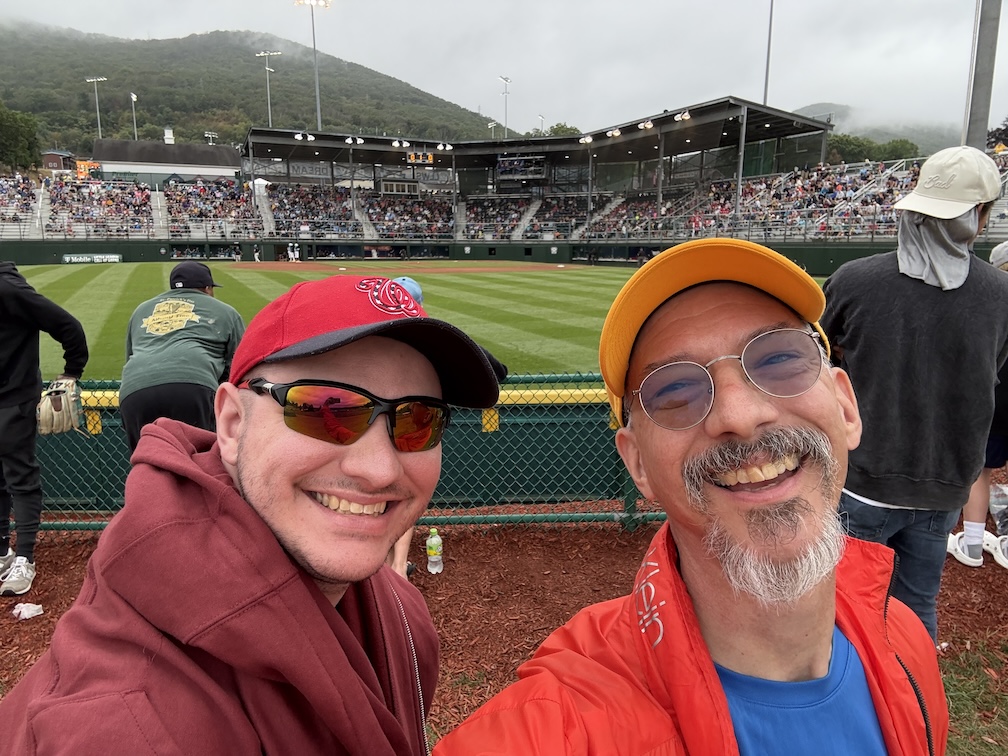
Look at those smiles! LLWS Baseball is awesome

What a fun day we had! It had travel and time to talk about life, the universe, and everything. It had a global melting pot where people from around the world come together just to enjoy a game and make friends. It had the energy, enthusiasm, skill, and resilience of kids trying to do their best. It had all the fun, excitement, and drama of baseball. And except for having to climb the hills, which can take a toll if you are out of shape, the facilities are clean, well cared for, with a good flow and sense of having been well thought out. What’s not to like? If you like baseball, this is definitely an experience I think you’ll enjoy. As to who went on to win the Series? If you don’t already know, you’ll just have to go to https://www.littleleague.org/world-series/2025/llbws/ and find out.

Second Base: Hall of Fame

Day Two of our pilgrimage took us from Mansfield, PA, to Cooperstown, NY, about three and a half hours drive, as I mentioned above. Day One had worn us both out with all the driving, fresh air, hills, and walking into the unknown (Jake and I are both a bit risk averse), so we slept in a bit and didn’t get on the road at the crack of dawn or anywhere near it. The trail to Cooperstown was laced with weird would-be detours and glitches from our GPS guides that made the trip a bit more exciting than it needed to be, but on the whole it was uneventful.

We arrived in Cooperstown at about 1:00 p.m. in beautiful weather and ready for lunch. I was starting to worry a little that we weren’t leaving ourselves enough time for the purpose of the trip, the Hall of Fame, but on their site they suggest a minimum of two hours to tour the museum. We would have plenty more than that. We parked at Doubleday Field, which turns out to be between a wooden bat factory and the Presbyterian Church, and turned onto Main Street, a classic old-style downtown. What we saw of Cooperstown is a quaint looking place, with mostly small, well-kept, tree-lined yards with mostly wood framed houses, an attractive, quiet-looking town. The Main Street business are all baseball themed somehow, from card shops and souvenir shops, to restaurants and bars, to banks and insurance brokers. They all play the game. We found a place that looked welcoming and fun for food, the Doubleday Cafe. More than likely it is a converted store from the early twentieth century or older, long and thin with tin tile ceiling and terrazzo tile floor. There are a dozen or so wooden tables with wooden chairs scattered about around the long bar, with flatscreen TVs in every direction showing a variety of sports shows. Yep, perfect! We ordered sandwiches and beer, both of which hit the spot. The waitstaff had T-shirts that read on the back, “Cooperstown: A Drinking Town with a Baseball Problem.” Again, perfect.
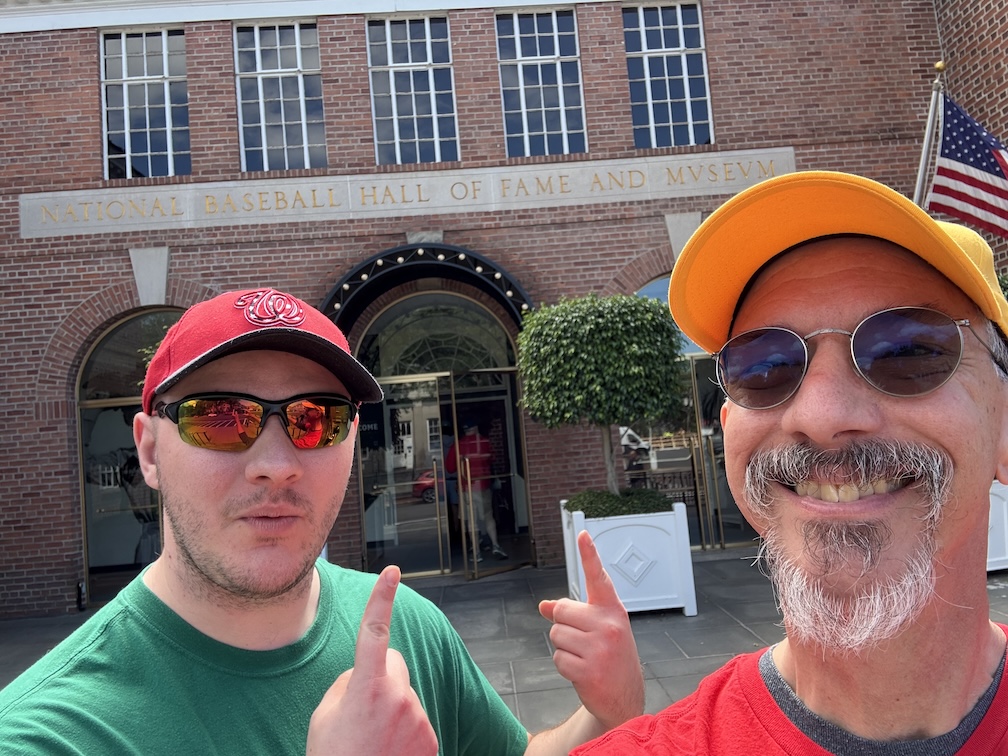
At the gates of the National Baseball Hall of Fame and Mvsevm. It is full of so much baseball!

At last we made our way to the National Baseball Hall of Fame, just a block to the east. There is definitely a sense of hushed reverence in the place. Even the entry with the admissions counter had subdued lighting. We had our tickets in advance, so we got scanned at the counter and headed into the exhibit halls. A docent met us as we entered, welcomed us, and asked if we’d been there before. No? Then your best plan is to start on the second floor, then go to the third, and finish on the first. Interesting layout, but okay. Who are we to argue? Up the grand staircase we went.

The first room we came to was dedicated to the recently inducted Hall of Fame Class of 2025. The class of five is Dick Allen, Dave Parker, CC Sabathia, Ichiro Suzuki, and Billy Wagner. Of these, Dave Parker was the one I knew best, as he played for the Pirates in the 1970s, while the others were little more than names to me before seeing the displays about them. But indeed, I learned that each was clearly deserving of a place among the greats and giants of the game. Follow the links above to learn more about them. Now, there is a time limit for a ballplayer to get nominated and elected to the Hall of Fame. If you don’t get the votes from peers, managers, and sports reporters in a few years, it doesn’t matter how good your career was, you will be left behind. However, in recent years there has been a move to correct some obvious oversights, many of which had to do with the prejudice and racism of the past. Not that prejudice and racism are no longer a problem, but it has been much worse. Dick Allen and Dave Parker were both passed over for the honors they deserved, and the board for historical reconsiderations has now rightly elevated them both to the Hall of Fame. I say, well done.

I won’t go room by room to tell you about what we saw. Couple reasons: first, there is just too much! and second, there is just too much! The first room was filled with the earliest stories of baseball going back to the early 19th century with remarkable detail. Baseball is a game that revels in its statistics and minutiae, and they are on full display in the museum. The development of rules. The development of clubs. The development of a fan base. The development of equipment. The development of professional leagues. The development of the business of baseball. All this was in the first room. We walked out in the next hallway that stretched for a hundred yards with more rooms full of just as much data and history sprouting on either side, looked at each other, and said, “This is so much baseball!” We were overwhelmed after one room!

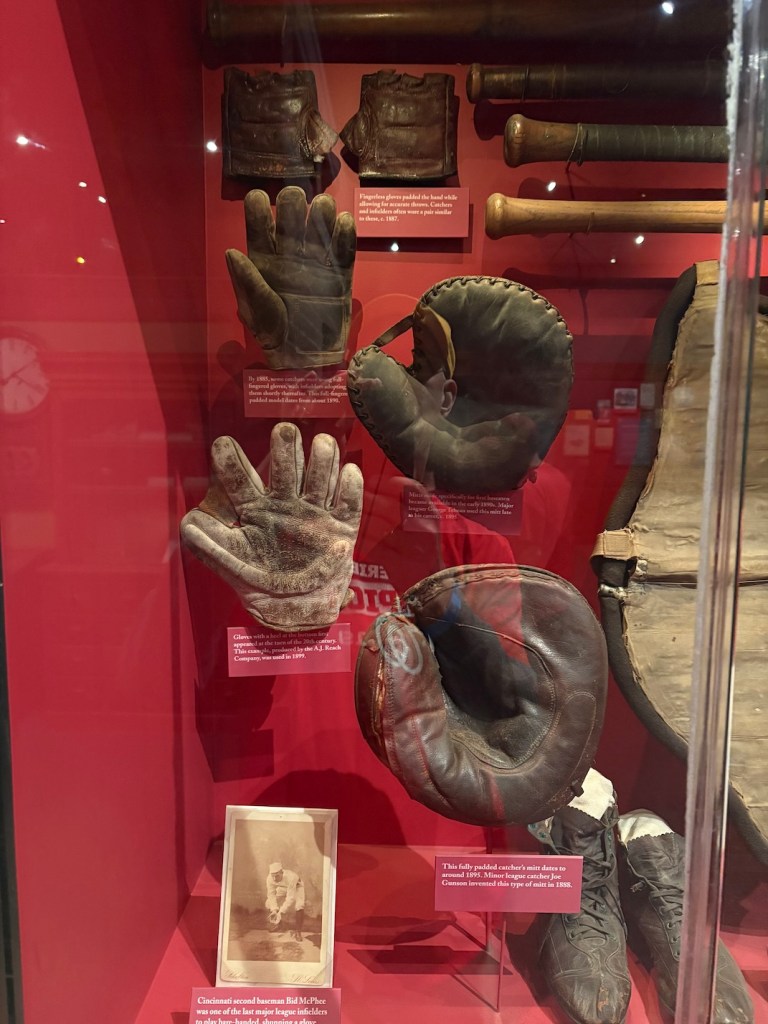
Down the hall there were, of note, a room for Babe Ruth, a room for the Negro Leagues, a room for the early 20th century, a room for women in baseball, a room for Latin Americans in baseball, and a room for the changing game at the turn of the 21st century including the doping scandal. While it continued to be overwhelming, we both thought they did a great job of lifting up the diversity of baseball through the contributions and struggles of ethnic minorities and women in the game.

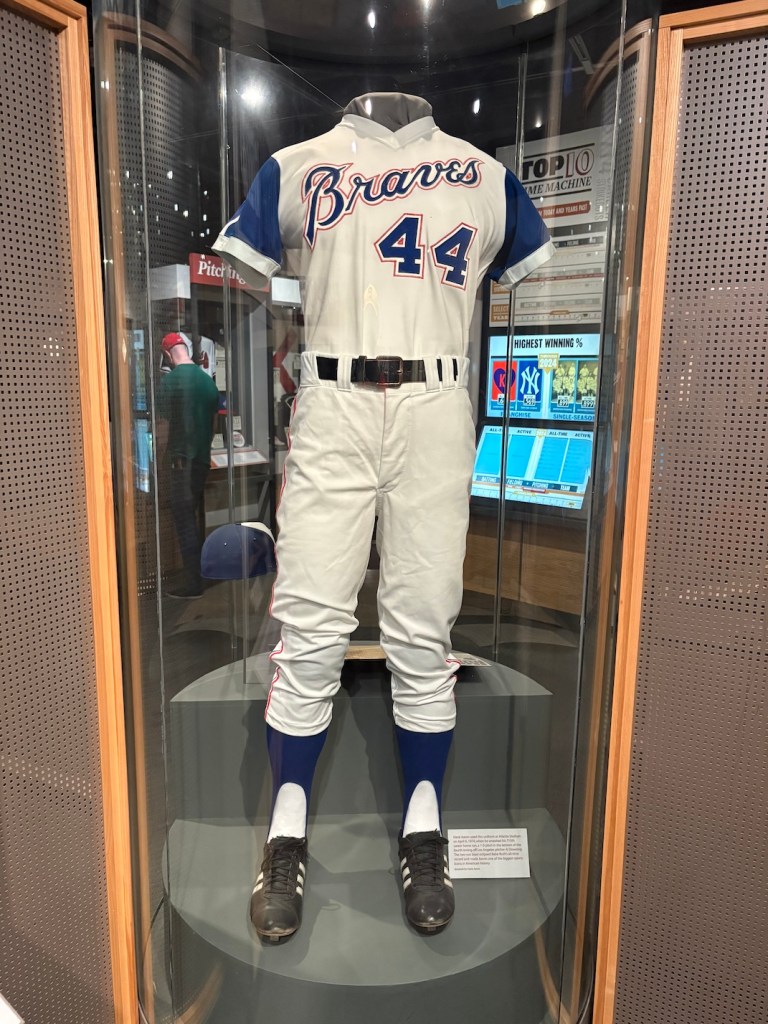
The third floor was similarly packed, starting with a large presentation of baseball in Japan, which dates back to the mid-1800s. There is a sizable space for Hank Aaron and his journey to overtake Babe Ruth as the home run king, including the racism and hatred he faced on the way. One wing is given to the top individuals and teams in each of a few dozen statistical categories – hits, strikeouts, RBIs, OBPs, Gold Glove winners, Cy Young winners, MVPs, and on and on. This is followed by all the World Series winner rings on display in a single case. These started out as fairly simple designs but have grown to several inches across and encrusted with jewels. Then there was more stuff after that. It’s really…. there’s just so much baseball there.
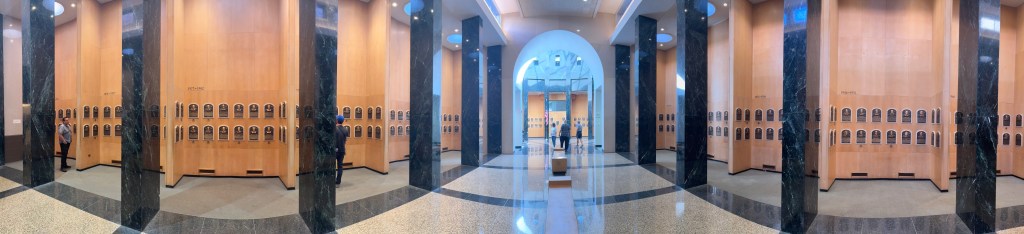
The Hall of Heroes

Finally, we made it downstairs. Eschewing the art gallery that I’m sure is spectacular, we went right to the Hall of Fame Gallery that holds the plaques commemorating all the Hall of Famers. This is the holy of holies, the Elysium, the vault of baseball heaven where the stars shine from bronze plaques that bear their names and embossed images (that often look nothing like them) into the ages, while the faithful fans remember and dream of glory past and yet to come. It is an impressive shrine.

Be that as it may, once more, we were pretty much done in after three hours. I could barely keep Jake in the Gallery while I looked for some of my old heroes, though at 31 he wasn’t physically pulling at my sleeve. All that remained was the required exiting through the gift shop. We bought just a couple wee tokens and headed back into the world.

Third Base: Yankee Stadium

We still had to get to New York City, about a four hour drive as it turned out, winding our way through some back roads in upstate before getting to the major highways down to the City. Again, it seemed like our GPS guide was choosing unnecessarily out of the way paths, but we did get to see some beautiful parts of rural New York before seeing urban New York. Jacob took the last turn at the wheel to get us to our hotel in the Bronx at about 10:00 p.m. and did a fine job with his first time driving in the Big Apple. The hotel is a recently renovated Days Inn now called the NOVA Hotel. It’s not the ritziest place I’ve ever stayed, and it’s not in the most attractive neighborhood, but it was clean, comfortable, and reasonably priced with good reviews.

Day Three of the tour was Friday. We had tickets for the Yankees-Red Sox game at 7:05 p.m. If you don’t know that that the Yankees and Red Sox have a long, deep, often painful rivalry, well, you don’t know much about baseball. Also, if you didn’t expect that the prices for this series of games were about 50% higher than any other games in the season, then you are naive. That’s the business of baseball. I had managed to get us some decent seats for decent prices, all things considered. More on that in a bit.

In the meantime, we had all day to kill before game time. There were a myriad of options in NYC, of course, but we settled on the Bronx Zoo. It was reasonably close and gets high marks. We started off walking a few blocks to a cafe Jacob had found online for breakfast. Just a little place with half a dozen booths across from some academic campus and on the edge of block of flats, you know, like New York. Great coffee, huge breakfast, good prices. Nice pick, son!

Pregame: Bronx Zoo

Jake had also plotted our course to the zoo by way of mass transit. We walked a few more blocks to catch the #2 train north to the zoo. We each got Metro pass with money to spare on it, and after just a few minutes wait we were on our way. The New York Metro system has a reputation for being gross with unseemly people doing unseemly things, but we didn’t have any of that. We got to our stop, and after another ten-minute walk we were at the Asian Gate of the Bronx Zoo. I had bought our tickets before we left (not cheap on the same day – buy ahead if you can), so we scanned in and began our adventure.
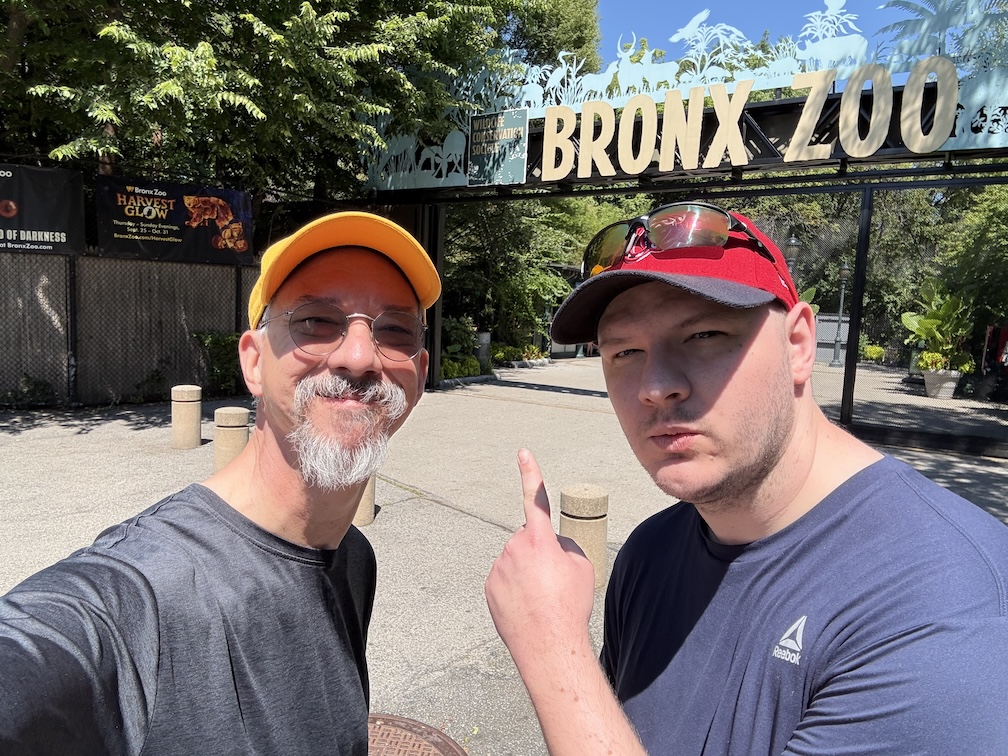
At the Asian Gate of the Bronx Zoo, the beginning of a delightful adventure

The Bronx Zoo is a beautiful place! It’s clean, lush, and surprisingly quiet! Trees and plants everywhere keep the noise and the temperature down. There were plenty of people at the zoo that day, but it never felt crowded or congested. The zoo was organized and its first buildings erected between 1909 and 1913. Some of those original buildings remain in use, though repurposed. The architecture is a nice mix of simplicity and ornamentation. Of course many of the current structures are much later additions. There are several divisions within the zoo for different climates, geographies, and special exhibits, such as the gorilla forest and tiger mountain. There’s even a dinosaur exhibit, although we didn’t get there.

As with the Hall of Fame, I won’t give you a beast-by-beast description. Suffice to say they were all there! We saw giraffes, lions, camels, various apes and gorillas, seals and sea lions, all manner of birds, alligators, and tigers, to name a few. The animals are all beautiful and/or remarkable, and the enclosures are generally well designed and as open as possible.

We stayed until they kicked us out at about 4:45 p.m. That was fine, because we figured it would take us about 45 minutes via Metro to get to our next and final goal, Yankee Stadium. The gates would open at 5:30 p.m., so we’d be right on schedule. Again, Jacob had sorted out that we would take the #2 train back the way we came and then some, until we could pick up the #4 for a couple stops to get to the stadium. That’s just what we did, and it was about as smooth as silk. Well, maybe polyester, as we had to wander around a little bit to find where to pick up the 4, and again to figure out how to get off the platform and down to the street outside the stadium. That one was pretty easy, really – just follow everyone in the Yankees hats and jerseys! We were outside the gate at took the picture below at 5:23. Not bad! I could get used to consistent public transit.

The Yankee Stadium Experience
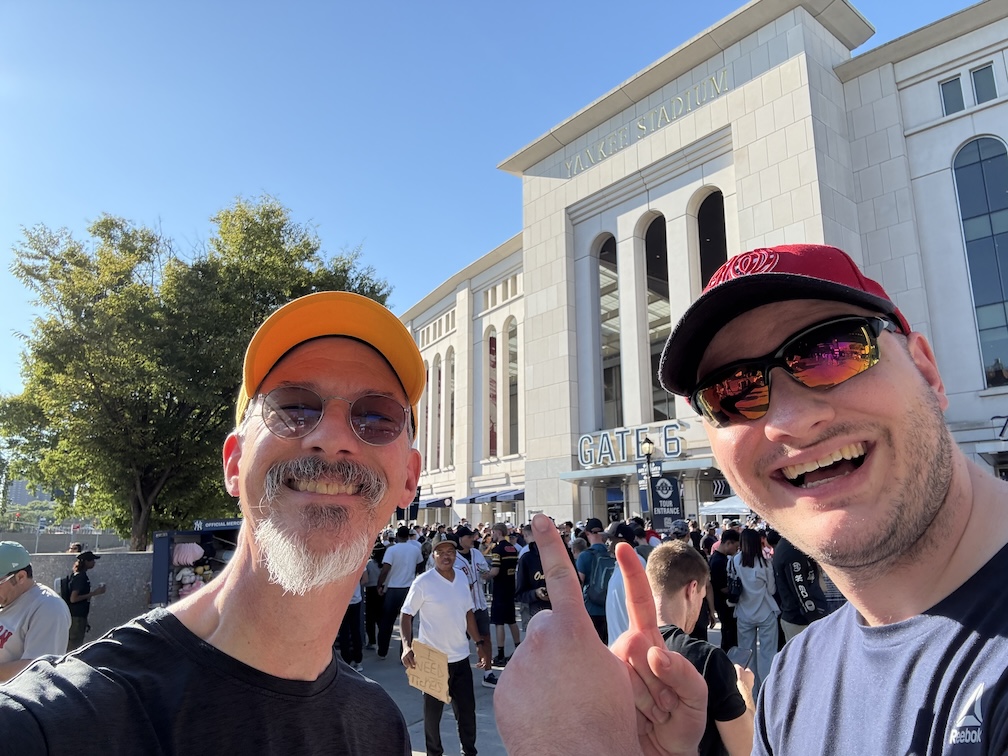
At the House That Replaced the House That Ruth Built

There was a pretty long line at Gate 6 on the southeast corner where we figured to enter the ballpark. I thought it might take us a long time to get in, since everyone had to go through metal detectors and all. So I was really surprised when we were inside the stadium at about 5:35, took pictures on the second deck at 5:45, and were in our seats before 6:00. Guess they’ve got the system worked out.

The stadium is a beauty on the outside with a sort of Romanesque facade. The spaces are wide and ceilings are high. They are built to accommodate lots of people. We made our way up to the second level and got a look at the field from there. Pretty cool, but we had a long way to go, all the way up to deck 4. Except it turns out there isn’t a deck 4. You go to deck 3 and then go down for 3rd tier seats and up for 4th tier. We went up. Way up. We weren’t in the very top row, but I could have hit it with an easy throw of my hotdog wrapper. But honestly, the view was great.
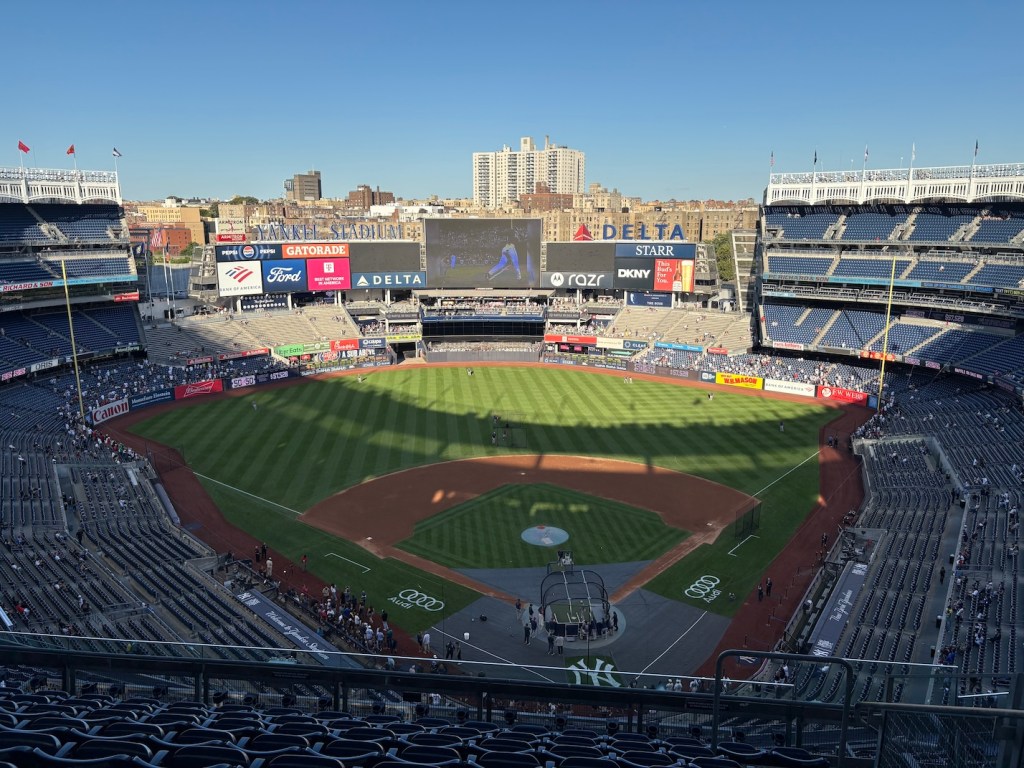
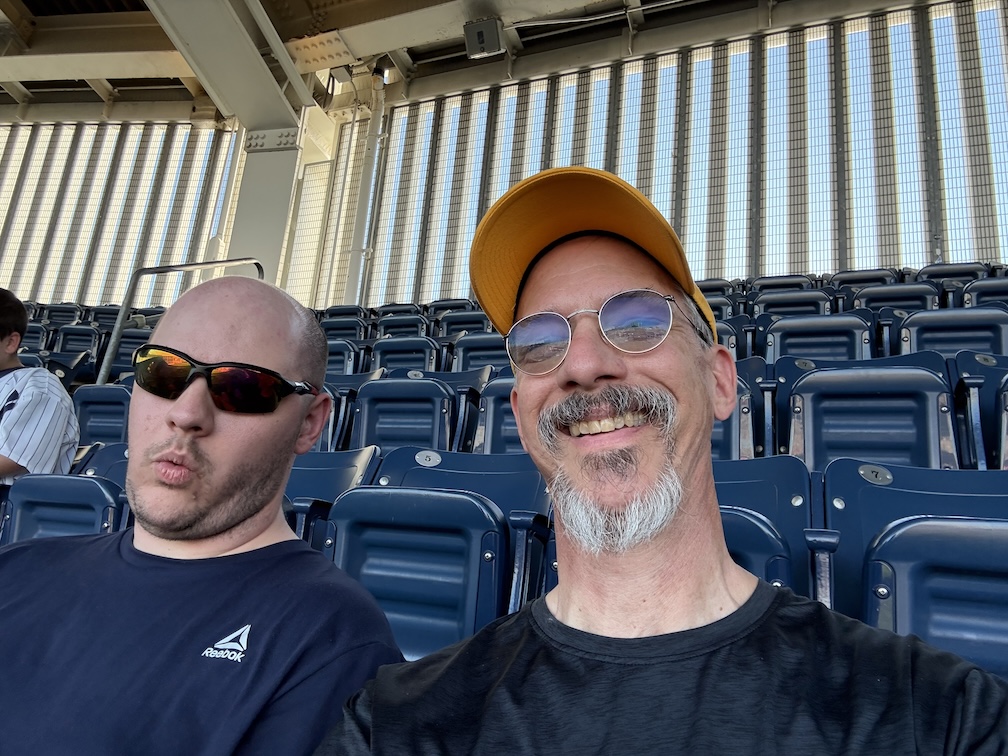
We were right behind home plate! The whole field was there before us without obstruction or distortion. So, too, with all the scoreboards, of which there were many. Plus a nice view of the surrounding cityscape. Except for a little vertigo looking down, I was quite satisfied. Besides all that, there were concession stands right below us, so we just had to go down a couple flights of stairs and we were practically in line for food and drink. So that’s what we did. It was still early, and the crowds hadn’t really made their way in yet, so there wasn’t even a line to get in. Hotdogs, fries, and soft serve ice cream with sprinkles in a souvenir batting helmet cup. Perfect!

While we waited for game time, there was a constant stream of video – promotional, informative, commercial, or hype-inducing. Some of it was interesting, but mostly it was just filler. You wouldn’t want anyone to go for more than a few seconds without some media input, after all. And boy, they stuck to that philosophy, even through the game. There was something happening on all three big screens, plus the animated strip around the 3rd deck, plus music or sound effects ALL. THE. TIME! It never stopped! I missed plays in the game because I got distracted by all the media that was pouring out. It was crazy. I didn’t like it.

I guess they do that because people say baseball is boring. So they do everything they can to keep you engaged with something, whether it is actually the baseball game or not. On this particular night and this particular game, maybe that wasn’t such a bad idea after all. It was a real pitchers’ duel and unfortunately a snoozer for the most part. The pitching wasn’t so good as to create drama, like it might be a no-hitter, but it was good enough that there were very few hits. That happens. It’s part of the great game of baseball. But as we approached the seventh inning stretch I was working on new lyrics to the classic song — “Wake me up at the ballgame!”

Eventually, the Red Sox found a little bit of spark and managed to score a run. The Yankees just had nothing going on and had no response. That’s how the game ended, 1-0 Boston. As I mentioned before, I’m not a Yankees fan, and neither am I a Red Sox fan. I wasn’t rooting one way or the other and just wanted a good game. Oh well.

The crowd was probably as interesting as the game itself. There were several pockets of Red Sox fans peppered around us and around the stadium. They were having a ball, not just because their team ended up winning but also because they could be a thorn in every Yankees fan’s side. There was also a group sitting in the row behind us that noticed I was wearing a Pirates cap. “Nice hat!” they said before the game. I thought they were giving me NY crap for it, but it turned out they were from Pittsburgh and were Pirates fans! That was fun, until they started talking about all the players and recent games and things happening in the Burgh and Pirate fan lingo as if I would be right there with them, but it turns out I’m just a poser. I haven’t really followed the Pirates and haven’t lived in Pennsylvania for decades. I had no idea what they were talking about. I tried to fake it as best as I could, but my cover was blown. They eventually gave up on me, I think. Oh well.

All in all, Jake and I had a fun time going to the game and being at Yankee Stadium (even if it isn’t the historic “House That Ruth Built”). The game itself wasn’t very good, but you’re gonna have some of that. The experience of going and being there was otherwise as good as you could want. We walked the mile or so from the stadium back to our hotel, which was fine until we got further from the crowds and businesses and out into the dark, uncharted parts of the city. Then we felt more out of our element and more exposed to all the horrors people who don’t live in cities hear about being in an unfamiliar city. But it was fine. We made the trip entirely without incident.

It had been a long day, with a lot of walking and adventure. We slept well.

Home Run!

Saturday morning we got up and got moving at a reasonable hour, checked out, and hit the road. We wanted to clear the city before we stopped for breakfast. That proved more challenging than we expected. Once more, my GPS guide lost its damn mind, wanting to send us the wrong way on one-way streets and not recognizing road closures and whatnot. Jake’s map was doing a bit better, but it took some creativity, intuition, and faith to find our way out. It shouldn’t be that hard, what with the city grid and all, but we have become woefully dependent on our tech. Anyway, like I said, we made it out and headed down the road. We kept both GPS guides running, and they continued to conflict with each other and with our reality. Fortunately, we figured out that if we took a particular interstate it would take us all the way back to familiar territory near home. So that’s what we did, robot overlords be hanged. thanks to our helpful robot protectors.

On the way home, we again had lots of time to talk about life, the universe, and everything, and we did. We recapped the trip. We talked about Jacob’s masters program classes. We explored different genres of music we each like. We talked about God, the state of the world, and how hard it is to have faith. We found that the air conditioning wasn’t quite working in the car. All the sorts of things you’d want for relationship building on a road trip. I enjoyed it thoroughly. This trip was really the first time since Jake was in college that we’ve had time together like this, and I think we’ve never had three days with just the two of us. I cherish the time we got to spend on this trip and am so grateful for my sabbatical, for my church’s support, for my wife Molly’s support, and of course for my son Jacob. I’m thankful for God’s grace and providence in all these things, and I’m glad there’s a thing called baseball.

To Boldly-er Go Again!

As I mentioned in my previous post, I’m on a trip to Florida to see if I could catch a rocket launch, and in fact I’ve caught two! There’s no limit, so I don’t even have to throw one back. In that previous post I told about seeing the first one, a night launch on a cloudy night. While that was a wonderful experience, the second was even better.

A Day at Kennedy Space Center

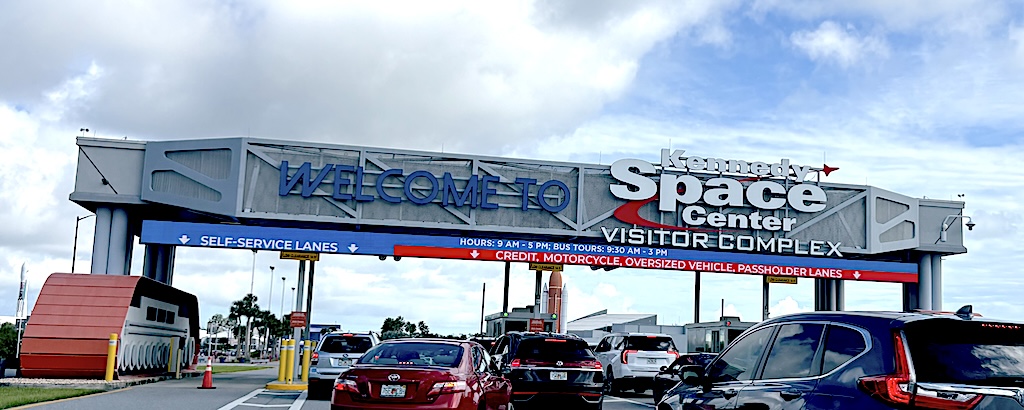
First, let me tell you about my day. [I’ve included some headings if you want to get right to the business. Otherwise,…] It was Sunday, September 14, and the rocket launch I’ll tell you about in a bit was scheduled for 6:11 p.m. EDT from Space Launch Complex (SLC) 40 at Cape Canaveral. While it was lovely to see a launch from Titusville the other evening, seeing one from Kennedy Space Center (KSC) would be about five miles closer and infinitely cooler. Admission to the KSC Visitor Complex isn’t cheap, but it’s probably a lot less than most of the other theme parks and attractions up the road. But once you get in, seeing a launch is included (if there is one to be seen during or close to regular operating hours). This one was going to have an official viewing in the bleachers. I mean, like I wasn’t going to go to KSC anyway, whether there was a launch or not, right? Of course I was going.

There are lots of displays, presentations, and attractions going on at the Visitor Complex, which, by the way, is not funded by NASA or your tax dollars at all. It is all funded by admission, parking fees, and food and merchandise sales. Who knew? Anyway, I bought a two-day pass, so I could get around to seeing everything eventually, but I picked out the things I most wanted to see for day one in case I didn’t come for day two for some reason. So that meant the Rocket Garden, the bus tour to the Gantry at LC-39 and the Apollo-Saturn V center, and the Space Shuttle Atlantis.

The Rocket Garden is a collection of early U.S. rockets that served in the Mercury, Gemini, and Apollo campaigns and launched some of the first U.S. satellites and such. They are actual rockets although none has actually flown. Among the most notable are the Redstone, Atlas, Titan II, and Saturn 1B. Except for the last, they all look pretty modest. Like, how is that thing going to get someone to space? But they did, in part because the capsules were so small! My car is bigger than a Mercury capsule and fits four to five times as many people. It gives one a great appreciation for the courage of those early astronauts.

It turned out that because of the scheduled launch, the Gantry exhibit was closed. That was a bummer. It is, as I understand it, a refit or reconstruction of part of an actual gantry at LC-39 where all the Apollo rockets went up. Now it has displays and exhibits about ground systems and rocket testing and things like that, plus it has panoramic views of several active launch pads from only about a mile and half away. So that would have been pretty cool to see.

Who Weeps for Apollo and Saturn?

Back in 1997, Molly and the kids and I spent a week in Orlando and took a side trip to KSC, but I don’t remember most of what we saw then. I do remember that we went to the Apollo-Saturn V center, and that it was an emotional experience for me. The space program was very formative in my early years. The moon landings happened when I was six to ten years old. The astronauts were all heroes. I remember getting up late at night or getting up extra early to watch moon walks. I used to draw the command/service module and the lunar lander endlessly. I was never much of a model builder, but I had a LEM. My toys were astronauts. It was a big deal to me and undoubtedly why I went to college to be an aerospace engineer. When I first walked into the hall where the Saturn V is on display, I nearly wept.

Nothing has changed in twenty-eight years. After the introductory movie about the moon landing campaign, you go into a mockup of the launch control center for Apollo 8, the first crewed mission to fly the Saturn V rocket, to leave Earth orbit, and to reach the moon. They reenact the last two minutes of the countdown and launch, and the whole room shakes with the power of the rocket, just as it did back in 1968. Then you walk out into the exhibit hall where the last Saturn V lays in repose, extending over the length of a football field. And I just about wept. It is a staggering machine for a staggering mission. For me it represents not just the hope and idealism of years past but also the reality of what humans can do through science, cooperation, and a shared vision. It also represents the power of cynicism to put the brakes on such achievements. It’s been 53 years since anyone went to the moon. Awash in mixed emotions, I gazed once more in wonder at this colossus and then spent a good bit of time with all the other exhibits in the hall.

Meanwhile, Back at Atlantis

Upon returning to the main complex, I found myself right outside the building where the space shuttle Atlantis is on display. There were six shuttles built: Enterprise, the prototype used for atmospheric testing, and the five that flew to orbit, Columbia, Challenger, Discovery, Atlantis, and Endeavor. As you surely know, Columbia and Challenger both were lost with all hands aboard. I have now seen all the other four. I actually saw a shuttle launching in March 1989. It was STS-29, I think. Discovery, I think. A couple seminary friends and I were visiting my brother Bill in Fort Lauderdale for our spring break. We drove up as far as West Palm Beach and watched it go from there, about 100 miles from the Cape. It was just a little, bright, red-orange streak in the sky. I’ve always wanted to get closer.

Anyway, as with the Saturn V, you are introduced to Atlantis with a couple of movies before entering the hall where the ship awaits you. They do a really nice job with this. If you get the chance, you should see it. Atlantis rests at an angle, its payload bay doors open, its robotic arm extended, all as if it were still on the job in orbit, yet it seems almost close enough to touch. The shuttle is surrounded by many, many fascinating displays and activities, several of which are designed for children, which is excellent. You can examine the underside of the craft with its myriad of ceramic heat shield tiles. There is a memorial room for the two lost shuttle crews. And there is a gift shop, of course.

Um, what about the boldly going?

Right. By this time it was after 4:00, and I was getting anxious and eager, so I made my way outside and found the sign for “Rocket Launch Viewing This Way” conveniently just around the corner. The bleachers are on the north lawn just behind the Atlantis building. Handy! Even two hours before launch and forty-five minutes before they opened the seating there was a pretty good line forming, so I joined it. The line continued to grow past where I could see. Everyone was pretty well behaved and mostly quiet until they opened the gate at 4:45.

I might mention here that probably 9 out of 10 people I heard speaking through the day were speaking something other than American English. NASA is the best international brand the United States has going. Too bad the current administration doesn’t seem to see its value, but that’s another story. I found it tremendously hopeful and encouraging to hear languages from around the world and global travelers who are interested in space just as I am. The three or four sets of bleachers, set in an L, filled with these space tourists quickly, and then people started to fill the yard that was about the size of a tennis court or more. It eventually filled up, too. Must have been, I don’t know, a thousand people? The couple in front of me were, I think, from Brazil. The family behind me were maybe Ukrainian or in that neighborhood. The couple beside me spoke Spanish, and there was a Chinese family just across from them. Sorry I keep getting distracted from the main event, but it made an impression.

Bart, our launch commentator representing NASA, welcomed everyone, “worked the room” some, and let us know what the mission was all about, what to expect in terms of the launch, and how to best enjoy the experience. On that last point, he recommended not trying to video record the launch, especially if it was the first you’d ever seen, which was true for at least 90% of the crowd. Naturally, being a pro now that I’d seen one, I felt confident trying to do both enjoy and record.

The mission

The mission was designated CRS2 NG-23, a Commercial Resupply Services (CRS) mission to the International Space Station (ISS). The cargo vessel being launched would be carrying equipment, scientific experiments, and the like, Built by Northrup Grumman (NG) and the 23rd of its kind, this one is called the S.S. William “Willie” McCool, named for the pilot of the lost space shuttle Columbia. The launch vehicle was a SpaceX Falcon 9, going from the same pad SLC-40 as the one I saw on Thursday night. It’s amazing how fast they can turn over missions these days! We were about 7 miles from the launch pad, almost half the distance from my previous experience. We would have to wait a few seconds after liftoff for the rocket to clear the tree line before we could see it, but as Bart explained several times, “when it comes up, you’ll know!” One more cool thing about this flight was the first stage booster would be returning to land at Cape Canaveral Space Force Station instead of landing on a barge at sea, so we would hopefully be able to see it on its way back, although we were too far away to see it actually touch down.

Because the S.S. Willie McCool would be docking with the ISS, which orbits the earth every 90 minutes in such a way that its ground track (if you traced its orbit onto the earth’s surface) moves several degrees with each pass, the folks who plan the trajectory tend to choose the shortest path from launch to rendezvous rather than trying to chase it around the globe a few times. Like firing a bullet at another bullet already in flight, that means there is only one flight solution. So whereas the satellite launch on Thursday night to an independent orbit of its own had a two-hour launch window, this mission had an “instantaneous launch window.” It would launch at 6:11 p.m. EDT, or it would have to wait for another day. Fortunately, in spite of a few odd sprinkles, the weather was looking really good, and the Next Space Flight app was showing 75% chance of GO for flight. Much better than the 40% from Thursday.

We had the benefit of a huge screen that was showing the live stream from Next Space Flight on YouTube. That offered us live views of the rocket and a countdown clock, and occasionally we were treated to bits of the SpaceX live stream once it came on, complete with talking heads going on about this or that and how wonderful SpaceX is blah blah blah.

The flight director called for “prop load,” that is propellant loading, right on schedule at T-38:00. About that point the app showed 90% GO for flight. Bart popped on the mike about every five or ten minutes to make sure we were paying attention and to tell us what was going on, for those who don’t regularly follow rocket launches like some of us do. I noticed the anticipation building with about 20:00 to go. Whether it was the whole crowd getting excited or just me I can’t really say. I would guess the former but would be satisfied with the latter. Bart reminded us once again of the two pieces of advice for getting the most out of the experience: (1) Look up, (2) Put your phone in your pocket. Some people even listened to him, I think.

With about ten minutes to go, Bart said, “I know what’s going to happen when we get to just a couple minutes in the countdown. Y’all are going to want to stand up. I get it, it’s very exciting and all. But let me tell you, first of all it won’t make any difference because the thing you want to see is going to be in the sky. You will see it just as well sitting as you would standing. But more importantly, if all you adults stand up you will be blocking the view for the children. They won’t get to see anything but your backs. So please, for the kids’ sake, just fight that urge and stay seated, okay?” There was great applause for this, and I think it was the best thing he said all day. And everyone listened and kept their seats through the launch. Makes me a little weepy again. Don’t know why.

The Launch

With a couple minutes to go, Bart invited the kids to help him do the countdown, which we would see on the big screen. Several youngsters joined him to fulfill this critical duty. He also allowed as how the adults could join in, too, if they could count backwards as well as kids can do.

At T-00:40, the flight director gave the call, “GO for launch.” Everyone got their cellphones ready and pointed in the direction of launchpad. Sorry, Bart, we just can’t help it. Bart and the kids started counting down at T-00:15, and most of the crowd joined in.

10-9-8-7-6-5-4-3-2-1!

On screen we could see the burst of cloud at the bottom of the Falcon 9, indicating engine start, then the rocket started to move. Almost immediately a narrow, bright orange stream appeared above the trees, although I didn’t see it right off. (I know it was almost immediately from the video.) It took me a few seconds to find it and lock in on it because it was rising right beside a utility pole in my line of sight. But Bart was right, that once it’s up, you’ll know. In the video the flame looks mostly white with orange hues around the edges, but in real life it was vivid red-orange against the blue of the sky, and it was incredibly bright! Like, hard-to-look-right-at-it bright, another effect that doesn’t come through on the video. The plume of flame was longer than the white and grey rocket was tall. Within 30 seconds the rumble of the engines’ thunder started to wash over us, mildly at first and building, building, building. At T+00:45 the characteristic crackle started in. The roar was impressively loud, though not quite enough to feel it thump in your chest.

At that point the rocket was noticeably pitching down range so that it appeared to be at an angle and the flamey end was more visible. (This was not connected to the crackle sound of the engines, which was about 30 seconds delayed in getting to us, as mentioned.) About a minute into flight, the rocket itself was hard to see, and the bright orange flame cone was becoming more of a spot than a line as we were looking more or less along its axis. Also around a minute and change, the rocket was going transonic, that is it was approaching the speed of sound. This produces condensation effects with the atmosphere so a vapor trail appears in the rocket’s wake. This part of the flight path is called Max Q, which stands for maximum dynamic pressure. The rocket is basically moving so fast that the air can’t get out of the way fast enough and starts pushing back harder and harder and with more turbulence. This puts the most stress on the vehicle structure in the flight. At the same time, as the rocket gains altitude, the atmosphere around it is getting thinner, and at a particular balance point the rocket punches through and goes supersonic, that is it exceeds the speed of sound, after which the air flow becomes smooth again on either side of a leading shock wave. The rocket is then free to pick up speed more easily. This is why we talk about the “sound barrier” and why it took until 1947 before anyone broke it (Chuck Yeager in the Bell X-1, a plane shaped like a .38 bullet). The vapor trail leaves off at that point, too. For reasons I may once have known but know no longer, the maximum dynamic pressure actually happens after the rocket goes supersonic, but they happen pretty close together.

Higher it went and further down range. Because of the geometry of curved space, it started looking like the rocket was heading back down. Some of the people around me were concerned. Nothing to fear, friends! It’s just an illusion.

The majority of the mass of a rocket launch, up to 95%, is fuel and something to hold it in. In order to maximize efficiency and not carry the weight of a lot of empty fuel tanks, rockets will have multiple stages that come apart during flight. Around T+2:00 the first stage booster ran out of fuel, and the rocket reached MECO, main engine cut off, followed pretty shortly by stage separation. The mostly empty booster drops off the back, and the second stage engine starts up to push the payload further “uphill” to orbit. That one second stage engine wasn’t bright enough to see from the ground with naked eyes, but we could see some clouds of vapor associated with MECO, staging, and the second stage startup. That was about the last evidence of the rocket we could see. Until….

Falcon 9: The Return

SpaceX has become successful in no small part because they have mastered the art of reusability. They routinely land their first stage boosters so they can be refit and reused over and over. This is an obvious advantage over just throwing away that extremely expensive and complicated piece of machinery. Most often they will land the booster on a barge out in the ocean along the flight path. That’s remarkable in its own right, and it is easier than turning the booster around to make it come back to land. However, sometimes the flight characteristics are such that they do in fact return the booster to land at Cape Canaveral, and as I mentioned, we were fortunate to be watching one such flight.

The returning booster makes three burns: the “boost-back” burn, the reentry burn, and the landing burn. “Boost back” is what redirects the booster away from the initial flight path and back in the direction of the launch/landing complex. The reentry burn slows the booster so it won’t burn up in the atmosphere and can also help with navigation. This uses three of the nine engines. The booster then glides down with guidance from its “grid fins,” specially designed appendages that redirect the airflow, like holding your hand out the window of a moving car, to navigate toward the landing site. The landing burn, also using three engines, is the final phase of slowing and steering to bring the booster down gently to the ground.

Just over six minutes into the flight the booster made its reappearance, lighting up during the reentry burn. Again, the intensely bright red-orange glow of the engine flame was easy to spot against the deep blue of the sky. It only lasted about 20 seconds. After that I could actually see the booster, although it doesn’t show up at all in the video. It was coming in at a steep angle and was obviously hauling butt! Man, it was moving fast! Indeed, it was still supersonic, so as it got lower and was pushing into more and more atmosphere it again went transonic, but the other way, going from supersonic to subsonic. Another vapor trail told the tale. I lost it behind some palm trees, but we could see it on the big screen. The landing burn started almost right after I lost sight of it and, as designed, its landing legs deployed, it settled gently on the ground, and the engines shut down.

The last bit of fun for the day was listening, right after touchdown, as Bart hushed the crowd. BaBOOM! A double sonic boom reverberated across the sky, to the delight of all! This is the crack of that last transition from supersonic to subsonic, I think it’s first from the base of the booster and then from top.

With that, Bart wrapped up the commentary with “Did you have a good time?” (thunderous yelling and applause) and “Thanks for being here, and be careful on your way home!” All that remained was waiting for a thousand people to get out of my way. I was in no hurry, though, as I savored the experience. What a thrill! What a remarkable day! What a world that has such wonders in it.

Now you can watch to find out if I told the story correctly and if I succeeded in capturing the video while I was taking in the experience. Enjoy!

To Boldly Go

Well, that might be overstating the case a bit. But here’s the thing. I got to see TWO rocket launches this week! I’ve been in Daytona Beach for just this purpose, to try to catch a launch, thanks to some lovely and generous friends who let me use their timeshare points. So Kennedy Space Center and Cape Canaveral Space Force Station are just about an hour away and easily accessible from here. I could probably even have seen a launch from where I’m staying, but the point was to get as close as possible, to hear the thunder, and maybe even feel it.

So to actually see two launches, I am, as they say, over the moon, even if the rockets were just going to low earth orbit. Here’s the story of the first one.

Nusantara Lima

The Nusantara Lima communications satellite was set to launch from Cape Canaveral, SLC-40 (Space Launch Complex), on a Falcon 9 rocket a couple days before I arrived, but it turns out that September is kind of monsoon season in Florida. In fact, without realizing it I actually chose the peak of the Atlantic hurricane season for my adventure! Anyway, the launch got scrubbed the day before I arrived, a Monday, and also the night I arrived, Tuesday, when it was raining quite a bit. I was watching the live stream, and they went ahead with propellant loading and all the rest. It looked like they might actually pull it off, but they scrubbed at T-18 seconds. One commentator said, “Welcome to Scrubtember!”

The next day brought more rain, but it was kind of clearing in the afternoon, although still pretty windy. The launch was scheduled for about 8:00 p.m. EDT. I decided to take a shot at it and drove to Space View Park in Titusville. This is across the Indian River from KSC and CCSFS, about twelve miles from the various launch pads. It has a good reputation as a viewing site, as the name of the park implies. I set out about 6:00, which would give me about an hour to get my bearings before the launch.

EXCEPT they scrubbed while I was on the way down! Well, that was inconsiderate of them! Especially since they had run down to 18 seconds in the pouring rain the night before. Admittedly, it was windy, and the weather was worse around the Cape than in Daytona, but still. I got out anyway and went to look around the park. It turns out to be two parks, Space View on one side of an inlet and Veterans Memorial on the other, although they share a bridge and design elements, but I didn’t find all that out until later. This night I found the commemorative sculpture to the Mercury Program with plaques about each of the first seven U.S. astronauts. Pretty cool! There is a pier that juts out into the river with a little cabana at the end, and another shorter one just off to the side. Good places to watch from. In fact, you can see several launch pads and the Vehicle Assembly Building (VAB) quite easily.

I met a fellow who was also poking around the park hoping to see the launch. It turns out he is a veteran of several launches there. He had been out both nights before, so this was his third scrub for this mission. He was quite the chatty fellow. I think he said his name was Randy. Let’s call him Randy. He pointed out where SLC-40 was, that one lit up all the way to the left. Cool. Another fellow showed up, Bob, similarly disappointed and similarly chatty. As an introvert, I had only to stand and nod and occasionally say, “No kidding!” as the other two had it out. We killed about an hour, I suppose, and that was about it for my peopling batteries, so I excused myself and headed back to Daytona.

Come! We Try Again!

Thursday looked better, at first. The morning was pretty clear and the forecast was patchy. Storms started popping up around 1:00, like they do, and it kind of stayed spitty and breezy. Predictions were 40-45% chance of launch. Having come all this way, I wanted to take every possible chance to see a launch, and you just never know. So off I went again, back to the park in Titusville. As the night before, it was breezy and cloudy. This time there were quite a few more people waiting and hoping. The launch window was two hours, so they had anywhere between 7:58 and 9:56 p.m. EDT to give it a go. Shortly after arriving at 7:00-ish, T-0 (read “Tee zero,” the estimated launch time) slipped to 8:28, and before long it was 8:44 and 8:58. I walked around the park to get my steps in and see what was there. I had seen online that there were markers for all the space campaigns, not just Mercury, and I wanted to see them. I found them on the other side of the park, as noted earlier: Gemini, Apollo, and the Space Shuttle all have their logo sculptures and lists of astronauts. Very cool. Good way to kill some time, too.

Along the way, T-0 went to 9:28, and it started raining. That thinned the crowd down to just a few of us, including Randy who was back, and Linda who had grown up nearby and worked for a contractor at KSC in the 70s. The rain stopped, but T-0 slipped again to 9:56, the end of the window. I decided to stick it out, anyway. I didn’t really think they would fly that night, but I’d kick myself if they launched and I missed it. One weird thing that reinforced my doubt was that the pad Randy had pointed out as LC-40, which had been lit up the night before, was now dark except for flashing beacons on the lightning rod towers. Yeah, they don’t even think they’re going go if they don’t have the lights on.

Nevertheless, propellant loading would have to start 35 minutes before launch. If the launch director didn’t give the order, then it would be another scrub, which we all expected. But lo, and behold, word was given, and they started prop load on schedule. Huh. Still 40% chance of GO for launch, but another good rehearsal for the ground crew, I guessed. More people started showing up in the last half hour and finding their places for a clear view. Still, why aren’t they turning on the lights at the pad, I wondered? I had tuned in to the live stream from Next Space Launch on YouTube on and off through the window. They seemed as surprised as anyone that the countdown was proceeding.

Finally, it got down to T-40 seconds and the flight director gave the GO for launch! Wow, they might actually do it! We (Randy, Linda, and I) found our various spots to watch, hoping against hope.

10-9-8-7-6-5-4-3-2-1

The horizon lit up all the way to the right of VAB, exactly on the opposite side of the complex from where Randy had assured us pad 40 was! We had been looking at the wrong pad all night! No wonder the lights weren’t on! No time for recriminations now, the rocket is launching!

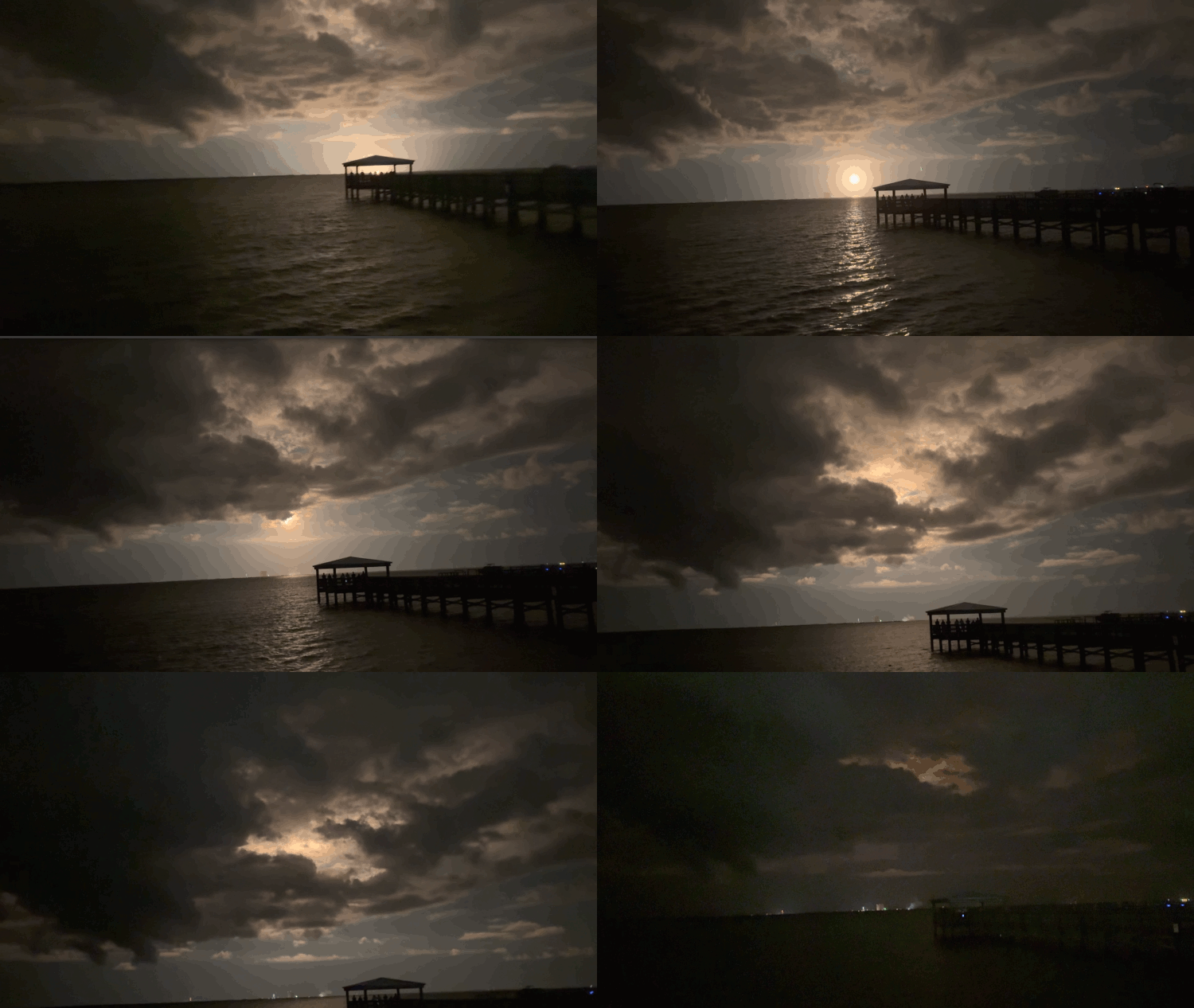
It was as if the sun had crept above the horizon without lighting the whole sky. A bright red-orange streak and a surrounding sphere of light spread across the horizon and lit the low hanging clouds, all reflecting on the water of the Indian River! It was spectacular! Ever so slowly the ball of light rose for maybe twenty seconds before being swallowed by the clouds. Then the clouds themselves began to glow and shift as the light tried to burst out from within them. For one more brief moment the rocket appeared to us through a gap in the clouds before diving back in to be lost to our sight for good. About a minute into flight, around the time the rocket was going supersonic, the rumble of the launch reached us. Low and slow at first, it built to a thunderous crescendo with the characteristic crackle of the engines over top. It wasn’t loud enough or close enough that we could feel it in our bones, but it seemed to fill the whole sphere of space in front of us. It went on and on and on and on Even though the light from the escaping rocket was long since lost, the sound went on and on.

Eventually, it settled and quieted. All returned to normal. A wispy vapor trail going up from the (actual) launch pad was all the evidence that remained. But I had seen a launch! Maybe not the most glorious to behold, but glorious nonetheless. To think that we mere mortals can routinely constrain and concentrate that much energy to hurl tons of material into space at 17,500 mph or more is simply remarkable. That I had the opportunity to just go and watch it happen gives me great pleasure and fills me with gratitude. The privilege is not lost on me. And there is much about the modern space age that is troublesome, raising moral and ethical questions about our stewardship of the environment and of space and who gets to decide about such things. But dang, it’s an amazing thing to see a rocket leave the earth.

Launch of the Nusantara Lima satellite as I saw it from Space View Park, Titusville, FL

If you want to see my video of the launch from which the above gif was assembled, it’s posted here on YouTube.

Touring Deep Time, Part 4

The intro is the same because, as I said at the end of Part 3, it’s series, you know? So be sure to read the previous episodes, Parts 1, 2, and 3.

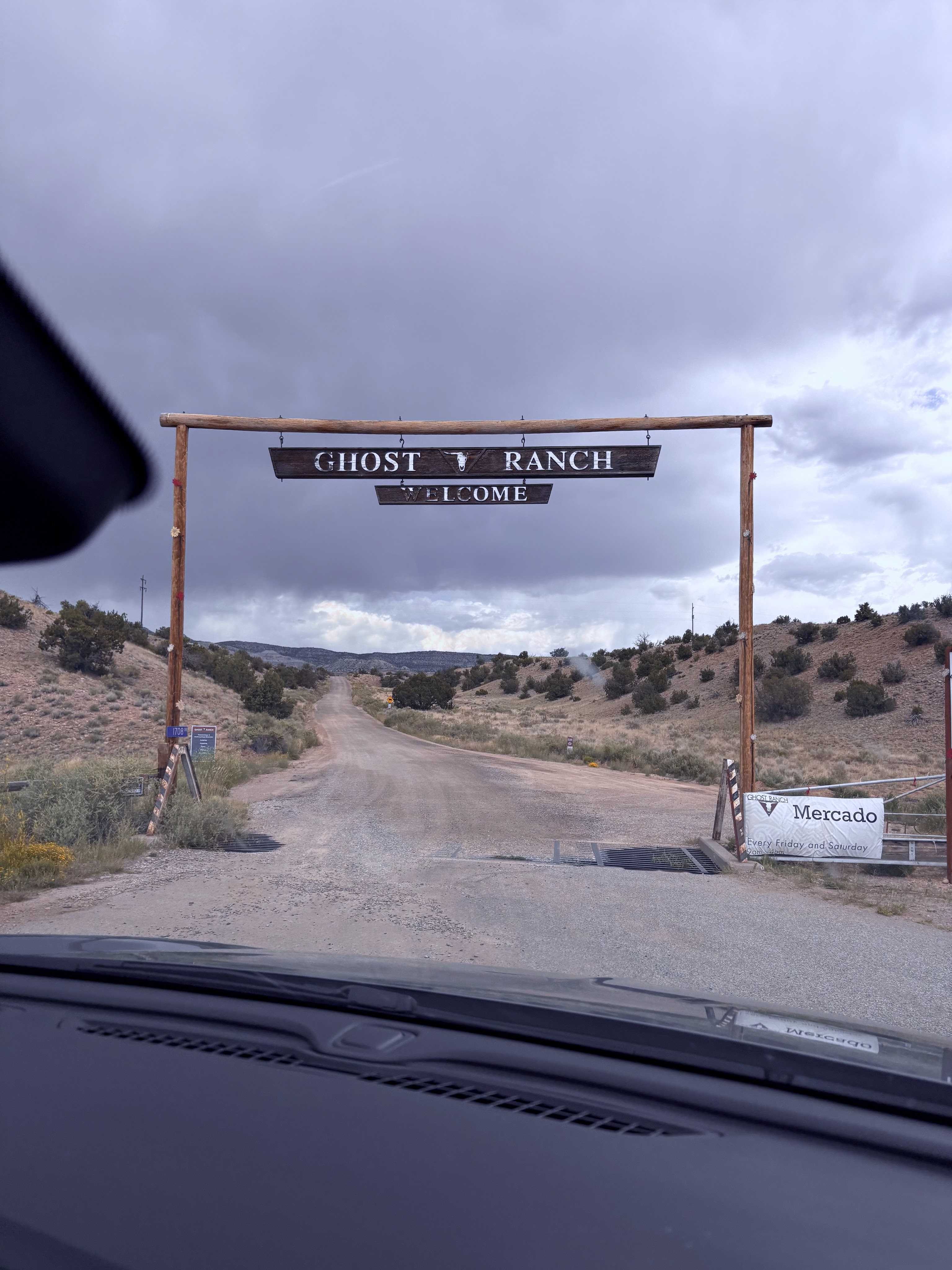
On our recent tour through New Mexico and Arizona, my wife Molly and I found ourselves in the presence of some deep time. And by “found ourselves” I mean “planned our trip to be.” The trip included Ghost Ranch, a Presbyterian camp and conference center near Abiquiu in northern New Mexico, the Chaco Culture National Historical Park a couple hours west, Meteor Crater near Winslow, Arizona (which has its own little time loop), and the Grand Canyon in northern Arizona. An unscheduled but anticipated stop at Lowell Observatory in Flagstaff, AZ, fit into the scheme as well. Each site confronted us with history on scales from human generations to older than human civilization, to a significant fraction of the age of Planet Earth.

Grand Canyon

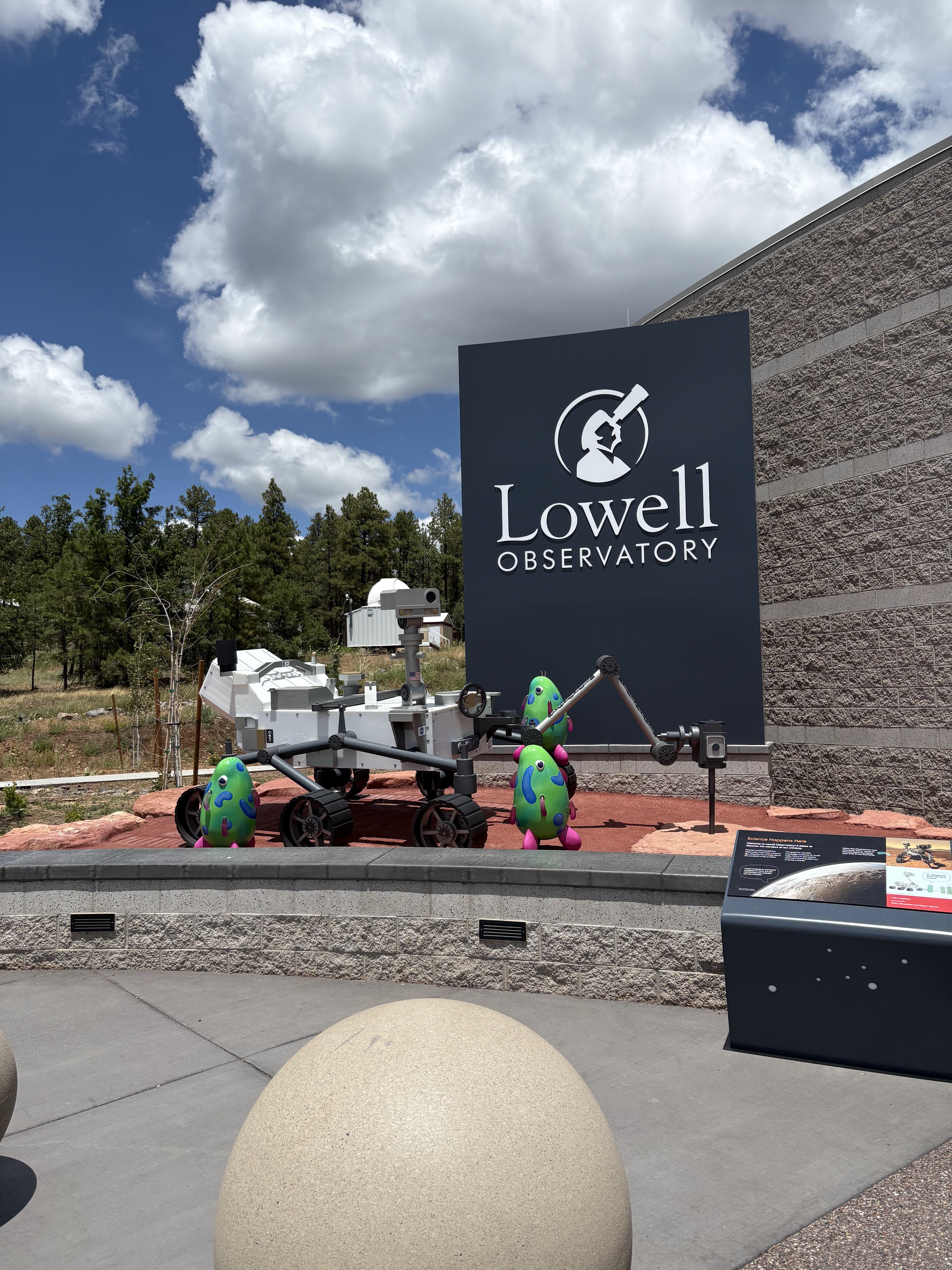
Our tour continued through deep time with a slight detour. On Monday we were in Flagstaff, AZ, which is the home of the Lowell Observatory. This had been one of my favorite stops in 2018, and while we didn’t have it scheduled, I was pleased that Molly wanted to see it. Certainly an observatory with instruments that helped identify the expansion of the universe, besides the discovery of Pluto and investigations of Mars and such, could be considered as part of our exploration of deep time. But I’m going to skip over it and stick to terrestrial and geological targets. Suffice it to say we had an enjoyable day of exploration at Lowell.

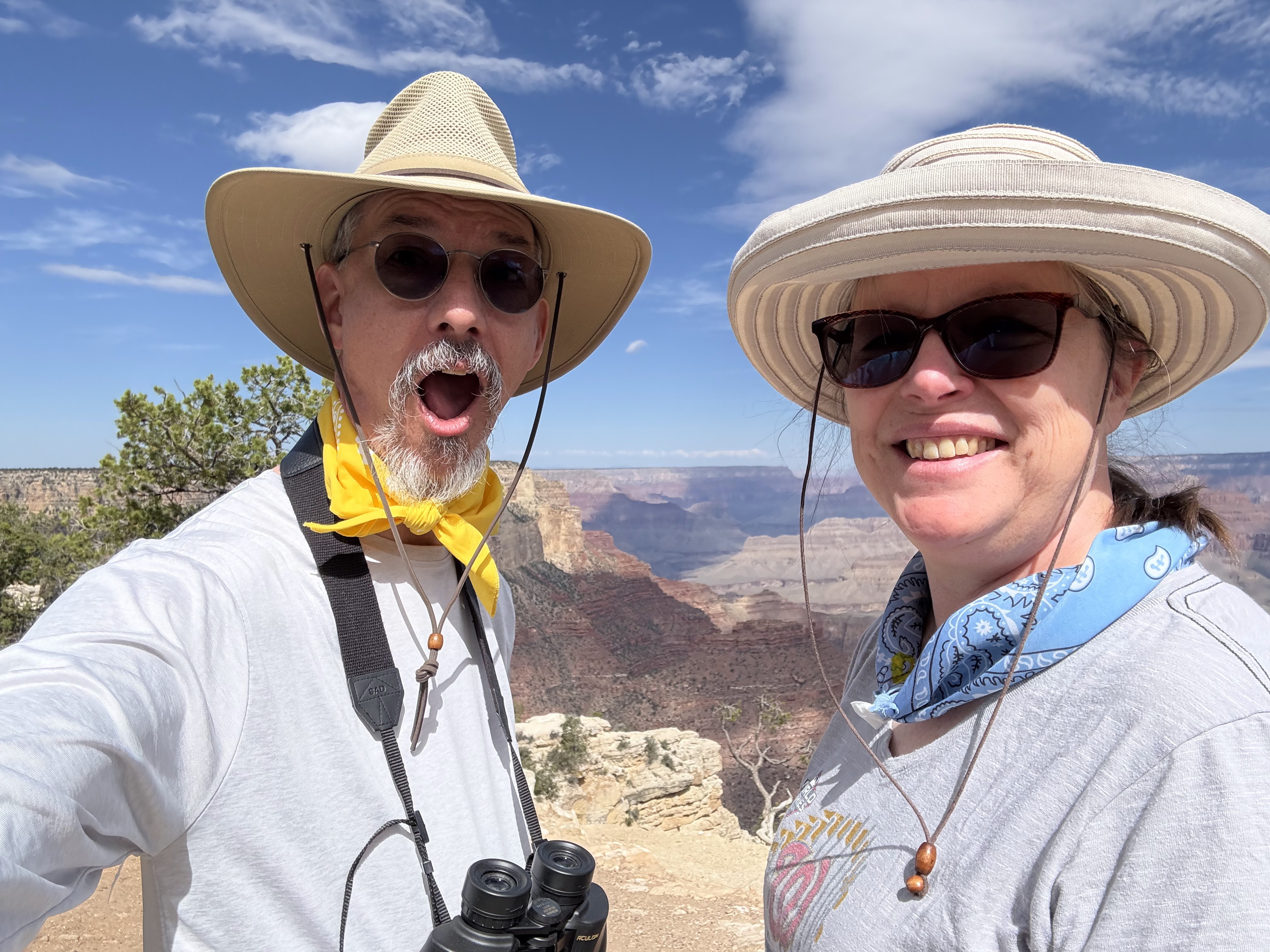
Tuesday morning started bright and early, a bit brighter and earlier than usual, as we were heading for the Big Ditch, the Grand Canyon. I had reserved spaces for us on an all-day tour with Canyon Dave Tours, a company that comes highly recommended for good reason. Our guide, Keaton, picked us up at our hotel in Flagstaff at 7:45 a.m. in a 10-(or so)-passenger van with the plan to pick up another couple in Wilson and another in the Grand Canyon National Park. That would be our entire tour group! We would see vistas and historically significant buildings and points of interest all along the South Rim, working our way around to the East Rim. Lunch was included. Keaton turned out to be a perfect tour guide with a wealth of knowledge on the canyon’s geology, flora and fauna, Native American habitations, and National Park history. Pretty much anything you would want to know about the Grand Canyon, Keaton had an answer. Plus, he was genuine and engaging with a good sense of when to jump in and when to leave space. At day’s end, Keaton drove us all back to where we belonged to the strains of Carlos Nakai, famed Native American flute virtuoso. Of our landmark tours, this was the most expensive, but it was also worth every dollar. But enough about the process. Let’s talk about the Canyon.

The Canyon

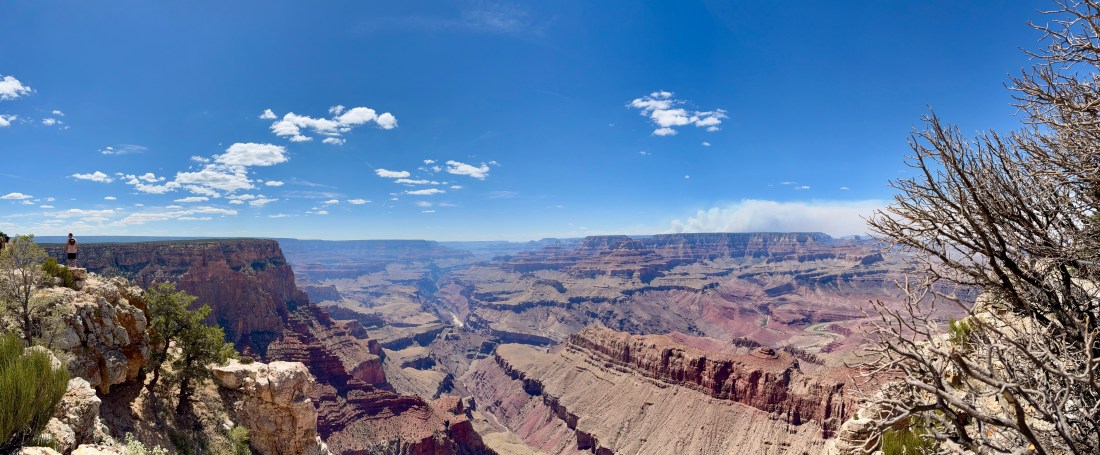
They always say that pictures don’t do it justice, and that turns out to be true. The Grand Canyon overwhelms one’s sense of scale at first sight. Standing between ten and 18 miles across from the South Rim to the North, between .75 and 1.25 miles in vertical depth, and 277 miles from end to end, this is the biggest canyon on Earth, at least on land. The Colorado River runs through the heart of it, having carved the canyon’s root over millenia. But as we learned, it is not the Colorado alone (averaging 300 ft. wide in the canyon) that made the canyon so wide. That was the work of various tributaries and erosion all along the length of the canyon on either side of the Colorado. The result is a spectacular display of revealed geologic layers in multiple shades of red, brown, green, gray, yellow, brown, and more.

Just as the layers of the mesas at Ghost Ranch revealed the ancient building and erosion of the landscape over millions of years, so the layers of the Grand Canyon reveal the same sort of processes, but going back much farther in time. In fact, the top of the canyon is about as old as the bottom of Ghost Ranch, about 270 million years. Think about that for just a moment. Standing at the rim of the Grand Canyon, you are starting at a point 1000X older than the modern human species of homo sapiens. You are starting at a time before dinosaurs appeared. You are starting in the era when all the continents were mashed together into a single landmass called Pangaea. The deeper you go, the older things get, and as we’ve seen, it gets pretty deep.

At the bottom of the canyon, the Colorado is currently cutting through layers called the Vishnu schist, or the Vishnu Basement, and beyond. These rocks are about 1.7 BILLION years old. That is about a third of the age of the planet. This is an era when the only life on the planet was single-celled, mostly bacteria and eventually some algae. Fungus was still a thing of the future. The atmosphere was still in the process of becoming oxygenated for the first time. There was only one supercontinent, but it is called Nuna, the great-grandparent of Pangaea. (Nuna would break up and recombine twice before Pangaea formed.)

In between the Vishnu Basement and the rim of the canyon are multiple layers of sandstone, shale, and limestone, each representing a different geologic era. They represent times when the canyon site was variously under an inland ocean or a dense forest or some other environment. The layers tell us of millions of years of deposits pressed down into solid rock. Think of the eons it would take to build up and compress enough sand, plants, and seashells to make a mile-deep mountain. Then think of the eons it would take to erode it all away so we can see it again.

Short Attention Span Eternity

The human mind is not adequately equipped to exist in timescapes that deep. So we can enjoy the glorious beauty of the Grand Canyon, and we can try to fathom its depth of time. But I think in the latter, we will ultimately fail. This is one of the reasons I wonder about God’s intention for us to live in eternity. Not that I don’t believe it. Not that I think God can’t make us fit for it. But as we are now, we can hardly process millions of years, much less billions. I mean, we get impatient waiting 30 seconds for the microwave to reheat our leftovers, or even a couple of seconds for a webpage to load. (Sorry about that big image at the top of the page.) If eternity is an infinitely-long linear time, we just aren’t ready. I believe we need to rethink how we talk about eternity and how we prepare people to live eternal life in this age, so we will be better prepared for the age to come.

Did you read the end first? Well, go back to read the rest! See also: Part 1, Part 2, Part 3

Touring Deep Time, Part 3

Yes, this intro is the same as in Part 1 and Part 2, but the rest is different, so read them all.

On our recent tour through New Mexico and Arizona, my wife Molly and I found ourselves in the presence of some deep time. And by “found ourselves” I mean “planned our trip to be.” The trip included Ghost Ranch, a Presbyterian camp and conference center near Abiquiu in northern New Mexico, the Chaco Culture National Historical Park a couple hours west, Meteor Crater near Winslow, Arizona (which has its own little time loop), and the Grand Canyon in northern Arizona. An unscheduled but anticipated stop at Lowell Observatory in Flagstaff, AZ, fit into the scheme as well. Each site confronted us with history on scales from human generations to older than human civilization, to a significant fraction of the age of Planet Earth.

Meteor Crater (via Winslow)

Winslow

The next day we headed to Meteor Crater, but first we stopped in Winslow, Arizona. People of a certain age and/or musical taste will recognize the reference immediately as coming from the song “Take It Easy” by the Eagles:

“I was standing on a corner in Winslow, Arizona,

Such a fine sight to see.

It’s a girl, my Lord, in a flatbed Ford

Slowin’ down to take a look at me.”

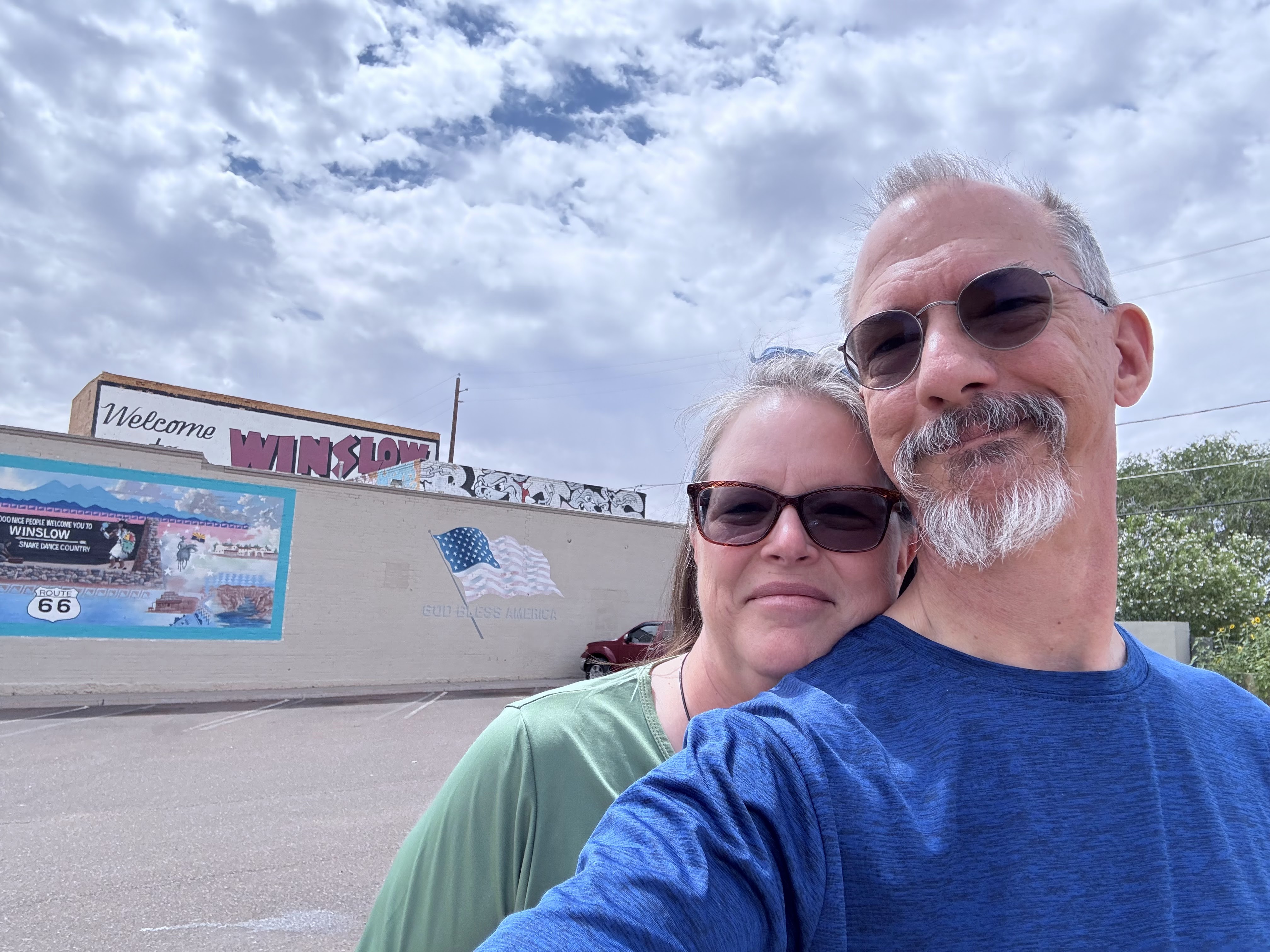
In the great tradition of American kitsch, there is a roadway attraction commemorating this song. Take It Easy Park, on a street corner in Winslow, on historic U.S. Route 66, has statues of Don Henley and Glenn Frey, the leaders of the Eagles. There is a mural of a store window reflecting a flatbed Ford truck with a blonde woman looking out the side, while an actual matching Ford truck is parked on the street. People cycle through taking pictures and selfies with the statues and the truck and all, and we took our turn as well. Winslow looks like it would be a pleasant enough place to live. There were plenty of restaurants, shops, and souvenir places in the area, although we didn’t indulge. Still, it carried me back to my youth. The song was released in 1972 and was a classic by the time I was coming of age. Funny how nostalgia can make you feel young, if only for a few minutes at a time.

Meteor Crater

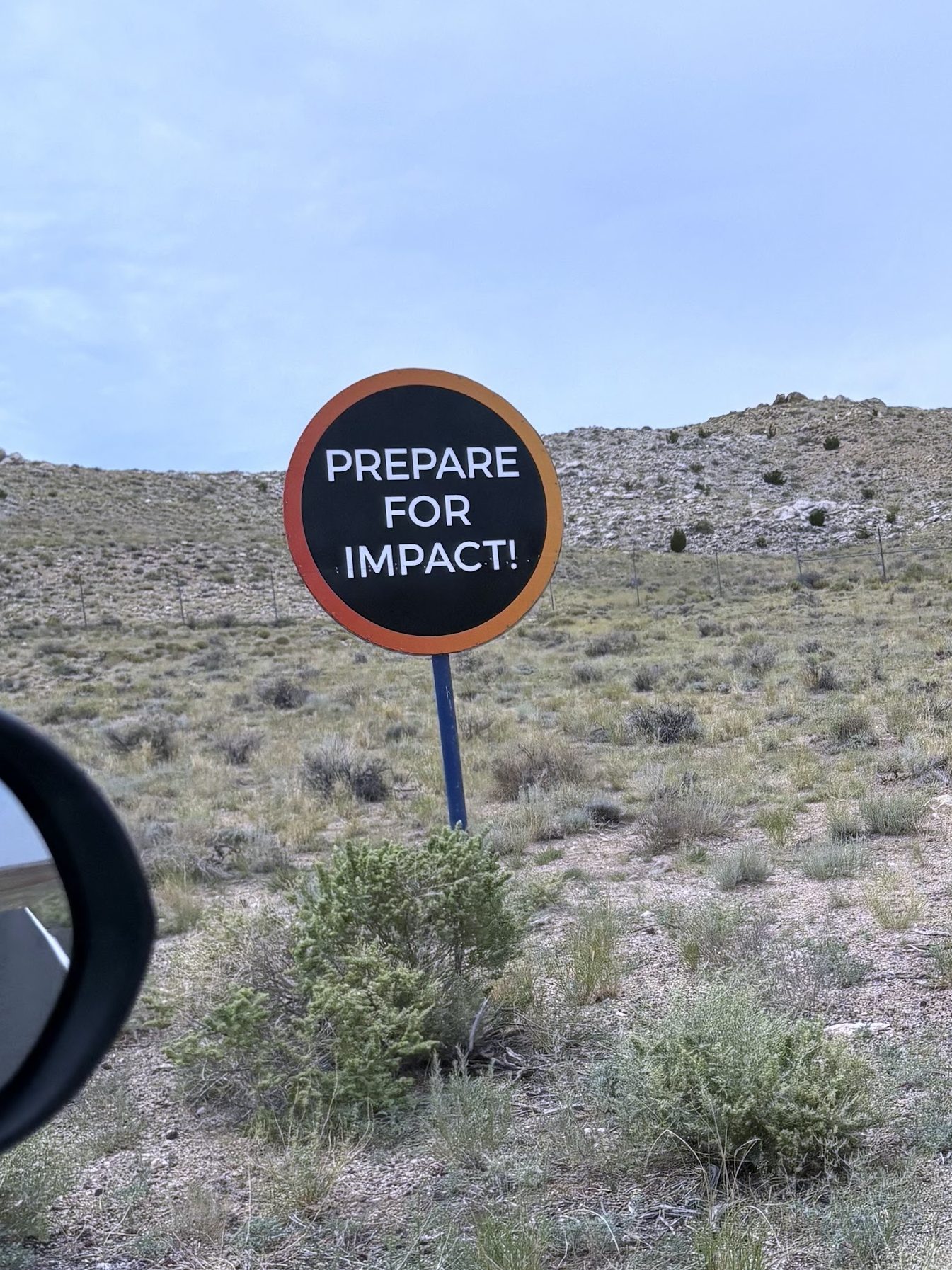
On we went to the main event for the day. Just about half an hour west down the highway is the exit for Meteor Crater, which is another five miles down the road to the south. It turns out there really isn’t much else anywhere around there. Clever signs appear every half mile or so, building the anticipation with announcements like, “3 Miles to Impact!”

The land is flat enough that when you are still those three miles out, you can make out a ridge in the distance that turns out to be the rim of the crater! It was just a suspicion at first, but the closer we got the more obvious it became. This was surprising and exciting! I’ve actually wanted to see the crater for years since I learned about it, so my anticipation was already running pretty high, even without the fun signs.

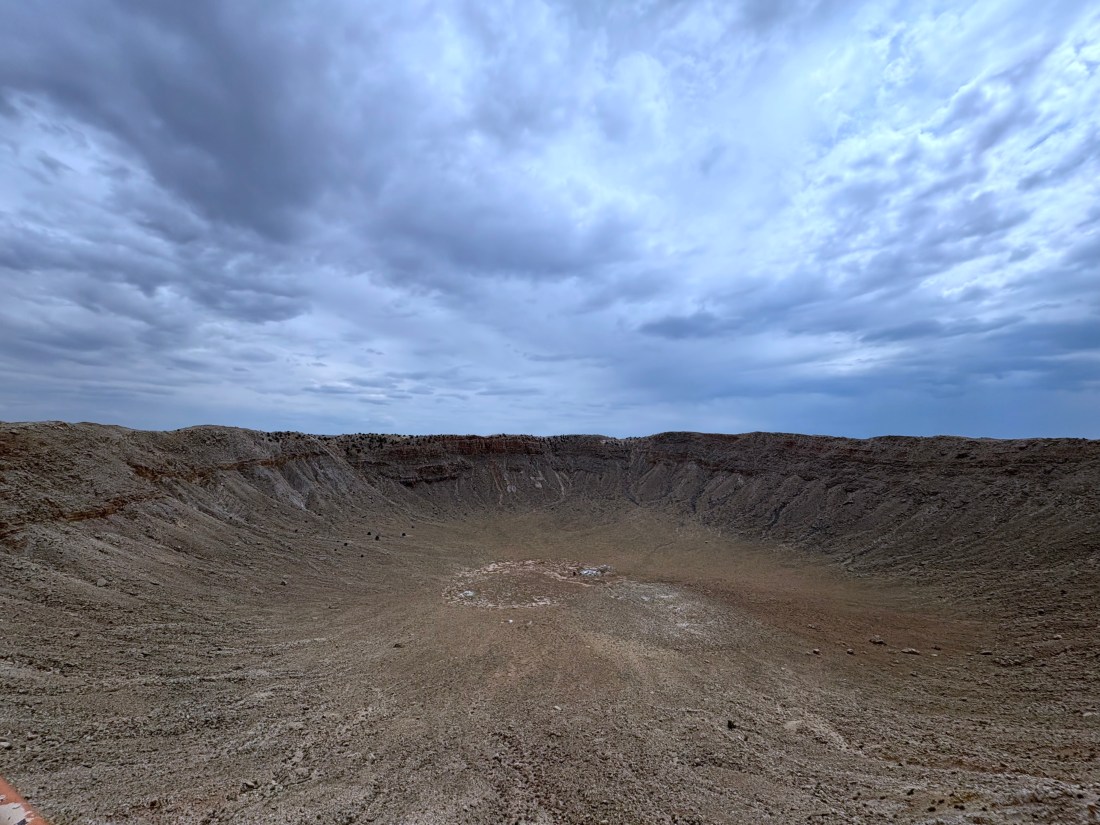
The crater did not disappoint. As the name suggests, this is the impact crater of a large meteor that struck the earth 50,000 years ago. The visitor center has an introductory film, a variety of interpretive and interactive scientific displays, a cheesy but fun “4-D” theatre experience, a fairly extensive gift shop, and an overpriced snack bar. All of that is pretty good, but the main attraction, of course, is the crater and the rim tours. 

The crater is about a mile across, three miles around the rim, and 550 feet deep. It is a big, old hole in the ground! We took the rim tour, and our guide, Hayden, was very knowledgeable and engaging. Between his talk, the introductory film, and the displays, we learned that, although the crater was long known to people in the area, it wasn’t until the early 20th century that anyone got the idea that it might be an impact crater and not volcanic. To that point, no impact craters were known to exist on earth. The discovery of a large iron meteorite (about two feet long) nearby triggered a decades-long failed mining exploration of the crater, but it also became the smoking gun that led to the impact conclusion. This became the start of a whole line of scientific inquiry into the process of meteor impacts, both here and on other worlds, so that scientists have been able to determine the history of the crater. About 50,000 years ago, an asteroid measuring about 150 feet (45 meters) across came in at a high angle (80º), traveling at 26,000 mph. It buried itself in the ground and exploded, creating the symmetrical crater 550 feet deep and a mile wide in about ten seconds. Other than pretty total local destruction for about 75 miles in any direction and the scar of the crater, they say it had no significant lasting effect on the planet. 

Because of the extremely dry and reasonably stable climate in northern Arizona, the crater has suffered little erosion and remains in excellent condition, mining shafts notwithstanding. It continues to provide insight into the potential for asteroid impacts on earth. Because this crater was identified as an impact, we have learned that the Earth has been hit many times and by much larger impactors, many of which caused global environmental disasters and mass extinctions. Consequently, we now have active scientific programs to identify potentially dangerous asteroids in the solar system. Scientists and governments around the world hold regular conferences to examine the state of affairs and to practice what to do if/when we find an inbound asteroid on its way. NASA has even sent a successful mission (DART) to impact an asteroid to see what it would take to divert a potentially hazardous one. As Bill Nye, CEO of the Planetary Society, is fond of saying, “The dinosaurs were wiped out because they didn’t have a space program.” Meteor impact is one of the few natural disasters that we now have the growing capacity to prevent.

All that from a big, old hole in the ground.

This is a whole series, so you’ll want to binge it all. See also: Part 1, Part 2, Part 4

Touring Deep Time, Part 2

As I wrote in PART 1 (you did read Part 1, didn’t you?)

On our recent tour through New Mexico and Arizona, my wife Molly and I found ourselves in the presence of some deep time. And by “found ourselves” I mean “planned our trip to be.” The trip included Ghost Ranch, a Presbyterian camp and conference center near Abiquiu in northern New Mexico, the Chaco Culture National Historical Park a couple hours west, Meteor Crater near Winslow, Arizona (which has its own little time loop), and the Grand Canyon in northern Arizona. An unscheduled but anticipated stop at Lowell Observatory in Flagstaff, AZ, fit into the scheme as well. Each site confronted us with history on scales from human generations to older than human civilization, to a significant fraction of the age of Planet Earth.

Chaco Canyon

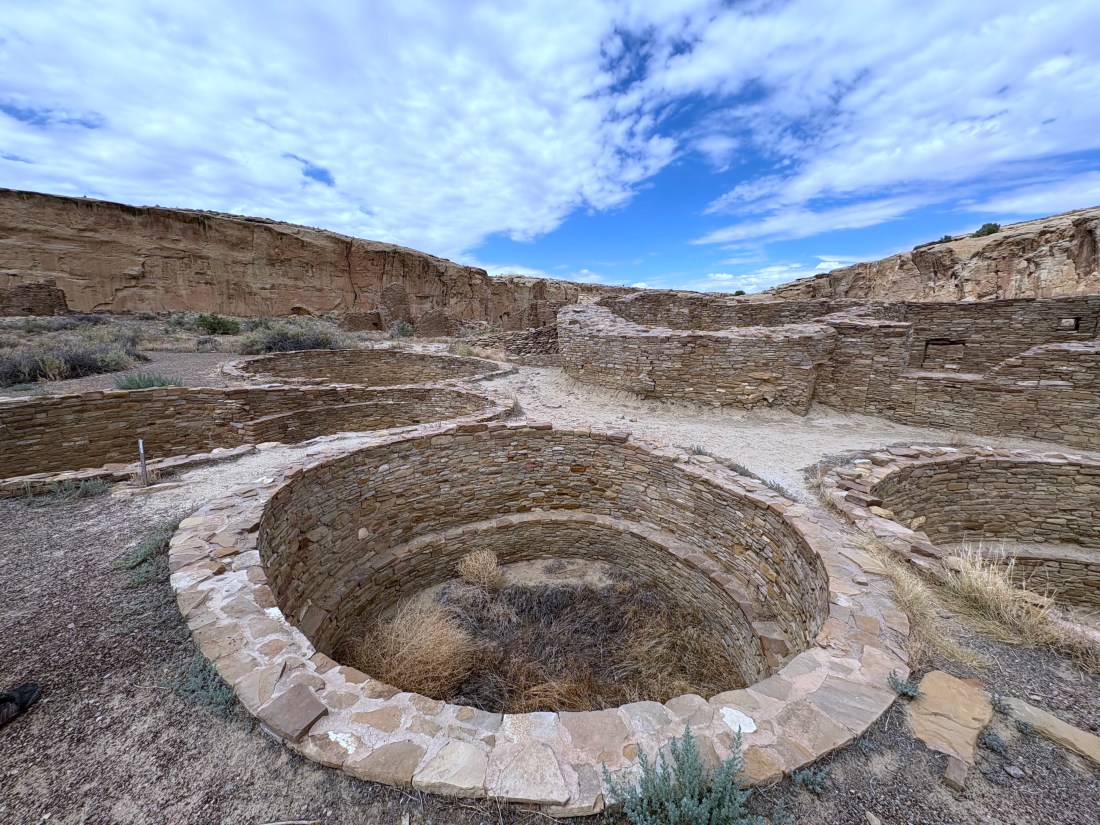
Our next stop was the Chaco Culture National Historical Park. This is a Native American and World Heritage Site that served as the center of a vast economic, political, and religious sphere of influence reaching as far as California and Mexico from 850 to 1250 CE (in the Common Era). I have wanted to visit Chaco for years since I learned about it, because it has a number of sites and architectural elements that are aligned with celestial events such as the solstices and equinoxes. So it’s an ancient astronomy site, and as an astronomy enthusiast, that’s fascinating to me.

In the book In Search of Time: The History, Physics, and Philosophy of Time by Dan Falk (© 2008 by Dan Falk, McClelland & Stewart Ltd., Toronto), the author describes other similar ancient astronomical sites and warns against calling them observatories, because that suggests a level of study and intention associated with modern scientific endeavor that we can’t assume or confirm for an ancient culture. It is most likely that the ancients were concerned primarily with the agricultural and subsequent religio-cultural times the heavens revealed more than the nature of the heavenly bodies themselves. Nevertheless, the accuracy with which the Chacoans and others were able to mark those celestial events with stone and architecture is remarkable.

The Chaco Canyon complex is enormous, much larger than I had imagined. Pilgrims and traders who travelled hundreds of miles on foot to get there would have been rewarded with an impressive expanse of urban hustle and bustle. Five great houses have been identified in the canyon, each covering dozens of acres. Over four hundred smaller structures have been found using modern technology like ground-penetrating radar and lidar but remain unexcavated. The great houses appear to include a mix of apartments, religious buildings, and perhaps governmental offices or shops, or both, everything you would need for a large crowd gathering for festivals in a capital city. The stonework of the architecture is exquisite with tightly-fitting, thin, flat stones laid expertly and held with a mud mortar. Much of this, as beautiful as I found it to be, was in its day covered with plaster to present a clean, bright facade to the public.

I was confronted with my modern bias when I found myself thoroughly surprised at the sophistication of the structures for people who lived twelve centuries ago. My bias comes into sharper focus when I consider the cathedrals of Europe that were built in the same era. I’ve been taught to expect that for white Europeans such building projects were normal and expected but that Native Americans were just living in animal hide tents and stick huts. It ain’t necessarily so. History, it seems, has more stories to tell than we often get to hear.

Keep going! See also: Part 1, Part 3, Part 4,

Touring Deep Time, Part 1

On our recent tour through New Mexico and Arizona, my wife Molly and I found ourselves in the presence of some deep time. And by “found ourselves” I mean “planned our trip to be.” The trip included Ghost Ranch, a Presbyterian camp and conference center near Abiquiu in northern New Mexico, the Chaco Culture National Historical Park a couple hours west, Meteor Crater near Winslow, Arizona (which has its own little time loop), and the Grand Canyon in northern Arizona. An unscheduled but anticipated stop at Lowell Observatory in Flagstaff, AZ, fit into the scheme as well. Each site confronted us with history on scales from human generations to older than human civilization, to a significant fraction of the age of Planet Earth.

Ghost Ranch

Taking our tour in order, let’s begin at Ghost Ranch. This first stop wasn’t planned for its time connection but as a site for spiritual retreat to begin my sabbatical. Spiritual retreats have their own time bubbles in our experience, standing outside the usual flow of chronos, the chronological time of schedules and calendars and time management. Instead, they tend to flow, in church lingo, in kairos, the timeless time of the eternal. That’s a special experience where time seems to lose its strict meaning and moments of inspiration seem to last forever while still being just now. While retreats aren’t all made up of kairos, they still tend to have a rhythm of their own outside our usual experience of time. I’ll get into all that more in another chapter. The thing here is we wanted to set the sabbatical time apart and a weeklong retreat seemed like a good way to do it.

What I didn’t realize was how beautiful and remarkable a place Ghost Ranch is. While the retreat program itself turned out not to be specifically spiritual, Ghost Ranch created an experience of a God-blessedness just for being at Ghost Ranch.

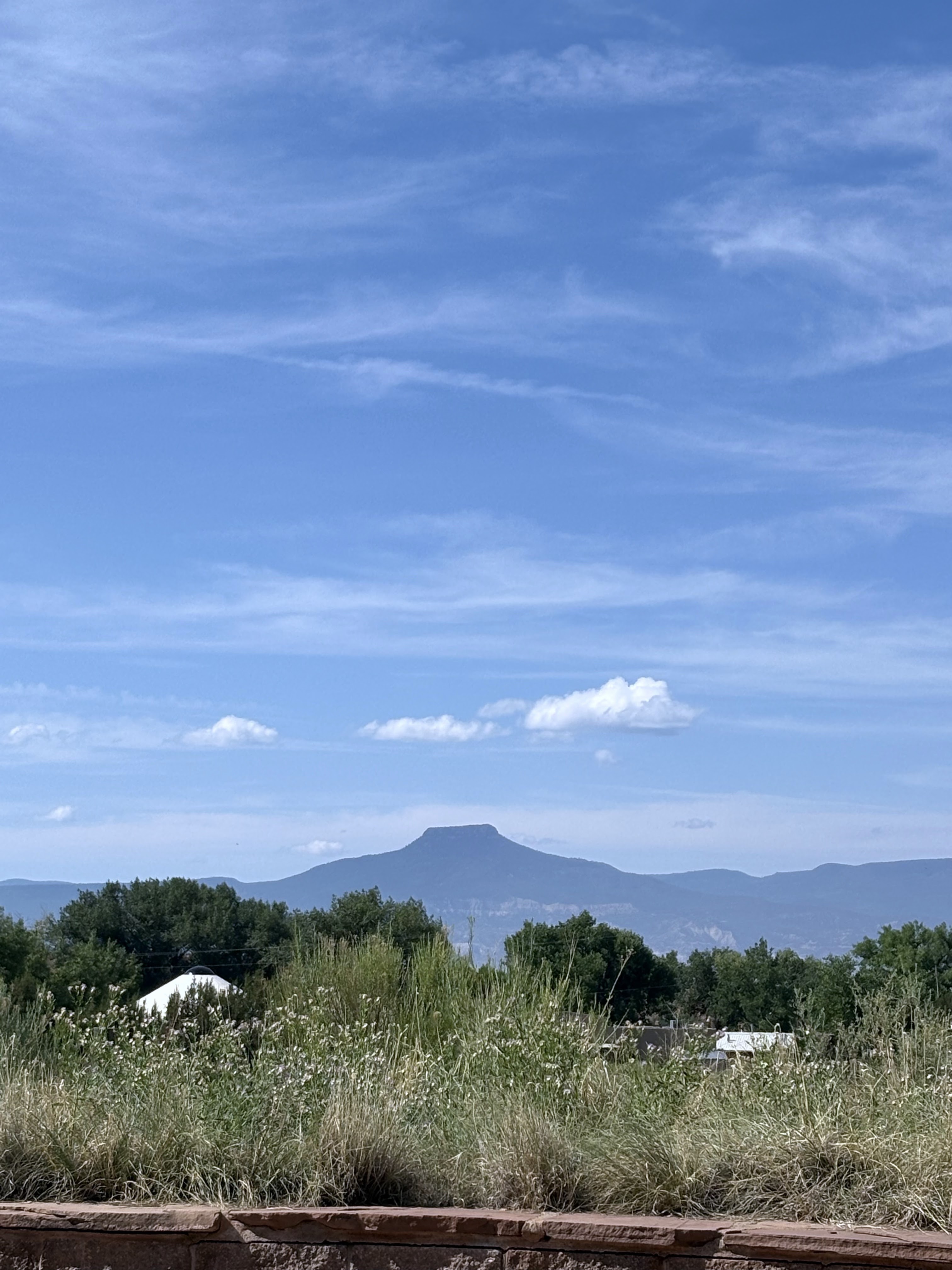
For me, the landscape carried much of the blessing. The geology of the area has created a system of mesas, flat-topped hills or ridges with steep sides that rise above a plain. They are refugees of erosion, having an area of denser rock at the top that protected the sedimentary layers below from washing away as quickly as surrounding areas. As a result, the sedimentary layers are laid bare for all to see and for geologists to study, date, and catalogue, and for artists and poets to gaze on in wonder, to capture in color and language. Being one with a love of science and a penchant for art, I was enthralled.

Ghost Ranch has two museums, one anthropological about the Native cultures of the area and one paleontological about the geology and dinosaurs of the area. What I learned about the geology blew my mind. You can look up the details yourself, but the two things that really grabbed me were that the bottom layers of the mesas date back to the time before dinosaurs appeared on earth, and that several of the layers of the mesas were laid down when New Mexico was under an inland sea and all the continents were still all mashed together. In a culture where 50 years is considered historic, walking on 250-million-year-old ground and being conscious of continental drift is shocking.

I wonder what would happen if we carried this awareness with us more consciously in our daily lives. No matter where you stand on the planet, you can have this sort of experience if you let your mind go there. Would we be more humble about our endeavors, less anxious about our mistakes and failures, more careful about how we spend our tiny slice of time, if it were in the context of millions of years instead of hours, minutes, and seconds? Would it be a step toward experiencing eternal life to frame our existence in the midst of such deep time instead of the urgent now?

Wait! There’s more! See also: Part 2, Part 3, Part 4,

An Artistic Journey, Part 2

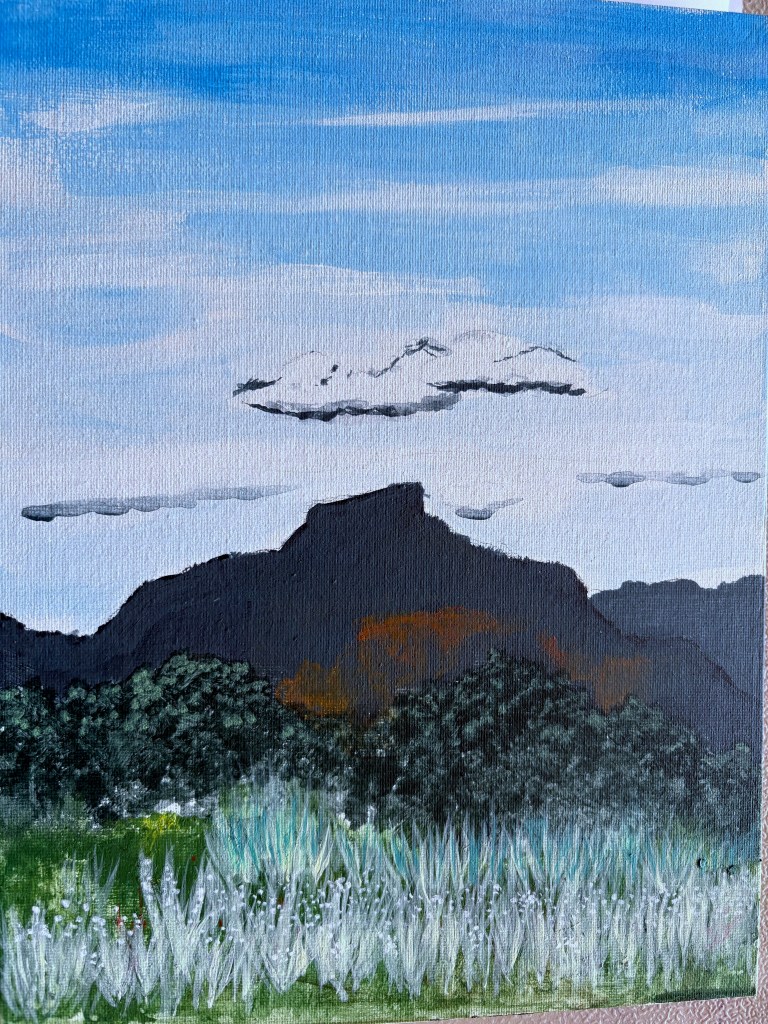
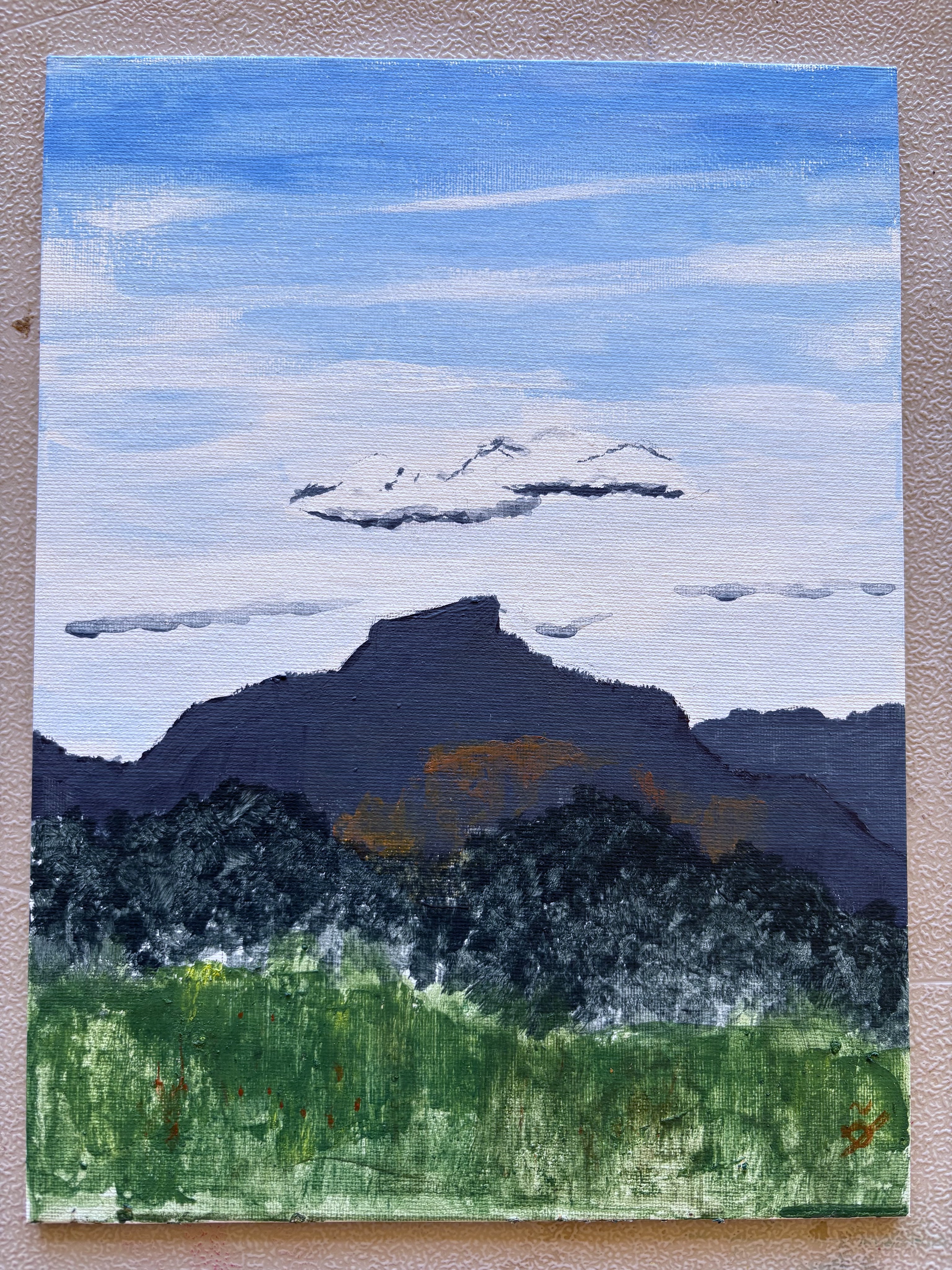
In my last entry I wrote about choosing a painting class at Ghost Ranch, about my lack of experience, training, and skill in painting, about the teacher’s fairly non-directive teaching style, about the first project – painting a landscape plein air – and about the initial results of my first attempt. Of particular interest for me about this first endeavor was overcoming my neurosis about needing to master a thing before I can try it. Right next door to that neurosis is a saying from Aunt Marty (a family friend kind of aunt) that I think I internalized as a child. She would often say, “I seldom fail! But then, I seldom try.” The fear of failure is a remarkable hindrance to living an adventurous life. In fact, although Aunt Marty (and I) seldom failed, there are many ways in which a non-failing life is not successful.

Keep Going

So, as I said previously, I made up my mind to try with this painting business. In the course of the week, I worked on three paintings. Some of my classmates produced that many in a day! While I am somewhat envious of their skill and capacity, I am not they, and that is not where I am. See how good I’m getting at giving myself grace and not comparing myself to others? Anyway, my three were that first landscape of Pedernal, another of Kitchen Mesa, and a still life. At the end of that first plein air session, I thought I was done with my painting. I even put a “D2” in the corner, my signature. Well, when we had a round-robin discussion in the class where we looked at everyone else’s work and offered comments, I got supportive comments of how they liked this or that about it, and several questions and suggestions of what I might do with it next. Next? Isn’t it done? Perhaps not. That one could continue working on a painting may seem obvious, but I guess I have watched too many episodes of Bob Ross’s Joy of Painting wherein he completes a work every half-hour show. So this was another point of my growth as an artist. I allowed as how perhaps I could continue working on my Pedernal, if only I could figure out how.

Another Target

I had a similar issue with my second painting, Kitchen Mesa. I was working on it from a photo I had taken so I could be inside. On a 9×12″ canvas board I penciled in the structures of clouds, mountain, and trees, and started in on the painting, working from top down. Calling on my experience with painting icons, I started a section with a dark base color and added progressively lighter colors on top of it. In iconography, this is a theological decision as much as artistic, to move from the darkness to the light. I still have no idea if that is what is ordinarily done in other styles of painting, but after watching my classmates working, I’d say not. Further, when KB, the instructor, came around to look at what I was doing, she was curious about my progression in that manner. Being a firm practitioner of the non-directive school, she offered suggestions of other possible methods, but insisted that if it worked for me, I should follow my path. I appreciated the permission giving, but the truth is I didn’t know if it was working or not.

The mesa has several distinct zones of different geology. There is a fairly dark, apparently dense rock that makes a kind of cap on the mesa. Maybe it isn’t actually dense, as there isn’t that much of it, either in width or depth. The next layer down is a pale yellow sandstone, and below that is an orange-red zone, almost salmon colored. There is an area of loose rock fall down the face of the red, and then, from where I was standing taking the picture, the trees take over the foreground. I’ll try to write about the geology in another post. As for my painting of these zones, as I said, I started at the top and I worked from dark to light. So that top cap came first. It has a number of vertical divisions. I overheard one of my classmates talking about trying to paint them in an earlier class, and she referred to them as the “teeth,” so that’s how I thought of them and referred to them. It turns out that wasn’t an official name as I imagined, but too bad. Now they’re called the Teeth of Kitchen Mesa. Anyway, using the iconographic approach, I actually got them to look pretty good! It took a lot of close, very detailed work. Usually I’m not a fan of details, but I kind of got into it with my icon painting, and I found it strangely engaging here, too.

I worked down to the sandstone zone. Here I ran into my lack of expertise with mixing paint to make the color you want. I couldn’t quite get the right tones or hues or values. I thought I could with layering, but my layers weren’t right either. I kept at it and got something blocked in, but I didn’t like it. Wrong color, wrong brush strokes, wrong texture to the sandstone, wrong, wrong, wrong. Again, in our review discussions, lots of positive comments on the sky and the “teeth”, and then encouragement to block in the rest of the colors and keep going. No one said, “that looks like crap,” or made me feel totally gross or morally bankrupt. I was encouraged, but I was also getting frustrated with the chasm between my desire and my product. I set the project aside until I could figure out what I was doing.

All this was on the first day of class.

Still Life Walking

On Tuesday, we started with a hike into the “back country” behind the art center toward the box canyon, if you know Ghost Ranch at all. If you don’t that’s okay. Suffice it to say it’s beautiful country, and it was a beautiful morning, and it was pretty flat walking. More views of more mesas and some of the beings that live on and around them, like lizards, bugs, and vultures. The goal of the expedition was to collect natural items from which to compose a still life. Again, KB, not wanting to make anyone do something that felt unnatural, wanted us each to compose our own items rather than her setting up one arrangement for all of us to paint. So not only don’t I know how to paint, I don’t know anything about arranging a still life, either. This was going to be great.

I found a handful of objects: two rocks, some yellow flowers, a stem of juniper, and a piece of …. wood? Yeah, I think it was wood. It had a lot of texture and a weird sage green color, and it was very crumbly. Let’s say it was wood. That was the easy part. Then, returning to the art center, I started trying to imagine how to arrange these things. All I can think of is the Dutch masters’ still life paintings, so I figure I need a table, some linen, a bowl, and maybe a skull? I don’t have nearly enough dark brown paint. Before long, KB came by, and I told her I was at a loss. She suggested just picking maybe three items, and then arrange them individually. Not so much an arrangement as a composition. That was a huge relief, really. I imagined being able to paint three items on their own much easier than trying to figure how to show them interacting. KB also recommended doing a neutral tone color wash on the canvas to 1) reduce the tyranny of the white canvas, 2) provide a background that would make the items stand out, and 3) I forget what 3 was. That seemed like a good idea, too, except I didn’t know how to do a neutral wash or what neutral tone meant. I took her recommendation under advisement for future consideration.

As I mentioned in the previous post, pencil drawing has always been more my thing. Since I felt like I was floundering with the paint, I decided to start this still life project by drawing the items in my sketchbook first. This would give me a sense of what I was looking at in terms of proportion and texture, it would focus my attention so I would “get to know” the items a little better, and it would give me a way to do art in a way I was comfortable with, just for a break. Well, if I’m honest, I was starting to doubt that I could actually do the painting. Drawing was a way to keep participating in the class without …. oh, what’s the word… trying. Or failing. Gosh, that runs deep. Nevertheless, drawing was comforting and productive and just what I needed to do at that point. KB wanted me to find my process. Drawing was going to be part of my process, one way or another.

Try. Fail. Learn. Keep Going.

Having completed sketches of my five items, I narrowed the field to three, as KB had suggested: the yellow flowers, the juniper branch, and the smaller, rounder, striped rock. Part of our class fees went to providing things to paint on, canvases, canvas boards, paper of different sorts, and so on. Somehow, all the 9×12″ canvas boards were gone already. I guess there weren’t that many to start with. That’s a pretty comfortable size for me, so I was disappointed. I didn’t feel like I was up to using an actual stretched canvas. So of the various options that remained, I went with a 12×16″ canvas board. This is so much bigger than I wanted. It’s a lot of white space for a beginner to fill. My already shaky confidence blanched before this white monolith. But come on, now, David. This is what you came for. Just go for it. I did. I sketched where I wanted my three items, and I started on the one I thought would be easiest, the yellow flowers. I started trying to mix the right shade of green for the stem and leaves. It’s a war between what nature has lain before me, the paints I have, my ineptitude, and my frugality that won’t let me waste anything. Nature loses. My green is far too bright, too blue, but again, I hope I can bring it down to where it “should” be in future applications. Besides, I don’t even know how to paint stems and leaves, so what difference does the color make? And you can’t just throw the paint away and not use it!

The painting itself doesn’t go any better. Even with my thinnest liner brush, my lines are fat, crude, uneven, overflowing. This is a disaster, a nightmare. What am I even doing here? What made me think I could paint? What a waste of time and money! I should just stop right now.

And yet…

Remember that you are a beginner. No one is here to judge you. This isn’t a competition. You are here because you wanted to learn and to grow. It doesn’t have to be perfect. It doesn’t even have to be good. It just has to be yours. You have talent. You can learn skills. Keep going.

So I did.

I went back to my sketchbook and practiced some ideas about how to do different kinds of strokes, using the extra bright green paint I didn’t want to waste. I practiced how I might make the petals of the flowers, and it looked good. I practiced some ideas for my Pedernal foreground. It didn’t take very long, and some of what I tried didn’t work, and some of it did.

I worked on Pedernal again, adding highlights to the mid-ground trees and adding grasses and flowers in the foreground. It was better.

I mixed some yellow that matched my flowers pretty well and added the petals to my painting. They got lost on the white canvas so I diluted some red paint and washed over them. It didn’t help! So I tried again with blue over the red. It didn’t help either! I took straight cobalt blue and very carefully painted around the petals and around the stems, and they all just popped! I practiced drawing my rock in my sketchbook with colored pencils, and then I painted it to look just like that, and it looked good. I painted around the rock with the cobalt blue, and it popped! I noticed that the boundary between where I stopped with the red wash (right in the middle of the canvas) and where it was just blue wash (at the top of the canvas) looked like the shape of Pedernal against the sky. I painted a thick, cobalt-blue, Pedernal-shaped line over that boundary. I connected the pools of blue around the two objects to the horizon line and to each other. I practiced and then painted the cow skull Ghost Ranch logo (originally be Georgia O’Keeffe!) at the top of the canvas, in place of the juniper branch.

And it was good.

What I Learned

I ended up really enjoying my painting class. I still don’t have much knowledge or skill, but I found a process, a path for doing art. As I spoke with classmates about my experience of nearly despairing and quitting before giving myself permission to just go ahead and ending up with something I really liked, several said they have had similar experiences. We even speculated that it is the nature of art to emerge with a push through the place of failure.

I learned about myself, of course, that I still wrestle with my perfectionism, and that I’m getting healthier about it. To offer grace to oneself to be less than “ideal” (whatever that is) is a gift of grace itself that comes, I believe, from a higher source. For that I am deeply grateful.

An Artistic Journey, Part 1

In planning for this year’s sabbatical, it worked out that it would begin on Molly’s and my 35th wedding anniversary. So wanting to do something to mark that milestone, we decided to go to Ghost Ranch near Abiquiu, New Mexico. Ghost Ranch is owned by the Presbyterian Church (USA) and has served as a retreat and conference center for the church since the 1950s or so. I’ve heard about Ghost Ranch for years and decades, but it was always so far away as to be somewhere between a mythological place or just not on my radar. Molly, having grown up in Colorado, had also heard much about GR but had never been there, either. In more recent years, particularly as my interest in astronomy led me to New Mexico a couple times, I started to think that going to Ghost Ranch could actually happen, but I never found the programming to match with my interests. They always seemed very arty, in many cases not especially religious, and kind of pricey on top of it. Well, since we weren’t looking for continuing education or professional development but sabbath and celebration time, and since we had funds for the sabbatical, we decided to check it out.

My initial interest was in an archaeology-paleontology course they were offering wherein guests would get to work an actual active archaeological site and dig for fossils. This sounded really interesting and fit with my sabbatical theme of time and eternity. I did wonder about how much fun it would be to be digging in the desert for 8 hours a day in July. Ultimately, it turned out that all the nice suites and single rooms with their own bathrooms were booked for that week, and we would have ended up in more of a dorm situation. That was a deal breaker. The week before that, they offered a class on how to put together a children’s book. That got Molly very excited, as she’s had an idea for years. I found a class on landscape and still life painting that I thought would be fun. So we signed up.

I will try to say more about Ghost Ranch itself and my experience of it in another post, and I’ll let Molly tell about her class where she will. For now, let me tell you about my painting class. I chose it because on my last sabbatical seven years ago I took a class on painting icons at the Siena Retreat Center near Racine, WI. I really enjoyed the work and turned out to be not bad at it for a first-timer. I haven’t done much painting since, and what I have done was working on a couple icons. So a class on the more traditional endeavors of landscapes and still-lifes offered a way to expand my artistic horizons, be creative, and try something I’ve always kind of wanted to do but was afraid to try. This last is actually a recurring theme in my life. I have had a weird neurosis that I feel like I have to have mastered a thing before I can try doing it. I’m getting better, but I’m still easily intimidated by new things. Thus, I guess this painting class was really a spiritual exercise for me, even if no explicit spirituality ever came up.

As with my icon class, I was in the minority here. I was the only man in the class of nine, and I was the only raw beginner. So much of a beginner that I had to ask my artist daughter about what some of the items on the list of supplies we were suppose to bring were and where I could get them. Daughter was very helpful, and I spent a bunch of money buying these mysterious tools. I did not spend any on paint, as I had bought some after the icon class, most of which seemed to be okay still, and also a box of eight 8-oz. bottles of basic colors that I got during the pandemic when I thought I’d be doing a lot more icon painting. Ha, ha, ha. Anyway, I arrived with my brand new unopened palettes and palette knives and my tiny old skanky paints and my “high quality” brushes (the fact that it says “High Quality” on the package is a dead giveaway that they are not, I discovered), and no idea what to do with any of them. Meanwhile, my classmates were all well equipped with piles of paints in well-worn cases with obviously proper brushes and tons of talent and experience, as would soon become obvious.

I thought KB, our instructor, would give us some lessons at the beginning of the day, and we would work out our artistic vision through the day, or something like that. It turns out that (1) most of the class knew what they were doing, and (2) KB is not that kind of a teacher. So we started by going outside on the patio of the art center to just start painting a landscape plein air (in the plain air, or outside). KB did give us a little demonstration of how she would begin, which was very helpful, because otherwise I was quite in the dark. Now, I’ve been drawing since I was a child, and I’m not bad at it. I have a good eye, I think, and can translate what I see to a page with a pencil. What I discovered quickly about painting (most of which I already knew) was that I knew nothing about technique, nothing about what sort of brush to use for what, nothing about how to mix paint to get a color you want, and nothing about how acrylic paints perform on a canvas. Well, that’s not entirely true. I had done those couple of icons, so I’ve mixed a little bit of paint, and I know that on an icon you thin the paint a lot an put on many, many layers to get the desired result. I have also watched a lot of Bob Ross, but he always worked with oils. So that’s what I had to draw from, as it were, as I started trying to paint the Ghost Ranch landscape.

Surprisingly, after 45 minutes I had covered most of a 9″x12″ canvas board with something that very generally resembled the scene before me. Somehow I had managed to overcome the tyranny of the white canvas and my fear of failure to produce…. something. Yeah, the really amazing part to me is that I consciously gave myself permission to do it wrong. Which, just to be clear, I did. Well, no, that’s not really fair. When it comes to art, what is right and what is wrong? My classmates and I all produced paintings of the same mountain in the distance, and not one of them looked like any other. I was certainly frustrated with mine not being “perfect” and a bit embarrassed that it wasn’t better than it was, but it was, after all, my first landscape painting ever. What do you want?

The Western Tour: An Overview

Molly and I have been traveling since July 12 (it being July 25 as I write this), so it’s definitely time for an update. This is a brief summary of what we have been up to. I’ll try to go into more detail in future posts.

July 12 – flew from Washington Dulles to Denver, got our rental car, and stayed overnight near the airport.

July 13 – Drove to Ghost Ranch near Abiquiu, New Mexico. The weather deteriorated from sunny to spitting rain, but it was a pleasant enough drive. We were very excited to arrive and get checked in. Our room was in Coyote Lodge on top of the mesa, putting us about as far from the dining hall as possible. We’ll be getting our steps in for sure! The room was a simple but pleasant suite with a sitting room with two loveseats and a couple tables, the bedroom, and a full bath. No A/C, but adobe, windows, and fans do a fine job keeping things comfortable. Made our way down for dinner, then orientation in the Agape Center (sort of chapel/community space), got introduced to our class instructors and saw where we would be meeting, then back up the mesa. The sky had cleared and was spectacular! Took some pics of the Milky Way that were amazing.

July 14-19 – Regular routine of breakfast at 7:30 a.m., Morning Light service at 8:30, class at 9:00-noon, lunch at 12:30, more class and/or free time in the afternoon, dinner at 5:30, usually free evenings, and early to bed. Made several friends over the course of the week, which is cool: Joel and Tammy from North Carolina, and Polly and Rigel from Texas, in particular. Hope to stay in touch with them.

My painting class turned out to be really good. I was the only real beginner, and everyone else in the class was very skilled and talented, so I felt a bit awkward knowing nothing, essentially. But everyone was very supportive, and I found my way. More on that later.

The scenery at Ghost Ranch is amazing. Such dramatic views wherever you look, and they change as the light changes through the day, so it’s always different. There’s height with the mesas, depth with the rock layers, and expanse across the valley and sky. More on that later, too.

July 19 – We left Ghost Ranch and drove to the Chaco Culture National Historical Park about 3 hours to the west. It’s three hours because you can’t get there from here. I’ve been wanting to go there since my last sabbatical trip, because it is not just a cultural heritage site but also an archaeo-astronomy site with buildings aligned with the solstices and such. There is a “sun dagger” that passes across a spiral petroglyph in one of the ruins, but that site is closed to the public because it’s gotten pretty unstable. Bummer. Unfortunately, no one made much of that aspect of the place while we were there. The ranger didn’t seem to know too much about it. Nevertheless, it was a remarkable place to see. The roads in and out were pretty … rustic. We went on to stay in Gallup, NM, that night.

July 20 – Next day we crossed into Arizona. We made a quick stop at Winslow on Route 66 and the “Take It Easy” Park, site of the line from the Eagles’ song of the same name. Kitschy fun! 

Just down the road a bit then is Meteor Crater, the target for the day’s outing. It is a mile-wide, 550-foot deep crater created by an asteroid strike about 50,000 years ago. Of course there were no humans in the area at the time, and there’s nothing much to recommend that patch of ground now, except the big hole and a nice visitor center with science displays. It’s another remarkable site that gives one a sense of time and the chanciness of existence.

July 21 – We had spent the night in Flagstaff, so we had a nice breakfast, went to pick up a few things at Wally World, and then spent the afternoon at Lowell Observatory. I had been there seven years ago, but they have added a new Discovery Center and telescope patio since then, making an already great science center even better in my opinion. It’s just a beautiful campus anyway.

July 22 – We signed up for a tour with Canyon Dave Tours to go to the Grand Canyon and had a great experience! Our tour guide, Keaton, picked us up at the hotel in Flagstaff at 7:45 a.m. and four other folks along the way. Then we spent the whole day at the canyon. Keaton was amazing, very knowledgeable and personable, imparting geology, biology, and history that was just fascinating. The scenery is of course amazing. We could see smoke still on the North Rim, which increased through the day. The weather was beautiful – sunny and upper 70s with nice breezes. We heard so many different languages through the day, too. Keaton delivered us back to the hotel at about 5:30 p.m. Great day! 10 out of 10, would recommend.

July 23 – Drove from Flagstaff to the Four Corners Monument, the point at which Utah, Arizona, New Mexico, and Colorado meet at right angles. We took the scenic route, US 160, a mostly two-lane road called the Navajo Trail (at least in part anyway). Lots of amazing scenery. The Four Corners Monument is on Navajo land. It’s a fairly simple site with the flags of the four states and the Navajo nation, various informational plaques, and a circle where the borders cross and you can stand in all four states at the same time. People take turns taking pictures. The plaza is surrounded by booths with native folk selling their crafts. We bought a couple really pretty pieces. You could tell the introvert merchants from the extrovert merchants pretty easily.

After that, we continued on Rt. 160, crossing Wolf Creek Pass, and on to Alamosa, CO, for the night. We got a call from the hotel about 9:15 saying that they close their desk and lock the door at 10pm, but if we could say when we were coming they’d have someone to let us in. That’s a local, non-chain hotel for you! And while the room had all the necessaries, it was definitely nonstandard. Not sure if it was a refreshing change or off-putting. It was a little more like staying in someone’s guest room than a Wyndham room (All hotels are Wyndham now, aren’t they?).

July 23 – Long drive from Alamosa to Mom’s house near Loveland, about seven and a half hours. Mostly high traffic on I-25, but otherwise uneventful. We’ll be here for a few days, and then we’ll fly home. As wonderful as this trip has been, I’m looking forward to just sitting and not touristing for a little while.

So those are your headlines from the Western front. Stay tuned for more details to follow, and stay subscribed!