The intro is the same because, as I said at the end of Part 3, it’s series, you know? So be sure to read the previous episodes, Parts 1, 2, and 3.
On our recent tour through New Mexico and Arizona, my wife Molly and I found ourselves in the presence of some deep time. And by “found ourselves” I mean “planned our trip to be.” The trip included Ghost Ranch, a Presbyterian camp and conference center near Abiquiu in northern New Mexico, the Chaco Culture National Historical Park a couple hours west, Meteor Crater near Winslow, Arizona (which has its own little time loop), and the Grand Canyon in northern Arizona. An unscheduled but anticipated stop at Lowell Observatory in Flagstaff, AZ, fit into the scheme as well. Each site confronted us with history on scales from human generations to older than human civilization, to a significant fraction of the age of Planet Earth.
Grand Canyon
Our tour continued through deep time with a slight detour. On Monday we were in Flagstaff, AZ, which is the home of the Lowell Observatory. This had been one of my favorite stops in 2018, and while we didn’t have it scheduled, I was pleased that Molly wanted to see it. Certainly an observatory with instruments that helped identify the expansion of the universe, besides the discovery of Pluto and investigations of Mars and such, could be considered as part of our exploration of deep time. But I’m going to skip over it and stick to terrestrial and geological targets. Suffice it to say we had an enjoyable day of exploration at Lowell.
Tuesday morning started bright and early, a bit brighter and earlier than usual, as we were heading for the Big Ditch, the Grand Canyon. I had reserved spaces for us on an all-day tour with Canyon Dave Tours, a company that comes highly recommended for good reason. Our guide, Keaton, picked us up at our hotel in Flagstaff at 7:45 a.m. in a 10-(or so)-passenger van with the plan to pick up another couple in Wilson and another in the Grand Canyon National Park. That would be our entire tour group! We would see vistas and historically significant buildings and points of interest all along the South Rim, working our way around to the East Rim. Lunch was included. Keaton turned out to be a perfect tour guide with a wealth of knowledge on the canyon’s geology, flora and fauna, Native American habitations, and National Park history. Pretty much anything you would want to know about the Grand Canyon, Keaton had an answer. Plus, he was genuine and engaging with a good sense of when to jump in and when to leave space. At day’s end, Keaton drove us all back to where we belonged to the strains of Carlos Nakai, famed Native American flute virtuoso. Of our landmark tours, this was the most expensive, but it was also worth every dollar. But enough about the process. Let’s talk about the Canyon.
The Canyon
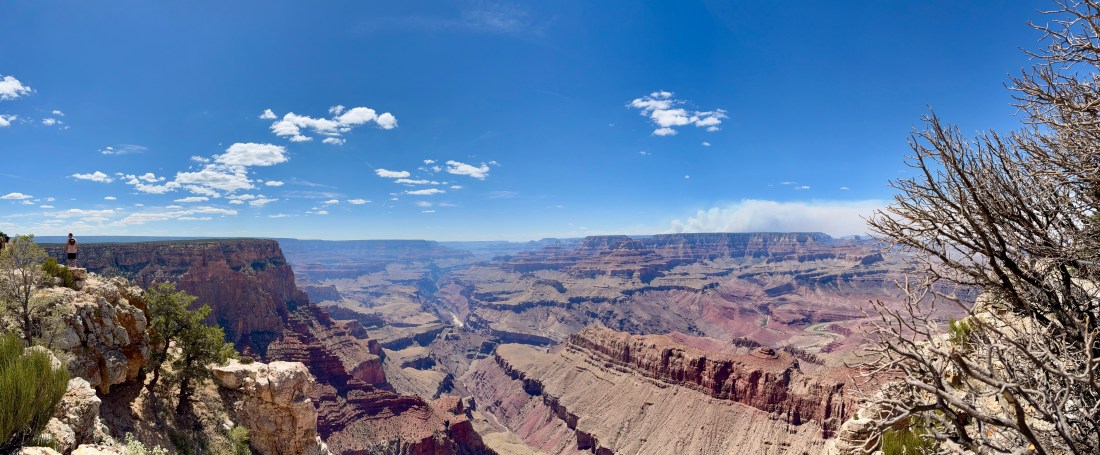
They always say that pictures don’t do it justice, and that turns out to be true. The Grand Canyon overwhelms one’s sense of scale at first sight. Standing between ten and 18 miles across from the South Rim to the North, between .75 and 1.25 miles in vertical depth, and 277 miles from end to end, this is the biggest canyon on Earth, at least on land. The Colorado River runs through the heart of it, having carved the canyon’s root over millenia. But as we learned, it is not the Colorado alone (averaging 300 ft. wide in the canyon) that made the canyon so wide. That was the work of various tributaries and erosion all along the length of the canyon on either side of the Colorado. The result is a spectacular display of revealed geologic layers in multiple shades of red, brown, green, gray, yellow, brown, and more.
Just as the layers of the mesas at Ghost Ranch revealed the ancient building and erosion of the landscape over millions of years, so the layers of the Grand Canyon reveal the same sort of processes, but going back much farther in time. In fact, the top of the canyon is about as old as the bottom of Ghost Ranch, about 270 million years. Think about that for just a moment. Standing at the rim of the Grand Canyon, you are starting at a point 1000X older than the modern human species of homo sapiens. You are starting at a time before dinosaurs appeared. You are starting in the era when all the continents were mashed together into a single landmass called Pangaea. The deeper you go, the older things get, and as we’ve seen, it gets pretty deep.
At the bottom of the canyon, the Colorado is currently cutting through layers called the Vishnu schist, or the Vishnu Basement, and beyond. These rocks are about 1.7 BILLION years old. That is about a third of the age of the planet. This is an era when the only life on the planet was single-celled, mostly bacteria and eventually some algae. Fungus was still a thing of the future. The atmosphere was still in the process of becoming oxygenated for the first time. There was only one supercontinent, but it is called Nuna, the great-grandparent of Pangaea. (Nuna would break up and recombine twice before Pangaea formed.)
In between the Vishnu Basement and the rim of the canyon are multiple layers of sandstone, shale, and limestone, each representing a different geologic era. They represent times when the canyon site was variously under an inland ocean or a dense forest or some other environment. The layers tell us of millions of years of deposits pressed down into solid rock. Think of the eons it would take to build up and compress enough sand, plants, and seashells to make a mile-deep mountain. Then think of the eons it would take to erode it all away so we can see it again.
Short Attention Span Eternity
The human mind is not adequately equipped to exist in timescapes that deep. So we can enjoy the glorious beauty of the Grand Canyon, and we can try to fathom its depth of time. But I think in the latter, we will ultimately fail. This is one of the reasons I wonder about God’s intention for us to live in eternity. Not that I don’t believe it. Not that I think God can’t make us fit for it. But as we are now, we can hardly process millions of years, much less billions. I mean, we get impatient waiting 30 seconds for the microwave to reheat our leftovers, or even a couple of seconds for a webpage to load. (Sorry about that big image at the top of the page.) If eternity is an infinitely-long linear time, we just aren’t ready. I believe we need to rethink how we talk about eternity and how we prepare people to live eternal life in this age, so we will be better prepared for the age to come.
Did you read the end first? Well, go back to read the rest! See also: Part 1, Part 2, Part 3
Yes, this intro is the same as in Part 1 and Part 2, but the rest is different, so read them all.
On our recent tour through New Mexico and Arizona, my wife Molly and I found ourselves in the presence of some deep time. And by “found ourselves” I mean “planned our trip to be.” The trip included Ghost Ranch, a Presbyterian camp and conference center near Abiquiu in northern New Mexico, the Chaco Culture National Historical Park a couple hours west, Meteor Crater near Winslow, Arizona (which has its own little time loop), and the Grand Canyon in northern Arizona. An unscheduled but anticipated stop at Lowell Observatory in Flagstaff, AZ, fit into the scheme as well. Each site confronted us with history on scales from human generations to older than human civilization, to a significant fraction of the age of Planet Earth.
Meteor Crater (via Winslow)
Winslow
The next day we headed to Meteor Crater, but first we stopped in Winslow, Arizona. People of a certain age and/or musical taste will recognize the reference immediately as coming from the song “Take It Easy” by the Eagles:
“I was standing on a corner in Winslow, Arizona,
Such a fine sight to see.
It’s a girl, my Lord, in a flatbed Ford
Slowin’ down to take a look at me.”
In the great tradition of American kitsch, there is a roadway attraction commemorating this song. Take It Easy Park, on a street corner in Winslow, on historic U.S. Route 66, has statues of Don Henley and Glenn Frey, the leaders of the Eagles. There is a mural of a store window reflecting a flatbed Ford truck with a blonde woman looking out the side, while an actual matching Ford truck is parked on the street. People cycle through taking pictures and selfies with the statues and the truck and all, and we took our turn as well. Winslow looks like it would be a pleasant enough place to live. There were plenty of restaurants, shops, and souvenir places in the area, although we didn’t indulge. Still, it carried me back to my youth. The song was released in 1972 and was a classic by the time I was coming of age. Funny how nostalgia can make you feel young, if only for a few minutes at a time.
Meteor Crater
On we went to the main event for the day. Just about half an hour west down the highway is the exit for Meteor Crater, which is another five miles down the road to the south. It turns out there really isn’t much else anywhere around there. Clever signs appear every half mile or so, building the anticipation with announcements like, “3 Miles to Impact!”
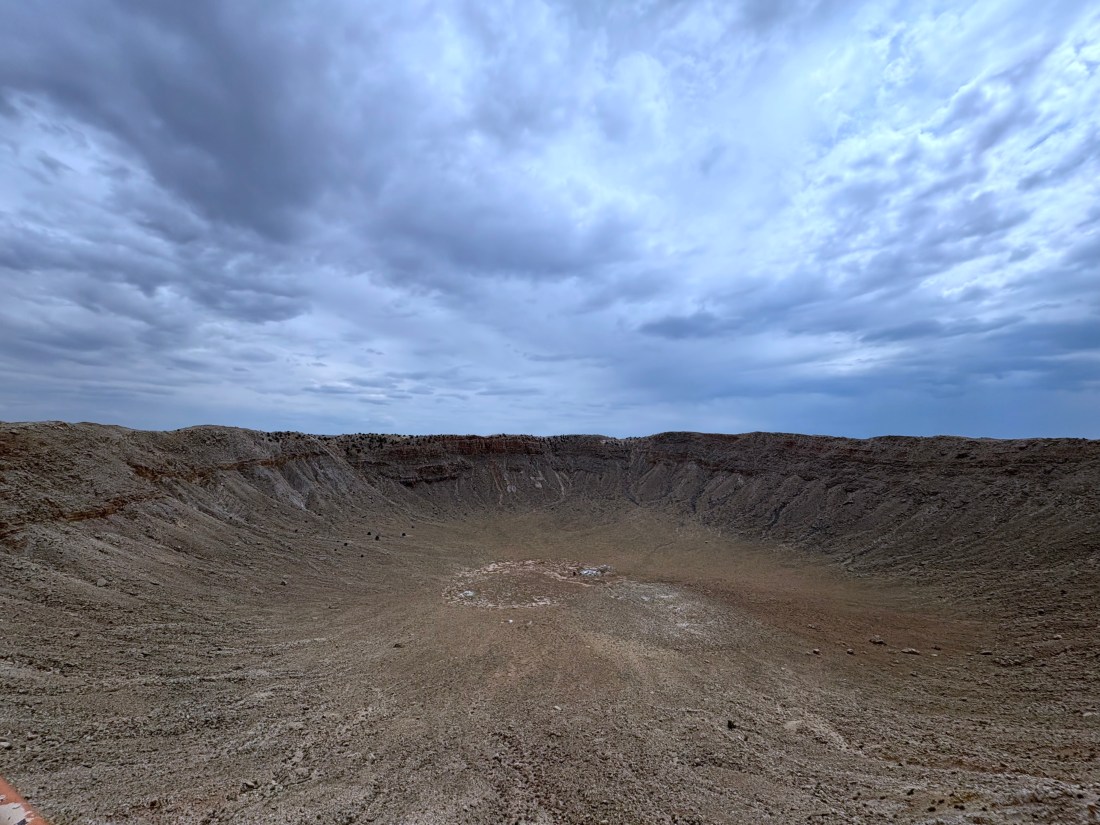
The land is flat enough that when you are still those three miles out, you can make out a ridge in the distance that turns out to be the rim of the crater! It was just a suspicion at first, but the closer we got the more obvious it became. This was surprising and exciting! I’ve actually wanted to see the crater for years since I learned about it, so my anticipation was already running pretty high, even without the fun signs.
The crater did not disappoint. As the name suggests, this is the impact crater of a large meteor that struck the earth 50,000 years ago. The visitor center has an introductory film, a variety of interpretive and interactive scientific displays, a cheesy but fun “4-D” theatre experience, a fairly extensive gift shop, and an overpriced snack bar. All of that is pretty good, but the main attraction, of course, is the crater and the rim tours.
The crater is about a mile across, three miles around the rim, and 550 feet deep. It is a big, old hole in the ground! We took the rim tour, and our guide, Hayden, was very knowledgeable and engaging. Between his talk, the introductory film, and the displays, we learned that, although the crater was long known to people in the area, it wasn’t until the early 20th century that anyone got the idea that it might be an impact crater and not volcanic. To that point, no impact craters were known to exist on earth. The discovery of a large iron meteorite (about two feet long) nearby triggered a decades-long failed mining exploration of the crater, but it also became the smoking gun that led to the impact conclusion. This became the start of a whole line of scientific inquiry into the process of meteor impacts, both here and on other worlds, so that scientists have been able to determine the history of the crater. About 50,000 years ago, an asteroid measuring about 150 feet (45 meters) across came in at a high angle (80º), traveling at 26,000 mph. It buried itself in the ground and exploded, creating the symmetrical crater 550 feet deep and a mile wide in about ten seconds. Other than pretty total local destruction for about 75 miles in any direction and the scar of the crater, they say it had no significant lasting effect on the planet.
Because of the extremely dry and reasonably stable climate in northern Arizona, the crater has suffered little erosion and remains in excellent condition, mining shafts notwithstanding. It continues to provide insight into the potential for asteroid impacts on earth. Because this crater was identified as an impact, we have learned that the Earth has been hit many times and by much larger impactors, many of which caused global environmental disasters and mass extinctions. Consequently, we now have active scientific programs to identify potentially dangerous asteroids in the solar system. Scientists and governments around the world hold regular conferences to examine the state of affairs and to practice what to do if/when we find an inbound asteroid on its way. NASA has even sent a successful mission (DART) to impact an asteroid to see what it would take to divert a potentially hazardous one. As Bill Nye, CEO of the Planetary Society, is fond of saying, “The dinosaurs were wiped out because they didn’t have a space program.” Meteor impact is one of the few natural disasters that we now have the growing capacity to prevent.
All that from a big, old hole in the ground.
This is a whole series, so you’ll want to binge it all. See also: Part 1, Part 2, Part 4
As I wrote in PART 1 (you did read Part 1, didn’t you?)
On our recent tour through New Mexico and Arizona, my wife Molly and I found ourselves in the presence of some deep time. And by “found ourselves” I mean “planned our trip to be.” The trip included Ghost Ranch, a Presbyterian camp and conference center near Abiquiu in northern New Mexico, the Chaco Culture National Historical Park a couple hours west, Meteor Crater near Winslow, Arizona (which has its own little time loop), and the Grand Canyon in northern Arizona. An unscheduled but anticipated stop at Lowell Observatory in Flagstaff, AZ, fit into the scheme as well. Each site confronted us with history on scales from human generations to older than human civilization, to a significant fraction of the age of Planet Earth.
Chaco Canyon
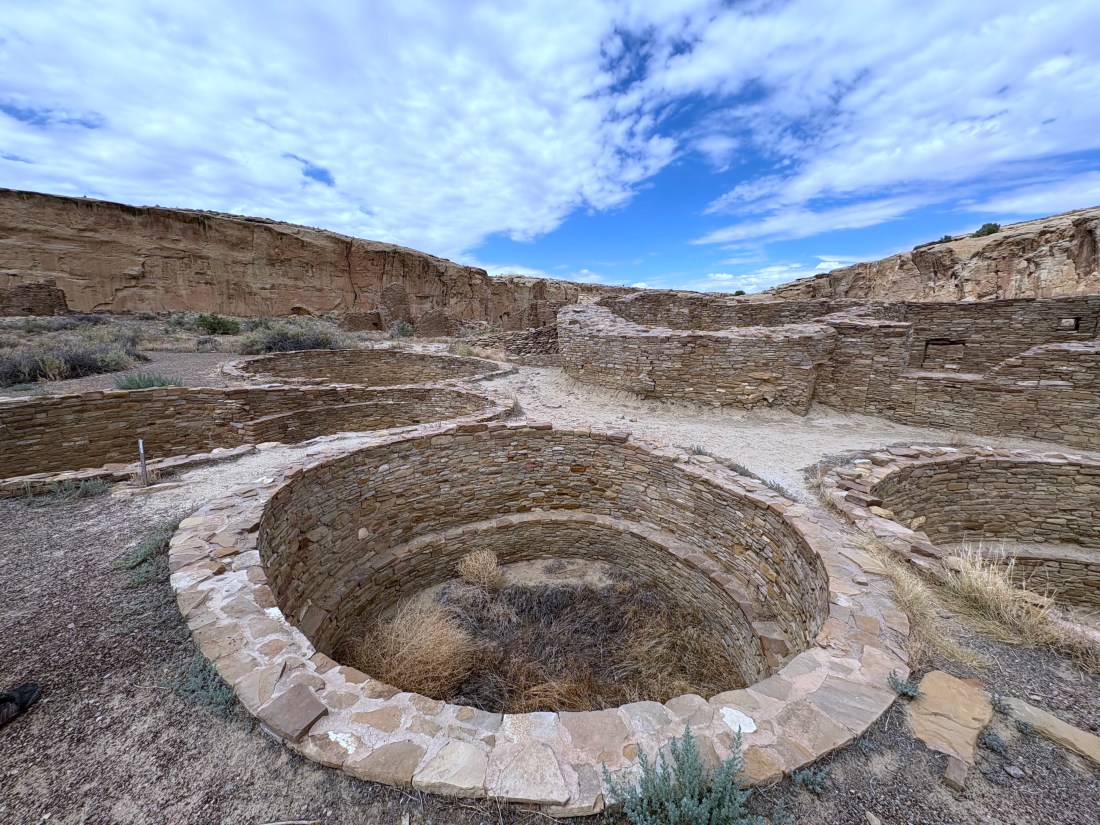
Our next stop was the Chaco Culture National Historical Park. This is a Native American and World Heritage Site that served as the center of a vast economic, political, and religious sphere of influence reaching as far as California and Mexico from 850 to 1250 CE (in the Common Era). I have wanted to visit Chaco for years since I learned about it, because it has a number of sites and architectural elements that are aligned with celestial events such as the solstices and equinoxes. So it’s an ancient astronomy site, and as an astronomy enthusiast, that’s fascinating to me.
The Chaco Canyon complex is enormous, much larger than I had imagined. Pilgrims and traders who travelled hundreds of miles on foot to get there would have been rewarded with an impressive expanse of urban hustle and bustle. Five great houses have been identified in the canyon, each covering dozens of acres. Over four hundred smaller structures have been found using modern technology like ground-penetrating radar and lidar but remain unexcavated. The great houses appear to include a mix of apartments, religious buildings, and perhaps governmental offices or shops, or both, everything you would need for a large crowd gathering for festivals in a capital city. The stonework of the architecture is exquisite with tightly-fitting, thin, flat stones laid expertly and held with a mud mortar. Much of this, as beautiful as I found it to be, was in its day covered with plaster to present a clean, bright facade to the public.
I was confronted with my modern bias when I found myself thoroughly surprised at the sophistication of the structures for people who lived twelve centuries ago. My bias comes into sharper focus when I consider the cathedrals of Europe that were built in the same era. I’ve been taught to expect that for white Europeans such building projects were normal and expected but that Native Americans were just living in animal hide tents and stick huts. It ain’t necessarily so. History, it seems, has more stories to tell than we often get to hear.
On our recent tour through New Mexico and Arizona, my wife Molly and I found ourselves in the presence of some deep time. And by “found ourselves” I mean “planned our trip to be.” The trip included Ghost Ranch, a Presbyterian camp and conference center near Abiquiu in northern New Mexico, the Chaco Culture National Historical Park a couple hours west, Meteor Crater near Winslow, Arizona (which has its own little time loop), and the Grand Canyon in northern Arizona. An unscheduled but anticipated stop at Lowell Observatory in Flagstaff, AZ, fit into the scheme as well. Each site confronted us with history on scales from human generations to older than human civilization, to a significant fraction of the age of Planet Earth.
Ghost Ranch
Taking our tour in order, let’s begin at Ghost Ranch. This first stop wasn’t planned for its time connection but as a site for spiritual retreat to begin my sabbatical. Spiritual retreats have their own time bubbles in our experience, standing outside the usual flow of chronos, the chronological time of schedules and calendars and time management. Instead, they tend to flow, in church lingo, in kairos, the timeless time of the eternal. That’s a special experience where time seems to lose its strict meaning and moments of inspiration seem to last forever while still being just now. While retreats aren’t all made up of kairos, they still tend to have a rhythm of their own outside our usual experience of time. I’ll get into all that more in another chapter. The thing here is we wanted to set the sabbatical time apart and a weeklong retreat seemed like a good way to do it.
What I didn’t realize was how beautiful and remarkable a place Ghost Ranch is. While the retreat program itself turned out not to be specifically spiritual, Ghost Ranch created an experience of a God-blessedness just for being at Ghost Ranch.
For me, the landscape carried much of the blessing. The geology of the area has created a system of mesas, flat-topped hills or ridges with steep sides that rise above a plain. They are refugees of erosion, having an area of denser rock at the top that protected the sedimentary layers below from washing away as quickly as surrounding areas. As a result, the sedimentary layers are laid bare for all to see and for geologists to study, date, and catalogue, and for artists and poets to gaze on in wonder, to capture in color and language. Being one with a love of science and a penchant for art, I was enthralled.
Ghost Ranch has two museums, one anthropological about the Native cultures of the area and one paleontological about the geology and dinosaurs of the area. What I learned about the geology blew my mind. You can look up the details yourself, but the two things that really grabbed me were that the bottom layers of the mesas date back to the time before dinosaurs appeared on earth, and that several of the layers of the mesas were laid down when New Mexico was under an inland sea and all the continents were still all mashed together. In a culture where 50 years is considered historic, walking on 250-million-year-old ground and being conscious of continental drift is shocking.
I wonder what would happen if we carried this awareness with us more consciously in our daily lives. No matter where you stand on the planet, you can have this sort of experience if you let your mind go there. Would we be more humble about our endeavors, less anxious about our mistakes and failures, more careful about how we spend our tiny slice of time, if it were in the context of millions of years instead of hours, minutes, and seconds? Would it be a step toward experiencing eternal life to frame our existence in the midst of such deep time instead of the urgent now?
In my last entry I wrote about choosing a painting class at Ghost Ranch, about my lack of experience, training, and skill in painting, about the teacher’s fairly non-directive teaching style, about the first project – painting a landscape plein air – and about the initial results of my first attempt. Of particular interest for me about this first endeavor was overcoming my neurosis about needing to master a thing before I can try it. Right next door to that neurosis is a saying from Aunt Marty (a family friend kind of aunt) that I think I internalized as a child. She would often say, “I seldom fail! But then, I seldom try.” The fear of failure is a remarkable hindrance to living an adventurous life. In fact, although Aunt Marty (and I) seldom failed, there are many ways in which a non-failing life is not successful.
Keep Going
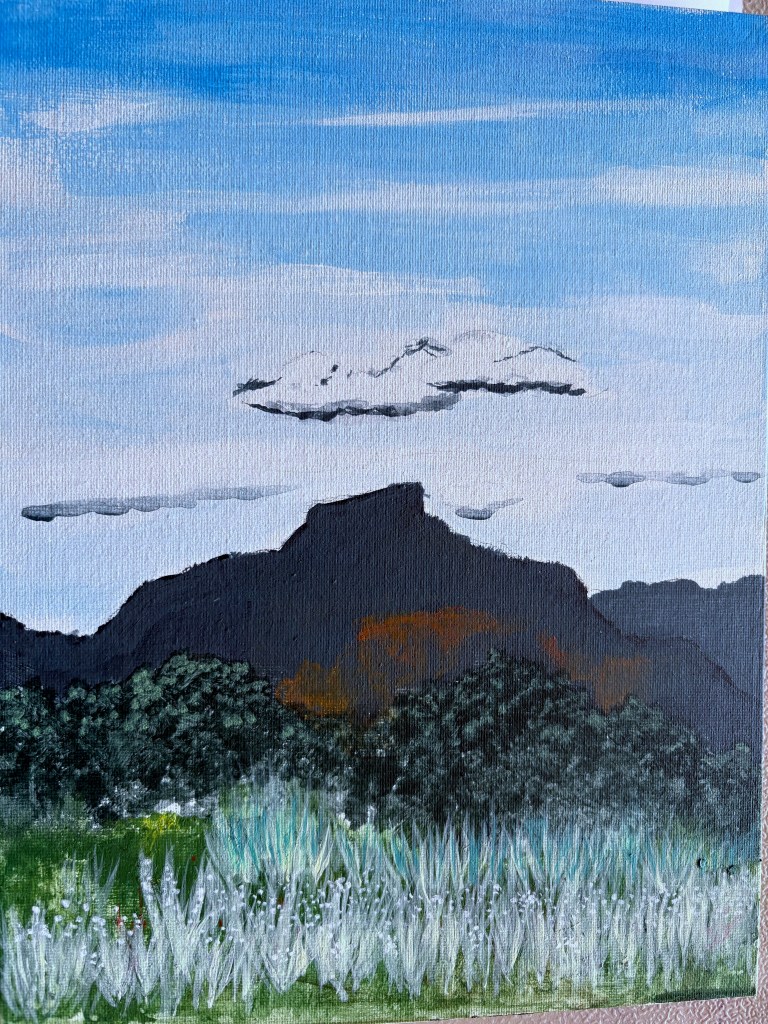
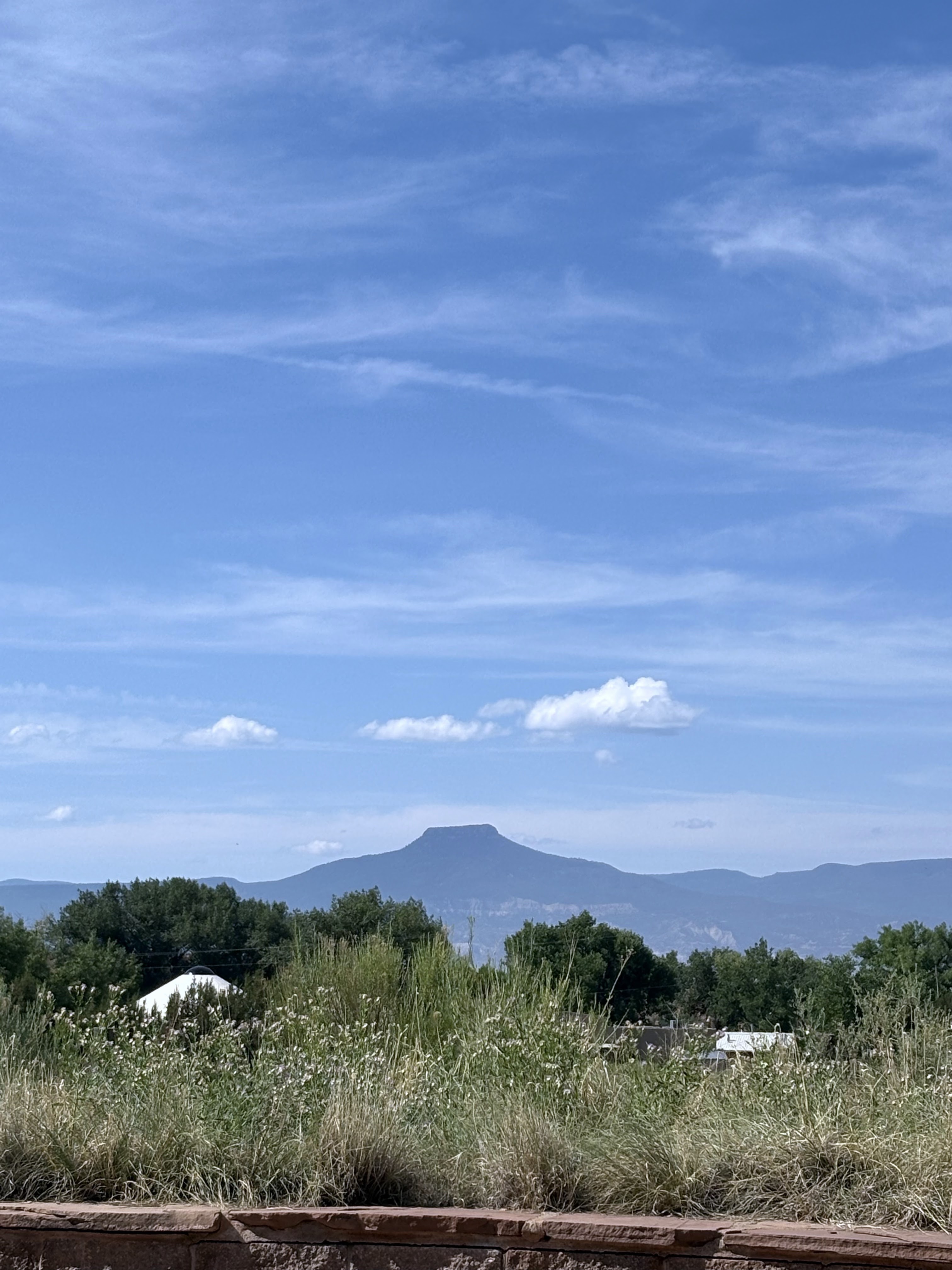
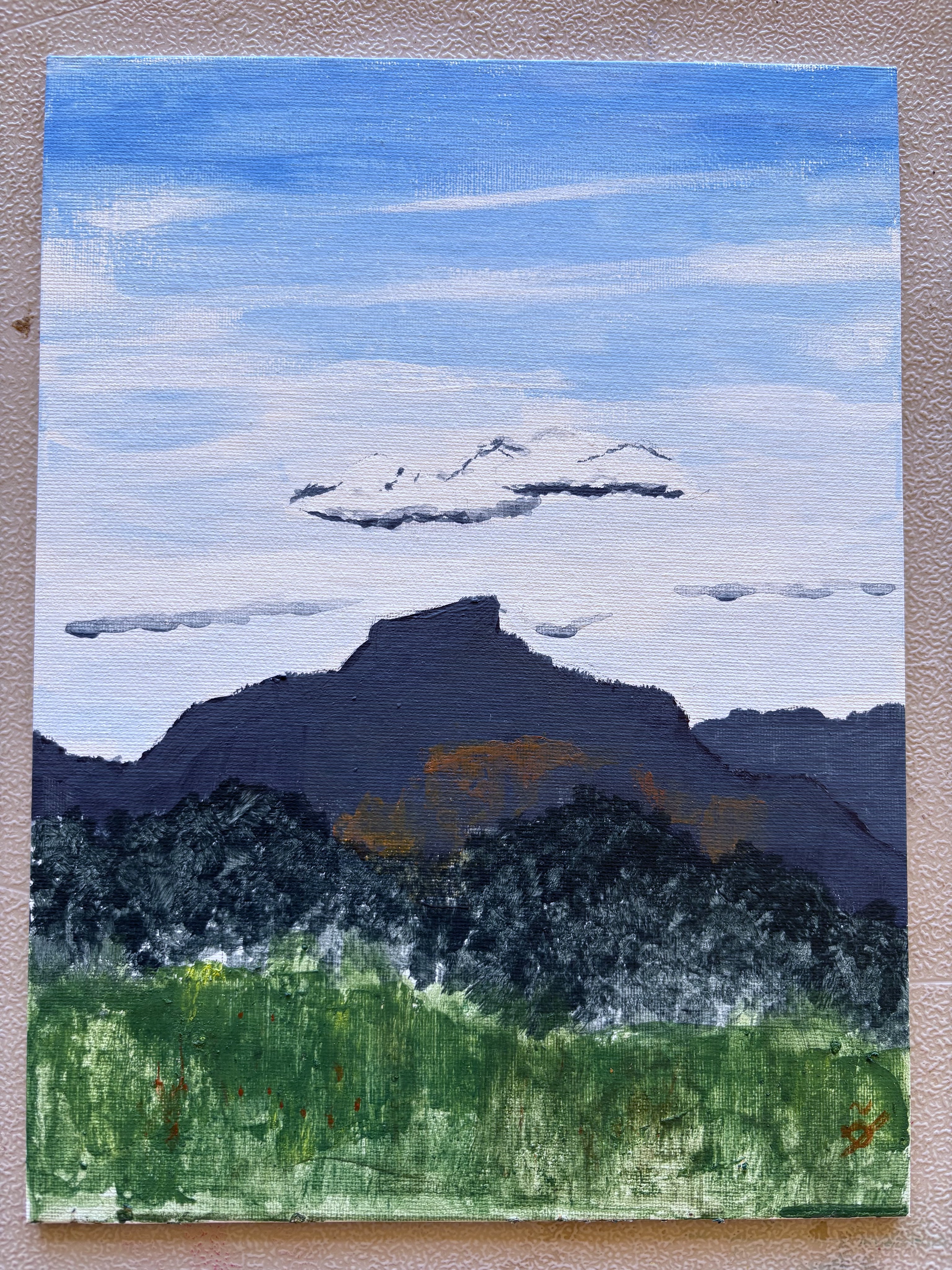
So, as I said previously, I made up my mind to try with this painting business. In the course of the week, I worked on three paintings. Some of my classmates produced that many in a day! While I am somewhat envious of their skill and capacity, I am not they, and that is not where I am. See how good I’m getting at giving myself grace and not comparing myself to others? Anyway, my three were that first landscape of Pedernal, another of Kitchen Mesa, and a still life. At the end of that first plein air session, I thought I was done with my painting. I even put a “D2” in the corner, my signature. Well, when we had a round-robin discussion in the class where we looked at everyone else’s work and offered comments, I got supportive comments of how they liked this or that about it, and several questions and suggestions of what I might do with it next. Next? Isn’t it done? Perhaps not. That one could continue working on a painting may seem obvious, but I guess I have watched too many episodes of Bob Ross’s Joy of Painting wherein he completes a work every half-hour show. So this was another point of my growth as an artist. I allowed as how perhaps I could continue working on my Pedernal, if only I could figure out how.
Another Target
I had a similar issue with my second painting, Kitchen Mesa. I was working on it from a photo I had taken so I could be inside. On a 9×12″ canvas board I penciled in the structures of clouds, mountain, and trees, and started in on the painting, working from top down. Calling on my experience with painting icons, I started a section with a dark base color and added progressively lighter colors on top of it. In iconography, this is a theological decision as much as artistic, to move from the darkness to the light. I still have no idea if that is what is ordinarily done in other styles of painting, but after watching my classmates working, I’d say not. Further, when KB, the instructor, came around to look at what I was doing, she was curious about my progression in that manner. Being a firm practitioner of the non-directive school, she offered suggestions of other possible methods, but insisted that if it worked for me, I should follow my path. I appreciated the permission giving, but the truth is I didn’t know if it was working or not.
The mesa has several distinct zones of different geology. There is a fairly dark, apparently dense rock that makes a kind of cap on the mesa. Maybe it isn’t actually dense, as there isn’t that much of it, either in width or depth. The next layer down is a pale yellow sandstone, and below that is an orange-red zone, almost salmon colored. There is an area of loose rock fall down the face of the red, and then, from where I was standing taking the picture, the trees take over the foreground. I’ll try to write about the geology in another post. As for my painting of these zones, as I said, I started at the top and I worked from dark to light. So that top cap came first. It has a number of vertical divisions. I overheard one of my classmates talking about trying to paint them in an earlier class, and she referred to them as the “teeth,” so that’s how I thought of them and referred to them. It turns out that wasn’t an official name as I imagined, but too bad. Now they’re called the Teeth of Kitchen Mesa. Anyway, using the iconographic approach, I actually got them to look pretty good! It took a lot of close, very detailed work. Usually I’m not a fan of details, but I kind of got into it with my icon painting, and I found it strangely engaging here, too.
I worked down to the sandstone zone. Here I ran into my lack of expertise with mixing paint to make the color you want. I couldn’t quite get the right tones or hues or values. I thought I could with layering, but my layers weren’t right either. I kept at it and got something blocked in, but I didn’t like it. Wrong color, wrong brush strokes, wrong texture to the sandstone, wrong, wrong, wrong. Again, in our review discussions, lots of positive comments on the sky and the “teeth”, and then encouragement to block in the rest of the colors and keep going. No one said, “that looks like crap,” or made me feel totally gross or morally bankrupt. I was encouraged, but I was also getting frustrated with the chasm between my desire and my product. I set the project aside until I could figure out what I was doing.
All this was on the first day of class.
Still Life Walking
On Tuesday, we started with a hike into the “back country” behind the art center toward the box canyon, if you know Ghost Ranch at all. If you don’t that’s okay. Suffice it to say it’s beautiful country, and it was a beautiful morning, and it was pretty flat walking. More views of more mesas and some of the beings that live on and around them, like lizards, bugs, and vultures. The goal of the expedition was to collect natural items from which to compose a still life. Again, KB, not wanting to make anyone do something that felt unnatural, wanted us each to compose our own items rather than her setting up one arrangement for all of us to paint. So not only don’t I know how to paint, I don’t know anything about arranging a still life, either. This was going to be great.
I found a handful of objects: two rocks, some yellow flowers, a stem of juniper, and a piece of …. wood? Yeah, I think it was wood. It had a lot of texture and a weird sage green color, and it was very crumbly. Let’s say it was wood. That was the easy part. Then, returning to the art center, I started trying to imagine how to arrange these things. All I can think of is the Dutch masters’ still life paintings, so I figure I need a table, some linen, a bowl, and maybe a skull? I don’t have nearly enough dark brown paint. Before long, KB came by, and I told her I was at a loss. She suggested just picking maybe three items, and then arrange them individually. Not so much an arrangement as a composition. That was a huge relief, really. I imagined being able to paint three items on their own much easier than trying to figure how to show them interacting. KB also recommended doing a neutral tone color wash on the canvas to 1) reduce the tyranny of the white canvas, 2) provide a background that would make the items stand out, and 3) I forget what 3 was. That seemed like a good idea, too, except I didn’t know how to do a neutral wash or what neutral tone meant. I took her recommendation under advisement for future consideration.
As I mentioned in the previous post, pencil drawing has always been more my thing. Since I felt like I was floundering with the paint, I decided to start this still life project by drawing the items in my sketchbook first. This would give me a sense of what I was looking at in terms of proportion and texture, it would focus my attention so I would “get to know” the items a little better, and it would give me a way to do art in a way I was comfortable with, just for a break. Well, if I’m honest, I was starting to doubt that I could actually do the painting. Drawing was a way to keep participating in the class without …. oh, what’s the word… trying. Or failing. Gosh, that runs deep. Nevertheless, drawing was comforting and productive and just what I needed to do at that point. KB wanted me to find my process. Drawing was going to be part of my process, one way or another.
Try. Fail. Learn. Keep Going.
Having completed sketches of my five items, I narrowed the field to three, as KB had suggested: the yellow flowers, the juniper branch, and the smaller, rounder, striped rock. Part of our class fees went to providing things to paint on, canvases, canvas boards, paper of different sorts, and so on. Somehow, all the 9×12″ canvas boards were gone already. I guess there weren’t that many to start with. That’s a pretty comfortable size for me, so I was disappointed. I didn’t feel like I was up to using an actual stretched canvas. So of the various options that remained, I went with a 12×16″ canvas board. This is so much bigger than I wanted. It’s a lot of white space for a beginner to fill. My already shaky confidence blanched before this white monolith. But come on, now, David. This is what you came for. Just go for it. I did. I sketched where I wanted my three items, and I started on the one I thought would be easiest, the yellow flowers. I started trying to mix the right shade of green for the stem and leaves. It’s a war between what nature has lain before me, the paints I have, my ineptitude, and my frugality that won’t let me waste anything. Nature loses. My green is far too bright, too blue, but again, I hope I can bring it down to where it “should” be in future applications. Besides, I don’t even know how to paint stems and leaves, so what difference does the color make? And you can’t just throw the paint away and not use it!
The painting itself doesn’t go any better. Even with my thinnest liner brush, my lines are fat, crude, uneven, overflowing. This is a disaster, a nightmare. What am I even doing here? What made me think I could paint? What a waste of time and money! I should just stop right now.
And yet…
Remember that you are a beginner. No one is here to judge you. This isn’t a competition. You are here because you wanted to learn and to grow. It doesn’t have to be perfect. It doesn’t even have to be good. It just has to be yours. You have talent. You can learn skills. Keep going.
So I did.
I went back to my sketchbook and practiced some ideas about how to do different kinds of strokes, using the extra bright green paint I didn’t want to waste. I practiced how I might make the petals of the flowers, and it looked good. I practiced some ideas for my Pedernal foreground. It didn’t take very long, and some of what I tried didn’t work, and some of it did.
I worked on Pedernal again, adding highlights to the mid-ground trees and adding grasses and flowers in the foreground. It was better.
I mixed some yellow that matched my flowers pretty well and added the petals to my painting. They got lost on the white canvas so I diluted some red paint and washed over them. It didn’t help! So I tried again with blue over the red. It didn’t help either! I took straight cobalt blue and very carefully painted around the petals and around the stems, and they all just popped! I practiced drawing my rock in my sketchbook with colored pencils, and then I painted it to look just like that, and it looked good. I painted around the rock with the cobalt blue, and it popped! I noticed that the boundary between where I stopped with the red wash (right in the middle of the canvas) and where it was just blue wash (at the top of the canvas) looked like the shape of Pedernal against the sky. I painted a thick, cobalt-blue, Pedernal-shaped line over that boundary. I connected the pools of blue around the two objects to the horizon line and to each other. I practiced and then painted the cow skull Ghost Ranch logo (originally be Georgia O’Keeffe!) at the top of the canvas, in place of the juniper branch.
And it was good.
What I Learned
I ended up really enjoying my painting class. I still don’t have much knowledge or skill, but I found a process, a path for doing art. As I spoke with classmates about my experience of nearly despairing and quitting before giving myself permission to just go ahead and ending up with something I really liked, several said they have had similar experiences. We even speculated that it is the nature of art to emerge with a push through the place of failure.
I learned about myself, of course, that I still wrestle with my perfectionism, and that I’m getting healthier about it. To offer grace to oneself to be less than “ideal” (whatever that is) is a gift of grace itself that comes, I believe, from a higher source. For that I am deeply grateful.
In planning for this year’s sabbatical, it worked out that it would begin on Molly’s and my 35th wedding anniversary. So wanting to do something to mark that milestone, we decided to go to Ghost Ranch near Abiquiu, New Mexico. Ghost Ranch is owned by the Presbyterian Church (USA) and has served as a retreat and conference center for the church since the 1950s or so. I’ve heard about Ghost Ranch for years and decades, but it was always so far away as to be somewhere between a mythological place or just not on my radar. Molly, having grown up in Colorado, had also heard much about GR but had never been there, either. In more recent years, particularly as my interest in astronomy led me to New Mexico a couple times, I started to think that going to Ghost Ranch could actually happen, but I never found the programming to match with my interests. They always seemed very arty, in many cases not especially religious, and kind of pricey on top of it. Well, since we weren’t looking for continuing education or professional development but sabbath and celebration time, and since we had funds for the sabbatical, we decided to check it out.
My initial interest was in an archaeology-paleontology course they were offering wherein guests would get to work an actual active archaeological site and dig for fossils. This sounded really interesting and fit with my sabbatical theme of time and eternity. I did wonder about how much fun it would be to be digging in the desert for 8 hours a day in July. Ultimately, it turned out that all the nice suites and single rooms with their own bathrooms were booked for that week, and we would have ended up in more of a dorm situation. That was a deal breaker. The week before that, they offered a class on how to put together a children’s book. That got Molly very excited, as she’s had an idea for years. I found a class on landscape and still life painting that I thought would be fun. So we signed up.
I will try to say more about Ghost Ranch itself and my experience of it in another post, and I’ll let Molly tell about her class where she will. For now, let me tell you about my painting class. I chose it because on my last sabbatical seven years ago I took a class on painting icons at the Siena Retreat Center near Racine, WI. I really enjoyed the work and turned out to be not bad at it for a first-timer. I haven’t done much painting since, and what I have done was working on a couple icons. So a class on the more traditional endeavors of landscapes and still-lifes offered a way to expand my artistic horizons, be creative, and try something I’ve always kind of wanted to do but was afraid to try. This last is actually a recurring theme in my life. I have had a weird neurosis that I feel like I have to have mastered a thing before I can try doing it. I’m getting better, but I’m still easily intimidated by new things. Thus, I guess this painting class was really a spiritual exercise for me, even if no explicit spirituality ever came up.
As with my icon class, I was in the minority here. I was the only man in the class of nine, and I was the only raw beginner. So much of a beginner that I had to ask my artist daughter about what some of the items on the list of supplies we were suppose to bring were and where I could get them. Daughter was very helpful, and I spent a bunch of money buying these mysterious tools. I did not spend any on paint, as I had bought some after the icon class, most of which seemed to be okay still, and also a box of eight 8-oz. bottles of basic colors that I got during the pandemic when I thought I’d be doing a lot more icon painting. Ha, ha, ha. Anyway, I arrived with my brand new unopened palettes and palette knives and my tiny old skanky paints and my “high quality” brushes (the fact that it says “High Quality” on the package is a dead giveaway that they are not, I discovered), and no idea what to do with any of them. Meanwhile, my classmates were all well equipped with piles of paints in well-worn cases with obviously proper brushes and tons of talent and experience, as would soon become obvious.
I thought KB, our instructor, would give us some lessons at the beginning of the day, and we would work out our artistic vision through the day, or something like that. It turns out that (1) most of the class knew what they were doing, and (2) KB is not that kind of a teacher. So we started by going outside on the patio of the art center to just start painting a landscape plein air (in the plain air, or outside). KB did give us a little demonstration of how she would begin, which was very helpful, because otherwise I was quite in the dark. Now, I’ve been drawing since I was a child, and I’m not bad at it. I have a good eye, I think, and can translate what I see to a page with a pencil. What I discovered quickly about painting (most of which I already knew) was that I knew nothing about technique, nothing about what sort of brush to use for what, nothing about how to mix paint to get a color you want, and nothing about how acrylic paints perform on a canvas. Well, that’s not entirely true. I had done those couple of icons, so I’ve mixed a little bit of paint, and I know that on an icon you thin the paint a lot an put on many, many layers to get the desired result. I have also watched a lot of Bob Ross, but he always worked with oils. So that’s what I had to draw from, as it were, as I started trying to paint the Ghost Ranch landscape.
Surprisingly, after 45 minutes I had covered most of a 9″x12″ canvas board with something that very generally resembled the scene before me. Somehow I had managed to overcome the tyranny of the white canvas and my fear of failure to produce…. something. Yeah, the really amazing part to me is that I consciously gave myself permission to do it wrong. Which, just to be clear, I did. Well, no, that’s not really fair. When it comes to art, what is right and what is wrong? My classmates and I all produced paintings of the same mountain in the distance, and not one of them looked like any other. I was certainly frustrated with mine not being “perfect” and a bit embarrassed that it wasn’t better than it was, but it was, after all, my first landscape painting ever. What do you want?
Can you believe it’s been seven years since my Grand Tour that occasioned this blog? Well, if you are among my ones and ones of followers, you might recognize the fact. It hardly seems possible that it was that long ago. At the same time, the world has changed dramatically since 2018, and that Tour seems like a lifetime ago!
If you don’t know, the Grand Tour was the bulk of my 2018 sabbatical in which I visited 17 astronomical observatories and facilities in nine states in under three months. It was an amazing journey of history, cutting edge science, and discovery. I grew to admire the incredibly detailed work of scientists, the remarkable persistence it requires of them, and the ingenuity and cleverness they deploy to make fantastic discoveries about the universe and our place in it. I mean, that’s a lot of superlatives right there, and it barely scratches the surface of what they do. To learn more about it, just go through my blog posts about it.
Now, it’s 2025, seven years later, and time for another sabbatical. This time, I got it in my mind to work on a book about time and eternity from scientific and theological points of view. This came to me last year when we were on our way across Texas to see the solar eclipse. I was thinking about a summer preaching series, and the eclipse put me in mind of the timing of the movements of the spheres. We happen to live in an era when the moon is just the right distance from the earth to match the apparent size of the sun to create a total eclipse. This doesn’t happen just everywhere in the universe, and it doesn’t happen forever. in a few million years the moon will have moved further from earth and won’t be able to cover the whole solar disk. So we live in a remarkable time. That’s what got me thinking about time as a sermon series theme. Then I realized I could make it into a book during this sabbatical! So that’s been the plan.
As it happens, I now suspect that it is impossible to write a book of much substance in three months. So I’ve scaled back my expectations a bit but still plan to work on the project. I’m thinking about questions like: What is the nature of time? Why do we bother with it at all? Does the past persist? Where does the future come from? What is eternity, and how long is it really? Would humans actually enjoy living forever? Does our view of eternity affect how we behave in this life? I have so many questions! The idea is to consider them scientifically and from a particular Christian framework in a way that is accessible, thought provoking, and maybe even fun. We’ll see how that all turns out. At this point I’m imagining a collection of essays that could be the basis for sermons, lessons, and a deeper book in the future.
Meanwhile, Molly and I have just celebrated our 35th wedding anniversary – hurray! So as part of the sabbatical and as a celebratory trip, we are going out west. We will spend a week at Ghost Ranch, a Presbyterian conference center in northern New Mexico. Each of us is taking a class – Molly on writing children’s books and me on painting still-life and landscapes. Then we’re going to Chaco Canyon National Historical Park, a Native American heritage site that I had hoped to get to on the Grand Tour of ’18. The site includes a number of archaeo-astronomical installations to mark solstices and equinoxes and such. It would have been the oldest observatory on my previous tour. Now it will be a stepping stone in considering deep time for life on earth. And the stepping stones get older and deeper! After Chaco, we will visit Meteor Crater near Winslow, AZ, and then the Grand Canyon. I hope these big holes in the ground will give me a richer sense of the passage of geological time that might just make it into the book.
So there you go! That’s what I’m going to be up to for the next few weeks and months. I hope to keep the updates coming here, and I hope you’ll come along for the ride. It’s going to be a fun time!
There’s an empty chair at the table, A missing voice in the song, A smile that won’t light up the room now, A stillness that lasts far too long.
There’s a guest room that’s missing its guest, A hug with no one to hold, An argument that’s only one-sided, Old stories that must go untold.
There’s laughter that’s a bit too quiet, Games with one too few players A gap in the circle for the blessing, A name that’s missing from our prayers.
Life’s road is short even at its longest, And our loved ones leave us too soon. The holidays exact a joyful song, But our grief sings a different tune.
Though we’re sad and feel brokenhearted, We can still give thanks to the Lord For the life and the love we’re now missing, And can trust in God’s excellent Word.
God still holds the one absent from us In that realm of love, mercy, and grace. The Risen Christ gives us hope for a thanksgiving Day When once more we shall meet face to face.
September 2, 2018, was a cloudy Sunday morning in Los Angeles. I was really tired. I had been on the road for close to five weeks, a personal record, and it was taking a toll. As an introvert I might expect to have been energized by so much time alone, but that isn’t really how it always works. In particular, I had never been away from my wife for so long, and I missed her terribly. I had seen none of the folks I usually engage with for all that time, too, and I was kind of lonely. I was on a great adventure to see some of the greatest American observatories ever, but I got up thinking, “If I have to go look at another damn telescope today, I’m gonna scream.”
That wasn’t anything I had expected for this trip. It was a sabbatical, after all, and it was supposed to be rejuvenating and energizing and whatnot. The trip was designed around my favorite hobby, one that I regularly turn to when I want to experience a sense of awe, and for the most part it was delivering that. At the same time, I was really feeling homesick and overstimulated. So I gave serious thought to skipping my scheduled trip to Mount Wilson.
This is how I recorded it in my journal a few days later:
I actually gave thought to blowing off Mt. Wilson. I’ve seen a LOT of telescopes and I was tired and whelmed. But this is what I had come so far to see and do! So I went, and glad I did.
My journal, September 5, 2018
One of the things that helped me get over the hump, as it were, was watching the worship service from Catoctin Presbyterian Church, the congregation I serve as pastor. We had been doing a live stream for about a year before I went on sabbatical, and that continued a little sporadically while I was away (as I was the primary tech driver for the project). This particular Sunday, they did have a broadcast. Being the first Sunday of the month, there was communion, and my wonderful wife and colleague Molly was the preacher and celebrant (the minister leading the sacrament). It’s hard to remember that we haven’t always been savvy with videoconferencing, but watching the service was about the first time I’d seen Molly since I’d been traveling, and it did my heart good. So, too, to see and hear my church family. When it came to the sacrament, I recorded in my journal:
I dipped my bagel in my coffee as they did communion.
My journal, September 5, 2018
Again, at the time virtual communion was entirely unknown and to some extent unthinkable, so I didn’t count it as fully communing, but it was the next best thing, and it made me feel connected again. This, I think, as much as anything, gave me the stillness of soul and clarity of purpose to make the trip to Mount Wilson that day.
Up the Hill
I was surprised when I mapped the drive up to Mount Wilson from my flat in Glendale, as it’s about 10 miles as the crow flies, but 27 miles driving and, according to Google Maps, 48 minutes travel time. You might think that after ascending so many mountains I would have figured out that it isn’t quick or easy, but I guess I’m stubborn that way. As I set off, with plenty of time to get to the top before the 1:00 p.m. tour times, it was still pretty overcast. The driving was easy on the broad highways of Los Angeles, until the turnoff to head up into the hills of national forest land, then it was two lanes and switchbacks the rest of the way. Hence, 48 minutes for 10 miles. About two thirds the way up, the weather broke suddenly for the better as the clouds fell away. No, seriously, I drove up out of the clouds and could look over the top of them! It was spectacular.
Not long after, I reached the summit parking area, which is surrounded by antennae of various types. It was not clearly marked where one ought to park for scientific geekiness as opposed to mountain biking or hiking, so I took first available. It was a short walk to the Cosmic Cafe where you buy your parking pass (if you haven’t already done so in the lowlands), regardless of your purpose on the mountain, and also tour passes for the observatory (to say nothing of food). Both passes were pretty reasonably priced. Standing around in the pavilion of the cafe, there were posters declaring the 150th anniversary of George Ellery Hale’s birth, 1868-2018, a point I had not realized in all my preparations and learning. How cool!
Eventually a group of about a dozen other nerds gathered for the 1pm tour, and we set out. Our docent was a retired engineer whose name is now far gone from my memory, but he was very personable and knowledgeable, as you would want in a docent. The campus is very pretty and quite a natural setting, bustling with evergreens and wide views of the valley below. It isn’t as carefully crafted as Lowell Observatory in Flagstaff, which seems to have been designed for visitors, but it is more like walking in a national park that happens to be home to a world class science outpost, which is what it is, of course.
Some of the first knowledge imparted was about how Hale selected the site, and how they built it up, and how they brought the equipment and instruments up the mountain with mules and carts. Not even kidding. The project started in 1904, so cars and trucks weren’t much of a thing yet, and this was pretty remote territory at that point. So naturally it took years before Hale and Co. could get any science done. This really isn’t unusual in the realm of astronomy, the long haul of time and materials in remote places to build a bigger telescope. It’s still happening in the Atacama Desert of Chile and the Australian Outback. There’s even talk of building a telescope on the far side of the moon, which would take the pattern to a whole new level. But I digress.
Starting with the Sun
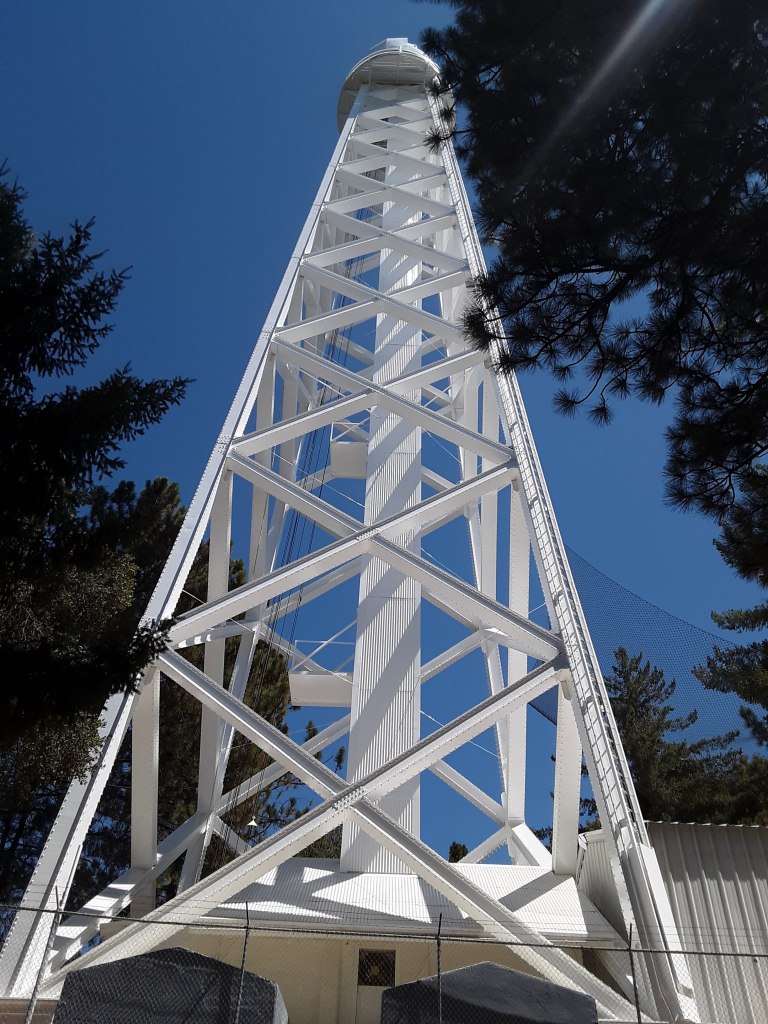
The 150-foot solar observatory tower
There are several observatories on the Mount Wilson campus, actually. The first we saw were the 60-foot and 150-foot solar observatories, the white heads of which both towered above the trees. Hale was himself a solar observer of some renown, so it isn’t surprising that he set up a sun tower at the new site. (If you haven’t been following along, and after two and a half years, there’s no reason for me to expect you would, the old site was the Yerkes Observatory in Williams Bay, Wisconsin, where Hale had organized the construction of the world’s largest telescope of 1897, the 40″ refractor. Before that he had a home observatory outside Chicago. The sky conditions in both places were regularly pretty poor, so this California mountain was a huge upgrade.)
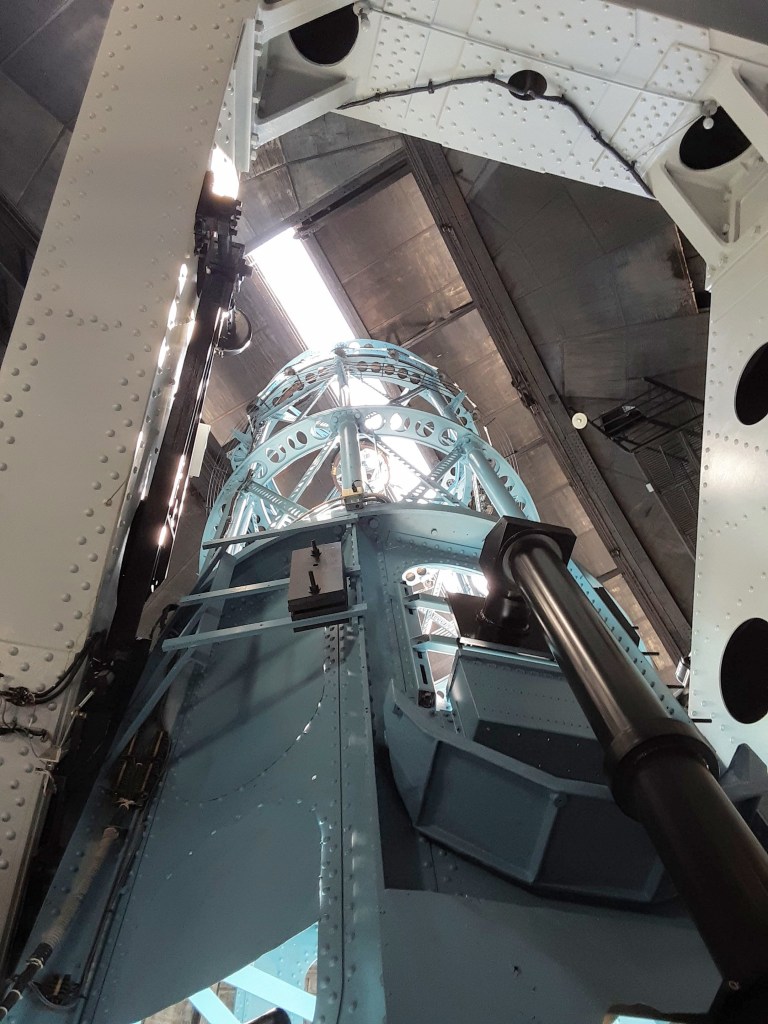
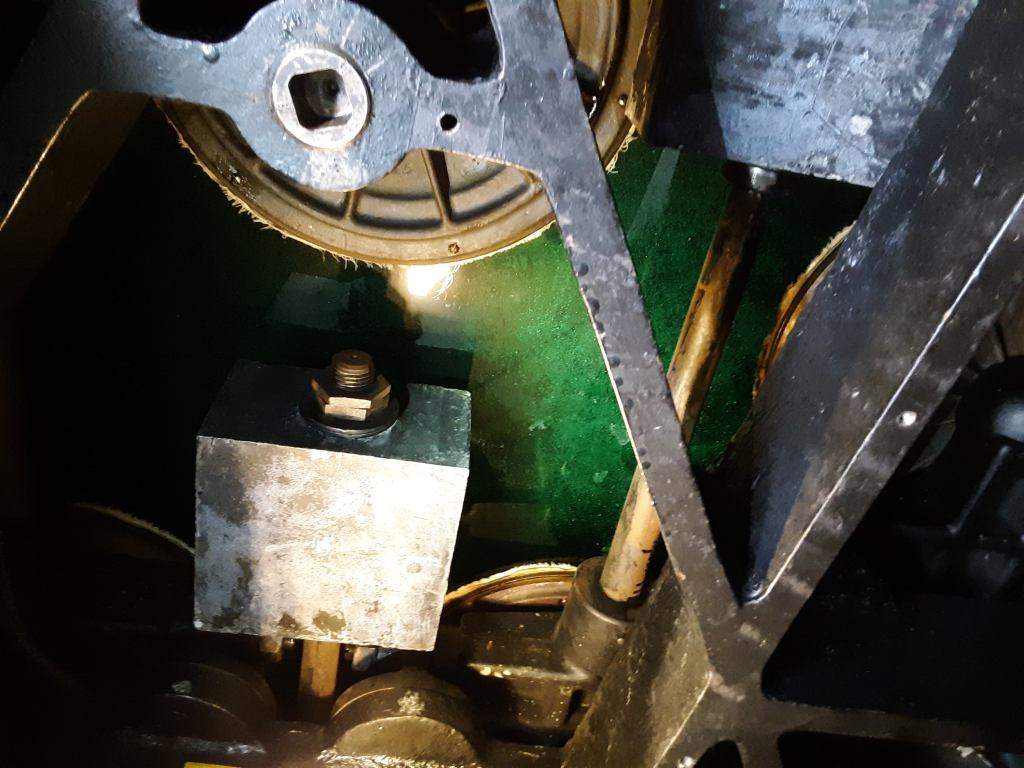
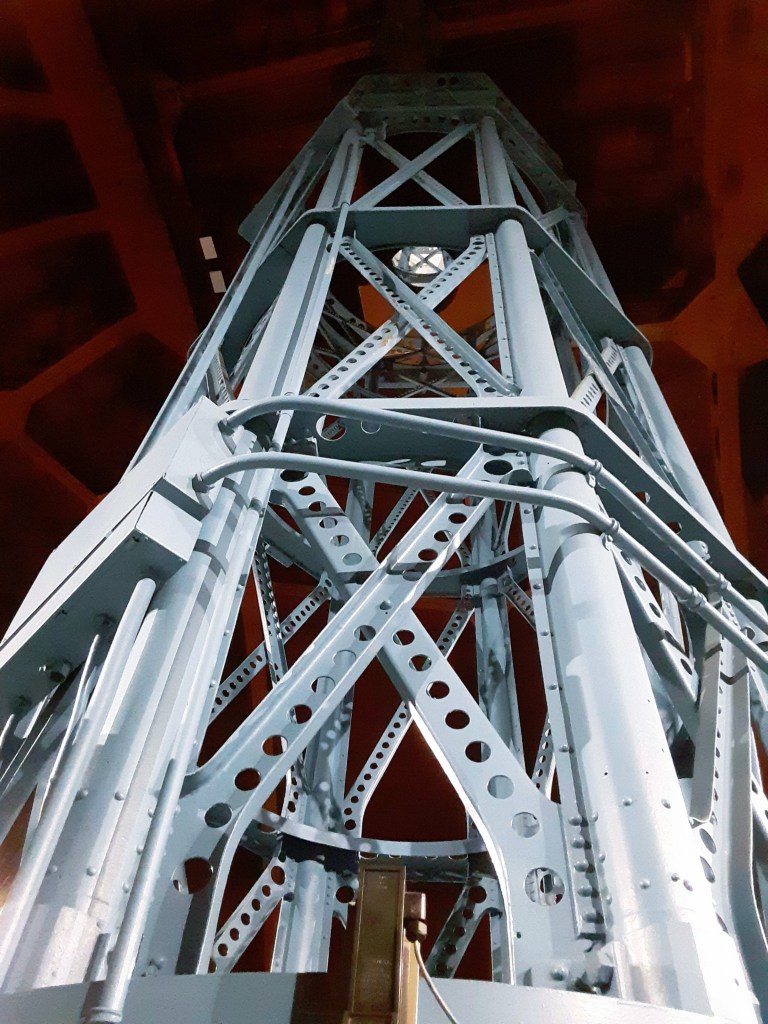
The way the solar towers work is there is a little dome at the top with a mirror and clockwork that tracks the sun. The light is reflected down a central shaft into a control room/laboratory where the image is projected and can be measured and recorded and whatnot. Astronomers could and can take spectra by sending the light through a prism or diffraction grating to spread it out. That gives you data to figure out what elements are present in the sun, among other things.
So we went to the lab of the 150-foot tower (actually the third solar telescope on the mountain) and met Sam, a solar astronomer who works there. They still do science there, recording and measuring sunspots and spectra and such. It’s not real cutting edge work these days, but this lab has some of the longest continuous records of solar observations at a single site in existence, and the early work done there really was groundbreaking. You can read more about it on the Mount Wilson website. It’s worth a read. I just learned some things I had missed or forgotten that raised Mr. Hale some more in my estimation, which was already pretty high.
There is a small museum near the 150-foot tower that we stopped to see. We didn’t spend very long there, though. They have a variety of documents, letters, photos, and a diorama of the observatory campus. It would have been interesting to spend some time there, but we had other fish to fry.
The Big Hooker
Most of the Hooker optical tube and some of its closed yoke mount.
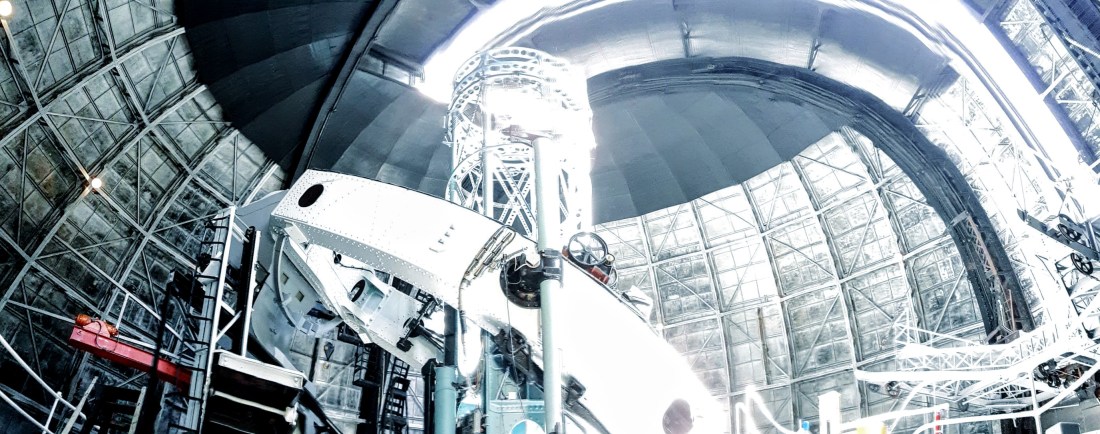
The centerpiece that I was most eager to see is the 100″ Hooker Reflector Telescope. This was the third “World’s Largest Telescope” that Hale was responsible for bringing into existence and the one that produced some of the most shocking discoveries in modern astronomy. Gaining first light in late 1917, the Hooker Telescope was at the same time a remarkable technological achievement and a remarkably flawed instrument. The closed yoke mount looks like a tank or a battleship (your preference), and the cage of the optical tube is impressively large. Coming as it did early in the industrial age when steam and mules were still major power sources, the mass and precision of the instrument is considerable.
The 100″ primary mirror is its greatest technological advance and also its greatest technological hindrance. No one had ever cast such a large piece of glass successfully, and it took quite a few attempts and several different contractors to actually do it. That they managed it at all was no small feat, but they only just barely managed. The glass is terrible quality, riddled with bubbles. We actually got to see a small section of it, and it’s stunningly bad! Bubbles in your mirror make it extremely difficult to get a smooth polished surface without pits and divots. Bubbles also mean the thermal and strength properties of the mirror are inconsistent, which leads to inconsistent expansion and contraction from warming or cooling, which causes distortions in the surface, which causes distortions in the image. Inconsistent stresses can also lead to things like cracking or shattering, which you don’t generally want for your mirror. Amazingly, the technicians were able to figure and polish the mirror smooth enough to do its job (within a millionth of an inch!), and it hasn’t cracked yet.
The 100″ primary mirror (the green part) is a frothy mess, full of bubbles! Skilled technicians made it work, though.
So they got it to work, and it turned out to be pretty good. Hale did start making plans immediately for a bigger and better telescope (the 200″ at Palomar), but the 100″ didn’t go to waste. This is the telescope used by Edwin Hubble and Milton Humason to discover, first, that the universe is bigger than just our galaxy, that there are in fact many galaxies, and second, that this much-larger-than-imagined universe is expanding. These were both radically revolutionary ideas in the 1930s. Other sites cover this much more thoroughly and intelligently than I can here, so I encourage you to learn about it if you aren’t familiar. My own connection to this is that when my dad passed on to me my grandfather’s homemade 6″ telescope, he told me how Grandpa would observe the Great Andromeda Nebula as a favorite target. This “nebula,” as it was known before Hubble, is now known as the Andromeda Galaxy, a spiral galaxy and bigger neighbor to the Milky Way. It’s the same galaxy that Hubble and Humason observed, discovering it was over 2 million lightyears away, when everything else being observed was on the order of tens of thousands of lightyears distant. So Andromeda is a favorite of mine, too.
Anyway, our docent was telling us about Hubble and the telescope and all while we were under the dome, which was open, and it was awesome. Meanwhile, I want to tell you about three things going on besides the telescope and the lesson, just because I think they were unusual. First, while we were there, they closed the shutters in the dome. This was pretty cool, and I got video of it. It’s faster and quieter than you might imagine. They closed the shutters because the sun was starting to shine on the telescope, which you never want, and the sun was warming up the inside of the dome. Both were unwanted because of item of interest #2, they were preparing to have a soiree in the dome later that evening. There would be jazz music, and guests (donors?) would get to look through the Hooker. So they wanted the dome to be cool and the telescope to be in thermal equilibrium for a good viewing experience. I had never thought of having a jazz party in an observatory dome, but I can’t think of anything much cooler than that. (Nerd!) This was so exciting it must be what led to item of interest #3. While the docent was telling us about Hubble, I looked around a bit. There is a visitors’ gallery half a floor down from the observing floor where we were, with large glass windows so guests can watch what is happening on the observing floor without getting close enough to mess anything up. In a reverse of that, I noticed down in the gallery there was a woman sitting on a man’s lap, and they were making out like crazy. Astronomy is so hot! Definitely not something I expected to see in the hallowed science halls.
We got to mill around in the dome for a while and even to touch the mighty Hooker. The docent showed us the bad mirror glass, leading to the picture above. I took many a selfie in front of this important instrument. Then we made our way outside heading toward the next tour stop. On that way there’s a spot where a famous picture was taken of Albert Einstein when he came to visit Mount Wilson and see (and use?) the great 100″ reflector. So naturally, we all took selfies on the spot. Einstein wasn’t keen on the idea of an expanding universe, and for many years dragged his feet in accepting it as true, although he eventually caved. He would have flipped completely at the discovery in 1997 that the expansion of the universe is accelerating. At any rate, it was kind of exciting to stand where your heroes have trod. It’s part of what made this a pilgrimage for me as opposed to just a big sightseeing trip.
4, 3, 2, …
Our last stop was to see the 60″ reflector. This telescope also was once the “world’s largest,” but now it is more like a forgotten middle child. It doesn’t even have a cool benefactor name, just “the 60-inch.” It was the successor to the Yerkes 40″ refractor and was itself succeeded by the 100″ Hooker. It was also cutting edge technology in its day and is still a formidable instrument for most people on the planet. I, for one, would love to spend a clear night with it. But these days public outreach is its main job as opposed to significant science.
Here’s what I wrote in my journal:
George E. Hale was responsible for the largest telescope in the world four times in a row, and now I’ve seen them all. Two of them are on Mount Wilson. They run Yerkes 40″, Mt. Wilson 60″, Mt. Wilson 100″, Palomar 200″. I saw them Yerkes-Palomar-MW100-Mw60. Consequently, by the time I got to the 60″ – five feet in diameter, mind you – it looked tiny! But the docent was very good and all the scopes in their context are quite impressive.
My journal, September 5, 2018
The venerable but nameless 60″ reflector. It may be obsolete, but I wouldn’t kick it out of bed.
Indeed, the docent acknowledged that seeing the 60″ after the 100″ does a disservice to the smaller scope, which was and is, as I mentioned, a remarkable instrument. We got to see the mirror glass on this one, too, and it is beautiful and clear, as it should have been. One fascinating part of the mounting system for this scope is that it rests in a pool of mercury that holds about 95% of its weight! This is a clever and very stable engineering solution except for the part about mercury being poisonous, which was apparently not well understood at the time. The optical tube for the scope is like steel girders, like an oversized Erector Set, for those old enough to remember such.
When I think of the dome for this one-time champion instrument, it seems kind of homey and rustic, like a cabin in the woods where you might spend a weekend. This is odd, because when I just looked at my photos I see that it is actually a metal framework and not the wood that I was imagining. Still, there was something cozy about the dome, especially after the lofty grandeur of Palomar and Hooker. I imagine that the guys that built it and used the 60″ didn’t think of it in those terms. I suppose for them it was a cutting edge outpost in the wilderness of science and the wilderness of California.
Postlude
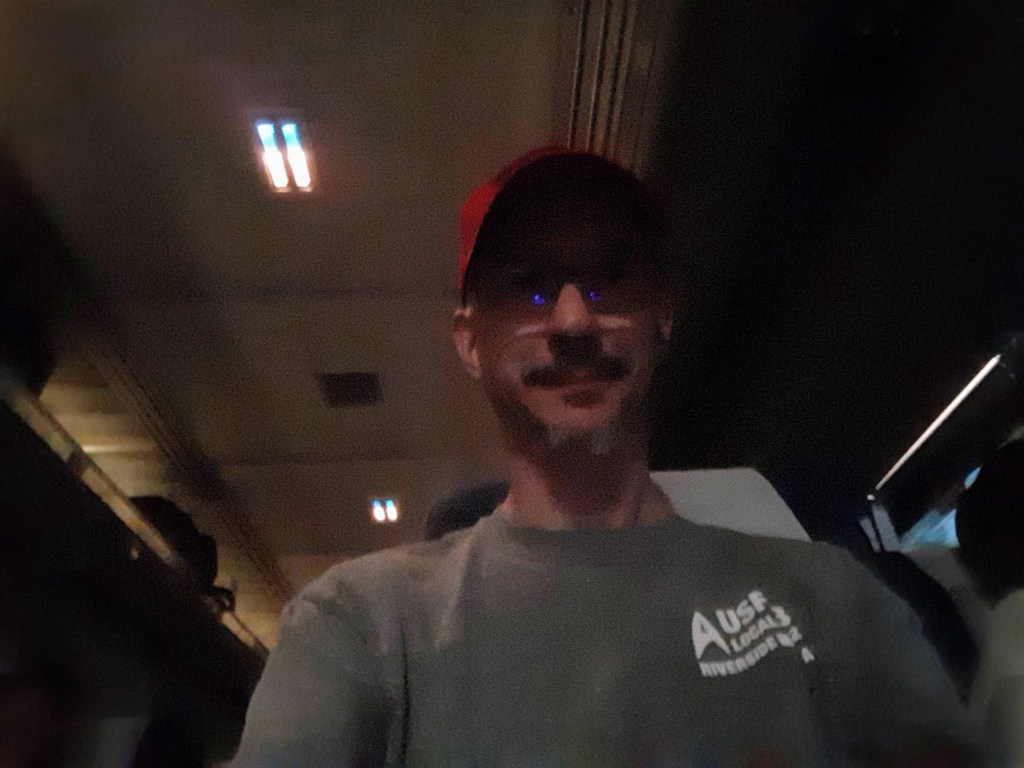
That brought the tour to an end. It was a little anticlimactic, but I was satisfied. It had turned out to be a beautiful warm day, and after a few hours of science and fresh air I was tuckered out. I was also pretty hungry, as that bagel was the last thing I’d eaten. So I made my way back to the Cosmic Cafe and got a lovely pastrami panini and a cup of coffee, if I recall, which were very good and not too expensive. They had no swag at all, which was very disappointing. When I got home I ordered a t-shirt of my own design with my own picture (see top of the post) from Cafe Press, and that sufficed.
I am so very glad I dragged myself out that morning. I have seen the four great Hale telescopes and more, and I overcame the lethargy that would have led to regret. In my journal, I wrote this:
I began to realize that I was having an experience like what I would expect had I done the Camino in Spain. Long and far and alone and awesome and exhausting.
My journal, September 5, 2018
Pilgrimage is a challenging road, filled with long slogs, many hardships, and in the best cases moments of brilliance. It is in persevering through the slogs and hardships that we put ourselves in a position to receive the brilliant. Whether it comes or not, we will be stronger and richer for the experience. That’s the theory, and it seems to have paid off this time.
I had a couple other smaller adventures before the end of my time in L.A. I had lunch in Pasadena with a church friend from Catoctin who was on extended stay in the area. I went to visit the headquarters of the Planetary Society, also in Pasadena. And I got to spend some more time with friend Steve Craig who bookmarked my sojourn by getting me back to the train station. Maybe I’ll tell you about those before I’m done with all this. Also, remind me to tell you about the guy at the gas station near LAX. But I was looking forward to the next leg of the sabbatical with great anticipation. Molly was coming to join me in Albuquerque, NM! Stay tuned.
If you have been following this journey of mine at all you know it started with a few short loop trips and then culminated in a coast-to-coast-and-top-to-bottom train trip that I refer to as the Grand Tour. You may have seen my map, my photo dumps, and other summary material by now. I’d like to tell you how it came together, more or less.
Y’all ready for this? Um, no.
One of the odd things to me about the Grand Tour is how elusive it was, how resistant to prediction and preparation. Now, if you have read any of this blog, you know that exact preparation is not really my strong suit any way, but I am capable of it from time to time. But the Grand Tour defied my best efforts in many regards. In the months leading up to my sabbatical I had to come up with enough of a plan to secure approval from the session (the congregation’s ruling board) and the presbytery (regional governing body), as well as procuring funding. In this I was successful, plotting the many observatories I wanted to visit, considering location, historical significance, scientific significance, and diversity of electromagnetic wavelengths being studied, as well as several Christian retreat centers adjacent to some of the scientific sites. I was able to imagine well enough a tour where I could travel by train to these various sites in windows that would allow me to catch their often very limited public tours. In fact, I had more than one plan for reaching most of my desired destinations. Further, I was able to construct a reasonable budget for the whole business. I put together a package comprehensive enough that it won the necessary approvals and members of the church made offerings of about 160% of my budget! So I can plan stuff, see.
Nevertheless, whenever I tried to get more specific about the tour, to really nail down where I was going to be when, the complexity of it was overwhelming. Perhaps it’s just the way my mind and spirit work, but I couldn’t for the life of me get the thing to settle down to a single equilibrium state, as it were. So, while I continued trying to do, other milestones started popping up, and I just had to roll with it. The last session meeting before sabbatical came, and no Grand Tour plan. Sabbatical began, and no Grand Tour plan. The Green Bank Star Quest came, and no Grand Tour plan. So I went on that first leg, knowing I still had time. Then I went on the second leg to NY-MA-NJ, knowing there was still time.
Here, let’s pick up from my journal entry for August 4, 2018, which begins with a description of my trip to the Allegheny Observatory and visit with my dad for his birthday at the end of July. Let’s listen in…
Had started arranging the Grand Tour earlier that week [July 23 or so], including a retreat at the Siena Center in Racine, WI, for Aug. 5-11 and the night program at Yerkes Observatory on Aug. 13 – looking through the 40″ Clark refractor. Got home Monday [July 30] and Molly said, when is your retreat? I said August 5. “Oh, Sunday,” she said. “What? No!” I said. “Oh yes, Sunday is August 5,” she said. “#@¶*!,” I said. As things had started to come together, you see, they had changed from “go to Yerkes and come home” to “go to Yerkes and keep going!” That meant I had 4 days to get ready for a six-week trip!
This is madness! This. Is. SABBATICAL!! (Kicks your settled ass down the pit.)
So here I am on a train to Chicago!
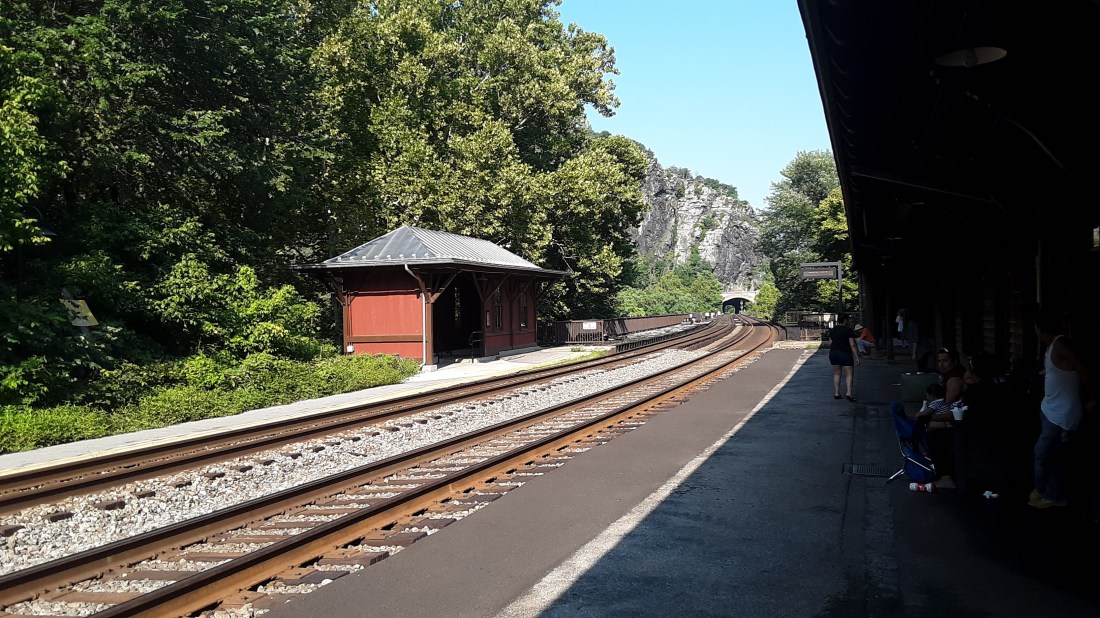
On the Capital Limited from Harpers Ferry to Chicago. In coach.
Pilgrimage is like that
And so it went. Chicago was the hub before getting to Racine for a week’s retreat. After the retreat, I spent another several days in Racine, much of which was spent making travel arrangements to get to New Orleans, get a place to stay, get a car, etc. While I was in New Orleans, I spent a lot of time arranging my travel to Arizona. While I was in Arizona I planned my trip to L.A., and while in L.A. I planned my travel to New Mexico. It was madness in some ways, and it took a lot of time and energy that I would have expected to be spending on reading the writings of the mystics and such, or praying, or seeing the less geeky sites, or just resting, or what have you. I do regret that a bit. But the funny thing is that everything fell into place just when it needed to. Particularly, I found nice places to stay at reasonable prices in usually expensive markets and in interesting residential, non-touristy neighborhoods. I had plenty of time for my observatory tours and got to most of the ones I wanted to see. I was able to stay pretty close to my budget. The other funny thing is how ironic it is that I had to do so very much planning the whole time when I always insist that I am no good at details and planning and that sort of thing. I don’t know, is that ironic or just a life lesson?
Let me wrap this up with some more from my journal from later that same day. Having reflected on my experiences and lack thereof in prayer during the sabbatical so far, I went on to record…
… So I prayed before bed Thursday night [8/2]. Again, [as during prayer at Miller Chapel in Princeton,] gratitude upon gratitude! Awareness of the rarity of this opportunity and experience, and its sacredness. I prayed, thankful for the privilege (with all that word carries these days); for protection for me and my family while we are apart; for providence while I’m on the road, that things will continue to fall into place; and for a pilgrim’s heart – that I not fall prey to tourism, but make this a truly sacred journey for the glory of God. This last became a powerful theme and led me at last to pray for great peace of heart, that I may be open to all who are around me and to opportunities to glorify God at every turn.
Last night I prayed with Molly before bed, and prayed much the same way. I feel like it really helped me in reframing this departure. I am a pilgrim now.
At the same time, I will be away from home for longer than I ever have been. I’lll be away from Molly for longer than I ever have been. I’d be lying if I said I’m not anxious about that. But why? Not any fear about our relationship. Just being away from home and heart for so long. Having things so unsettled for so long. Being out with strangers in strange lands for so long.
But then, isn’t that exactly what pilgrimage is about? Perhaps facing this, more than all else, is a lesson worth carrying back to the Church. Well, let’s maybe see how it turns out before we write that sermon, but yeah, keep it in the hopper for sure.
I did preach that when I got back. Might be time to revisit that theme of leaving the comfort of home for the wilds of the next destination where God is leading us. If for no other reason than I need to remind myself how good that can be.





 A Pilgrim of Earth and Heavens