A Great American Pastime

I went to my first baseball game when I was four years old. It was at Forbes Field in Pittsburgh with my dad, almost certainly my brother (although I don’t remember), and I assume the Swedish exchange student who was living with us. I have only very faint, fragmentary memories of it, but I think it settled in pretty deep. Baseball has always been my favorite sport. Not that I ever played the game. Some softball here and there, but I think even as a kid I had a need to have mastered a thing before I could try it. So I never let myself join a little league team. I know, I know.

Anyway, I was still a fan, especially of the Pittsburgh Pirates. I knew all the players, the lineup, the stats (such as they were in the day), the standings. Of course, I collected baseball cards. In fourth grade I had stacks of hundreds of cards, but my prized possession was the complete collection of the whole 1971 Pirates team, which I still have. That was a lot of bubblegum.

Even at that, my baseball fandom pales compared to my son, Jacob. He started with tee-ball when he was little and went on to play Little League for several years. He opted for band when he got to high school but kept a love for the game. Through his college years our local team, the Washington Nationals, were actually playing some good ball, and Jake was all about it. He got the gene that skipped me that allows him to retain and recall all the stats of all the players of all the teams for decades worth of seasons. When his mom picked him up from college for spring break one year and asked, “What’s up with the Nats this year?” he talked for all of the three hour drive home. His passion has cooled some over the last couple years, just as the Nats have, but he still loves the game.

When I was planning my sabbatical for this year I wanted to include something that Jacob and I could do together. As you might guess by now, it occurred to me to do something related to baseball. We are within a day’s drive of Cooperstown, NY, and the National Baseball Hall of Fame. That seemed like a good idea. It got better when I realized the Little League World Series in Williamsport, PA, would be on the way and in the right timeframe. If it was going to be something of a pilgrimage, then it wouldn’t be that much more to go from Cooperstown to New York City to go to Yankee Stadium. Neither of us is a Yankees fan, but they are surely the most storied and iconic team in the majors. When I introduced the idea, Jake was immediately on board. I started mapping it out and looking for schedules, tickets, hotels, and whatnot. We both noticed that the basic track took us 3 1/2 hours from home to Williamsport, about 3 1/2 hours to Cooperstown, about 3 1/2 hours to New York, and about 4 hours home. It’s practically a baseball diamond! This was going to be great.

First Base: Little League World Series

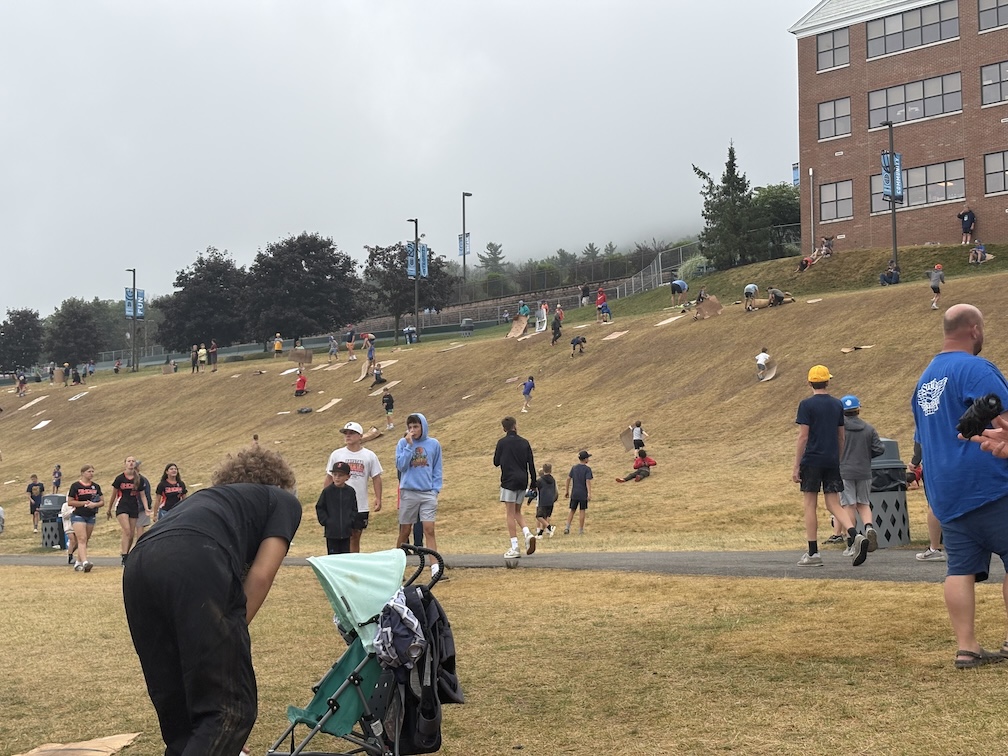
I’ve always wanted to go to the Little League World Series, so I was excited to start our tour this way. We got to Williamsport at about 1:00 p.m. on Wednesday, August 20, just as the first of four semifinal games for the day and the tournament was beginning. The Little League International Complex is a sizable venue with two large stadiums (in little league terms), several practice fields, food vendors, a dining pavilion, restrooms, first aid building, Little League headquarters, a museum, and of course a gift shop. The newer stadium, Volunteer Stadium, is the smaller of the two, and it is used for international teams, while the older LaMade (LAH-mah-dee) Stadium is where the U.S. regional games and the World Series final are played. Both have seating for several thousand spectators, although LaMade has seating on the grass hill in the outfield, which is a big part of the tradition. The hill is high enough that the top section is primarily used by kids with flattened cardboard boxes to sled down the grass without interfering with the majority of spectators. But I’m getting ahead of myself. When we arrived, all three large (free!) parking lots were already full, and townsfolk were making some coin by using their yards and spare properties to park cars. So for $10 we found a place that was reasonably close to the complex and away from the flow of crowds.

One of the amazing things about the Little League World Series is that admission is free. Free to enter the complex, free for all the games. It’s as if they consider it a public good that should be open to anyone and everyone, so it is. I think that’s awesome. Of course you pay for food and drinks, but honestly, the prices weren’t as bad as I expected. And they have a swag shop, as I said. We didn’t stop, and I suppose it isn’t cheap, but it is voluntary. You could go and not pay a thing if you work it right. So we just walked right in.
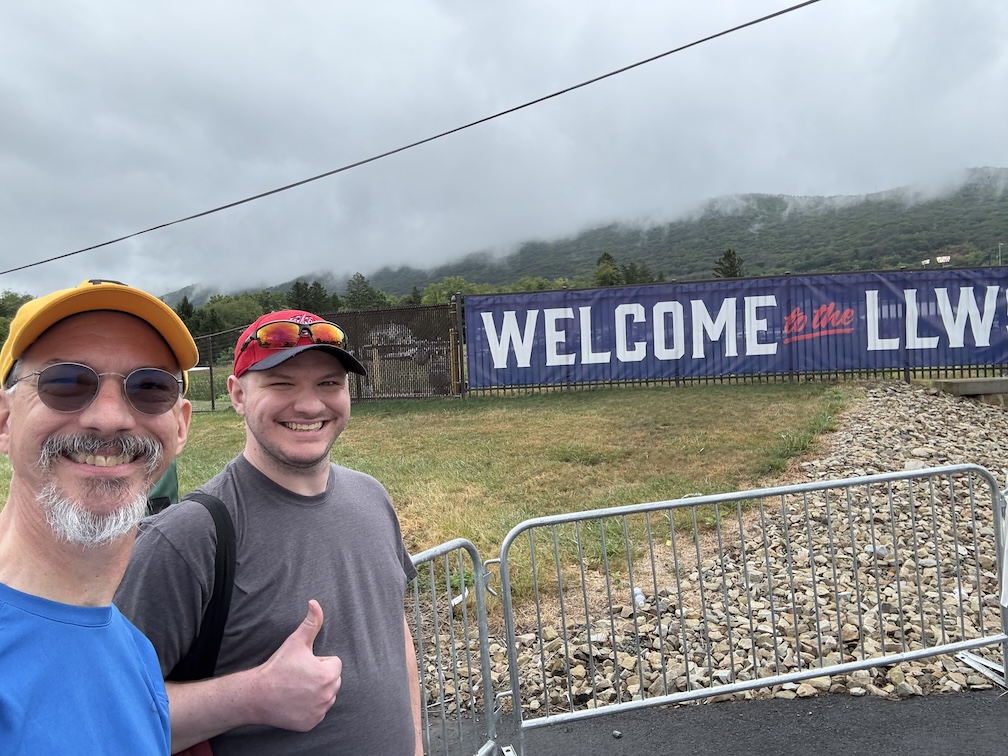
We arrived at the Little League World Series International Complex in Williamsport, PA

The weather was, as they might say in Scotland, “a bit of low cloud,” that is heavy clouds, misty, and spitting rain. It looked as though we had arrived just after a good storm, really. We made our way to Volunteer Stadium and found some open seats in the bleachers that weren’t too terribly wet. It was warm enough that we could sit on our jackets instead of wearing them, so that was good. Williamsport is hilly country, and the complex is built on a hill with some pretty steep peaks just behind. These were hung with misty clouds.

Notwithstanding, the game was on between Latin America (Venezuela) and Asia-Pacific (Chinese Taipei). The players appeared to be upper elementary to middle school age. Asia-Pacific had scored a couple runs before we got there, but after that it was kind of a slow game without much hitting. The pitching was really pretty good for both teams. Only a couple of balls got out of the infield, and they were all handled pretty easily. The announcers did (as far as I can tell) a really good job pronouncing all the kids’ names. I was impressed. After the fourth inning we both needed some food, so we went searching. It was still about an hour before the next game started in LaMade Stadium, but people were starting to move in that direction already. We decided to do the same. Jake wanted to sit on the hill, and that was fine with me. We went and set up our folding chairs behind right field, looking down the first base line, just at the brow of the hill, and ate our lunch. Meanwhile, at Volunteer Stadium, someone turned up the action meter after we left. Asia-Pacific beat Latin America 7-3. Oh well. [Recap video here]
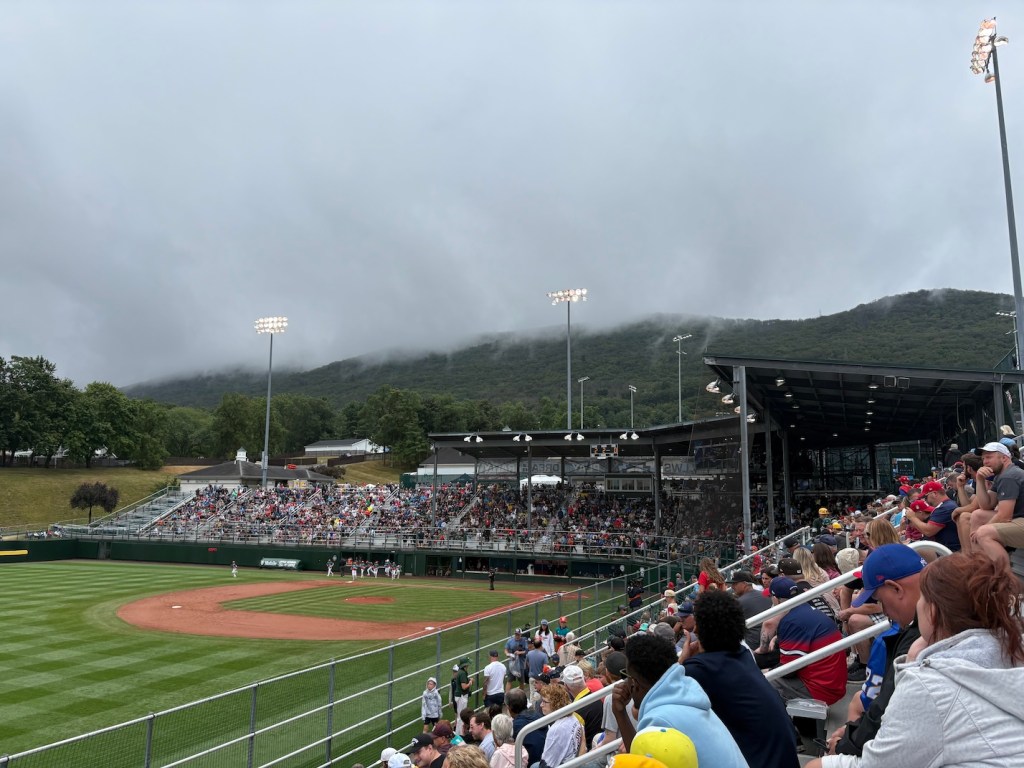
Volunteer Stadium, home of the International Regional games at LLWS

The second game of the day was Mountain (Nevada) vs. Metro (Connecticut). This was a much more energetic and aggressive game, with both teams getting lots of hits. The level of play was very good, especially having watched my share of Little League games back home when Jake was still playing. I mean, there were good and bad teams in our leagues, and they had good and bad days, but these teams were both playing really good baseball. There were some great fielding plays, a couple of home runs, besides some consistent pitching. When the dust settled, it was Metro on top, again by the score of 7-3, but this one was exciting from top to bottom. [Recap video here]
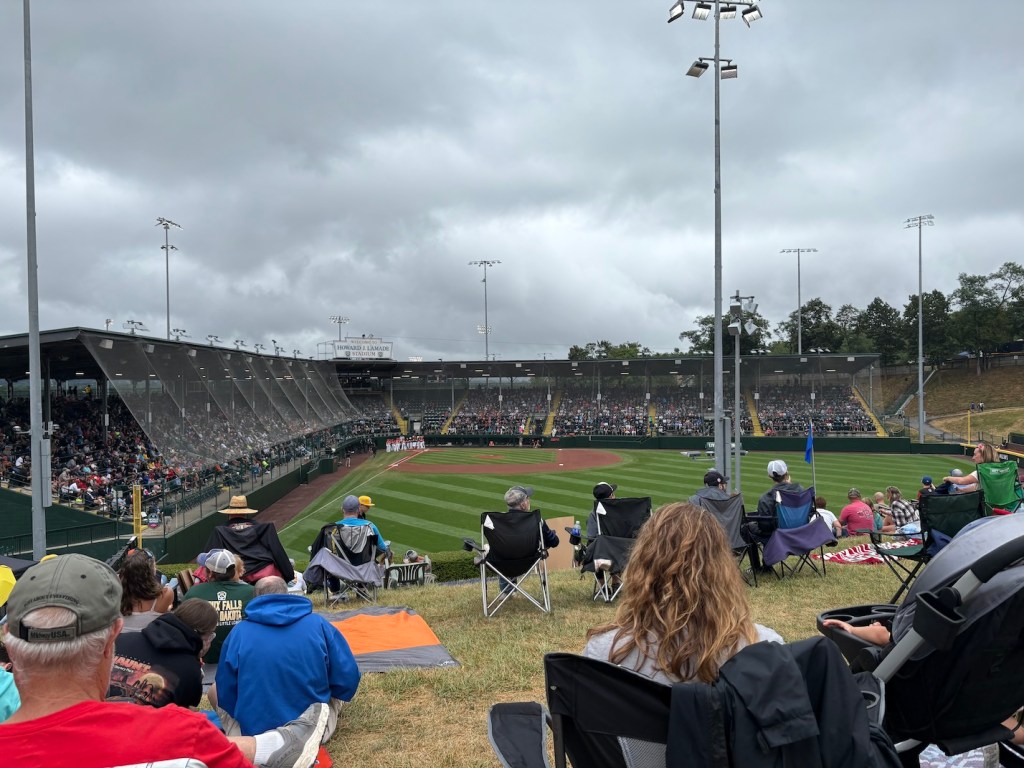
Game three for us (game 31 overall) was back at Volunteer Stadium, pitting Japan against Caribbean (Aruba). This one seemed more deliberate, like our first game. Jacob suspects there’s more attention paid to pitching and fielding in international teams while U.S. teams give more emphasis to aggressive hitting, which is a plausible theory. Japan is well known for its love of baseball, and as we would learn the next day, they have played baseball since the 1850s! But the Caribbean nations also love their baseball, sending a large number of players to the U.S. Major Leagues. Of course, these were just kids we were watching, so no pressure, right? The pitchers were definitely in control for the bulk of the game. Then Aruba broke it open in the fifth inning with back to back home runs! When it came their turn, Japan had no answer for them. Oh, the height and depth of human emotion displayed on the playing field! Half were leaping, yelling, laughing, and hugging, half were holding their heads, curling up or lying prone, in stunned silence or fighting back tears. Baseball is a lot like life. [Recap video here]

Back up to LaMade for the fourth and final game of the day. This one pitted Midwest (South Dakota) against Southeast (South Carolina). Now, even though the games are only six innings, this was still a lot of baseball! Frankly, Jake and I were both getting a little bleary, and we still had an hour to drive to get to our hotel for the night. So as much as we wanted to make a full day of it with all four games, we were kind of done. We stuck around for the first inning or so and made our way back to the car and on to our reservation. As it happened, when we got to our room and turned on the tv, we turned over to ESPN, only to find that the Midwest-Southeast game was still going! They ended regulation tied at one, after South Dakota walked in the tying run in the bottom of the sixth inning. South Dakota went on to rally, scoring five runs in the top of the seventh, making it 6-1. South Carolina’s coach gave his team a short pep talk before they went to bat, telling them just to believe. Apparently they listened, because they scored six runs to win the game with a walk-off double. It was very exciting, and again, the height and depth of elation and heartbreak were revealed on the little league field. [Recap video here]
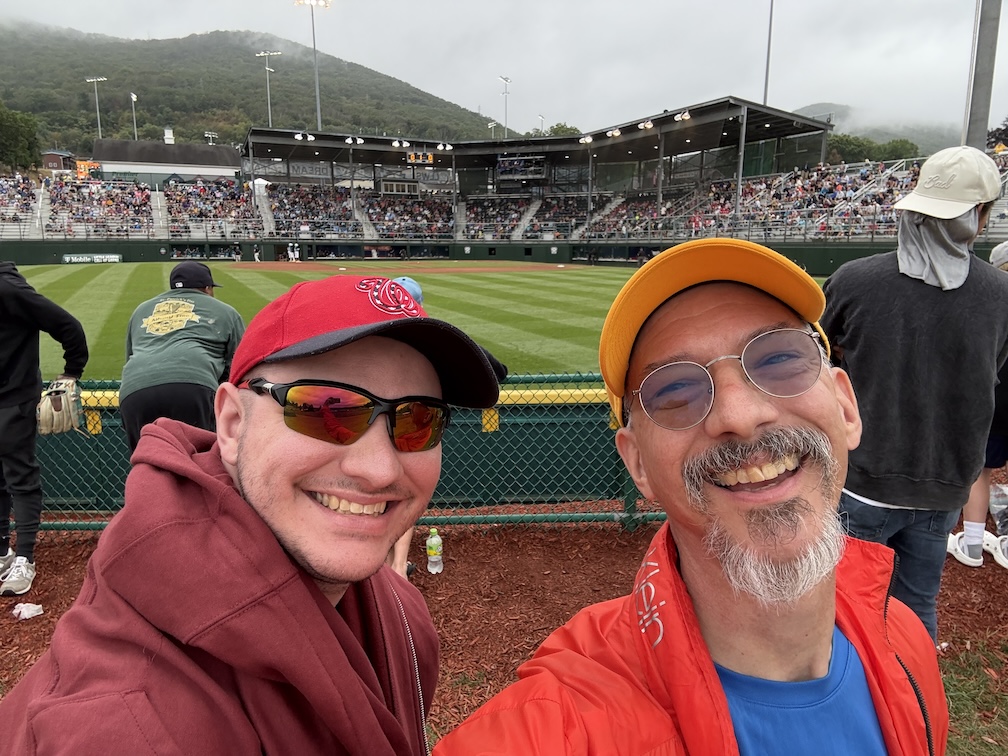
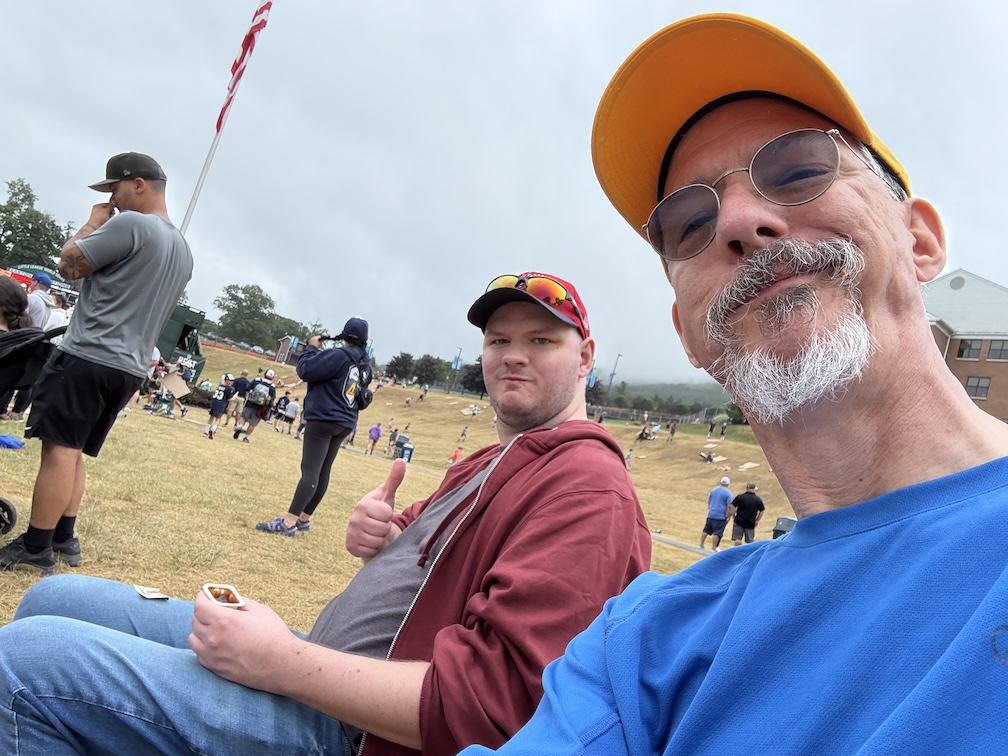
Look at those smiles! LLWS Baseball is awesome

What a fun day we had! It had travel and time to talk about life, the universe, and everything. It had a global melting pot where people from around the world come together just to enjoy a game and make friends. It had the energy, enthusiasm, skill, and resilience of kids trying to do their best. It had all the fun, excitement, and drama of baseball. And except for having to climb the hills, which can take a toll if you are out of shape, the facilities are clean, well cared for, with a good flow and sense of having been well thought out. What’s not to like? If you like baseball, this is definitely an experience I think you’ll enjoy. As to who went on to win the Series? If you don’t already know, you’ll just have to go to https://www.littleleague.org/world-series/2025/llbws/ and find out.

Second Base: Hall of Fame

Day Two of our pilgrimage took us from Mansfield, PA, to Cooperstown, NY, about three and a half hours drive, as I mentioned above. Day One had worn us both out with all the driving, fresh air, hills, and walking into the unknown (Jake and I are both a bit risk averse), so we slept in a bit and didn’t get on the road at the crack of dawn or anywhere near it. The trail to Cooperstown was laced with weird would-be detours and glitches from our GPS guides that made the trip a bit more exciting than it needed to be, but on the whole it was uneventful.

We arrived in Cooperstown at about 1:00 p.m. in beautiful weather and ready for lunch. I was starting to worry a little that we weren’t leaving ourselves enough time for the purpose of the trip, the Hall of Fame, but on their site they suggest a minimum of two hours to tour the museum. We would have plenty more than that. We parked at Doubleday Field, which turns out to be between a wooden bat factory and the Presbyterian Church, and turned onto Main Street, a classic old-style downtown. What we saw of Cooperstown is a quaint looking place, with mostly small, well-kept, tree-lined yards with mostly wood framed houses, an attractive, quiet-looking town. The Main Street business are all baseball themed somehow, from card shops and souvenir shops, to restaurants and bars, to banks and insurance brokers. They all play the game. We found a place that looked welcoming and fun for food, the Doubleday Cafe. More than likely it is a converted store from the early twentieth century or older, long and thin with tin tile ceiling and terrazzo tile floor. There are a dozen or so wooden tables with wooden chairs scattered about around the long bar, with flatscreen TVs in every direction showing a variety of sports shows. Yep, perfect! We ordered sandwiches and beer, both of which hit the spot. The waitstaff had T-shirts that read on the back, “Cooperstown: A Drinking Town with a Baseball Problem.” Again, perfect.
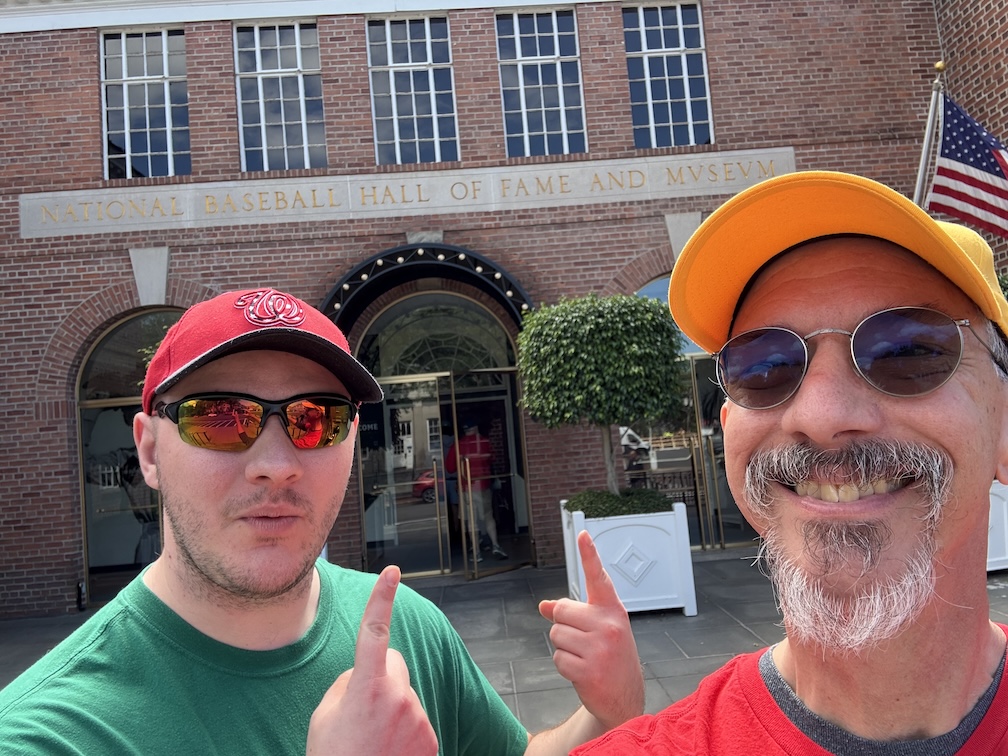
At the gates of the National Baseball Hall of Fame and Mvsevm. It is full of so much baseball!

At last we made our way to the National Baseball Hall of Fame, just a block to the east. There is definitely a sense of hushed reverence in the place. Even the entry with the admissions counter had subdued lighting. We had our tickets in advance, so we got scanned at the counter and headed into the exhibit halls. A docent met us as we entered, welcomed us, and asked if we’d been there before. No? Then your best plan is to start on the second floor, then go to the third, and finish on the first. Interesting layout, but okay. Who are we to argue? Up the grand staircase we went.

The first room we came to was dedicated to the recently inducted Hall of Fame Class of 2025. The class of five is Dick Allen, Dave Parker, CC Sabathia, Ichiro Suzuki, and Billy Wagner. Of these, Dave Parker was the one I knew best, as he played for the Pirates in the 1970s, while the others were little more than names to me before seeing the displays about them. But indeed, I learned that each was clearly deserving of a place among the greats and giants of the game. Follow the links above to learn more about them. Now, there is a time limit for a ballplayer to get nominated and elected to the Hall of Fame. If you don’t get the votes from peers, managers, and sports reporters in a few years, it doesn’t matter how good your career was, you will be left behind. However, in recent years there has been a move to correct some obvious oversights, many of which had to do with the prejudice and racism of the past. Not that prejudice and racism are no longer a problem, but it has been much worse. Dick Allen and Dave Parker were both passed over for the honors they deserved, and the board for historical reconsiderations has now rightly elevated them both to the Hall of Fame. I say, well done.

I won’t go room by room to tell you about what we saw. Couple reasons: first, there is just too much! and second, there is just too much! The first room was filled with the earliest stories of baseball going back to the early 19th century with remarkable detail. Baseball is a game that revels in its statistics and minutiae, and they are on full display in the museum. The development of rules. The development of clubs. The development of a fan base. The development of equipment. The development of professional leagues. The development of the business of baseball. All this was in the first room. We walked out in the next hallway that stretched for a hundred yards with more rooms full of just as much data and history sprouting on either side, looked at each other, and said, “This is so much baseball!” We were overwhelmed after one room!

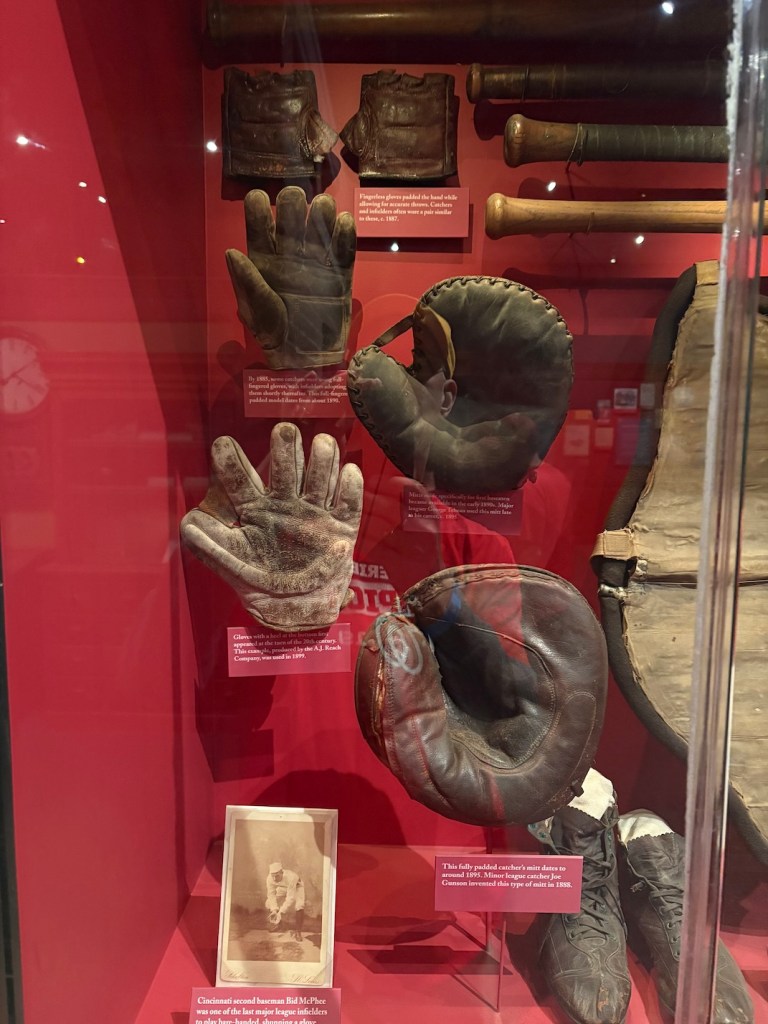
Down the hall there were, of note, a room for Babe Ruth, a room for the Negro Leagues, a room for the early 20th century, a room for women in baseball, a room for Latin Americans in baseball, and a room for the changing game at the turn of the 21st century including the doping scandal. While it continued to be overwhelming, we both thought they did a great job of lifting up the diversity of baseball through the contributions and struggles of ethnic minorities and women in the game.

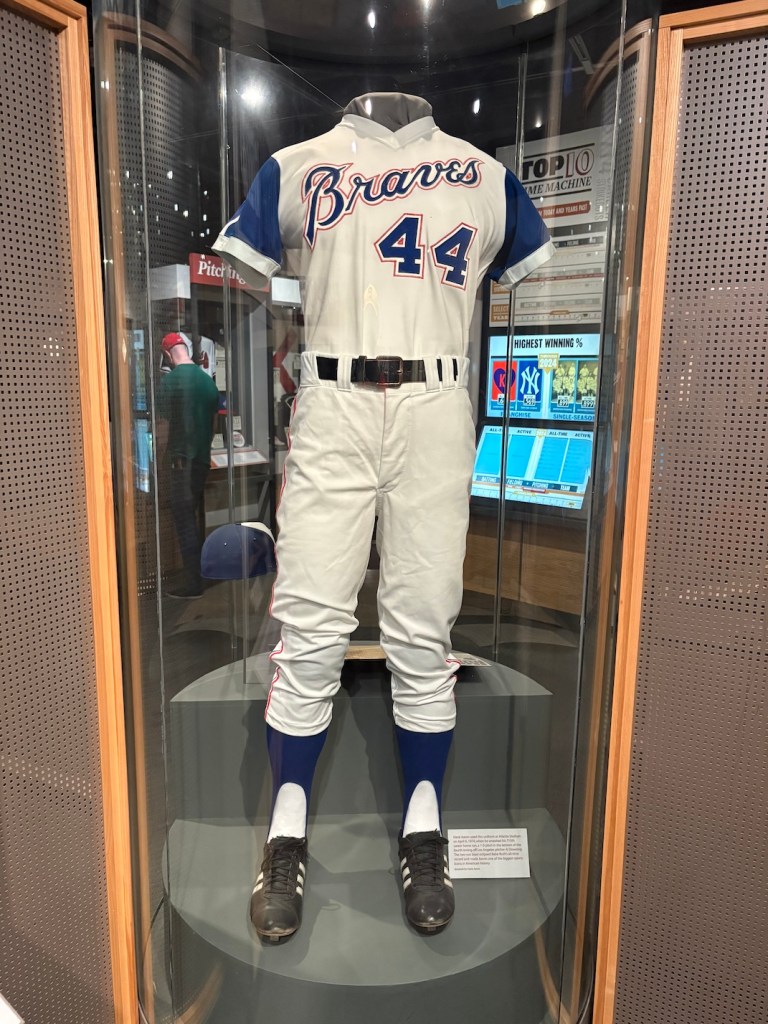
The third floor was similarly packed, starting with a large presentation of baseball in Japan, which dates back to the mid-1800s. There is a sizable space for Hank Aaron and his journey to overtake Babe Ruth as the home run king, including the racism and hatred he faced on the way. One wing is given to the top individuals and teams in each of a few dozen statistical categories – hits, strikeouts, RBIs, OBPs, Gold Glove winners, Cy Young winners, MVPs, and on and on. This is followed by all the World Series winner rings on display in a single case. These started out as fairly simple designs but have grown to several inches across and encrusted with jewels. Then there was more stuff after that. It’s really…. there’s just so much baseball there.
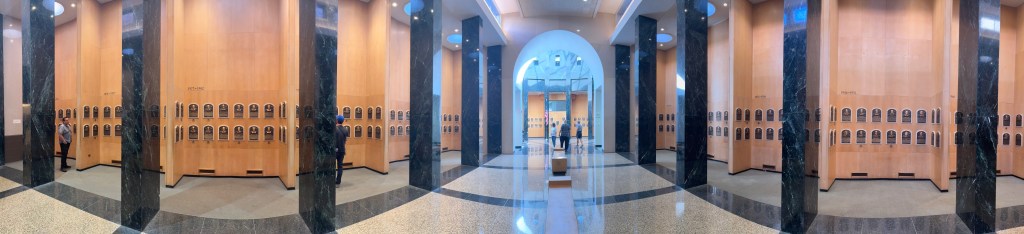
The Hall of Heroes

Finally, we made it downstairs. Eschewing the art gallery that I’m sure is spectacular, we went right to the Hall of Fame Gallery that holds the plaques commemorating all the Hall of Famers. This is the holy of holies, the Elysium, the vault of baseball heaven where the stars shine from bronze plaques that bear their names and embossed images (that often look nothing like them) into the ages, while the faithful fans remember and dream of glory past and yet to come. It is an impressive shrine.

Be that as it may, once more, we were pretty much done in after three hours. I could barely keep Jake in the Gallery while I looked for some of my old heroes, though at 31 he wasn’t physically pulling at my sleeve. All that remained was the required exiting through the gift shop. We bought just a couple wee tokens and headed back into the world.

Third Base: Yankee Stadium

We still had to get to New York City, about a four hour drive as it turned out, winding our way through some back roads in upstate before getting to the major highways down to the City. Again, it seemed like our GPS guide was choosing unnecessarily out of the way paths, but we did get to see some beautiful parts of rural New York before seeing urban New York. Jacob took the last turn at the wheel to get us to our hotel in the Bronx at about 10:00 p.m. and did a fine job with his first time driving in the Big Apple. The hotel is a recently renovated Days Inn now called the NOVA Hotel. It’s not the ritziest place I’ve ever stayed, and it’s not in the most attractive neighborhood, but it was clean, comfortable, and reasonably priced with good reviews.

Day Three of the tour was Friday. We had tickets for the Yankees-Red Sox game at 7:05 p.m. If you don’t know that that the Yankees and Red Sox have a long, deep, often painful rivalry, well, you don’t know much about baseball. Also, if you didn’t expect that the prices for this series of games were about 50% higher than any other games in the season, then you are naive. That’s the business of baseball. I had managed to get us some decent seats for decent prices, all things considered. More on that in a bit.

In the meantime, we had all day to kill before game time. There were a myriad of options in NYC, of course, but we settled on the Bronx Zoo. It was reasonably close and gets high marks. We started off walking a few blocks to a cafe Jacob had found online for breakfast. Just a little place with half a dozen booths across from some academic campus and on the edge of block of flats, you know, like New York. Great coffee, huge breakfast, good prices. Nice pick, son!

Pregame: Bronx Zoo

Jake had also plotted our course to the zoo by way of mass transit. We walked a few more blocks to catch the #2 train north to the zoo. We each got Metro pass with money to spare on it, and after just a few minutes wait we were on our way. The New York Metro system has a reputation for being gross with unseemly people doing unseemly things, but we didn’t have any of that. We got to our stop, and after another ten-minute walk we were at the Asian Gate of the Bronx Zoo. I had bought our tickets before we left (not cheap on the same day – buy ahead if you can), so we scanned in and began our adventure.
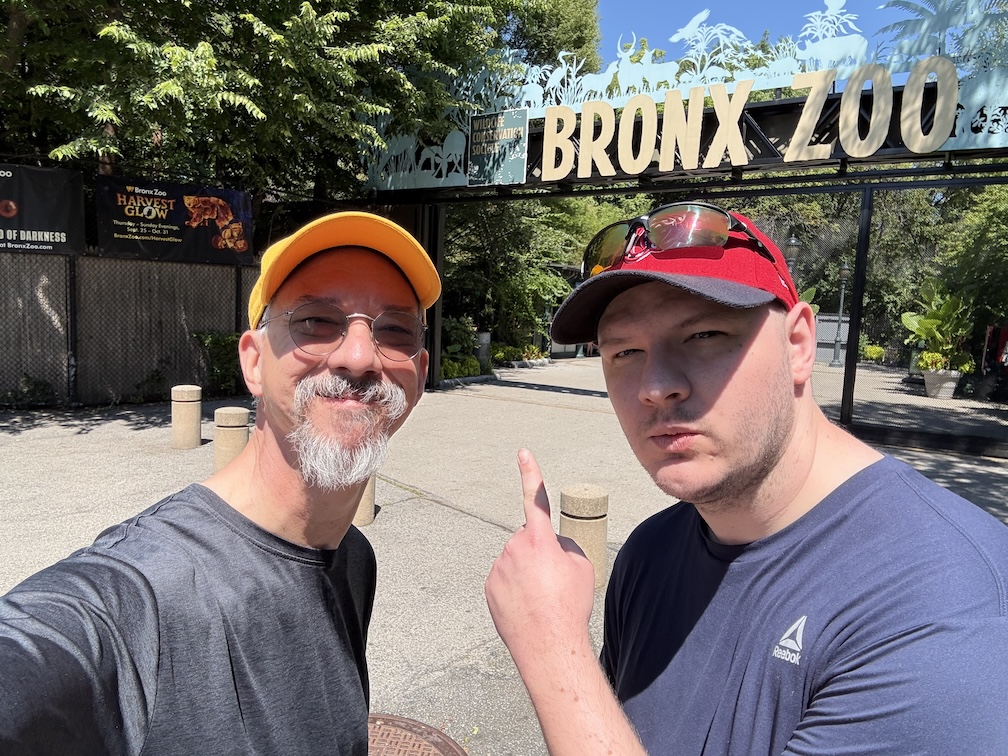
At the Asian Gate of the Bronx Zoo, the beginning of a delightful adventure

The Bronx Zoo is a beautiful place! It’s clean, lush, and surprisingly quiet! Trees and plants everywhere keep the noise and the temperature down. There were plenty of people at the zoo that day, but it never felt crowded or congested. The zoo was organized and its first buildings erected between 1909 and 1913. Some of those original buildings remain in use, though repurposed. The architecture is a nice mix of simplicity and ornamentation. Of course many of the current structures are much later additions. There are several divisions within the zoo for different climates, geographies, and special exhibits, such as the gorilla forest and tiger mountain. There’s even a dinosaur exhibit, although we didn’t get there.

As with the Hall of Fame, I won’t give you a beast-by-beast description. Suffice to say they were all there! We saw giraffes, lions, camels, various apes and gorillas, seals and sea lions, all manner of birds, alligators, and tigers, to name a few. The animals are all beautiful and/or remarkable, and the enclosures are generally well designed and as open as possible.

We stayed until they kicked us out at about 4:45 p.m. That was fine, because we figured it would take us about 45 minutes via Metro to get to our next and final goal, Yankee Stadium. The gates would open at 5:30 p.m., so we’d be right on schedule. Again, Jacob had sorted out that we would take the #2 train back the way we came and then some, until we could pick up the #4 for a couple stops to get to the stadium. That’s just what we did, and it was about as smooth as silk. Well, maybe polyester, as we had to wander around a little bit to find where to pick up the 4, and again to figure out how to get off the platform and down to the street outside the stadium. That one was pretty easy, really – just follow everyone in the Yankees hats and jerseys! We were outside the gate at took the picture below at 5:23. Not bad! I could get used to consistent public transit.

The Yankee Stadium Experience
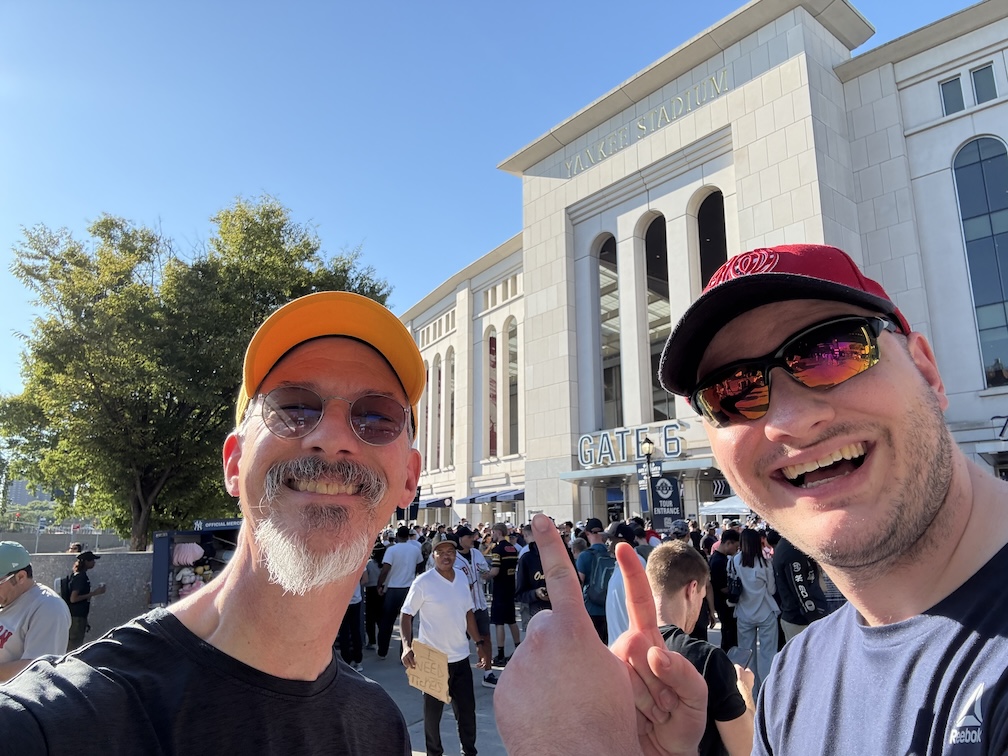
At the House That Replaced the House That Ruth Built

There was a pretty long line at Gate 6 on the southeast corner where we figured to enter the ballpark. I thought it might take us a long time to get in, since everyone had to go through metal detectors and all. So I was really surprised when we were inside the stadium at about 5:35, took pictures on the second deck at 5:45, and were in our seats before 6:00. Guess they’ve got the system worked out.

The stadium is a beauty on the outside with a sort of Romanesque facade. The spaces are wide and ceilings are high. They are built to accommodate lots of people. We made our way up to the second level and got a look at the field from there. Pretty cool, but we had a long way to go, all the way up to deck 4. Except it turns out there isn’t a deck 4. You go to deck 3 and then go down for 3rd tier seats and up for 4th tier. We went up. Way up. We weren’t in the very top row, but I could have hit it with an easy throw of my hotdog wrapper. But honestly, the view was great.
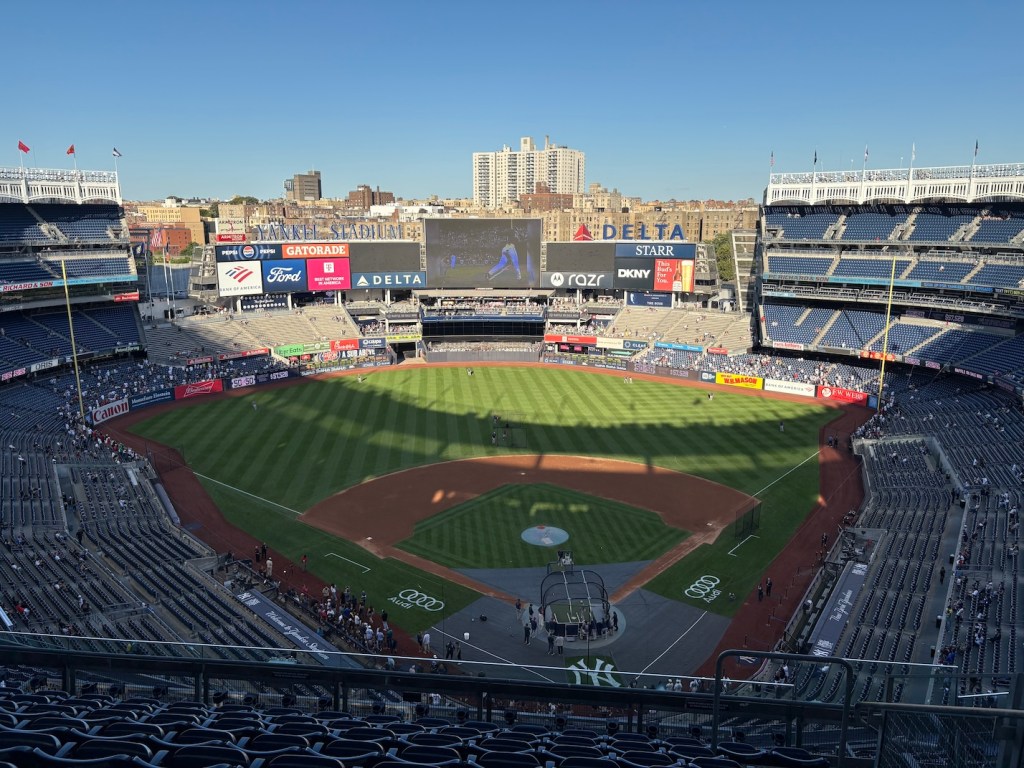
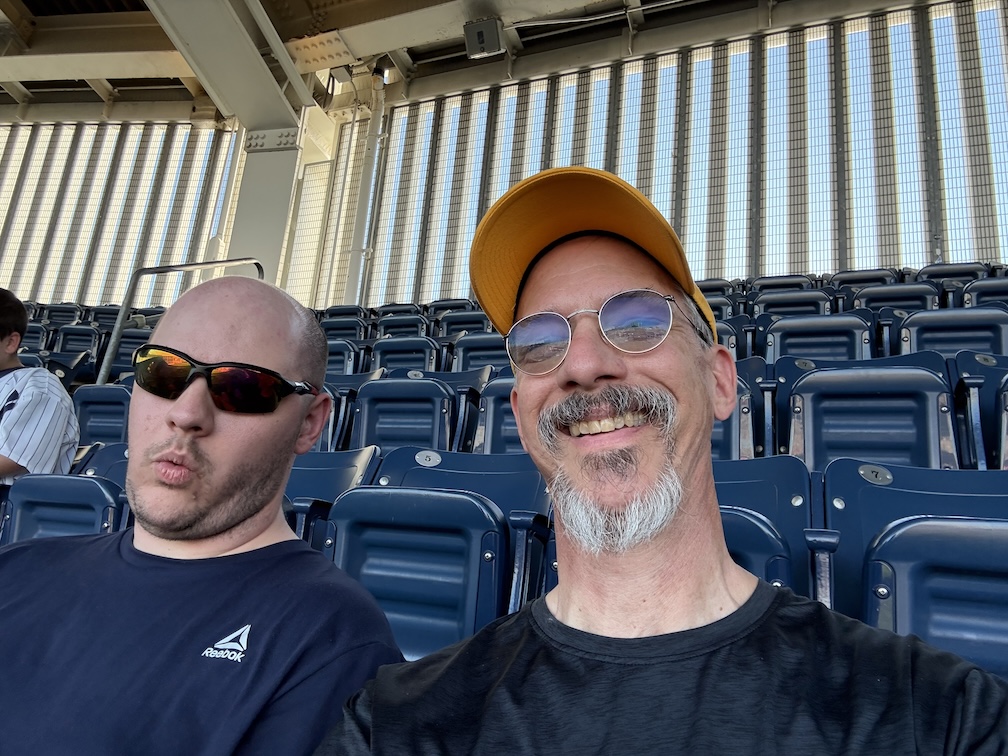
We were right behind home plate! The whole field was there before us without obstruction or distortion. So, too, with all the scoreboards, of which there were many. Plus a nice view of the surrounding cityscape. Except for a little vertigo looking down, I was quite satisfied. Besides all that, there were concession stands right below us, so we just had to go down a couple flights of stairs and we were practically in line for food and drink. So that’s what we did. It was still early, and the crowds hadn’t really made their way in yet, so there wasn’t even a line to get in. Hotdogs, fries, and soft serve ice cream with sprinkles in a souvenir batting helmet cup. Perfect!

While we waited for game time, there was a constant stream of video – promotional, informative, commercial, or hype-inducing. Some of it was interesting, but mostly it was just filler. You wouldn’t want anyone to go for more than a few seconds without some media input, after all. And boy, they stuck to that philosophy, even through the game. There was something happening on all three big screens, plus the animated strip around the 3rd deck, plus music or sound effects ALL. THE. TIME! It never stopped! I missed plays in the game because I got distracted by all the media that was pouring out. It was crazy. I didn’t like it.

I guess they do that because people say baseball is boring. So they do everything they can to keep you engaged with something, whether it is actually the baseball game or not. On this particular night and this particular game, maybe that wasn’t such a bad idea after all. It was a real pitchers’ duel and unfortunately a snoozer for the most part. The pitching wasn’t so good as to create drama, like it might be a no-hitter, but it was good enough that there were very few hits. That happens. It’s part of the great game of baseball. But as we approached the seventh inning stretch I was working on new lyrics to the classic song — “Wake me up at the ballgame!”

Eventually, the Red Sox found a little bit of spark and managed to score a run. The Yankees just had nothing going on and had no response. That’s how the game ended, 1-0 Boston. As I mentioned before, I’m not a Yankees fan, and neither am I a Red Sox fan. I wasn’t rooting one way or the other and just wanted a good game. Oh well.

The crowd was probably as interesting as the game itself. There were several pockets of Red Sox fans peppered around us and around the stadium. They were having a ball, not just because their team ended up winning but also because they could be a thorn in every Yankees fan’s side. There was also a group sitting in the row behind us that noticed I was wearing a Pirates cap. “Nice hat!” they said before the game. I thought they were giving me NY crap for it, but it turned out they were from Pittsburgh and were Pirates fans! That was fun, until they started talking about all the players and recent games and things happening in the Burgh and Pirate fan lingo as if I would be right there with them, but it turns out I’m just a poser. I haven’t really followed the Pirates and haven’t lived in Pennsylvania for decades. I had no idea what they were talking about. I tried to fake it as best as I could, but my cover was blown. They eventually gave up on me, I think. Oh well.

All in all, Jake and I had a fun time going to the game and being at Yankee Stadium (even if it isn’t the historic “House That Ruth Built”). The game itself wasn’t very good, but you’re gonna have some of that. The experience of going and being there was otherwise as good as you could want. We walked the mile or so from the stadium back to our hotel, which was fine until we got further from the crowds and businesses and out into the dark, uncharted parts of the city. Then we felt more out of our element and more exposed to all the horrors people who don’t live in cities hear about being in an unfamiliar city. But it was fine. We made the trip entirely without incident.

It had been a long day, with a lot of walking and adventure. We slept well.

Home Run!

Saturday morning we got up and got moving at a reasonable hour, checked out, and hit the road. We wanted to clear the city before we stopped for breakfast. That proved more challenging than we expected. Once more, my GPS guide lost its damn mind, wanting to send us the wrong way on one-way streets and not recognizing road closures and whatnot. Jake’s map was doing a bit better, but it took some creativity, intuition, and faith to find our way out. It shouldn’t be that hard, what with the city grid and all, but we have become woefully dependent on our tech. Anyway, like I said, we made it out and headed down the road. We kept both GPS guides running, and they continued to conflict with each other and with our reality. Fortunately, we figured out that if we took a particular interstate it would take us all the way back to familiar territory near home. So that’s what we did, robot overlords be hanged. thanks to our helpful robot protectors.

On the way home, we again had lots of time to talk about life, the universe, and everything, and we did. We recapped the trip. We talked about Jacob’s masters program classes. We explored different genres of music we each like. We talked about God, the state of the world, and how hard it is to have faith. We found that the air conditioning wasn’t quite working in the car. All the sorts of things you’d want for relationship building on a road trip. I enjoyed it thoroughly. This trip was really the first time since Jake was in college that we’ve had time together like this, and I think we’ve never had three days with just the two of us. I cherish the time we got to spend on this trip and am so grateful for my sabbatical, for my church’s support, for my wife Molly’s support, and of course for my son Jacob. I’m thankful for God’s grace and providence in all these things, and I’m glad there’s a thing called baseball.
An Artistic Journey, Part 2

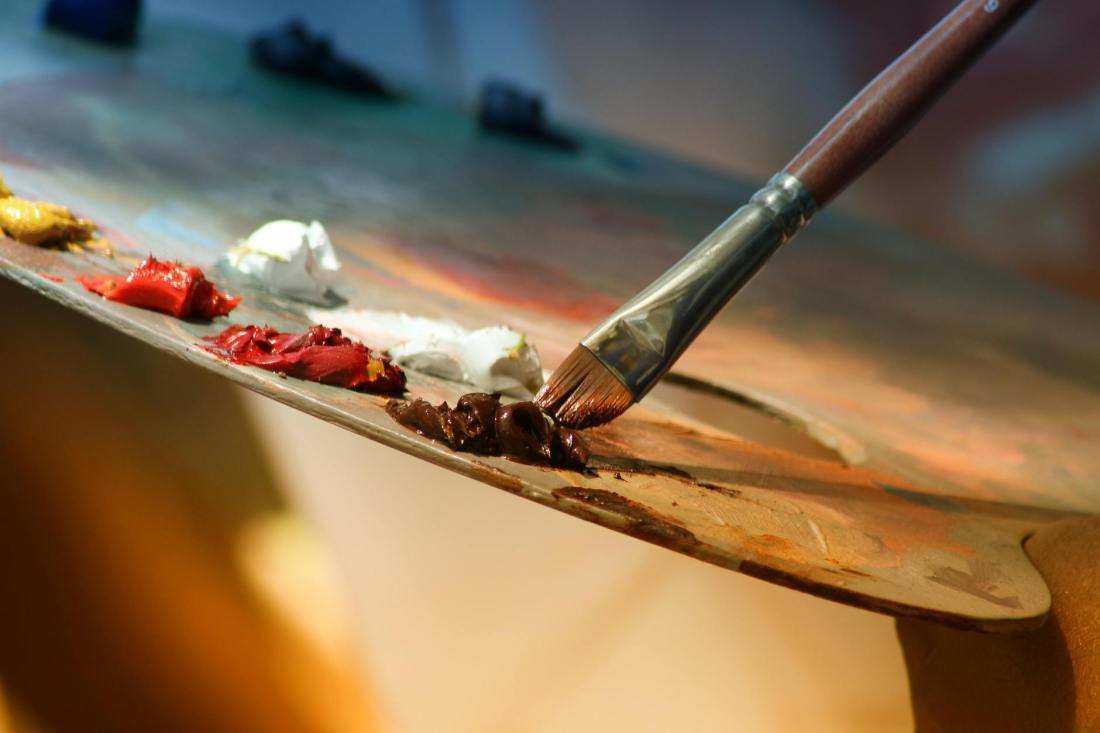
In my last entry I wrote about choosing a painting class at Ghost Ranch, about my lack of experience, training, and skill in painting, about the teacher’s fairly non-directive teaching style, about the first project – painting a landscape plein air – and about the initial results of my first attempt. Of particular interest for me about this first endeavor was overcoming my neurosis about needing to master a thing before I can try it. Right next door to that neurosis is a saying from Aunt Marty (a family friend kind of aunt) that I think I internalized as a child. She would often say, “I seldom fail! But then, I seldom try.” The fear of failure is a remarkable hindrance to living an adventurous life. In fact, although Aunt Marty (and I) seldom failed, there are many ways in which a non-failing life is not successful.

Keep Going

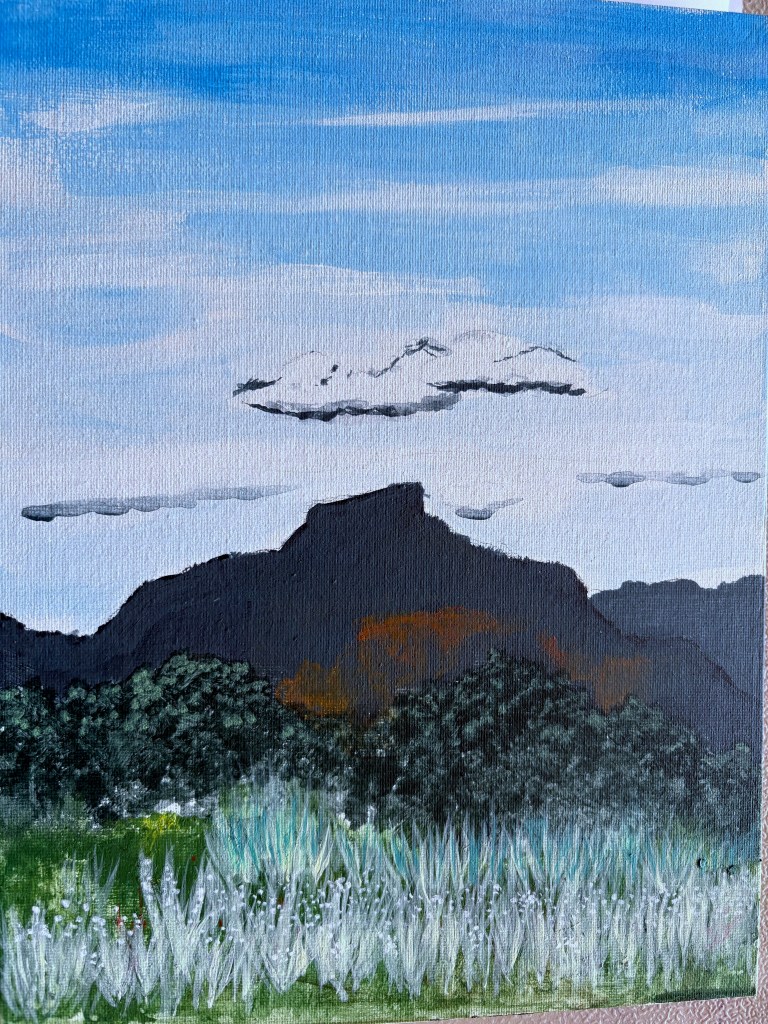
So, as I said previously, I made up my mind to try with this painting business. In the course of the week, I worked on three paintings. Some of my classmates produced that many in a day! While I am somewhat envious of their skill and capacity, I am not they, and that is not where I am. See how good I’m getting at giving myself grace and not comparing myself to others? Anyway, my three were that first landscape of Pedernal, another of Kitchen Mesa, and a still life. At the end of that first plein air session, I thought I was done with my painting. I even put a “D2” in the corner, my signature. Well, when we had a round-robin discussion in the class where we looked at everyone else’s work and offered comments, I got supportive comments of how they liked this or that about it, and several questions and suggestions of what I might do with it next. Next? Isn’t it done? Perhaps not. That one could continue working on a painting may seem obvious, but I guess I have watched too many episodes of Bob Ross’s Joy of Painting wherein he completes a work every half-hour show. So this was another point of my growth as an artist. I allowed as how perhaps I could continue working on my Pedernal, if only I could figure out how.

Another Target

I had a similar issue with my second painting, Kitchen Mesa. I was working on it from a photo I had taken so I could be inside. On a 9×12″ canvas board I penciled in the structures of clouds, mountain, and trees, and started in on the painting, working from top down. Calling on my experience with painting icons, I started a section with a dark base color and added progressively lighter colors on top of it. In iconography, this is a theological decision as much as artistic, to move from the darkness to the light. I still have no idea if that is what is ordinarily done in other styles of painting, but after watching my classmates working, I’d say not. Further, when KB, the instructor, came around to look at what I was doing, she was curious about my progression in that manner. Being a firm practitioner of the non-directive school, she offered suggestions of other possible methods, but insisted that if it worked for me, I should follow my path. I appreciated the permission giving, but the truth is I didn’t know if it was working or not.

The mesa has several distinct zones of different geology. There is a fairly dark, apparently dense rock that makes a kind of cap on the mesa. Maybe it isn’t actually dense, as there isn’t that much of it, either in width or depth. The next layer down is a pale yellow sandstone, and below that is an orange-red zone, almost salmon colored. There is an area of loose rock fall down the face of the red, and then, from where I was standing taking the picture, the trees take over the foreground. I’ll try to write about the geology in another post. As for my painting of these zones, as I said, I started at the top and I worked from dark to light. So that top cap came first. It has a number of vertical divisions. I overheard one of my classmates talking about trying to paint them in an earlier class, and she referred to them as the “teeth,” so that’s how I thought of them and referred to them. It turns out that wasn’t an official name as I imagined, but too bad. Now they’re called the Teeth of Kitchen Mesa. Anyway, using the iconographic approach, I actually got them to look pretty good! It took a lot of close, very detailed work. Usually I’m not a fan of details, but I kind of got into it with my icon painting, and I found it strangely engaging here, too.

I worked down to the sandstone zone. Here I ran into my lack of expertise with mixing paint to make the color you want. I couldn’t quite get the right tones or hues or values. I thought I could with layering, but my layers weren’t right either. I kept at it and got something blocked in, but I didn’t like it. Wrong color, wrong brush strokes, wrong texture to the sandstone, wrong, wrong, wrong. Again, in our review discussions, lots of positive comments on the sky and the “teeth”, and then encouragement to block in the rest of the colors and keep going. No one said, “that looks like crap,” or made me feel totally gross or morally bankrupt. I was encouraged, but I was also getting frustrated with the chasm between my desire and my product. I set the project aside until I could figure out what I was doing.

All this was on the first day of class.

Still Life Walking

On Tuesday, we started with a hike into the “back country” behind the art center toward the box canyon, if you know Ghost Ranch at all. If you don’t that’s okay. Suffice it to say it’s beautiful country, and it was a beautiful morning, and it was pretty flat walking. More views of more mesas and some of the beings that live on and around them, like lizards, bugs, and vultures. The goal of the expedition was to collect natural items from which to compose a still life. Again, KB, not wanting to make anyone do something that felt unnatural, wanted us each to compose our own items rather than her setting up one arrangement for all of us to paint. So not only don’t I know how to paint, I don’t know anything about arranging a still life, either. This was going to be great.

I found a handful of objects: two rocks, some yellow flowers, a stem of juniper, and a piece of …. wood? Yeah, I think it was wood. It had a lot of texture and a weird sage green color, and it was very crumbly. Let’s say it was wood. That was the easy part. Then, returning to the art center, I started trying to imagine how to arrange these things. All I can think of is the Dutch masters’ still life paintings, so I figure I need a table, some linen, a bowl, and maybe a skull? I don’t have nearly enough dark brown paint. Before long, KB came by, and I told her I was at a loss. She suggested just picking maybe three items, and then arrange them individually. Not so much an arrangement as a composition. That was a huge relief, really. I imagined being able to paint three items on their own much easier than trying to figure how to show them interacting. KB also recommended doing a neutral tone color wash on the canvas to 1) reduce the tyranny of the white canvas, 2) provide a background that would make the items stand out, and 3) I forget what 3 was. That seemed like a good idea, too, except I didn’t know how to do a neutral wash or what neutral tone meant. I took her recommendation under advisement for future consideration.

As I mentioned in the previous post, pencil drawing has always been more my thing. Since I felt like I was floundering with the paint, I decided to start this still life project by drawing the items in my sketchbook first. This would give me a sense of what I was looking at in terms of proportion and texture, it would focus my attention so I would “get to know” the items a little better, and it would give me a way to do art in a way I was comfortable with, just for a break. Well, if I’m honest, I was starting to doubt that I could actually do the painting. Drawing was a way to keep participating in the class without …. oh, what’s the word… trying. Or failing. Gosh, that runs deep. Nevertheless, drawing was comforting and productive and just what I needed to do at that point. KB wanted me to find my process. Drawing was going to be part of my process, one way or another.

Try. Fail. Learn. Keep Going.

Having completed sketches of my five items, I narrowed the field to three, as KB had suggested: the yellow flowers, the juniper branch, and the smaller, rounder, striped rock. Part of our class fees went to providing things to paint on, canvases, canvas boards, paper of different sorts, and so on. Somehow, all the 9×12″ canvas boards were gone already. I guess there weren’t that many to start with. That’s a pretty comfortable size for me, so I was disappointed. I didn’t feel like I was up to using an actual stretched canvas. So of the various options that remained, I went with a 12×16″ canvas board. This is so much bigger than I wanted. It’s a lot of white space for a beginner to fill. My already shaky confidence blanched before this white monolith. But come on, now, David. This is what you came for. Just go for it. I did. I sketched where I wanted my three items, and I started on the one I thought would be easiest, the yellow flowers. I started trying to mix the right shade of green for the stem and leaves. It’s a war between what nature has lain before me, the paints I have, my ineptitude, and my frugality that won’t let me waste anything. Nature loses. My green is far too bright, too blue, but again, I hope I can bring it down to where it “should” be in future applications. Besides, I don’t even know how to paint stems and leaves, so what difference does the color make? And you can’t just throw the paint away and not use it!

The painting itself doesn’t go any better. Even with my thinnest liner brush, my lines are fat, crude, uneven, overflowing. This is a disaster, a nightmare. What am I even doing here? What made me think I could paint? What a waste of time and money! I should just stop right now.

And yet…

Remember that you are a beginner. No one is here to judge you. This isn’t a competition. You are here because you wanted to learn and to grow. It doesn’t have to be perfect. It doesn’t even have to be good. It just has to be yours. You have talent. You can learn skills. Keep going.

So I did.

I went back to my sketchbook and practiced some ideas about how to do different kinds of strokes, using the extra bright green paint I didn’t want to waste. I practiced how I might make the petals of the flowers, and it looked good. I practiced some ideas for my Pedernal foreground. It didn’t take very long, and some of what I tried didn’t work, and some of it did.

I worked on Pedernal again, adding highlights to the mid-ground trees and adding grasses and flowers in the foreground. It was better.

I mixed some yellow that matched my flowers pretty well and added the petals to my painting. They got lost on the white canvas so I diluted some red paint and washed over them. It didn’t help! So I tried again with blue over the red. It didn’t help either! I took straight cobalt blue and very carefully painted around the petals and around the stems, and they all just popped! I practiced drawing my rock in my sketchbook with colored pencils, and then I painted it to look just like that, and it looked good. I painted around the rock with the cobalt blue, and it popped! I noticed that the boundary between where I stopped with the red wash (right in the middle of the canvas) and where it was just blue wash (at the top of the canvas) looked like the shape of Pedernal against the sky. I painted a thick, cobalt-blue, Pedernal-shaped line over that boundary. I connected the pools of blue around the two objects to the horizon line and to each other. I practiced and then painted the cow skull Ghost Ranch logo (originally be Georgia O’Keeffe!) at the top of the canvas, in place of the juniper branch.

And it was good.

What I Learned

I ended up really enjoying my painting class. I still don’t have much knowledge or skill, but I found a process, a path for doing art. As I spoke with classmates about my experience of nearly despairing and quitting before giving myself permission to just go ahead and ending up with something I really liked, several said they have had similar experiences. We even speculated that it is the nature of art to emerge with a push through the place of failure.

I learned about myself, of course, that I still wrestle with my perfectionism, and that I’m getting healthier about it. To offer grace to oneself to be less than “ideal” (whatever that is) is a gift of grace itself that comes, I believe, from a higher source. For that I am deeply grateful.

A Sabbatical Map

Here is a map of my sabbatical journeys. It includes the trip to Green Bank, the New England swing, and the Grand Tour in chunks. The paths are approximate, especially on the Grand Tour, as they are here driving routes, and I took the train. Also, I didn’t put the exact addresses of the places I stayed. But you’ll get the idea. I think if you click on the box in the top left of the map header you’ll get the legend. Then if you want, you can turn off the driving routes, which will make it easier to see the places I visited. There are several light blue pins marking places I thought I might get to but ended up not going. This time. I worked out a rough estimate that I traveled over 8000 miles in a little over two months.

I can’t tell you how grateful I am for this experience, for the opportunity to travel to see these amazing astronomical instruments, and for the people who made it possible, namely my congregation at Catoctin Presbyterian Church, my family, and my wife Molly. I am grateful to the church for the financial means to go and for the spiritual support to send me. I am grateful to Molly for her encouragement and for her taking over many of the duties I left as I went. I am grateful to God for the privilege of this journey and for these beloved people in my life.

As my sabbatical is drawing to an end I plan still to keep writing about my experiences. I’m still processing the whole thing, what happened, what didn’t happen, what I learned and didn’t learn, what it all means. So stay tuned.


Photo Dump… Observatories 7-17!

My sabbatical is drawing quickly to an end. My Grand Tour wrapped up last week. My writing output has been lousy. I do, however, have lots and lots of pictures from the Tour that are in annotated albums over at my Google account. (My last photo dump went to my flickr account, but I got a new Android phone for the Grand Tour, so all the pictures automatically synced with Google, so there we go.) So I’m doing what I did after the Lesser Tour and dumping the pics for you to see. I then hope to go back and add commentary posts here for each leg, plus some interpretive and reflective posts on the whole experience.

So here we go. Click on the headings to see the pictures.

Arizona

Kitt Peak Observatory

Kitt Peak, near Tucson, Arizona, is the National Optical Astronomy Observatory for the United States, established in 1958. There are over two dozen telescopes of various shapes, designs, and age there ranging from 16″ to 4 meters (160″) in size. They do a nice job with their tours, visitor center, and gift shop. I also participated in a nighttime observing program, and that was also well done, despite the monsoon making actual observing impossible.

Sunset at Kitt Peak

As part of the evening program, we got to view the sunset from the crest, which was spectacular. I took many pictures which only hint at the glory. The clouds made it more dramatic, but as the light faded the clouds took control of the night, precluding any astronomical observing.

Mount Graham International Observatories

A couple hours east of Tucson you can find Mount Graham, but you can’t go up it without a permit or signing on with the Eastern Arizona College Discovery Park tour, which is what I did. It takes over an hour to ascend the mountain road with its 108 switchbacks. At the summit are three observatories: the Sub-millimeter Radio Telescope, the Vatican Advanced Technology Telescope, and the Large Binocular Telescope. We toured all three. Meanwhile, the weather degraded from mostly sunny to socked in, foggy, and 25-30 mph winds. The monsoon is real. I’m sure it had nothing to do with me being there.

Lowell Observatory

I traveled by car from Tucson to Flagstaff to see the Lowell Observatory, about a 4-hour drive. It saved me some logistical nightmares of getting there by train. Lowell is a beautiful facility, and they do very nice interpretive work. They also do public observing every clear night, and we happened to get such a thing while I was there. Lowell, named for famed astronomer Percival Lowell, is where Clyde Thombaugh discovered Pluto.

California

California Science Center

Not an observatory, but a cool science museum that has lots of space artifacts including the space shuttle Endeavor.

Griffith Observatory

Sitting on a hill overlooking Los Angeles is Griffith Observatory, named for Griffith Griffith. Yep, that was his name. This facility has been an important center for science education in L.A. for generations. It’s still very cool. They do public observing through their 12-inch Zeiss every clear night, despite the atrocious light pollution. You still get a decent view of the planets, which can be a real Gee-Whiz! moment, especially for the uninitiated.

Palomar Observatory

The Big Eye, that is the 200″ Hale reflector, one of the most famous telescopes in the world, is housed in this beautiful, Art Deco observatory dome. If you ever see an observatory in a cartoon, it’s probably based on Palomar. It is still among the largest telescopes in active service, and this is an active scientific facility. A couple hours southeast of Los Angeles, actually closer to San Diego, Palomar doesn’t suffer too much from pollution of the bright lights, big city. They have nice gift shop and visitor center and a good tour.

Mount Wilson Observatory

Mount Wilson was one of the first great observatories on the West Coast, developed by George Hale, the man behind Yerkes and (eventually) Palomar. It’s about an hour and change northeast of Los Angeles and is home to several former claimants of World’s Largest Telescope. Now primarily an educational outreach facility and center for outdoor activities like hiking and mountain biking, Mt. Wilson played a key roll in changing the way we understand the shape, structure, size, and age of the Universe.

New Mexico

Molly flew out to join me in Albuquerque 32 days after I boarded the train in Harpers Ferry. We spent a day doing a self-guided Breaking Bad tour, which you can look here at if you’re into the show. We also enjoyed the New Mexico Space History Museum, the White Sands National Monument, the Three Rivers Petroglyph park, and the Valley of Fires lava flow site. Again, if you are interested in these, feel free to click on over. I’m going to keep the major bullet points for the official Grand Tour sites, such as…

Sunspot and Apache Point Observatories

Up on a mountain overlooking Alamogordo and White Sands, near the town of Cloudcroft, and just down the way from Mayhill where I spent a week on my last sabbatical, you can find Sunspot, the national solar observatory. You might have heard about Sunspot in the news recently. It was closed and evacuated by the FBI three days before we got there, leading to all sorts of speculation and conspiracy theories. Turned out to be a criminal investigation of a janitor involved in child porn, and definitely not aliens. Gross. Any way, just around the corner is Apache Point, an active observatory that is home to the Sloan Digital Sky Survey, an important digital, 3-D map of stars and celestial objects that revolutionized the field about the turn of the century. No visitor center, gift shop, or tours, but the public is welcome to stroll around. So we did.

Monastery of Christ in the Desert

This is the bookend retreat for the sabbatical, balancing the week at the Sienna Center in Wisconsin. Molly and I spent three days and three nights with the Benedictine brotherhood at this monastery on the Chama River near Abiquiu, NM. It is a beautiful and remote setting. Most of the time was spent in silence, or a close facsimile, and we attended quite a few of the services of the hours. The brothers start their day with Vigils at 3:30 a.m. and Lauds at 5:00 a.m., and we managed to miss those somehow. We very much enjoyed our time in reflection there, and the night sky was incredible.

Moon Over the Monastery

Here are many repetitive pictures of the moon, Venus, Jupiter, and friends low over the mountains west of the monastery on two successive nights.

Acoma Sky City Pueblo

Molly’s mom joined us from Colorado when we returned from the monastery to Albuquerque. We spent a day at the Acoma Pueblo, about an hour west of ABQ. I had been planning to go to the Chaco Canyon Native American Heritage site, which is the remains of a very large community dating from about 800-1200 AD in northwestern New Mexico. Chaco shows a great deal of intricate astronomical knowledge built into the layout and architecture of the entire site. Unfortunately, the logistics of travel precluded getting everywhere I hoped to go, and Chaco fell off the list. Sky City was much more doable and turned out to be a fascinating side trip. The Acoma are thought to be descendants of the Chaco people.

The Very Large Array

The last of the Grand Tour observatories, the Very Large Array, is a bookend to the first observatory on my sabbatical, Green Bank. The VLA is the largest radio observatory in the world, a collection of 27 radio dishes, each 25 meters (82 feet) in diameter, set in a Y pattern with a 22-mile diameter. It is well known from Carl Sagan’s original Cosmos series and the Jodie Foster movie (based on a book by Sagan), Contact. Once again, radio astronomy proved to be absolutely fascinating, not only to me, but also to Molly and Mom who were both quite impressed. Good tour, good visitor center, nice gift shop.

And that’s pretty much it!

We spent a couple days with Mom at her place in northern Colorado, after which we took the train from Denver home to Harpers Ferry. I have some pics of the trip home here. I still have a couple places I want to get to in and around DC, but time is running out to get it in under the title “sabbatical.” Like I said, I hope to post more about the journey, things I learned, ideas I’ve pondered, observations I’ve made about life, the universe, and everything, so stay tuned.


Pictures from My Siena Retreat

I have so much to write about, and I’m so far behind! I hope you took opportunity to look at the pictures at the links I posted last time. I hope you enjoyed doing that, because I’m sending you another set the same way.  But not at the same place.

I got a new phone for the Grand Tour. A smart phone. My first smart phone. Yes, I know, but my old flippy was just fine and no one ever tried to hack it, I’m pretty sure. Any way, the new phone is also my new camera, of course. And in a major breach of Douthett etiquette, it’s not an iPhone but an Android-running Samsung thing. It cost about a third of what an iPhone would have been, so I got it. Fine, I’m cheap. I can live with that. But I digress. Any way, since it’s an Android, it syncs with Google Photos, so that’s where my pics are going at this point.

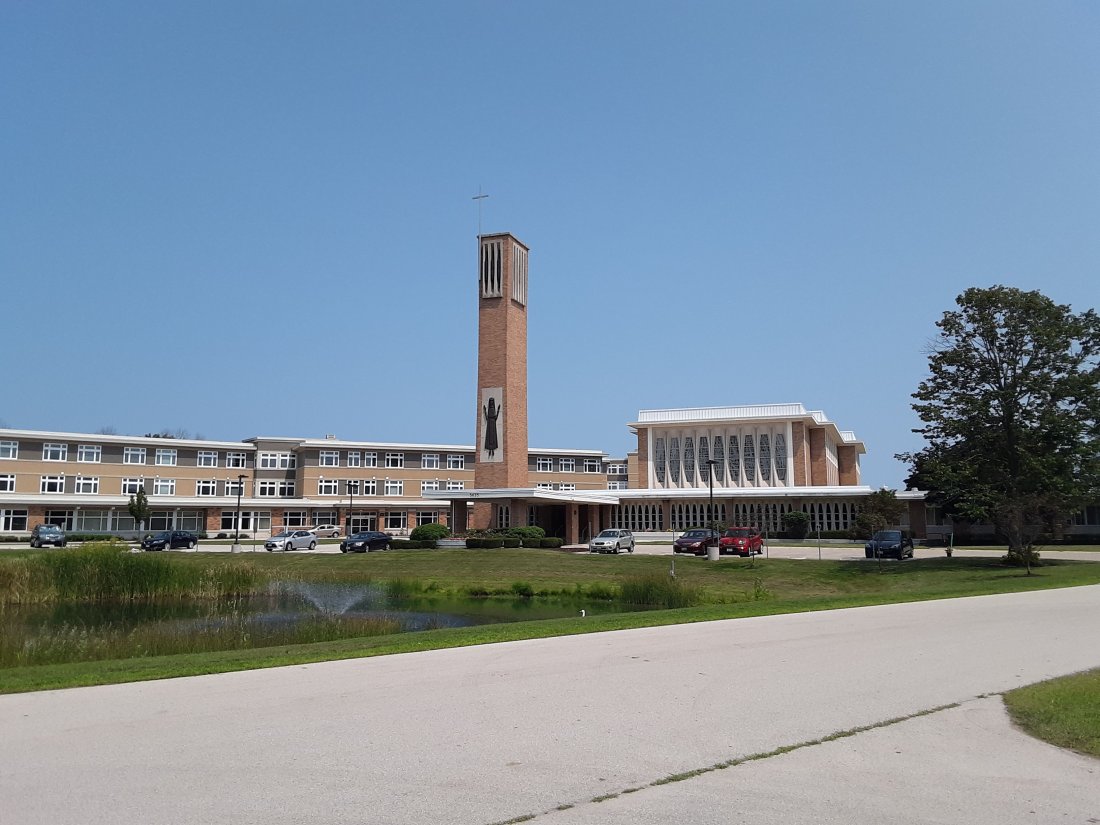
After a stupidly long train trip from Harpers Ferry to Chicago (6.5 hours late arriving) and another hour train from Chicago to Sturtevant, WI, I arrived at the >Siena Retreat Center< on Sunday, August 5. Siena is a ministry of the Dominican Sisters of Racine, and it’s a really lovely facility. There is still a convent there with a fairly small group of sisters who are faithfully living out their vows and their mission of praise, blessing, and preaching. I chose Siena fairly early in my planning process for the Grand Tour, as it is only an hour from Yerkes Observatory, and it looked like a beautiful site right on Lake Michigan with some interesting retreat offerings. These observations turned out to be accurate. It’s a beautiful place, a lovely setting, and I chose an interesting and challenging retreat.

The retreat I signed up for was about the only one I could fit into any plan for the Grand Tour that was open to men and Protestants. It also intrigued me. “Painting and Praying with Icons: Our Lady of the Sign” is what I selected. I remember when I was in seminary and we studied the Great Schism between the Eastern and Western Church in 1050 AD, which in no small part focused on the proper use or lack thereof of icons. It was the culmination of what I remember being called the iconoclast controversy. I sided with the iconoclasts, the side that believed icons were a violation of the second commandment. As with many things, I have mellowed on this issue a good bit. Nevertheless, the idea of actually painting (or “writing” as it is said) an icon and praying with it was definitely going to be a stretch! Spoiler, I did paint/write my icon, but its future in my prayer regimen remains in question.

So I have a collection of pictures from the retreat that are primarily showing the progression, step by step of my icon writing. It is a fascinating process, but a bit grueling for beginners to fit in a week. I expected that it would almost a paint by numbers process, and that there would be vary little room for variation from the proscribed structure of the icon. At our level of competence any way, this turned out not to be the case. While all (there were 17 of us in the retreat) of our icons are essentially the same, they are also wildly diverse in their style and detail. This is due to different levels of skill and experience in part, as some of us had never really done any painting before and some were 30-year art teachers. But it also was a product of choice and preference, and maybe also theological emphasis. Any way, in the end, the icons were as unique as the people in the room. I think this was a delightful outcome for our group and is also generally acceptable at the casual iconography level. If we were doing icons for a church installation, I think the rules are more rigid.

Let me say just a word more about the group. It was predominantly women and predominantly Catholic, but there were a few Protestants and a few men. Well, about three of each out of 17. Still. Quite a few of the women were sisters/religious, but only a couple were from Siena. One of the Protestant women was a pastor at Fourth Presbyterian Church in Chicago. Despite being in the minority in religious tradition, gender, and geography, I felt very much included in the group as a rule. Indeed, the group seemed to gel really well, being very supportive of one another and enjoying one another’s company. You know how in groups like this there is often that one person who is a thorn in the flesh? Well, unless it was me and I didn’t realize it, that thorn was not present.

Now, I did feel a bit like a stranger in a strange land in as much as many of the participants knew each other or knew the same people and places. Perhaps more than that were the distinct theological difference of belief and experience between Catholics and Presbyterians. The icon was of Mary and Jesus (more on that later), and my relationship with Mary is pretty academic. Meanwhile, for most of the Catholic folks, Mary is a present and active player in their daily life. For example, when we were finishing up, some of the women were complimenting my icon, and when I said I had never really painted before they were all the more impressed. One said, “She was really working through you, you can tell that!” I was caught completely off guard by this and had to spend quite a few moments figuring out who “she” was that was working. Of course it was Mary, but it never crossed my mind that Mary was as much author of my icon as its subject.

Okay, well, let’s get to the pictures. The link below will take you to an album full with some additional commentary on the process and the meaning of the icon itself, so I encourage you to go have a look. I say more about him in the album, but our instructor was Drazen Dupor from Croatia, and his website is >here<. Enjoyed getting to know him a bit.

Alright, alright. Enough talk. Let’s look at some >Platytera pictures<. There are a lot of near-duplicates, and some differences from one step to the next are pretty subtle, so you’ll have to pay attention. I’ll be glad to take your questions when you’re done.

And tomorrow, it’s on to the Yerkes Observatory, home of the largest refracting telescope in the world.

Picture this…. Observatories 1, 2, 3, and 4

I’ve been collecting pictures of my sabbatical travels, only a few of which have appeared here so far. I’m putting them on flickr. I think flickr is kind of out of favor, but I’ve got a terabyte of free space, so I’m going to use it. If you want to see my pics, you’ll have to use it, too.

[Update: I ended up putting all my photos on Google, so I’ve added those as secondary links in the descriptions. So you can see them at either Big G or flickr, or both.]

So here are the links for my travels so far. I still have to write up a few of these visits, and I’m about to embark on the Grand Tour, so expect more posts and more pics soon.

Green Bank Observatory

The Green Bank Observatory, Green Bank, WV, is a premiere radio astronomy site and a great place for a star party. Their largest instrument, featured here, is the enormous GBT, or more formally the Robert Byrd Green Bank Telescope, the largest fully steerable radio telescope in the world.

Hopkins Observatory

The Hopkins Observatory at Williams College, Williamstown, MA, is the oldest extent and continuous observatory in the United States, with 180 years under its belt. It has been moved on campus twice and hosts a small museum, a planetarium, and Alvan Clark’s first professional telescope, a 7″ refractor.

Princeton Theological Seminary

PTS is not an observatory, but it is my alma mater, and it’s one of my retreat stops. I didn’t spend as long as I had hoped there this trip, but I guess I spent long enough. Pics include my old hall, Miller Chapel, and the very spot where I met my wife, among others.

Holmdel Horn Antenna

The Holmdel Horn is a national historical landmark in Holmdel, NJ, but you have work to find it. It is on the campus of the Nokia lab on Holmdel Road, across the parking lot, up a hill, around the bend, and in the maintenance yard. It is important for being the instrument that found the first evidence of the Big Bang, namely the cosmic microwave background radiation.

Allegheny Observatory

The Allegheny Observatory is on my list primarily because it’s near my hometown, making it easy to also visit my dad and my daughter. It is, however, a pretty cool site with two impressive refracting telescopes. The smaller, the 13″ Fitz-Clark, was built by Fitz, later damaged, and then refigured by Alvan Clark near the height of his career, and we got to look at Jupiter through it. The big scope is called the Thaw (for its benefactor), a 30″ refractor, about 48 feet in length built by Brasheer Optics.

Coming up next…

This weekend I’ll travel by train to Racine, WI, to the Siena Retreat Center for a week, followed by a visit to the Yerkes Observatory, an important historical and scientific facility that is scheduled to close in October. Here’s hoping they find new patrons. After that, it looks like LIGO in Louisiana, then Arizona, southern Cal, back to Arizona, and New Mexico. That should wrap up by mid-September.