Touring Deep Time, Part 4

The intro is the same because, as I said at the end of Part 3, it’s series, you know? So be sure to read the previous episodes, Parts 1, 2, and 3.

On our recent tour through New Mexico and Arizona, my wife Molly and I found ourselves in the presence of some deep time. And by “found ourselves” I mean “planned our trip to be.” The trip included Ghost Ranch, a Presbyterian camp and conference center near Abiquiu in northern New Mexico, the Chaco Culture National Historical Park a couple hours west, Meteor Crater near Winslow, Arizona (which has its own little time loop), and the Grand Canyon in northern Arizona. An unscheduled but anticipated stop at Lowell Observatory in Flagstaff, AZ, fit into the scheme as well. Each site confronted us with history on scales from human generations to older than human civilization, to a significant fraction of the age of Planet Earth.

Grand Canyon

Our tour continued through deep time with a slight detour. On Monday we were in Flagstaff, AZ, which is the home of the Lowell Observatory. This had been one of my favorite stops in 2018, and while we didn’t have it scheduled, I was pleased that Molly wanted to see it. Certainly an observatory with instruments that helped identify the expansion of the universe, besides the discovery of Pluto and investigations of Mars and such, could be considered as part of our exploration of deep time. But I’m going to skip over it and stick to terrestrial and geological targets. Suffice it to say we had an enjoyable day of exploration at Lowell.

Tuesday morning started bright and early, a bit brighter and earlier than usual, as we were heading for the Big Ditch, the Grand Canyon. I had reserved spaces for us on an all-day tour with Canyon Dave Tours, a company that comes highly recommended for good reason. Our guide, Keaton, picked us up at our hotel in Flagstaff at 7:45 a.m. in a 10-(or so)-passenger van with the plan to pick up another couple in Wilson and another in the Grand Canyon National Park. That would be our entire tour group! We would see vistas and historically significant buildings and points of interest all along the South Rim, working our way around to the East Rim. Lunch was included. Keaton turned out to be a perfect tour guide with a wealth of knowledge on the canyon’s geology, flora and fauna, Native American habitations, and National Park history. Pretty much anything you would want to know about the Grand Canyon, Keaton had an answer. Plus, he was genuine and engaging with a good sense of when to jump in and when to leave space. At day’s end, Keaton drove us all back to where we belonged to the strains of Carlos Nakai, famed Native American flute virtuoso. Of our landmark tours, this was the most expensive, but it was also worth every dollar. But enough about the process. Let’s talk about the Canyon.

The Canyon

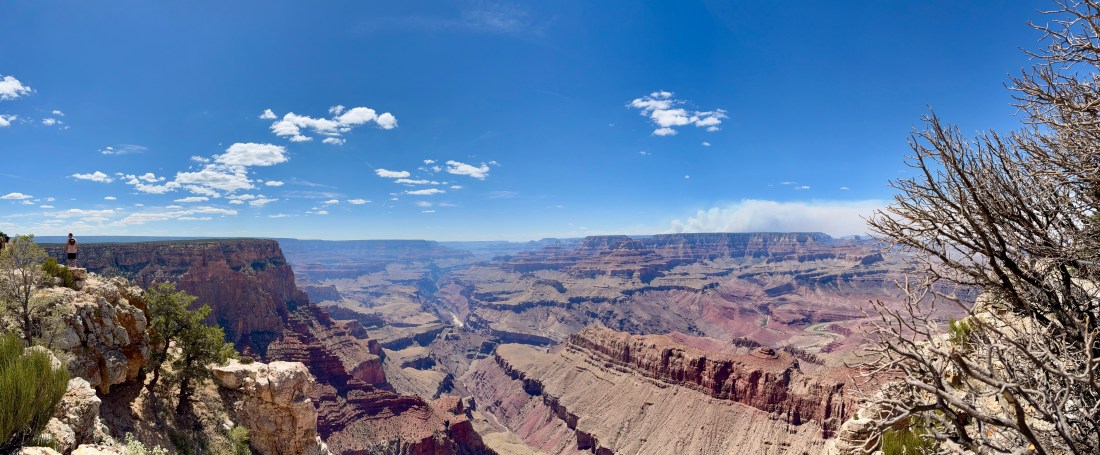
They always say that pictures don’t do it justice, and that turns out to be true. The Grand Canyon overwhelms one’s sense of scale at first sight. Standing between ten and 18 miles across from the South Rim to the North, between .75 and 1.25 miles in vertical depth, and 277 miles from end to end, this is the biggest canyon on Earth, at least on land. The Colorado River runs through the heart of it, having carved the canyon’s root over millenia. But as we learned, it is not the Colorado alone (averaging 300 ft. wide in the canyon) that made the canyon so wide. That was the work of various tributaries and erosion all along the length of the canyon on either side of the Colorado. The result is a spectacular display of revealed geologic layers in multiple shades of red, brown, green, gray, yellow, brown, and more.

Just as the layers of the mesas at Ghost Ranch revealed the ancient building and erosion of the landscape over millions of years, so the layers of the Grand Canyon reveal the same sort of processes, but going back much farther in time. In fact, the top of the canyon is about as old as the bottom of Ghost Ranch, about 270 million years. Think about that for just a moment. Standing at the rim of the Grand Canyon, you are starting at a point 1000X older than the modern human species of homo sapiens. You are starting at a time before dinosaurs appeared. You are starting in the era when all the continents were mashed together into a single landmass called Pangaea. The deeper you go, the older things get, and as we’ve seen, it gets pretty deep.

At the bottom of the canyon, the Colorado is currently cutting through layers called the Vishnu schist, or the Vishnu Basement, and beyond. These rocks are about 1.7 BILLION years old. That is about a third of the age of the planet. This is an era when the only life on the planet was single-celled, mostly bacteria and eventually some algae. Fungus was still a thing of the future. The atmosphere was still in the process of becoming oxygenated for the first time. There was only one supercontinent, but it is called Nuna, the great-grandparent of Pangaea. (Nuna would break up and recombine twice before Pangaea formed.)

In between the Vishnu Basement and the rim of the canyon are multiple layers of sandstone, shale, and limestone, each representing a different geologic era. They represent times when the canyon site was variously under an inland ocean or a dense forest or some other environment. The layers tell us of millions of years of deposits pressed down into solid rock. Think of the eons it would take to build up and compress enough sand, plants, and seashells to make a mile-deep mountain. Then think of the eons it would take to erode it all away so we can see it again.

Short Attention Span Eternity

The human mind is not adequately equipped to exist in timescapes that deep. So we can enjoy the glorious beauty of the Grand Canyon, and we can try to fathom its depth of time. But I think in the latter, we will ultimately fail. This is one of the reasons I wonder about God’s intention for us to live in eternity. Not that I don’t believe it. Not that I think God can’t make us fit for it. But as we are now, we can hardly process millions of years, much less billions. I mean, we get impatient waiting 30 seconds for the microwave to reheat our leftovers, or even a couple of seconds for a webpage to load. (Sorry about that big image at the top of the page.) If eternity is an infinitely-long linear time, we just aren’t ready. I believe we need to rethink how we talk about eternity and how we prepare people to live eternal life in this age, so we will be better prepared for the age to come.
Did you read the end first? Well, go back to read the rest! See also: Part 1, Part 2, Part 3

An Artistic Journey, Part 2

In my last entry I wrote about choosing a painting class at Ghost Ranch, about my lack of experience, training, and skill in painting, about the teacher’s fairly non-directive teaching style, about the first project – painting a landscape plein air – and about the initial results of my first attempt. Of particular interest for me about this first endeavor was overcoming my neurosis about needing to master a thing before I can try it. Right next door to that neurosis is a saying from Aunt Marty (a family friend kind of aunt) that I think I internalized as a child. She would often say, “I seldom fail! But then, I seldom try.” The fear of failure is a remarkable hindrance to living an adventurous life. In fact, although Aunt Marty (and I) seldom failed, there are many ways in which a non-failing life is not successful.

Keep Going

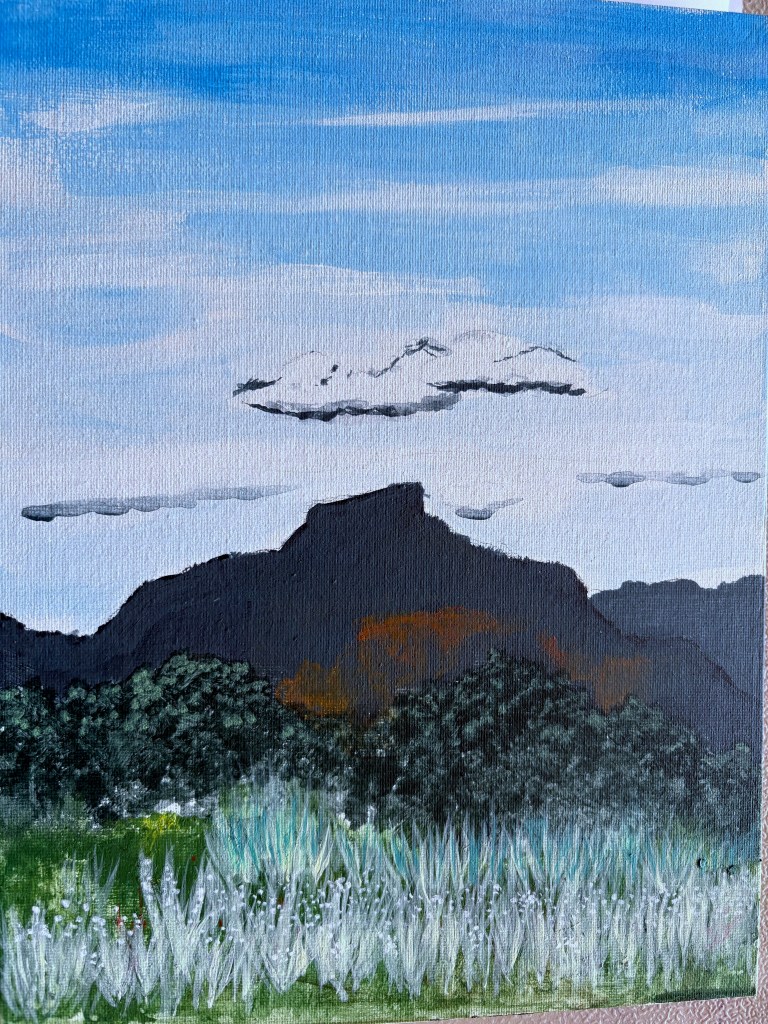
So, as I said previously, I made up my mind to try with this painting business. In the course of the week, I worked on three paintings. Some of my classmates produced that many in a day! While I am somewhat envious of their skill and capacity, I am not they, and that is not where I am. See how good I’m getting at giving myself grace and not comparing myself to others? Anyway, my three were that first landscape of Pedernal, another of Kitchen Mesa, and a still life. At the end of that first plein air session, I thought I was done with my painting. I even put a “D2” in the corner, my signature. Well, when we had a round-robin discussion in the class where we looked at everyone else’s work and offered comments, I got supportive comments of how they liked this or that about it, and several questions and suggestions of what I might do with it next. Next? Isn’t it done? Perhaps not. That one could continue working on a painting may seem obvious, but I guess I have watched too many episodes of Bob Ross’s Joy of Painting wherein he completes a work every half-hour show. So this was another point of my growth as an artist. I allowed as how perhaps I could continue working on my Pedernal, if only I could figure out how.

Another Target

I had a similar issue with my second painting, Kitchen Mesa. I was working on it from a photo I had taken so I could be inside. On a 9×12″ canvas board I penciled in the structures of clouds, mountain, and trees, and started in on the painting, working from top down. Calling on my experience with painting icons, I started a section with a dark base color and added progressively lighter colors on top of it. In iconography, this is a theological decision as much as artistic, to move from the darkness to the light. I still have no idea if that is what is ordinarily done in other styles of painting, but after watching my classmates working, I’d say not. Further, when KB, the instructor, came around to look at what I was doing, she was curious about my progression in that manner. Being a firm practitioner of the non-directive school, she offered suggestions of other possible methods, but insisted that if it worked for me, I should follow my path. I appreciated the permission giving, but the truth is I didn’t know if it was working or not.

The mesa has several distinct zones of different geology. There is a fairly dark, apparently dense rock that makes a kind of cap on the mesa. Maybe it isn’t actually dense, as there isn’t that much of it, either in width or depth. The next layer down is a pale yellow sandstone, and below that is an orange-red zone, almost salmon colored. There is an area of loose rock fall down the face of the red, and then, from where I was standing taking the picture, the trees take over the foreground. I’ll try to write about the geology in another post. As for my painting of these zones, as I said, I started at the top and I worked from dark to light. So that top cap came first. It has a number of vertical divisions. I overheard one of my classmates talking about trying to paint them in an earlier class, and she referred to them as the “teeth,” so that’s how I thought of them and referred to them. It turns out that wasn’t an official name as I imagined, but too bad. Now they’re called the Teeth of Kitchen Mesa. Anyway, using the iconographic approach, I actually got them to look pretty good! It took a lot of close, very detailed work. Usually I’m not a fan of details, but I kind of got into it with my icon painting, and I found it strangely engaging here, too.

I worked down to the sandstone zone. Here I ran into my lack of expertise with mixing paint to make the color you want. I couldn’t quite get the right tones or hues or values. I thought I could with layering, but my layers weren’t right either. I kept at it and got something blocked in, but I didn’t like it. Wrong color, wrong brush strokes, wrong texture to the sandstone, wrong, wrong, wrong. Again, in our review discussions, lots of positive comments on the sky and the “teeth”, and then encouragement to block in the rest of the colors and keep going. No one said, “that looks like crap,” or made me feel totally gross or morally bankrupt. I was encouraged, but I was also getting frustrated with the chasm between my desire and my product. I set the project aside until I could figure out what I was doing.

All this was on the first day of class.

Still Life Walking

On Tuesday, we started with a hike into the “back country” behind the art center toward the box canyon, if you know Ghost Ranch at all. If you don’t that’s okay. Suffice it to say it’s beautiful country, and it was a beautiful morning, and it was pretty flat walking. More views of more mesas and some of the beings that live on and around them, like lizards, bugs, and vultures. The goal of the expedition was to collect natural items from which to compose a still life. Again, KB, not wanting to make anyone do something that felt unnatural, wanted us each to compose our own items rather than her setting up one arrangement for all of us to paint. So not only don’t I know how to paint, I don’t know anything about arranging a still life, either. This was going to be great.

I found a handful of objects: two rocks, some yellow flowers, a stem of juniper, and a piece of …. wood? Yeah, I think it was wood. It had a lot of texture and a weird sage green color, and it was very crumbly. Let’s say it was wood. That was the easy part. Then, returning to the art center, I started trying to imagine how to arrange these things. All I can think of is the Dutch masters’ still life paintings, so I figure I need a table, some linen, a bowl, and maybe a skull? I don’t have nearly enough dark brown paint. Before long, KB came by, and I told her I was at a loss. She suggested just picking maybe three items, and then arrange them individually. Not so much an arrangement as a composition. That was a huge relief, really. I imagined being able to paint three items on their own much easier than trying to figure how to show them interacting. KB also recommended doing a neutral tone color wash on the canvas to 1) reduce the tyranny of the white canvas, 2) provide a background that would make the items stand out, and 3) I forget what 3 was. That seemed like a good idea, too, except I didn’t know how to do a neutral wash or what neutral tone meant. I took her recommendation under advisement for future consideration.

As I mentioned in the previous post, pencil drawing has always been more my thing. Since I felt like I was floundering with the paint, I decided to start this still life project by drawing the items in my sketchbook first. This would give me a sense of what I was looking at in terms of proportion and texture, it would focus my attention so I would “get to know” the items a little better, and it would give me a way to do art in a way I was comfortable with, just for a break. Well, if I’m honest, I was starting to doubt that I could actually do the painting. Drawing was a way to keep participating in the class without …. oh, what’s the word… trying. Or failing. Gosh, that runs deep. Nevertheless, drawing was comforting and productive and just what I needed to do at that point. KB wanted me to find my process. Drawing was going to be part of my process, one way or another.

Try. Fail. Learn. Keep Going.

Having completed sketches of my five items, I narrowed the field to three, as KB had suggested: the yellow flowers, the juniper branch, and the smaller, rounder, striped rock. Part of our class fees went to providing things to paint on, canvases, canvas boards, paper of different sorts, and so on. Somehow, all the 9×12″ canvas boards were gone already. I guess there weren’t that many to start with. That’s a pretty comfortable size for me, so I was disappointed. I didn’t feel like I was up to using an actual stretched canvas. So of the various options that remained, I went with a 12×16″ canvas board. This is so much bigger than I wanted. It’s a lot of white space for a beginner to fill. My already shaky confidence blanched before this white monolith. But come on, now, David. This is what you came for. Just go for it. I did. I sketched where I wanted my three items, and I started on the one I thought would be easiest, the yellow flowers. I started trying to mix the right shade of green for the stem and leaves. It’s a war between what nature has lain before me, the paints I have, my ineptitude, and my frugality that won’t let me waste anything. Nature loses. My green is far too bright, too blue, but again, I hope I can bring it down to where it “should” be in future applications. Besides, I don’t even know how to paint stems and leaves, so what difference does the color make? And you can’t just throw the paint away and not use it!

The painting itself doesn’t go any better. Even with my thinnest liner brush, my lines are fat, crude, uneven, overflowing. This is a disaster, a nightmare. What am I even doing here? What made me think I could paint? What a waste of time and money! I should just stop right now.

And yet…

Remember that you are a beginner. No one is here to judge you. This isn’t a competition. You are here because you wanted to learn and to grow. It doesn’t have to be perfect. It doesn’t even have to be good. It just has to be yours. You have talent. You can learn skills. Keep going.

So I did.

I went back to my sketchbook and practiced some ideas about how to do different kinds of strokes, using the extra bright green paint I didn’t want to waste. I practiced how I might make the petals of the flowers, and it looked good. I practiced some ideas for my Pedernal foreground. It didn’t take very long, and some of what I tried didn’t work, and some of it did.

I worked on Pedernal again, adding highlights to the mid-ground trees and adding grasses and flowers in the foreground. It was better.

I mixed some yellow that matched my flowers pretty well and added the petals to my painting. They got lost on the white canvas so I diluted some red paint and washed over them. It didn’t help! So I tried again with blue over the red. It didn’t help either! I took straight cobalt blue and very carefully painted around the petals and around the stems, and they all just popped! I practiced drawing my rock in my sketchbook with colored pencils, and then I painted it to look just like that, and it looked good. I painted around the rock with the cobalt blue, and it popped! I noticed that the boundary between where I stopped with the red wash (right in the middle of the canvas) and where it was just blue wash (at the top of the canvas) looked like the shape of Pedernal against the sky. I painted a thick, cobalt-blue, Pedernal-shaped line over that boundary. I connected the pools of blue around the two objects to the horizon line and to each other. I practiced and then painted the cow skull Ghost Ranch logo (originally be Georgia O’Keeffe!) at the top of the canvas, in place of the juniper branch.

And it was good.

What I Learned

I ended up really enjoying my painting class. I still don’t have much knowledge or skill, but I found a process, a path for doing art. As I spoke with classmates about my experience of nearly despairing and quitting before giving myself permission to just go ahead and ending up with something I really liked, several said they have had similar experiences. We even speculated that it is the nature of art to emerge with a push through the place of failure.

I learned about myself, of course, that I still wrestle with my perfectionism, and that I’m getting healthier about it. To offer grace to oneself to be less than “ideal” (whatever that is) is a gift of grace itself that comes, I believe, from a higher source. For that I am deeply grateful.

The Grand Tour

If you have been following this journey of mine at all you know it started with a few short loop trips and then culminated in a coast-to-coast-and-top-to-bottom train trip that I refer to as the Grand Tour. You may have seen my map, my photo dumps, and other summary material by now. I’d like to tell you how it came together, more or less.

Y’all ready for this? Um, no.

One of the odd things to me about the Grand Tour is how elusive it was, how resistant to prediction and preparation. Now, if you have read any of this blog, you know that exact preparation is not really my strong suit any way, but I am capable of it from time to time. But the Grand Tour defied my best efforts in many regards. In the months leading up to my sabbatical I had to come up with enough of a plan to secure approval from the session (the congregation’s ruling board) and the presbytery (regional governing body), as well as procuring funding. In this I was successful, plotting the many observatories I wanted to visit, considering location, historical significance, scientific significance, and diversity of electromagnetic wavelengths being studied, as well as several Christian retreat centers adjacent to some of the scientific sites. I was able to imagine well enough a tour where I could travel by train to these various sites in windows that would allow me to catch their often very limited public tours. In fact, I had more than one plan for reaching most of my desired destinations. Further, I was able to construct a reasonable budget for the whole business. I put together a package comprehensive enough that it won the necessary approvals and members of the church made offerings of about 160% of my budget! So I can plan stuff, see.

Nevertheless, whenever I tried to get more specific about the tour, to really nail down where I was going to be when, the complexity of it was overwhelming. Perhaps it’s just the way my mind and spirit work, but I couldn’t for the life of me get the thing to settle down to a single equilibrium state, as it were. So, while I continued trying to do, other milestones started popping up, and I just had to roll with it. The last session meeting before sabbatical came, and no Grand Tour plan. Sabbatical began, and no Grand Tour plan. The Green Bank Star Quest came, and no Grand Tour plan. So I went on that first leg, knowing I still had time. Then I went on the second leg to NY-MA-NJ, knowing there was still time.

Here, let’s pick up from my journal entry for August 4, 2018, which begins with a description of my trip to the Allegheny Observatory and visit with my dad for his birthday at the end of July. Let’s listen in…


Had started arranging the Grand Tour earlier that week [July 23 or so], including a retreat at the Siena Center in Racine, WI, for Aug. 5-11 and the night program at Yerkes Observatory on Aug. 13 – looking through the 40″ Clark refractor. Got home Monday [July 30] and Molly said, when is your retreat? I said August 5. “Oh, Sunday,” she said. “What? No!” I said. “Oh yes, Sunday is August 5,” she said. “#@¶*!,” I said. As things had started to come together, you see, they had changed from “go to Yerkes and come home” to “go to Yerkes and keep going!” That meant I had 4 days to get ready for a six-week trip!

This is madness! This. Is. SABBATICAL!! (Kicks your settled ass down the pit.)

So here I am on a train to Chicago!


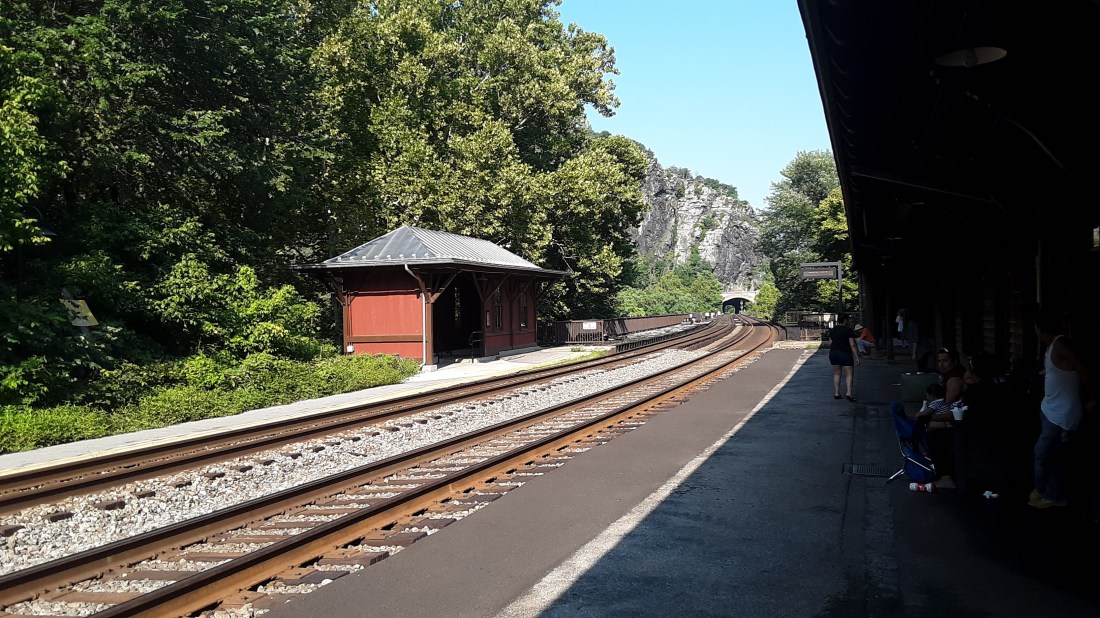
On the Capital Limited from Harpers Ferry to Chicago. In coach.

Pilgrimage is like that

And so it went. Chicago was the hub before getting to Racine for a week’s retreat. After the retreat, I spent another several days in Racine, much of which was spent making travel arrangements to get to New Orleans, get a place to stay, get a car, etc. While I was in New Orleans, I spent a lot of time arranging my travel to Arizona. While I was in Arizona I planned my trip to L.A., and while in L.A. I planned my travel to New Mexico. It was madness in some ways, and it took a lot of time and energy that I would have expected to be spending on reading the writings of the mystics and such, or praying, or seeing the less geeky sites, or just resting, or what have you. I do regret that a bit. But the funny thing is that everything fell into place just when it needed to. Particularly, I found nice places to stay at reasonable prices in usually expensive markets and in interesting residential, non-touristy neighborhoods. I had plenty of time for my observatory tours and got to most of the ones I wanted to see. I was able to stay pretty close to my budget. The other funny thing is how ironic it is that I had to do so very much planning the whole time when I always insist that I am no good at details and planning and that sort of thing. I don’t know, is that ironic or just a life lesson?

Let me wrap this up with some more from my journal from later that same day. Having reflected on my experiences and lack thereof in prayer during the sabbatical so far, I went on to record…

… So I prayed before bed Thursday night [8/2]. Again, [as during prayer at Miller Chapel in Princeton,] gratitude upon gratitude! Awareness of the rarity of this opportunity and experience, and its sacredness. I prayed, thankful for the privilege (with all that word carries these days); for protection for me and my family while we are apart; for providence while I’m on the road, that things will continue to fall into place; and for a pilgrim’s heart – that I not fall prey to tourism, but make this a truly sacred journey for the glory of God. This last became a powerful theme and led me at last to pray for great peace of heart, that I may be open to all who are around me and to opportunities to glorify God at every turn.

Last night I prayed with Molly before bed, and prayed much the same way. I feel like it really helped me in reframing this departure. I am a pilgrim now.

At the same time, I will be away from home for longer than I ever have been. I’lll be away from Molly for longer than I ever have been. I’d be lying if I said I’m not anxious about that. But why? Not any fear about our relationship. Just being away from home and heart for so long. Having things so unsettled for so long. Being out with strangers in strange lands for so long.

But then, isn’t that exactly what pilgrimage is about? Perhaps facing this, more than all else, is a lesson worth carrying back to the Church. Well, let’s maybe see how it turns out before we write that sermon, but yeah, keep it in the hopper for sure.

I did preach that when I got back. Might be time to revisit that theme of leaving the comfort of home for the wilds of the next destination where God is leading us. If for no other reason than I need to remind myself how good that can be.

Enjoy the ride.

10/21 – Making Sense of Things

I’ve been reading headlines and social media the last couple days. I don’t claim to be well informed about all the big topics, but between the big topics and the small topics, I find it very difficult to comprehend what people are thinking, or more to the point, why they are thinking it. I concluded this morning that I understand quantum physics better than what is going on in the world these days. No need to go into details, but nothing seems to make sense.

I also have been reading daily devotional emails from Fr. Richard Rohr, a popular contemplative Christian writer. The contemplative Christian tradition is also challenging to understand at times, especially for the Western thinker. We have been raised to think in categories, to separate things into “this” or “that,” and then to define our terms of “thisness” and “thatness.” We organize things and classify things and make decisions about whether a thing goes here or there. And that’s key, the word “or.” It’s a binary decision, “either/or.” But the contemplatives and mystics write about “and,” and about wholeness, and connection, and transcending “either/or” to find “both/and.” They seek after and often experience unity with God that radically changes their perception of everything around them, so that they seek and experience unity with them, too. They are not afraid to say that God lives in light and in darkness, and that we do, too. They are not afraid of brokenness, because they understand that God fills that space. They don’t have a compulsion to make everything right, because they know that God is in the midst of every situation. Things, situations, relationships, humans all become both earthy and heavenly, both broken and sacred, both sinful and redeemed, both material and spiritual, both mundane and holy.

A third stream in my consciousness comes from a book I read on my Grand Tour called Stars Beneath Us: Seeking God in the Evolving Cosmos by Paul Wallace, a physics professor who is also an ordained pastor. He writes about his own spiritual journey that started with a deep Christian faith that fell apart in the face of experience and science because it didn’t match reality as he perceived it. He went through years of agnosticism and not quite atheism, and then back to faith through the same reality and science that had challenge the faith of his youth. But when he came back to faith it was quite a different shape than that of his traditional upbringing. Any way, in the book, he points to Job as a model – the book, not just the man. Job lived a righteous and prosperous life, but God allowed Satan to test Job by destroying just about everything he had or was. Job writhed in his suffering trying to make sense of it and demanded an audience with God to get justice, or at least understanding. In the end, God shows up but never answers Job’s questions about the meaning of it all. God just leads Job on a journey, showing him all the corners of the cosmos where Job had never been, never considered, and never dared to go. And in all those place, God was there, and God delighted in what was there. God even loves the Leviathan, the mythical chaos monster of the deep! In the end, Job is satisfied, not because of logical answers, but because he realized that God is God, and “it’s not all about you.” Wallace offers, among other things, that we need to go on such a journey, too.

So as I am trying to make sense of this world, where people do absurd things for money, power, fame, rebellion, or spite, I turn to the cosmos. I think about the wonders of the universe, the really beautiful and really weird things going on in spacetime. I think about how we have come to know so much and still know so little. I have long had hopes that we would become a spacefaring species, colonizing worlds and systems and galaxies. Now I have less hope that we will achieve it and more doubts about whether we should inflict ourselves on the cosmos. I wish that more people would have a sense of the cosmos, like what Job got to see and what I think I have seen. Whether or not we ever get to Mars, God is there, delighting in its ice and dust. We may never know if there is life in the subsurface oceans of half a dozen worlds in our solar system, but in each of those oceans, God is there, rejoicing in the richness of the environment. Even if most people never know about what happens when two neutron stars collide, God is there, using dead stars to create worlds’ worth of gold, silver, platinum, and all manner of heavy elements, just to have them blown into space. We can’t see the primordial chaos right after the Big Bang from which all that we can see and experience was brought to birth, but God is there, maybe dancing and singing our universe into existence.

We are living in chaotic times, but God lives in chaos and brings forth new kinds of order. We live in a day when human affection seems to have run cold, but God promises to turn hearts of stone into hearts of flesh once more. We struggle with one another about what is just, what is fair, what is right, what is kind, but God sends the sun and the rain on both the righteous and the unrighteous, and God will hold those with means and status and privilege to account for how they treat the poor, the outcast, and the bereft.

Humility before the cosmos and humility before the Creator and humility before our fellow creatures are common threads I find in my (admittedly scant) study of both science and contemplative theology. Faithfulness is another; faithfulness to the pursuit of knowledge for the betterment of our species in science, and faithfulness to experiencing and expressing the absolute love of God for all creatures among the mystics. So I think these will be my guideposts for navigating these days. I will try to be humble, to learn, to be faithful, to love. I will try to work for change.


Pictures from My Siena Retreat

I have so much to write about, and I’m so far behind! I hope you took opportunity to look at the pictures at the links I posted last time. I hope you enjoyed doing that, because I’m sending you another set the same way.  But not at the same place.

I got a new phone for the Grand Tour. A smart phone. My first smart phone. Yes, I know, but my old flippy was just fine and no one ever tried to hack it, I’m pretty sure. Any way, the new phone is also my new camera, of course. And in a major breach of Douthett etiquette, it’s not an iPhone but an Android-running Samsung thing. It cost about a third of what an iPhone would have been, so I got it. Fine, I’m cheap. I can live with that. But I digress. Any way, since it’s an Android, it syncs with Google Photos, so that’s where my pics are going at this point.

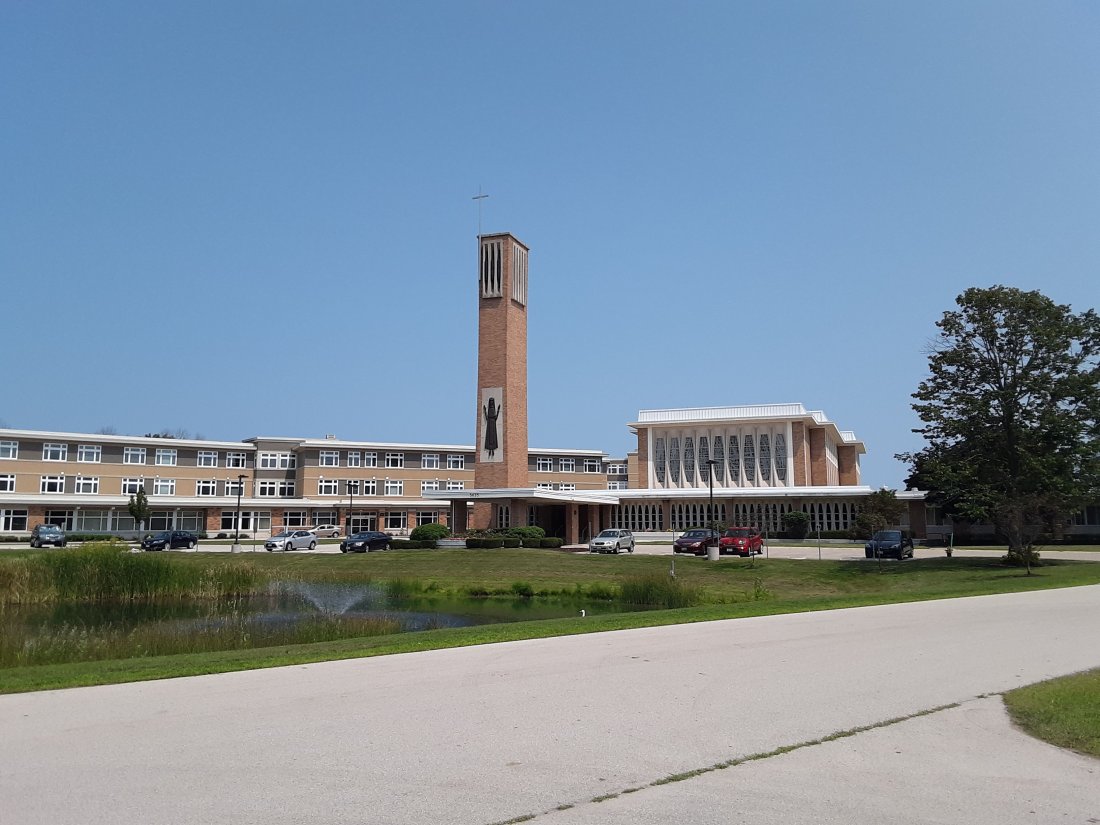
After a stupidly long train trip from Harpers Ferry to Chicago (6.5 hours late arriving) and another hour train from Chicago to Sturtevant, WI, I arrived at the >Siena Retreat Center< on Sunday, August 5. Siena is a ministry of the Dominican Sisters of Racine, and it’s a really lovely facility. There is still a convent there with a fairly small group of sisters who are faithfully living out their vows and their mission of praise, blessing, and preaching. I chose Siena fairly early in my planning process for the Grand Tour, as it is only an hour from Yerkes Observatory, and it looked like a beautiful site right on Lake Michigan with some interesting retreat offerings. These observations turned out to be accurate. It’s a beautiful place, a lovely setting, and I chose an interesting and challenging retreat.

The retreat I signed up for was about the only one I could fit into any plan for the Grand Tour that was open to men and Protestants. It also intrigued me. “Painting and Praying with Icons: Our Lady of the Sign” is what I selected. I remember when I was in seminary and we studied the Great Schism between the Eastern and Western Church in 1050 AD, which in no small part focused on the proper use or lack thereof of icons. It was the culmination of what I remember being called the iconoclast controversy. I sided with the iconoclasts, the side that believed icons were a violation of the second commandment. As with many things, I have mellowed on this issue a good bit. Nevertheless, the idea of actually painting (or “writing” as it is said) an icon and praying with it was definitely going to be a stretch! Spoiler, I did paint/write my icon, but its future in my prayer regimen remains in question.

So I have a collection of pictures from the retreat that are primarily showing the progression, step by step of my icon writing. It is a fascinating process, but a bit grueling for beginners to fit in a week. I expected that it would almost a paint by numbers process, and that there would be vary little room for variation from the proscribed structure of the icon. At our level of competence any way, this turned out not to be the case. While all (there were 17 of us in the retreat) of our icons are essentially the same, they are also wildly diverse in their style and detail. This is due to different levels of skill and experience in part, as some of us had never really done any painting before and some were 30-year art teachers. But it also was a product of choice and preference, and maybe also theological emphasis. Any way, in the end, the icons were as unique as the people in the room. I think this was a delightful outcome for our group and is also generally acceptable at the casual iconography level. If we were doing icons for a church installation, I think the rules are more rigid.

Let me say just a word more about the group. It was predominantly women and predominantly Catholic, but there were a few Protestants and a few men. Well, about three of each out of 17. Still. Quite a few of the women were sisters/religious, but only a couple were from Siena. One of the Protestant women was a pastor at Fourth Presbyterian Church in Chicago. Despite being in the minority in religious tradition, gender, and geography, I felt very much included in the group as a rule. Indeed, the group seemed to gel really well, being very supportive of one another and enjoying one another’s company. You know how in groups like this there is often that one person who is a thorn in the flesh? Well, unless it was me and I didn’t realize it, that thorn was not present.

Now, I did feel a bit like a stranger in a strange land in as much as many of the participants knew each other or knew the same people and places. Perhaps more than that were the distinct theological difference of belief and experience between Catholics and Presbyterians. The icon was of Mary and Jesus (more on that later), and my relationship with Mary is pretty academic. Meanwhile, for most of the Catholic folks, Mary is a present and active player in their daily life. For example, when we were finishing up, some of the women were complimenting my icon, and when I said I had never really painted before they were all the more impressed. One said, “She was really working through you, you can tell that!” I was caught completely off guard by this and had to spend quite a few moments figuring out who “she” was that was working. Of course it was Mary, but it never crossed my mind that Mary was as much author of my icon as its subject.

Okay, well, let’s get to the pictures. The link below will take you to an album full with some additional commentary on the process and the meaning of the icon itself, so I encourage you to go have a look. I say more about him in the album, but our instructor was Drazen Dupor from Croatia, and his website is >here<. Enjoyed getting to know him a bit.

Alright, alright. Enough talk. Let’s look at some >Platytera pictures<. There are a lot of near-duplicates, and some differences from one step to the next are pretty subtle, so you’ll have to pay attention. I’ll be glad to take your questions when you’re done.

And tomorrow, it’s on to the Yerkes Observatory, home of the largest refracting telescope in the world.