Touring Deep Time, Part 4

The intro is the same because, as I said at the end of Part 3, it’s series, you know? So be sure to read the previous episodes, Parts 1, 2, and 3.

On our recent tour through New Mexico and Arizona, my wife Molly and I found ourselves in the presence of some deep time. And by “found ourselves” I mean “planned our trip to be.” The trip included Ghost Ranch, a Presbyterian camp and conference center near Abiquiu in northern New Mexico, the Chaco Culture National Historical Park a couple hours west, Meteor Crater near Winslow, Arizona (which has its own little time loop), and the Grand Canyon in northern Arizona. An unscheduled but anticipated stop at Lowell Observatory in Flagstaff, AZ, fit into the scheme as well. Each site confronted us with history on scales from human generations to older than human civilization, to a significant fraction of the age of Planet Earth.

Grand Canyon

Our tour continued through deep time with a slight detour. On Monday we were in Flagstaff, AZ, which is the home of the Lowell Observatory. This had been one of my favorite stops in 2018, and while we didn’t have it scheduled, I was pleased that Molly wanted to see it. Certainly an observatory with instruments that helped identify the expansion of the universe, besides the discovery of Pluto and investigations of Mars and such, could be considered as part of our exploration of deep time. But I’m going to skip over it and stick to terrestrial and geological targets. Suffice it to say we had an enjoyable day of exploration at Lowell.

Tuesday morning started bright and early, a bit brighter and earlier than usual, as we were heading for the Big Ditch, the Grand Canyon. I had reserved spaces for us on an all-day tour with Canyon Dave Tours, a company that comes highly recommended for good reason. Our guide, Keaton, picked us up at our hotel in Flagstaff at 7:45 a.m. in a 10-(or so)-passenger van with the plan to pick up another couple in Wilson and another in the Grand Canyon National Park. That would be our entire tour group! We would see vistas and historically significant buildings and points of interest all along the South Rim, working our way around to the East Rim. Lunch was included. Keaton turned out to be a perfect tour guide with a wealth of knowledge on the canyon’s geology, flora and fauna, Native American habitations, and National Park history. Pretty much anything you would want to know about the Grand Canyon, Keaton had an answer. Plus, he was genuine and engaging with a good sense of when to jump in and when to leave space. At day’s end, Keaton drove us all back to where we belonged to the strains of Carlos Nakai, famed Native American flute virtuoso. Of our landmark tours, this was the most expensive, but it was also worth every dollar. But enough about the process. Let’s talk about the Canyon.

The Canyon

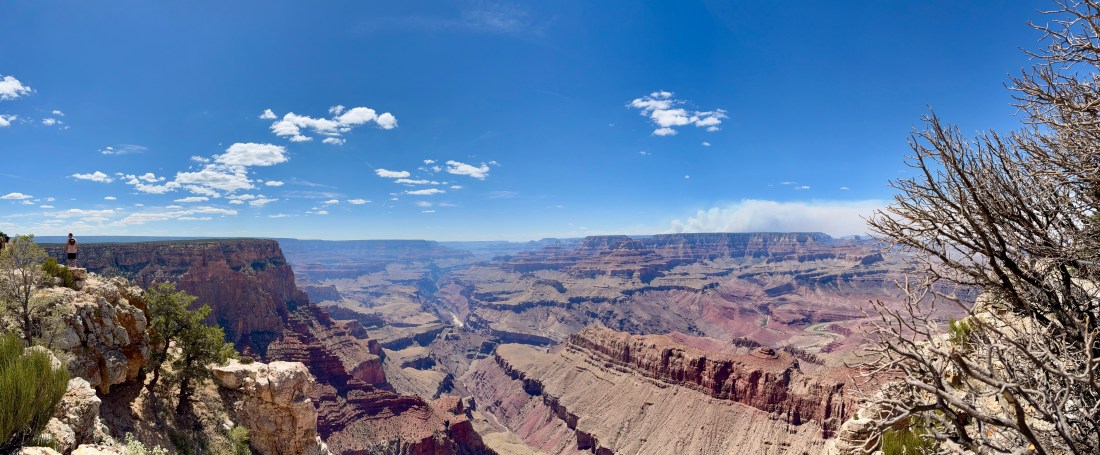
They always say that pictures don’t do it justice, and that turns out to be true. The Grand Canyon overwhelms one’s sense of scale at first sight. Standing between ten and 18 miles across from the South Rim to the North, between .75 and 1.25 miles in vertical depth, and 277 miles from end to end, this is the biggest canyon on Earth, at least on land. The Colorado River runs through the heart of it, having carved the canyon’s root over millenia. But as we learned, it is not the Colorado alone (averaging 300 ft. wide in the canyon) that made the canyon so wide. That was the work of various tributaries and erosion all along the length of the canyon on either side of the Colorado. The result is a spectacular display of revealed geologic layers in multiple shades of red, brown, green, gray, yellow, brown, and more.

Just as the layers of the mesas at Ghost Ranch revealed the ancient building and erosion of the landscape over millions of years, so the layers of the Grand Canyon reveal the same sort of processes, but going back much farther in time. In fact, the top of the canyon is about as old as the bottom of Ghost Ranch, about 270 million years. Think about that for just a moment. Standing at the rim of the Grand Canyon, you are starting at a point 1000X older than the modern human species of homo sapiens. You are starting at a time before dinosaurs appeared. You are starting in the era when all the continents were mashed together into a single landmass called Pangaea. The deeper you go, the older things get, and as we’ve seen, it gets pretty deep.

At the bottom of the canyon, the Colorado is currently cutting through layers called the Vishnu schist, or the Vishnu Basement, and beyond. These rocks are about 1.7 BILLION years old. That is about a third of the age of the planet. This is an era when the only life on the planet was single-celled, mostly bacteria and eventually some algae. Fungus was still a thing of the future. The atmosphere was still in the process of becoming oxygenated for the first time. There was only one supercontinent, but it is called Nuna, the great-grandparent of Pangaea. (Nuna would break up and recombine twice before Pangaea formed.)

In between the Vishnu Basement and the rim of the canyon are multiple layers of sandstone, shale, and limestone, each representing a different geologic era. They represent times when the canyon site was variously under an inland ocean or a dense forest or some other environment. The layers tell us of millions of years of deposits pressed down into solid rock. Think of the eons it would take to build up and compress enough sand, plants, and seashells to make a mile-deep mountain. Then think of the eons it would take to erode it all away so we can see it again.

Short Attention Span Eternity

The human mind is not adequately equipped to exist in timescapes that deep. So we can enjoy the glorious beauty of the Grand Canyon, and we can try to fathom its depth of time. But I think in the latter, we will ultimately fail. This is one of the reasons I wonder about God’s intention for us to live in eternity. Not that I don’t believe it. Not that I think God can’t make us fit for it. But as we are now, we can hardly process millions of years, much less billions. I mean, we get impatient waiting 30 seconds for the microwave to reheat our leftovers, or even a couple of seconds for a webpage to load. (Sorry about that big image at the top of the page.) If eternity is an infinitely-long linear time, we just aren’t ready. I believe we need to rethink how we talk about eternity and how we prepare people to live eternal life in this age, so we will be better prepared for the age to come.

Did you read the end first? Well, go back to read the rest! See also: Part 1, Part 2, Part 3

Here We Go Again!

Can you believe it’s been seven years since my Grand Tour that occasioned this blog? Well, if you are among my ones and ones of followers, you might recognize the fact. It hardly seems possible that it was that long ago. At the same time, the world has changed dramatically since 2018, and that Tour seems like a lifetime ago!

If you don’t know, the Grand Tour was the bulk of my 2018 sabbatical in which I visited 17 astronomical observatories and facilities in nine states in under three months. It was an amazing journey of history, cutting edge science, and discovery. I grew to admire the incredibly detailed work of scientists, the remarkable persistence it requires of them, and the ingenuity and cleverness they deploy to make fantastic discoveries about the universe and our place in it. I mean, that’s a lot of superlatives right there, and it barely scratches the surface of what they do. To learn more about it, just go through my blog posts about it.

Now, it’s 2025, seven years later, and time for another sabbatical. This time, I got it in my mind to work on a book about time and eternity from scientific and theological points of view. This came to me last year when we were on our way across Texas to see the solar eclipse. I was thinking about a summer preaching series, and the eclipse put me in mind of the timing of the movements of the spheres. We happen to live in an era when the moon is just the right distance from the earth to match the apparent size of the sun to create a total eclipse. This doesn’t happen just everywhere in the universe, and it doesn’t happen forever. in a few million years the moon will have moved further from earth and won’t be able to cover the whole solar disk. So we live in a remarkable time. That’s what got me thinking about time as a sermon series theme. Then I realized I could make it into a book during this sabbatical! So that’s been the plan.

As it happens, I now suspect that it is impossible to write a book of much substance in three months. So I’ve scaled back my expectations a bit but still plan to work on the project. I’m thinking about questions like: What is the nature of time? Why do we bother with it at all? Does the past persist? Where does the future come from? What is eternity, and how long is it really? Would humans actually enjoy living forever? Does our view of eternity affect how we behave in this life? I have so many questions! The idea is to consider them scientifically and from a particular Christian framework in a way that is accessible, thought provoking, and maybe even fun. We’ll see how that all turns out. At this point I’m imagining a collection of essays that could be the basis for sermons, lessons, and a deeper book in the future.

Meanwhile, Molly and I have just celebrated our 35th wedding anniversary – hurray! So as part of the sabbatical and as a celebratory trip, we are going out west. We will spend a week at Ghost Ranch, a Presbyterian conference center in northern New Mexico. Each of us is taking a class – Molly on writing children’s books and me on painting still-life and landscapes. Then we’re going to Chaco Canyon National Historical Park, a Native American heritage site that I had hoped to get to on the Grand Tour of ’18. The site includes a number of archaeo-astronomical installations to mark solstices and equinoxes and such. It would have been the oldest observatory on my previous tour. Now it will be a stepping stone in considering deep time for life on earth. And the stepping stones get older and deeper! After Chaco, we will visit Meteor Crater near Winslow, AZ, and then the Grand Canyon. I hope these big holes in the ground will give me a richer sense of the passage of geological time that might just make it into the book.

So there you go! That’s what I’m going to be up to for the next few weeks and months. I hope to keep the updates coming here, and I hope you’ll come along for the ride. It’s going to be a fun time!

10/21 – Making Sense of Things

I’ve been reading headlines and social media the last couple days. I don’t claim to be well informed about all the big topics, but between the big topics and the small topics, I find it very difficult to comprehend what people are thinking, or more to the point, why they are thinking it. I concluded this morning that I understand quantum physics better than what is going on in the world these days. No need to go into details, but nothing seems to make sense.

I also have been reading daily devotional emails from Fr. Richard Rohr, a popular contemplative Christian writer. The contemplative Christian tradition is also challenging to understand at times, especially for the Western thinker. We have been raised to think in categories, to separate things into “this” or “that,” and then to define our terms of “thisness” and “thatness.” We organize things and classify things and make decisions about whether a thing goes here or there. And that’s key, the word “or.” It’s a binary decision, “either/or.” But the contemplatives and mystics write about “and,” and about wholeness, and connection, and transcending “either/or” to find “both/and.” They seek after and often experience unity with God that radically changes their perception of everything around them, so that they seek and experience unity with them, too. They are not afraid to say that God lives in light and in darkness, and that we do, too. They are not afraid of brokenness, because they understand that God fills that space. They don’t have a compulsion to make everything right, because they know that God is in the midst of every situation. Things, situations, relationships, humans all become both earthy and heavenly, both broken and sacred, both sinful and redeemed, both material and spiritual, both mundane and holy.

A third stream in my consciousness comes from a book I read on my Grand Tour called Stars Beneath Us: Seeking God in the Evolving Cosmos by Paul Wallace, a physics professor who is also an ordained pastor. He writes about his own spiritual journey that started with a deep Christian faith that fell apart in the face of experience and science because it didn’t match reality as he perceived it. He went through years of agnosticism and not quite atheism, and then back to faith through the same reality and science that had challenge the faith of his youth. But when he came back to faith it was quite a different shape than that of his traditional upbringing. Any way, in the book, he points to Job as a model – the book, not just the man. Job lived a righteous and prosperous life, but God allowed Satan to test Job by destroying just about everything he had or was. Job writhed in his suffering trying to make sense of it and demanded an audience with God to get justice, or at least understanding. In the end, God shows up but never answers Job’s questions about the meaning of it all. God just leads Job on a journey, showing him all the corners of the cosmos where Job had never been, never considered, and never dared to go. And in all those place, God was there, and God delighted in what was there. God even loves the Leviathan, the mythical chaos monster of the deep! In the end, Job is satisfied, not because of logical answers, but because he realized that God is God, and “it’s not all about you.” Wallace offers, among other things, that we need to go on such a journey, too.

So as I am trying to make sense of this world, where people do absurd things for money, power, fame, rebellion, or spite, I turn to the cosmos. I think about the wonders of the universe, the really beautiful and really weird things going on in spacetime. I think about how we have come to know so much and still know so little. I have long had hopes that we would become a spacefaring species, colonizing worlds and systems and galaxies. Now I have less hope that we will achieve it and more doubts about whether we should inflict ourselves on the cosmos. I wish that more people would have a sense of the cosmos, like what Job got to see and what I think I have seen. Whether or not we ever get to Mars, God is there, delighting in its ice and dust. We may never know if there is life in the subsurface oceans of half a dozen worlds in our solar system, but in each of those oceans, God is there, rejoicing in the richness of the environment. Even if most people never know about what happens when two neutron stars collide, God is there, using dead stars to create worlds’ worth of gold, silver, platinum, and all manner of heavy elements, just to have them blown into space. We can’t see the primordial chaos right after the Big Bang from which all that we can see and experience was brought to birth, but God is there, maybe dancing and singing our universe into existence.

We are living in chaotic times, but God lives in chaos and brings forth new kinds of order. We live in a day when human affection seems to have run cold, but God promises to turn hearts of stone into hearts of flesh once more. We struggle with one another about what is just, what is fair, what is right, what is kind, but God sends the sun and the rain on both the righteous and the unrighteous, and God will hold those with means and status and privilege to account for how they treat the poor, the outcast, and the bereft.

Humility before the cosmos and humility before the Creator and humility before our fellow creatures are common threads I find in my (admittedly scant) study of both science and contemplative theology. Faithfulness is another; faithfulness to the pursuit of knowledge for the betterment of our species in science, and faithfulness to experiencing and expressing the absolute love of God for all creatures among the mystics. So I think these will be my guideposts for navigating these days. I will try to be humble, to learn, to be faithful, to love. I will try to work for change.