A Great American Pastime

I went to my first baseball game when I was four years old. It was at Forbes Field in Pittsburgh with my dad, almost certainly my brother (although I don’t remember), and I assume the Swedish exchange student who was living with us. I have only very faint, fragmentary memories of it, but I think it settled in pretty deep. Baseball has always been my favorite sport. Not that I ever played the game. Some softball here and there, but I think even as a kid I had a need to have mastered a thing before I could try it. So I never let myself join a little league team. I know, I know.

Anyway, I was still a fan, especially of the Pittsburgh Pirates. I knew all the players, the lineup, the stats (such as they were in the day), the standings. Of course, I collected baseball cards. In fourth grade I had stacks of hundreds of cards, but my prized possession was the complete collection of the whole 1971 Pirates team, which I still have. That was a lot of bubblegum.

Even at that, my baseball fandom pales compared to my son, Jacob. He started with tee-ball when he was little and went on to play Little League for several years. He opted for band when he got to high school but kept a love for the game. Through his college years our local team, the Washington Nationals, were actually playing some good ball, and Jake was all about it. He got the gene that skipped me that allows him to retain and recall all the stats of all the players of all the teams for decades worth of seasons. When his mom picked him up from college for spring break one year and asked, “What’s up with the Nats this year?” he talked for all of the three hour drive home. His passion has cooled some over the last couple years, just as the Nats have, but he still loves the game.

When I was planning my sabbatical for this year I wanted to include something that Jacob and I could do together. As you might guess by now, it occurred to me to do something related to baseball. We are within a day’s drive of Cooperstown, NY, and the National Baseball Hall of Fame. That seemed like a good idea. It got better when I realized the Little League World Series in Williamsport, PA, would be on the way and in the right timeframe. If it was going to be something of a pilgrimage, then it wouldn’t be that much more to go from Cooperstown to New York City to go to Yankee Stadium. Neither of us is a Yankees fan, but they are surely the most storied and iconic team in the majors. When I introduced the idea, Jake was immediately on board. I started mapping it out and looking for schedules, tickets, hotels, and whatnot. We both noticed that the basic track took us 3 1/2 hours from home to Williamsport, about 3 1/2 hours to Cooperstown, about 3 1/2 hours to New York, and about 4 hours home. It’s practically a baseball diamond! This was going to be great.

First Base: Little League World Series

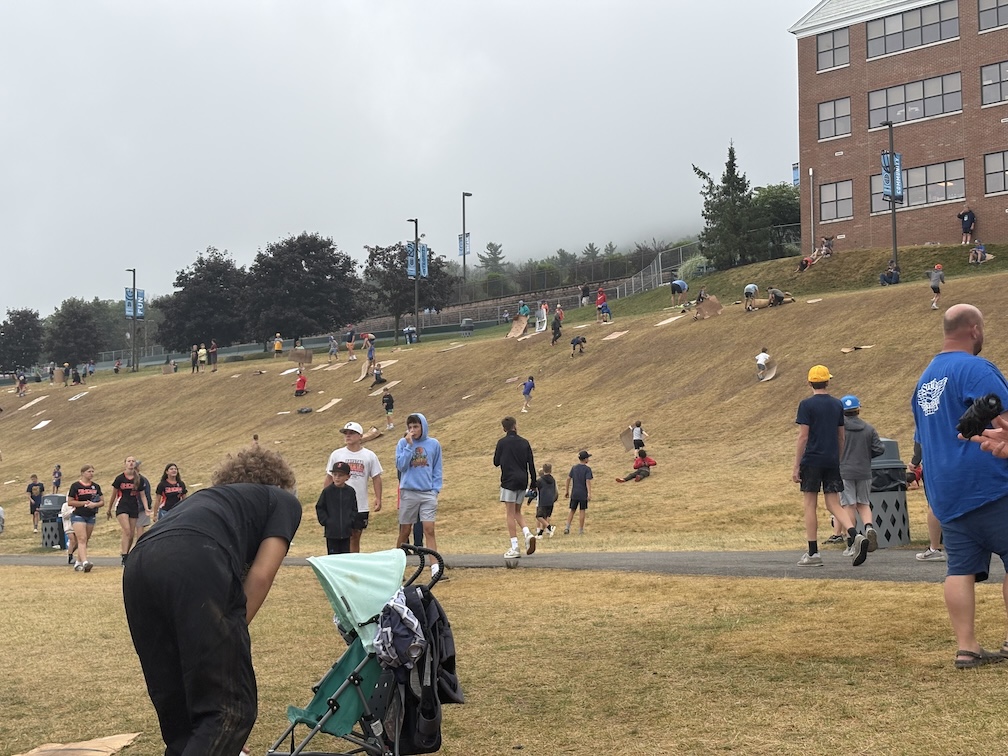
I’ve always wanted to go to the Little League World Series, so I was excited to start our tour this way. We got to Williamsport at about 1:00 p.m. on Wednesday, August 20, just as the first of four semifinal games for the day and the tournament was beginning. The Little League International Complex is a sizable venue with two large stadiums (in little league terms), several practice fields, food vendors, a dining pavilion, restrooms, first aid building, Little League headquarters, a museum, and of course a gift shop. The newer stadium, Volunteer Stadium, is the smaller of the two, and it is used for international teams, while the older LaMade (LAH-mah-dee) Stadium is where the U.S. regional games and the World Series final are played. Both have seating for several thousand spectators, although LaMade has seating on the grass hill in the outfield, which is a big part of the tradition. The hill is high enough that the top section is primarily used by kids with flattened cardboard boxes to sled down the grass without interfering with the majority of spectators. But I’m getting ahead of myself. When we arrived, all three large (free!) parking lots were already full, and townsfolk were making some coin by using their yards and spare properties to park cars. So for $10 we found a place that was reasonably close to the complex and away from the flow of crowds.

One of the amazing things about the Little League World Series is that admission is free. Free to enter the complex, free for all the games. It’s as if they consider it a public good that should be open to anyone and everyone, so it is. I think that’s awesome. Of course you pay for food and drinks, but honestly, the prices weren’t as bad as I expected. And they have a swag shop, as I said. We didn’t stop, and I suppose it isn’t cheap, but it is voluntary. You could go and not pay a thing if you work it right. So we just walked right in.
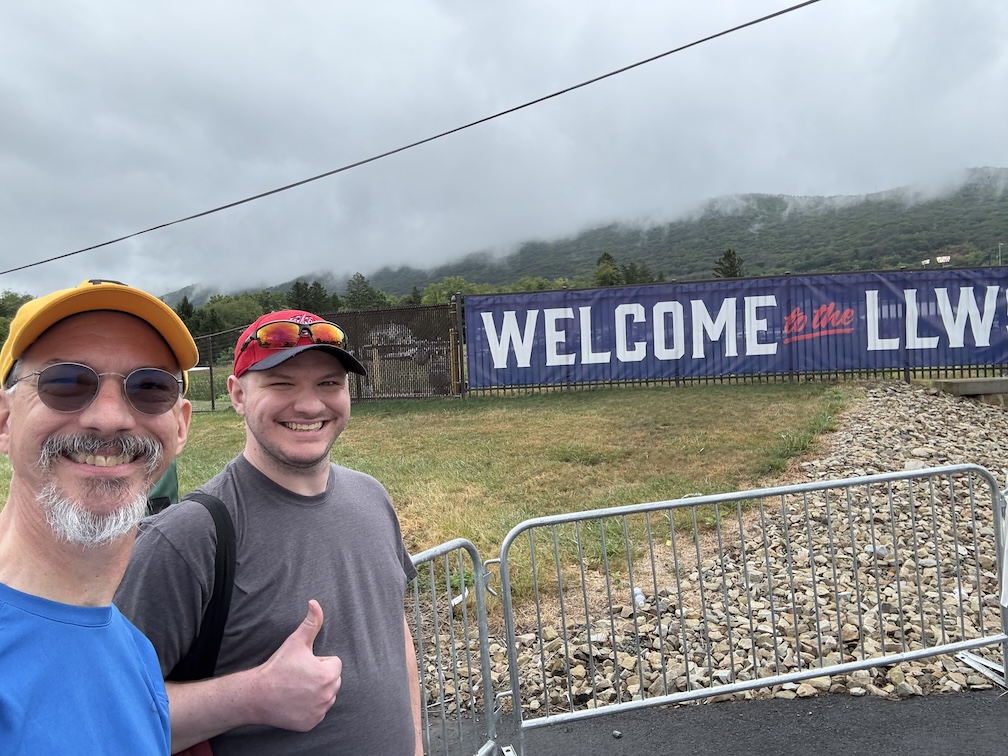
We arrived at the Little League World Series International Complex in Williamsport, PA

The weather was, as they might say in Scotland, “a bit of low cloud,” that is heavy clouds, misty, and spitting rain. It looked as though we had arrived just after a good storm, really. We made our way to Volunteer Stadium and found some open seats in the bleachers that weren’t too terribly wet. It was warm enough that we could sit on our jackets instead of wearing them, so that was good. Williamsport is hilly country, and the complex is built on a hill with some pretty steep peaks just behind. These were hung with misty clouds.

Notwithstanding, the game was on between Latin America (Venezuela) and Asia-Pacific (Chinese Taipei). The players appeared to be upper elementary to middle school age. Asia-Pacific had scored a couple runs before we got there, but after that it was kind of a slow game without much hitting. The pitching was really pretty good for both teams. Only a couple of balls got out of the infield, and they were all handled pretty easily. The announcers did (as far as I can tell) a really good job pronouncing all the kids’ names. I was impressed. After the fourth inning we both needed some food, so we went searching. It was still about an hour before the next game started in LaMade Stadium, but people were starting to move in that direction already. We decided to do the same. Jake wanted to sit on the hill, and that was fine with me. We went and set up our folding chairs behind right field, looking down the first base line, just at the brow of the hill, and ate our lunch. Meanwhile, at Volunteer Stadium, someone turned up the action meter after we left. Asia-Pacific beat Latin America 7-3. Oh well. [Recap video here]
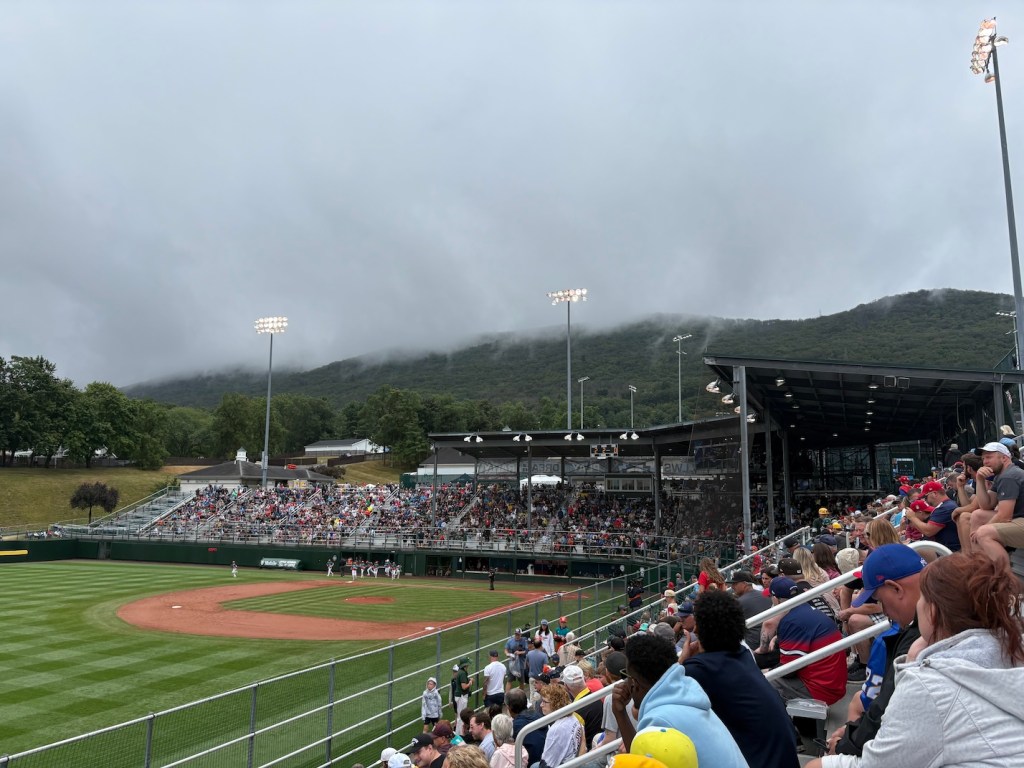
Volunteer Stadium, home of the International Regional games at LLWS

The second game of the day was Mountain (Nevada) vs. Metro (Connecticut). This was a much more energetic and aggressive game, with both teams getting lots of hits. The level of play was very good, especially having watched my share of Little League games back home when Jake was still playing. I mean, there were good and bad teams in our leagues, and they had good and bad days, but these teams were both playing really good baseball. There were some great fielding plays, a couple of home runs, besides some consistent pitching. When the dust settled, it was Metro on top, again by the score of 7-3, but this one was exciting from top to bottom. [Recap video here]
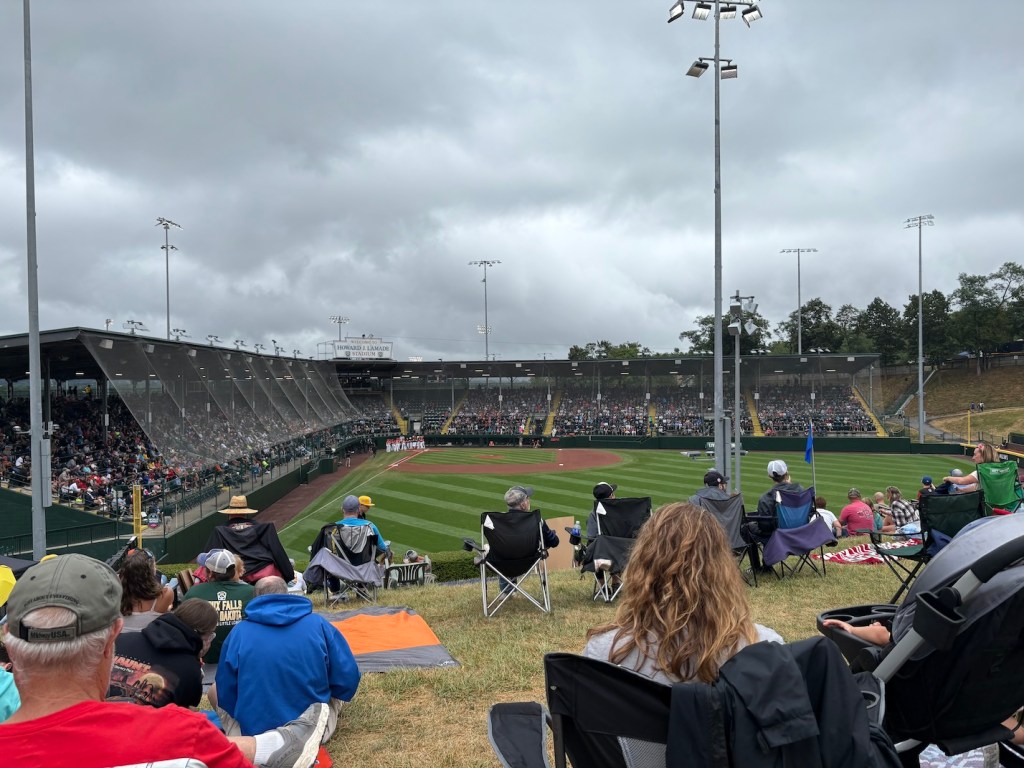
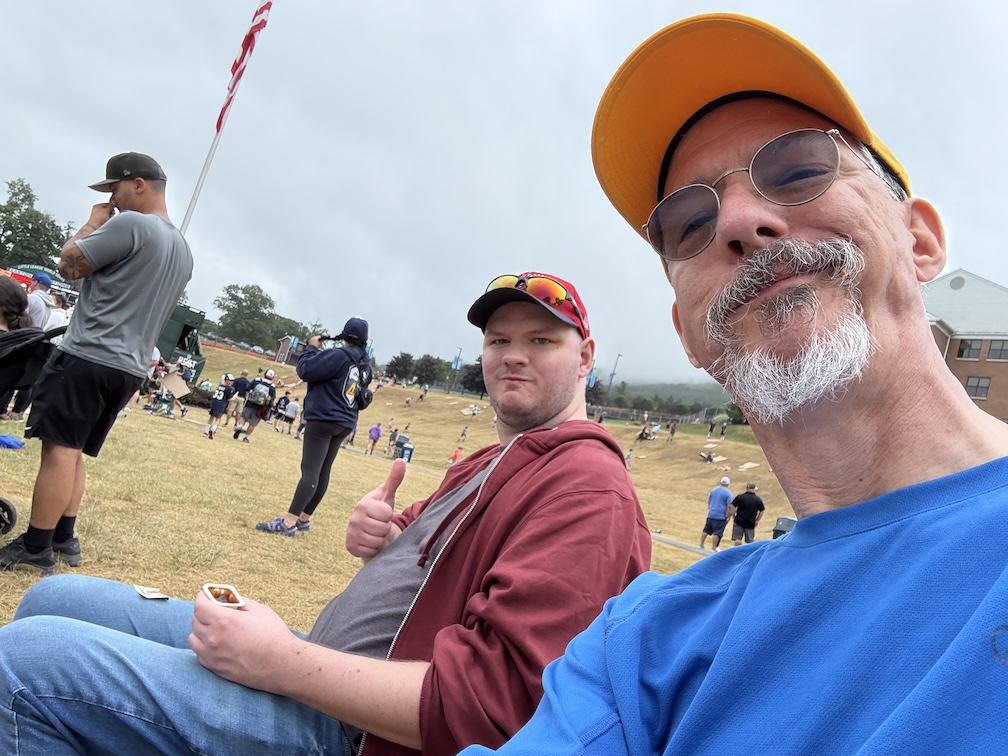
Game three for us (game 31 overall) was back at Volunteer Stadium, pitting Japan against Caribbean (Aruba). This one seemed more deliberate, like our first game. Jacob suspects there’s more attention paid to pitching and fielding in international teams while U.S. teams give more emphasis to aggressive hitting, which is a plausible theory. Japan is well known for its love of baseball, and as we would learn the next day, they have played baseball since the 1850s! But the Caribbean nations also love their baseball, sending a large number of players to the U.S. Major Leagues. Of course, these were just kids we were watching, so no pressure, right? The pitchers were definitely in control for the bulk of the game. Then Aruba broke it open in the fifth inning with back to back home runs! When it came their turn, Japan had no answer for them. Oh, the height and depth of human emotion displayed on the playing field! Half were leaping, yelling, laughing, and hugging, half were holding their heads, curling up or lying prone, in stunned silence or fighting back tears. Baseball is a lot like life. [Recap video here]

Back up to LaMade for the fourth and final game of the day. This one pitted Midwest (South Dakota) against Southeast (South Carolina). Now, even though the games are only six innings, this was still a lot of baseball! Frankly, Jake and I were both getting a little bleary, and we still had an hour to drive to get to our hotel for the night. So as much as we wanted to make a full day of it with all four games, we were kind of done. We stuck around for the first inning or so and made our way back to the car and on to our reservation. As it happened, when we got to our room and turned on the tv, we turned over to ESPN, only to find that the Midwest-Southeast game was still going! They ended regulation tied at one, after South Dakota walked in the tying run in the bottom of the sixth inning. South Dakota went on to rally, scoring five runs in the top of the seventh, making it 6-1. South Carolina’s coach gave his team a short pep talk before they went to bat, telling them just to believe. Apparently they listened, because they scored six runs to win the game with a walk-off double. It was very exciting, and again, the height and depth of elation and heartbreak were revealed on the little league field. [Recap video here]
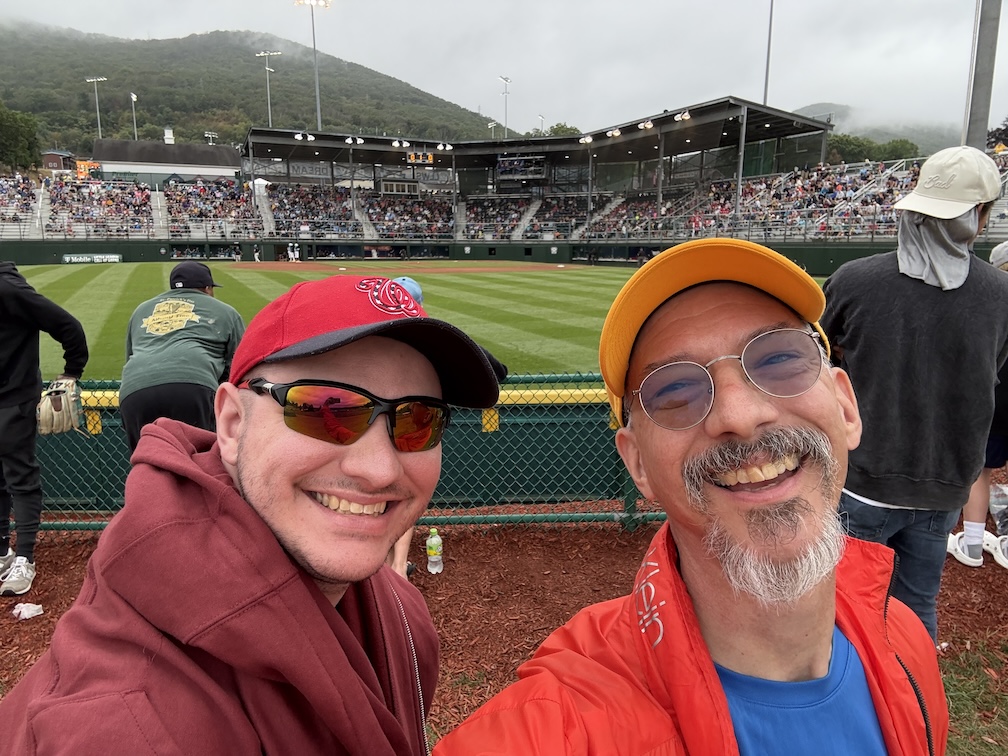
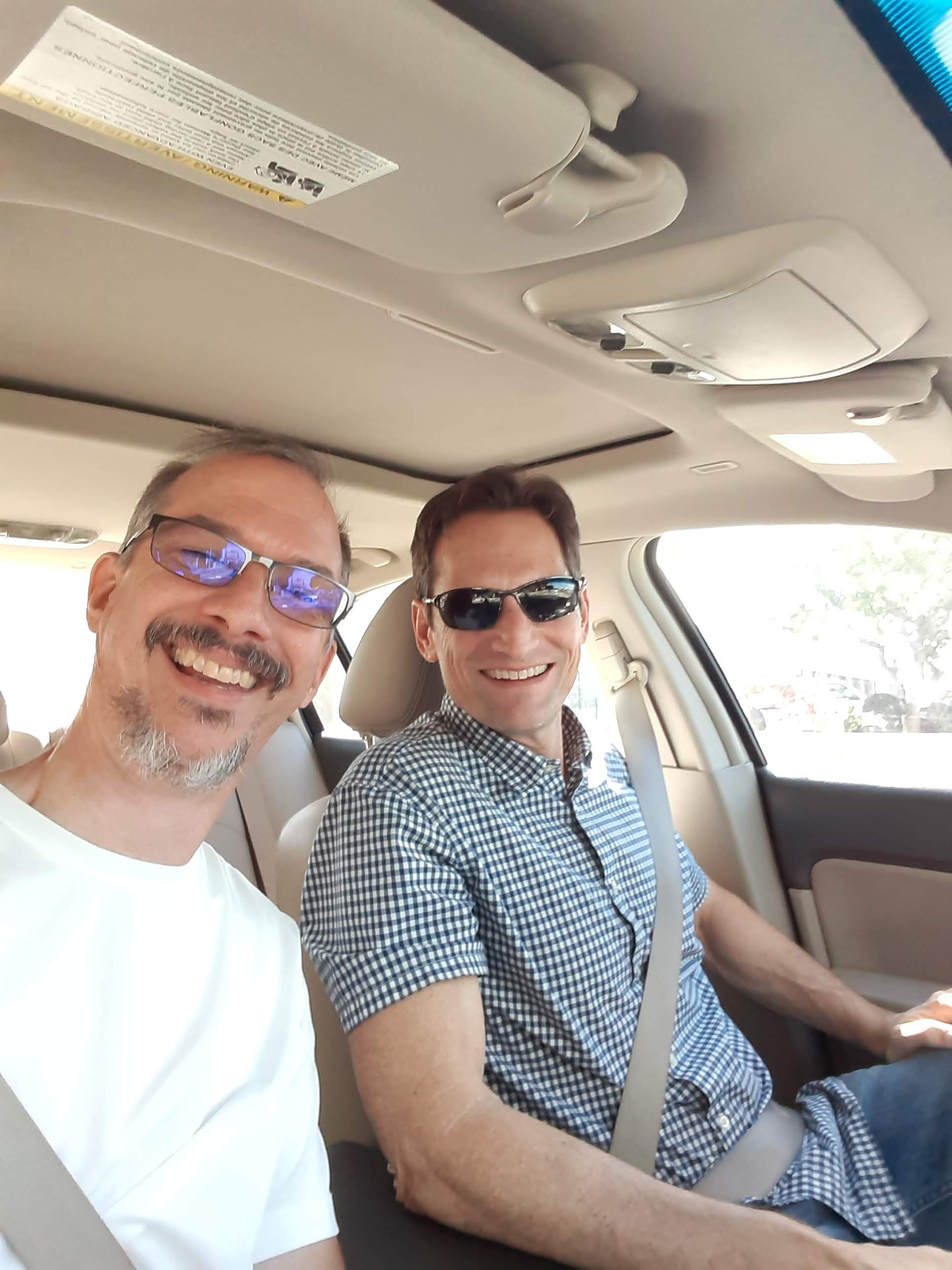
Look at those smiles! LLWS Baseball is awesome

What a fun day we had! It had travel and time to talk about life, the universe, and everything. It had a global melting pot where people from around the world come together just to enjoy a game and make friends. It had the energy, enthusiasm, skill, and resilience of kids trying to do their best. It had all the fun, excitement, and drama of baseball. And except for having to climb the hills, which can take a toll if you are out of shape, the facilities are clean, well cared for, with a good flow and sense of having been well thought out. What’s not to like? If you like baseball, this is definitely an experience I think you’ll enjoy. As to who went on to win the Series? If you don’t already know, you’ll just have to go to https://www.littleleague.org/world-series/2025/llbws/ and find out.

Second Base: Hall of Fame

Day Two of our pilgrimage took us from Mansfield, PA, to Cooperstown, NY, about three and a half hours drive, as I mentioned above. Day One had worn us both out with all the driving, fresh air, hills, and walking into the unknown (Jake and I are both a bit risk averse), so we slept in a bit and didn’t get on the road at the crack of dawn or anywhere near it. The trail to Cooperstown was laced with weird would-be detours and glitches from our GPS guides that made the trip a bit more exciting than it needed to be, but on the whole it was uneventful.

We arrived in Cooperstown at about 1:00 p.m. in beautiful weather and ready for lunch. I was starting to worry a little that we weren’t leaving ourselves enough time for the purpose of the trip, the Hall of Fame, but on their site they suggest a minimum of two hours to tour the museum. We would have plenty more than that. We parked at Doubleday Field, which turns out to be between a wooden bat factory and the Presbyterian Church, and turned onto Main Street, a classic old-style downtown. What we saw of Cooperstown is a quaint looking place, with mostly small, well-kept, tree-lined yards with mostly wood framed houses, an attractive, quiet-looking town. The Main Street business are all baseball themed somehow, from card shops and souvenir shops, to restaurants and bars, to banks and insurance brokers. They all play the game. We found a place that looked welcoming and fun for food, the Doubleday Cafe. More than likely it is a converted store from the early twentieth century or older, long and thin with tin tile ceiling and terrazzo tile floor. There are a dozen or so wooden tables with wooden chairs scattered about around the long bar, with flatscreen TVs in every direction showing a variety of sports shows. Yep, perfect! We ordered sandwiches and beer, both of which hit the spot. The waitstaff had T-shirts that read on the back, “Cooperstown: A Drinking Town with a Baseball Problem.” Again, perfect.
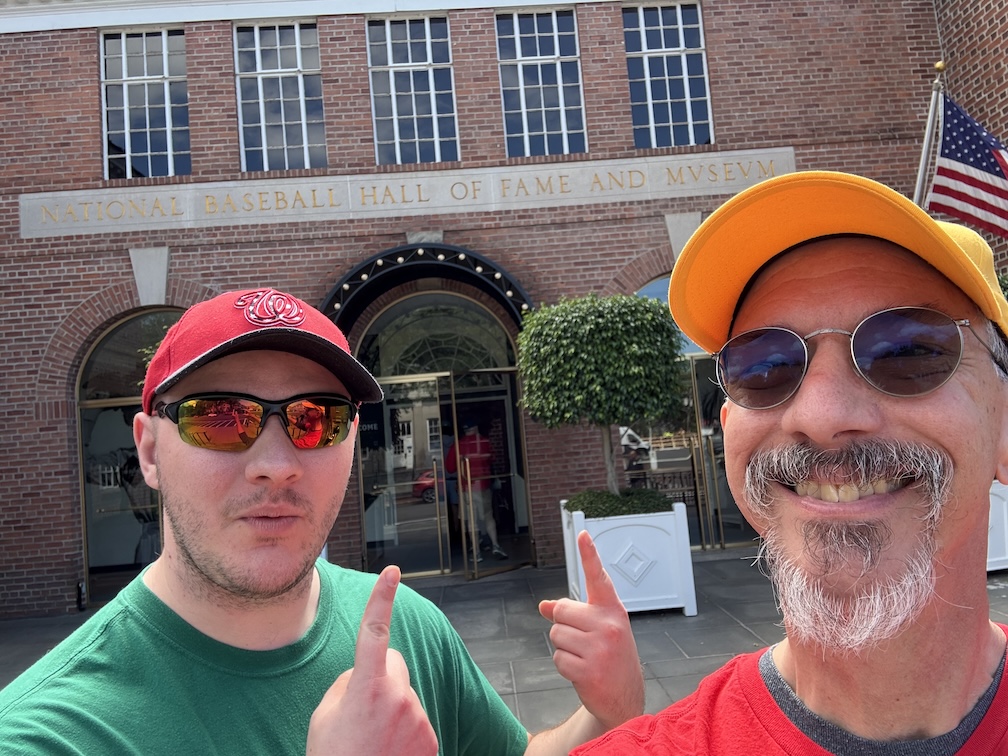
At the gates of the National Baseball Hall of Fame and Mvsevm. It is full of so much baseball!

At last we made our way to the National Baseball Hall of Fame, just a block to the east. There is definitely a sense of hushed reverence in the place. Even the entry with the admissions counter had subdued lighting. We had our tickets in advance, so we got scanned at the counter and headed into the exhibit halls. A docent met us as we entered, welcomed us, and asked if we’d been there before. No? Then your best plan is to start on the second floor, then go to the third, and finish on the first. Interesting layout, but okay. Who are we to argue? Up the grand staircase we went.

The first room we came to was dedicated to the recently inducted Hall of Fame Class of 2025. The class of five is Dick Allen, Dave Parker, CC Sabathia, Ichiro Suzuki, and Billy Wagner. Of these, Dave Parker was the one I knew best, as he played for the Pirates in the 1970s, while the others were little more than names to me before seeing the displays about them. But indeed, I learned that each was clearly deserving of a place among the greats and giants of the game. Follow the links above to learn more about them. Now, there is a time limit for a ballplayer to get nominated and elected to the Hall of Fame. If you don’t get the votes from peers, managers, and sports reporters in a few years, it doesn’t matter how good your career was, you will be left behind. However, in recent years there has been a move to correct some obvious oversights, many of which had to do with the prejudice and racism of the past. Not that prejudice and racism are no longer a problem, but it has been much worse. Dick Allen and Dave Parker were both passed over for the honors they deserved, and the board for historical reconsiderations has now rightly elevated them both to the Hall of Fame. I say, well done.

I won’t go room by room to tell you about what we saw. Couple reasons: first, there is just too much! and second, there is just too much! The first room was filled with the earliest stories of baseball going back to the early 19th century with remarkable detail. Baseball is a game that revels in its statistics and minutiae, and they are on full display in the museum. The development of rules. The development of clubs. The development of a fan base. The development of equipment. The development of professional leagues. The development of the business of baseball. All this was in the first room. We walked out in the next hallway that stretched for a hundred yards with more rooms full of just as much data and history sprouting on either side, looked at each other, and said, “This is so much baseball!” We were overwhelmed after one room!

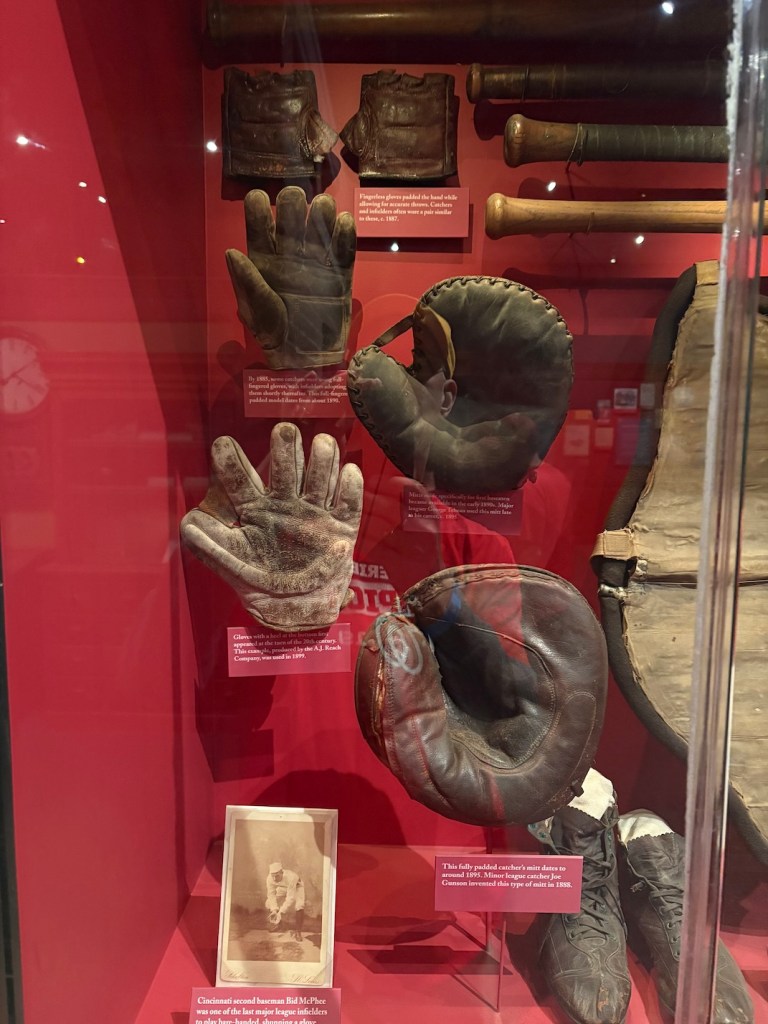
Down the hall there were, of note, a room for Babe Ruth, a room for the Negro Leagues, a room for the early 20th century, a room for women in baseball, a room for Latin Americans in baseball, and a room for the changing game at the turn of the 21st century including the doping scandal. While it continued to be overwhelming, we both thought they did a great job of lifting up the diversity of baseball through the contributions and struggles of ethnic minorities and women in the game.

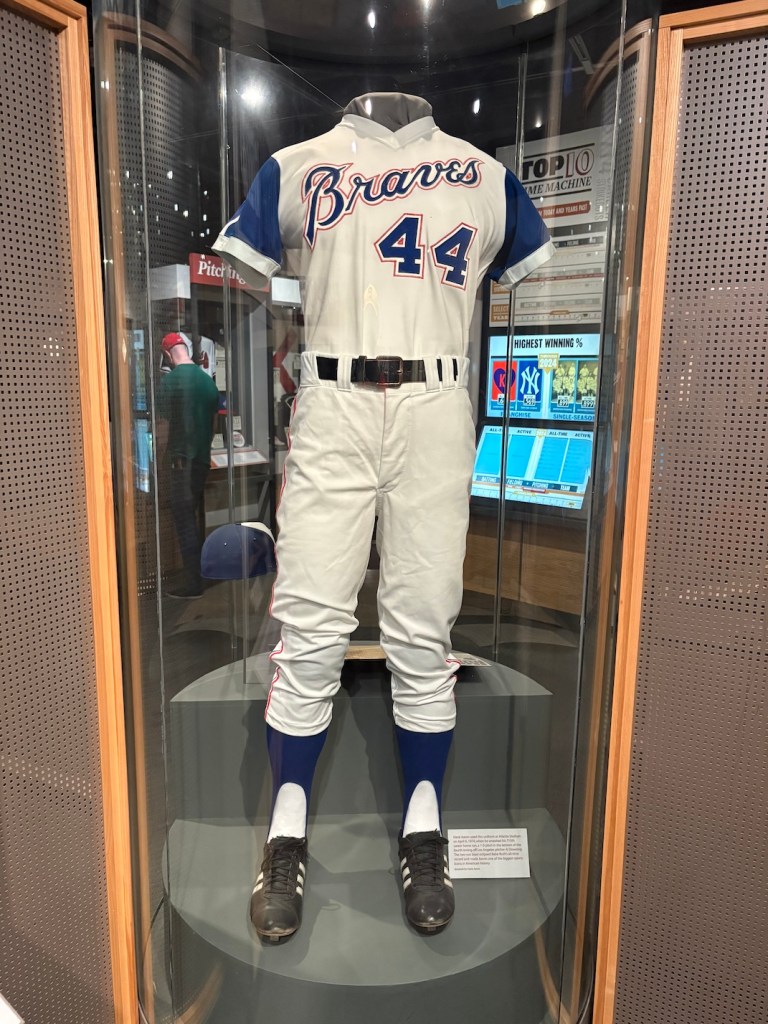
The third floor was similarly packed, starting with a large presentation of baseball in Japan, which dates back to the mid-1800s. There is a sizable space for Hank Aaron and his journey to overtake Babe Ruth as the home run king, including the racism and hatred he faced on the way. One wing is given to the top individuals and teams in each of a few dozen statistical categories – hits, strikeouts, RBIs, OBPs, Gold Glove winners, Cy Young winners, MVPs, and on and on. This is followed by all the World Series winner rings on display in a single case. These started out as fairly simple designs but have grown to several inches across and encrusted with jewels. Then there was more stuff after that. It’s really…. there’s just so much baseball there.
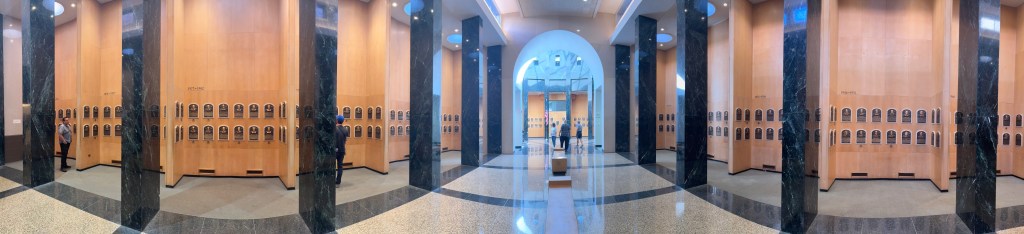
The Hall of Heroes

Finally, we made it downstairs. Eschewing the art gallery that I’m sure is spectacular, we went right to the Hall of Fame Gallery that holds the plaques commemorating all the Hall of Famers. This is the holy of holies, the Elysium, the vault of baseball heaven where the stars shine from bronze plaques that bear their names and embossed images (that often look nothing like them) into the ages, while the faithful fans remember and dream of glory past and yet to come. It is an impressive shrine.

Be that as it may, once more, we were pretty much done in after three hours. I could barely keep Jake in the Gallery while I looked for some of my old heroes, though at 31 he wasn’t physically pulling at my sleeve. All that remained was the required exiting through the gift shop. We bought just a couple wee tokens and headed back into the world.

Third Base: Yankee Stadium

We still had to get to New York City, about a four hour drive as it turned out, winding our way through some back roads in upstate before getting to the major highways down to the City. Again, it seemed like our GPS guide was choosing unnecessarily out of the way paths, but we did get to see some beautiful parts of rural New York before seeing urban New York. Jacob took the last turn at the wheel to get us to our hotel in the Bronx at about 10:00 p.m. and did a fine job with his first time driving in the Big Apple. The hotel is a recently renovated Days Inn now called the NOVA Hotel. It’s not the ritziest place I’ve ever stayed, and it’s not in the most attractive neighborhood, but it was clean, comfortable, and reasonably priced with good reviews.

Day Three of the tour was Friday. We had tickets for the Yankees-Red Sox game at 7:05 p.m. If you don’t know that that the Yankees and Red Sox have a long, deep, often painful rivalry, well, you don’t know much about baseball. Also, if you didn’t expect that the prices for this series of games were about 50% higher than any other games in the season, then you are naive. That’s the business of baseball. I had managed to get us some decent seats for decent prices, all things considered. More on that in a bit.

In the meantime, we had all day to kill before game time. There were a myriad of options in NYC, of course, but we settled on the Bronx Zoo. It was reasonably close and gets high marks. We started off walking a few blocks to a cafe Jacob had found online for breakfast. Just a little place with half a dozen booths across from some academic campus and on the edge of block of flats, you know, like New York. Great coffee, huge breakfast, good prices. Nice pick, son!

Pregame: Bronx Zoo

Jake had also plotted our course to the zoo by way of mass transit. We walked a few more blocks to catch the #2 train north to the zoo. We each got Metro pass with money to spare on it, and after just a few minutes wait we were on our way. The New York Metro system has a reputation for being gross with unseemly people doing unseemly things, but we didn’t have any of that. We got to our stop, and after another ten-minute walk we were at the Asian Gate of the Bronx Zoo. I had bought our tickets before we left (not cheap on the same day – buy ahead if you can), so we scanned in and began our adventure.
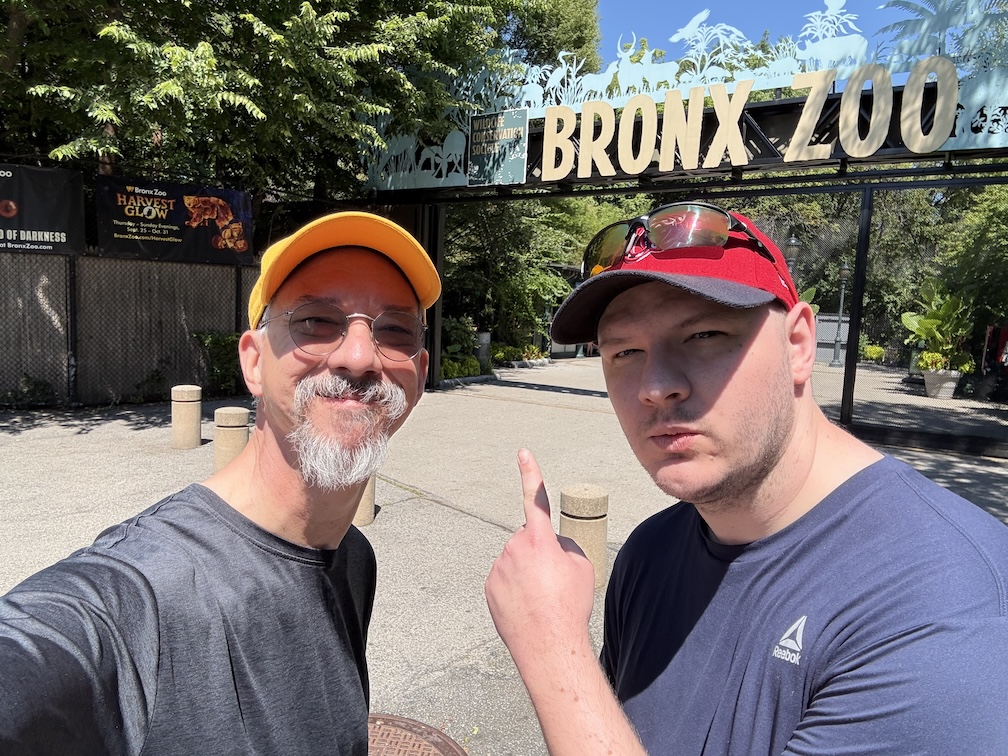
At the Asian Gate of the Bronx Zoo, the beginning of a delightful adventure

The Bronx Zoo is a beautiful place! It’s clean, lush, and surprisingly quiet! Trees and plants everywhere keep the noise and the temperature down. There were plenty of people at the zoo that day, but it never felt crowded or congested. The zoo was organized and its first buildings erected between 1909 and 1913. Some of those original buildings remain in use, though repurposed. The architecture is a nice mix of simplicity and ornamentation. Of course many of the current structures are much later additions. There are several divisions within the zoo for different climates, geographies, and special exhibits, such as the gorilla forest and tiger mountain. There’s even a dinosaur exhibit, although we didn’t get there.

As with the Hall of Fame, I won’t give you a beast-by-beast description. Suffice to say they were all there! We saw giraffes, lions, camels, various apes and gorillas, seals and sea lions, all manner of birds, alligators, and tigers, to name a few. The animals are all beautiful and/or remarkable, and the enclosures are generally well designed and as open as possible.

We stayed until they kicked us out at about 4:45 p.m. That was fine, because we figured it would take us about 45 minutes via Metro to get to our next and final goal, Yankee Stadium. The gates would open at 5:30 p.m., so we’d be right on schedule. Again, Jacob had sorted out that we would take the #2 train back the way we came and then some, until we could pick up the #4 for a couple stops to get to the stadium. That’s just what we did, and it was about as smooth as silk. Well, maybe polyester, as we had to wander around a little bit to find where to pick up the 4, and again to figure out how to get off the platform and down to the street outside the stadium. That one was pretty easy, really – just follow everyone in the Yankees hats and jerseys! We were outside the gate at took the picture below at 5:23. Not bad! I could get used to consistent public transit.

The Yankee Stadium Experience
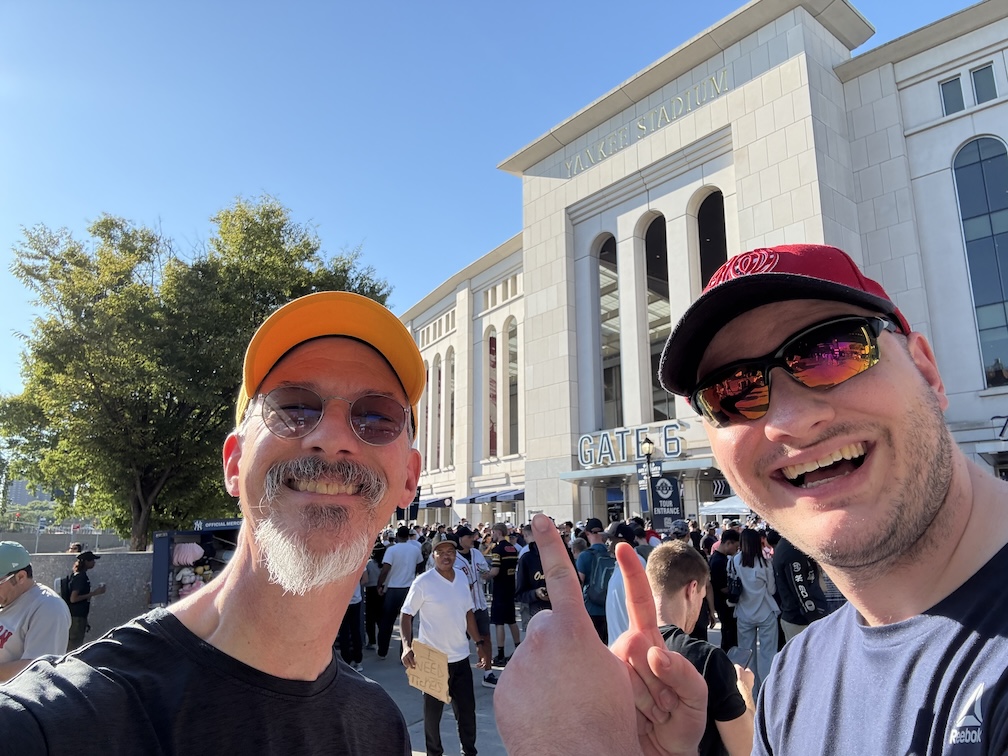
At the House That Replaced the House That Ruth Built

There was a pretty long line at Gate 6 on the southeast corner where we figured to enter the ballpark. I thought it might take us a long time to get in, since everyone had to go through metal detectors and all. So I was really surprised when we were inside the stadium at about 5:35, took pictures on the second deck at 5:45, and were in our seats before 6:00. Guess they’ve got the system worked out.

The stadium is a beauty on the outside with a sort of Romanesque facade. The spaces are wide and ceilings are high. They are built to accommodate lots of people. We made our way up to the second level and got a look at the field from there. Pretty cool, but we had a long way to go, all the way up to deck 4. Except it turns out there isn’t a deck 4. You go to deck 3 and then go down for 3rd tier seats and up for 4th tier. We went up. Way up. We weren’t in the very top row, but I could have hit it with an easy throw of my hotdog wrapper. But honestly, the view was great.
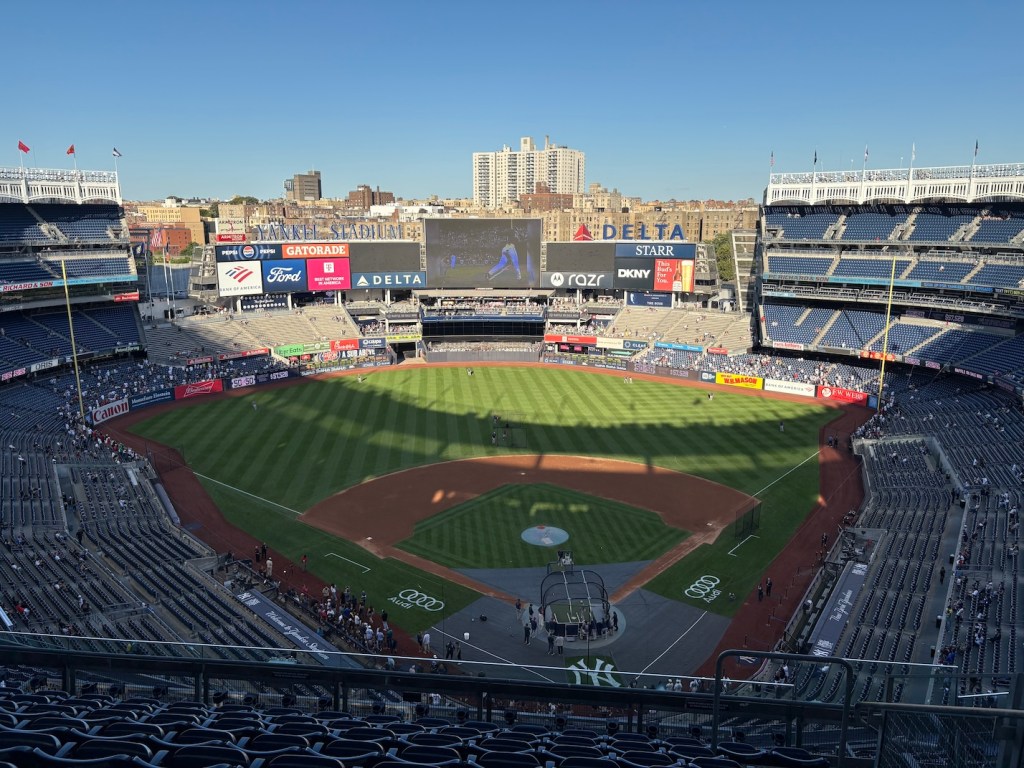
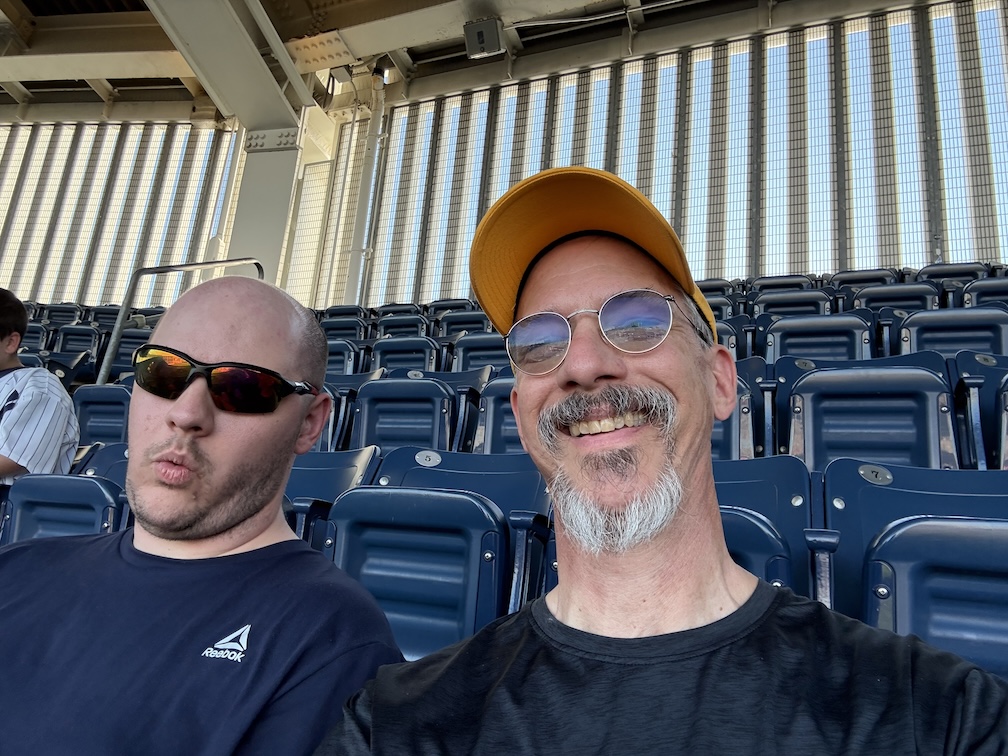
We were right behind home plate! The whole field was there before us without obstruction or distortion. So, too, with all the scoreboards, of which there were many. Plus a nice view of the surrounding cityscape. Except for a little vertigo looking down, I was quite satisfied. Besides all that, there were concession stands right below us, so we just had to go down a couple flights of stairs and we were practically in line for food and drink. So that’s what we did. It was still early, and the crowds hadn’t really made their way in yet, so there wasn’t even a line to get in. Hotdogs, fries, and soft serve ice cream with sprinkles in a souvenir batting helmet cup. Perfect!

While we waited for game time, there was a constant stream of video – promotional, informative, commercial, or hype-inducing. Some of it was interesting, but mostly it was just filler. You wouldn’t want anyone to go for more than a few seconds without some media input, after all. And boy, they stuck to that philosophy, even through the game. There was something happening on all three big screens, plus the animated strip around the 3rd deck, plus music or sound effects ALL. THE. TIME! It never stopped! I missed plays in the game because I got distracted by all the media that was pouring out. It was crazy. I didn’t like it.

I guess they do that because people say baseball is boring. So they do everything they can to keep you engaged with something, whether it is actually the baseball game or not. On this particular night and this particular game, maybe that wasn’t such a bad idea after all. It was a real pitchers’ duel and unfortunately a snoozer for the most part. The pitching wasn’t so good as to create drama, like it might be a no-hitter, but it was good enough that there were very few hits. That happens. It’s part of the great game of baseball. But as we approached the seventh inning stretch I was working on new lyrics to the classic song — “Wake me up at the ballgame!”

Eventually, the Red Sox found a little bit of spark and managed to score a run. The Yankees just had nothing going on and had no response. That’s how the game ended, 1-0 Boston. As I mentioned before, I’m not a Yankees fan, and neither am I a Red Sox fan. I wasn’t rooting one way or the other and just wanted a good game. Oh well.

The crowd was probably as interesting as the game itself. There were several pockets of Red Sox fans peppered around us and around the stadium. They were having a ball, not just because their team ended up winning but also because they could be a thorn in every Yankees fan’s side. There was also a group sitting in the row behind us that noticed I was wearing a Pirates cap. “Nice hat!” they said before the game. I thought they were giving me NY crap for it, but it turned out they were from Pittsburgh and were Pirates fans! That was fun, until they started talking about all the players and recent games and things happening in the Burgh and Pirate fan lingo as if I would be right there with them, but it turns out I’m just a poser. I haven’t really followed the Pirates and haven’t lived in Pennsylvania for decades. I had no idea what they were talking about. I tried to fake it as best as I could, but my cover was blown. They eventually gave up on me, I think. Oh well.

All in all, Jake and I had a fun time going to the game and being at Yankee Stadium (even if it isn’t the historic “House That Ruth Built”). The game itself wasn’t very good, but you’re gonna have some of that. The experience of going and being there was otherwise as good as you could want. We walked the mile or so from the stadium back to our hotel, which was fine until we got further from the crowds and businesses and out into the dark, uncharted parts of the city. Then we felt more out of our element and more exposed to all the horrors people who don’t live in cities hear about being in an unfamiliar city. But it was fine. We made the trip entirely without incident.

It had been a long day, with a lot of walking and adventure. We slept well.

Home Run!

Saturday morning we got up and got moving at a reasonable hour, checked out, and hit the road. We wanted to clear the city before we stopped for breakfast. That proved more challenging than we expected. Once more, my GPS guide lost its damn mind, wanting to send us the wrong way on one-way streets and not recognizing road closures and whatnot. Jake’s map was doing a bit better, but it took some creativity, intuition, and faith to find our way out. It shouldn’t be that hard, what with the city grid and all, but we have become woefully dependent on our tech. Anyway, like I said, we made it out and headed down the road. We kept both GPS guides running, and they continued to conflict with each other and with our reality. Fortunately, we figured out that if we took a particular interstate it would take us all the way back to familiar territory near home. So that’s what we did, robot overlords be hanged. thanks to our helpful robot protectors.

On the way home, we again had lots of time to talk about life, the universe, and everything, and we did. We recapped the trip. We talked about Jacob’s masters program classes. We explored different genres of music we each like. We talked about God, the state of the world, and how hard it is to have faith. We found that the air conditioning wasn’t quite working in the car. All the sorts of things you’d want for relationship building on a road trip. I enjoyed it thoroughly. This trip was really the first time since Jake was in college that we’ve had time together like this, and I think we’ve never had three days with just the two of us. I cherish the time we got to spend on this trip and am so grateful for my sabbatical, for my church’s support, for my wife Molly’s support, and of course for my son Jacob. I’m thankful for God’s grace and providence in all these things, and I’m glad there’s a thing called baseball.

To Boldly-er Go Again!

As I mentioned in my previous post, I’m on a trip to Florida to see if I could catch a rocket launch, and in fact I’ve caught two! There’s no limit, so I don’t even have to throw one back. In that previous post I told about seeing the first one, a night launch on a cloudy night. While that was a wonderful experience, the second was even better.

A Day at Kennedy Space Center

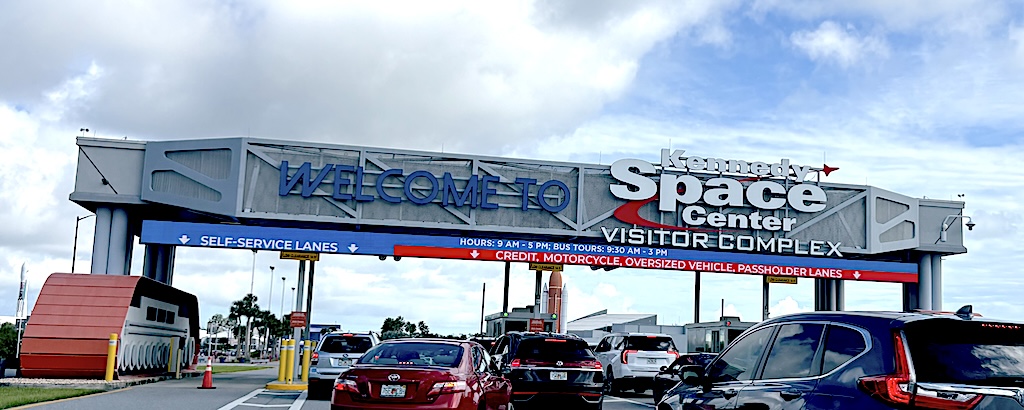
First, let me tell you about my day. [I’ve included some headings if you want to get right to the business. Otherwise,…] It was Sunday, September 14, and the rocket launch I’ll tell you about in a bit was scheduled for 6:11 p.m. EDT from Space Launch Complex (SLC) 40 at Cape Canaveral. While it was lovely to see a launch from Titusville the other evening, seeing one from Kennedy Space Center (KSC) would be about five miles closer and infinitely cooler. Admission to the KSC Visitor Complex isn’t cheap, but it’s probably a lot less than most of the other theme parks and attractions up the road. But once you get in, seeing a launch is included (if there is one to be seen during or close to regular operating hours). This one was going to have an official viewing in the bleachers. I mean, like I wasn’t going to go to KSC anyway, whether there was a launch or not, right? Of course I was going.

There are lots of displays, presentations, and attractions going on at the Visitor Complex, which, by the way, is not funded by NASA or your tax dollars at all. It is all funded by admission, parking fees, and food and merchandise sales. Who knew? Anyway, I bought a two-day pass, so I could get around to seeing everything eventually, but I picked out the things I most wanted to see for day one in case I didn’t come for day two for some reason. So that meant the Rocket Garden, the bus tour to the Gantry at LC-39 and the Apollo-Saturn V center, and the Space Shuttle Atlantis.
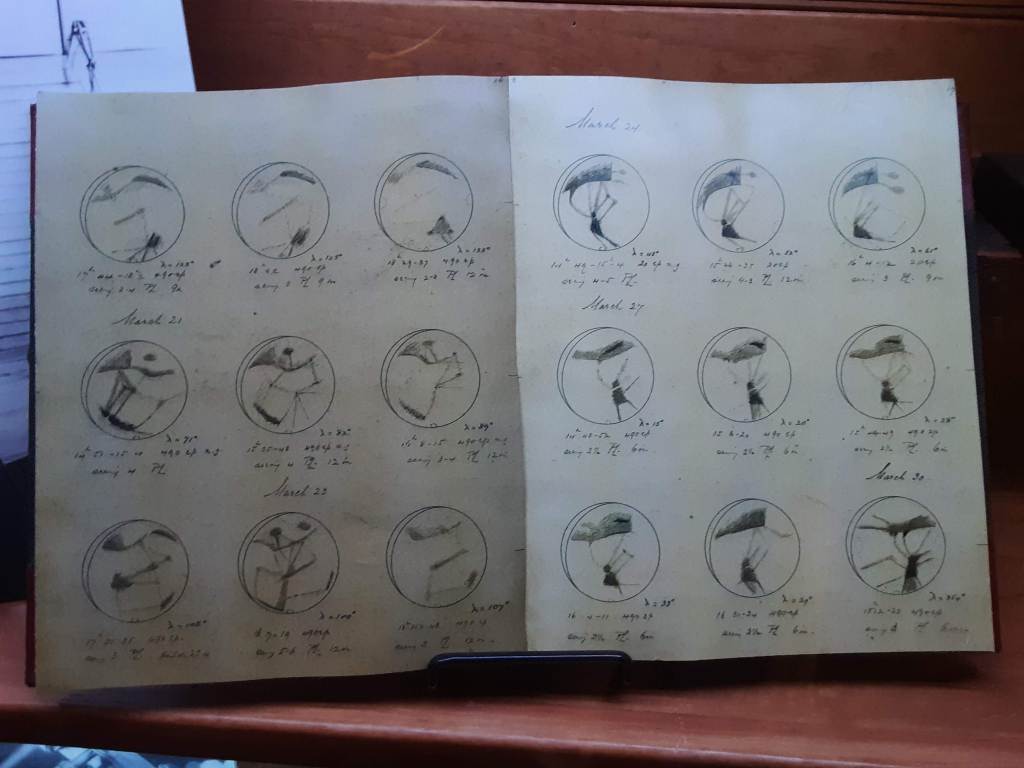
The Rocket Garden is a collection of early U.S. rockets that served in the Mercury, Gemini, and Apollo campaigns and launched some of the first U.S. satellites and such. They are actual rockets although none has actually flown. Among the most notable are the Redstone, Atlas, Titan II, and Saturn 1B. Except for the last, they all look pretty modest. Like, how is that thing going to get someone to space? But they did, in part because the capsules were so small! My car is bigger than a Mercury capsule and fits four to five times as many people. It gives one a great appreciation for the courage of those early astronauts.

It turned out that because of the scheduled launch, the Gantry exhibit was closed. That was a bummer. It is, as I understand it, a refit or reconstruction of part of an actual gantry at LC-39 where all the Apollo rockets went up. Now it has displays and exhibits about ground systems and rocket testing and things like that, plus it has panoramic views of several active launch pads from only about a mile and half away. So that would have been pretty cool to see.

Who Weeps for Apollo and Saturn?

Back in 1997, Molly and the kids and I spent a week in Orlando and took a side trip to KSC, but I don’t remember most of what we saw then. I do remember that we went to the Apollo-Saturn V center, and that it was an emotional experience for me. The space program was very formative in my early years. The moon landings happened when I was six to ten years old. The astronauts were all heroes. I remember getting up late at night or getting up extra early to watch moon walks. I used to draw the command/service module and the lunar lander endlessly. I was never much of a model builder, but I had a LEM. My toys were astronauts. It was a big deal to me and undoubtedly why I went to college to be an aerospace engineer. When I first walked into the hall where the Saturn V is on display, I nearly wept.

Nothing has changed in twenty-eight years. After the introductory movie about the moon landing campaign, you go into a mockup of the launch control center for Apollo 8, the first crewed mission to fly the Saturn V rocket, to leave Earth orbit, and to reach the moon. They reenact the last two minutes of the countdown and launch, and the whole room shakes with the power of the rocket, just as it did back in 1968. Then you walk out into the exhibit hall where the last Saturn V lays in repose, extending over the length of a football field. And I just about wept. It is a staggering machine for a staggering mission. For me it represents not just the hope and idealism of years past but also the reality of what humans can do through science, cooperation, and a shared vision. It also represents the power of cynicism to put the brakes on such achievements. It’s been 53 years since anyone went to the moon. Awash in mixed emotions, I gazed once more in wonder at this colossus and then spent a good bit of time with all the other exhibits in the hall.
Meanwhile, Back at Atlantis

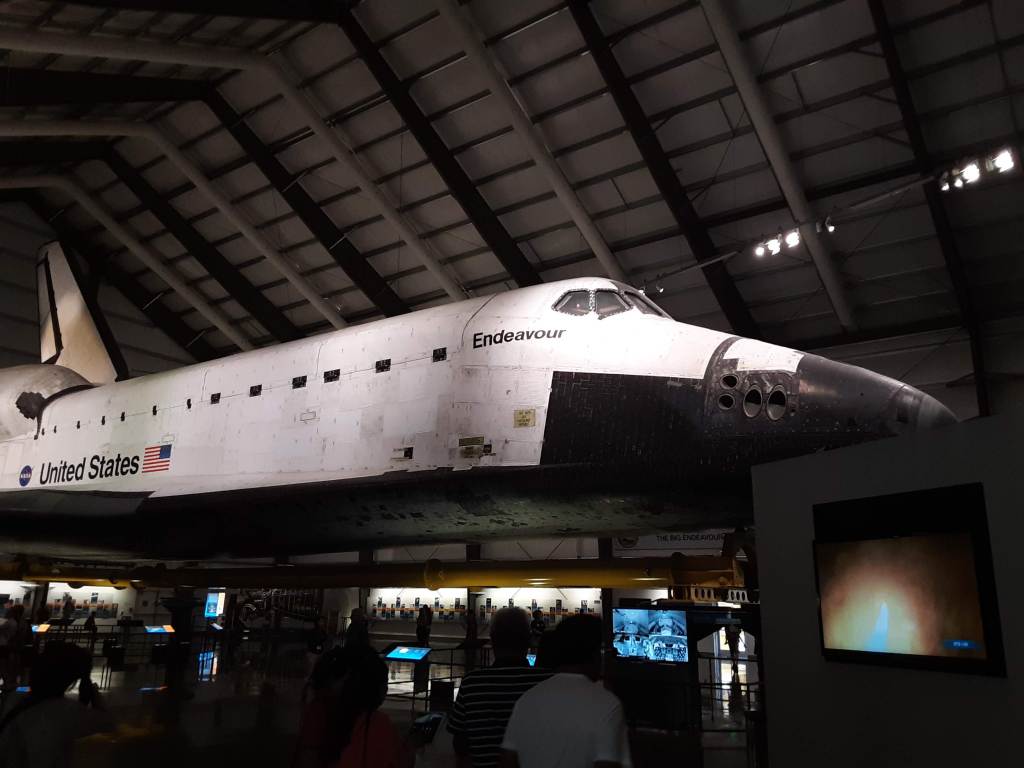
Upon returning to the main complex, I found myself right outside the building where the space shuttle Atlantis is on display. There were six shuttles built: Enterprise, the prototype used for atmospheric testing, and the five that flew to orbit, Columbia, Challenger, Discovery, Atlantis, and Endeavor. As you surely know, Columbia and Challenger both were lost with all hands aboard. I have now seen all the other four. I actually saw a shuttle launching in March 1989. It was STS-29, I think. Discovery, I think. A couple seminary friends and I were visiting my brother Bill in Fort Lauderdale for our spring break. We drove up as far as West Palm Beach and watched it go from there, about 100 miles from the Cape. It was just a little, bright, red-orange streak in the sky. I’ve always wanted to get closer.

Anyway, as with the Saturn V, you are introduced to Atlantis with a couple of movies before entering the hall where the ship awaits you. They do a really nice job with this. If you get the chance, you should see it. Atlantis rests at an angle, its payload bay doors open, its robotic arm extended, all as if it were still on the job in orbit, yet it seems almost close enough to touch. The shuttle is surrounded by many, many fascinating displays and activities, several of which are designed for children, which is excellent. You can examine the underside of the craft with its myriad of ceramic heat shield tiles. There is a memorial room for the two lost shuttle crews. And there is a gift shop, of course.

Um, what about the boldly going?

Right. By this time it was after 4:00, and I was getting anxious and eager, so I made my way outside and found the sign for “Rocket Launch Viewing This Way” conveniently just around the corner. The bleachers are on the north lawn just behind the Atlantis building. Handy! Even two hours before launch and forty-five minutes before they opened the seating there was a pretty good line forming, so I joined it. The line continued to grow past where I could see. Everyone was pretty well behaved and mostly quiet until they opened the gate at 4:45.

I might mention here that probably 9 out of 10 people I heard speaking through the day were speaking something other than American English. NASA is the best international brand the United States has going. Too bad the current administration doesn’t seem to see its value, but that’s another story. I found it tremendously hopeful and encouraging to hear languages from around the world and global travelers who are interested in space just as I am. The three or four sets of bleachers, set in an L, filled with these space tourists quickly, and then people started to fill the yard that was about the size of a tennis court or more. It eventually filled up, too. Must have been, I don’t know, a thousand people? The couple in front of me were, I think, from Brazil. The family behind me were maybe Ukrainian or in that neighborhood. The couple beside me spoke Spanish, and there was a Chinese family just across from them. Sorry I keep getting distracted from the main event, but it made an impression.
Bart, our launch commentator representing NASA, welcomed everyone, “worked the room” some, and let us know what the mission was all about, what to expect in terms of the launch, and how to best enjoy the experience. On that last point, he recommended not trying to video record the launch, especially if it was the first you’d ever seen, which was true for at least 90% of the crowd. Naturally, being a pro now that I’d seen one, I felt confident trying to do both enjoy and record.

The mission

The mission was designated CRS2 NG-23, a Commercial Resupply Services (CRS) mission to the International Space Station (ISS). The cargo vessel being launched would be carrying equipment, scientific experiments, and the like, Built by Northrup Grumman (NG) and the 23rd of its kind, this one is called the S.S. William “Willie” McCool, named for the pilot of the lost space shuttle Columbia. The launch vehicle was a SpaceX Falcon 9, going from the same pad SLC-40 as the one I saw on Thursday night. It’s amazing how fast they can turn over missions these days! We were about 7 miles from the launch pad, almost half the distance from my previous experience. We would have to wait a few seconds after liftoff for the rocket to clear the tree line before we could see it, but as Bart explained several times, “when it comes up, you’ll know!” One more cool thing about this flight was the first stage booster would be returning to land at Cape Canaveral Space Force Station instead of landing on a barge at sea, so we would hopefully be able to see it on its way back, although we were too far away to see it actually touch down.

Because the S.S. Willie McCool would be docking with the ISS, which orbits the earth every 90 minutes in such a way that its ground track (if you traced its orbit onto the earth’s surface) moves several degrees with each pass, the folks who plan the trajectory tend to choose the shortest path from launch to rendezvous rather than trying to chase it around the globe a few times. Like firing a bullet at another bullet already in flight, that means there is only one flight solution. So whereas the satellite launch on Thursday night to an independent orbit of its own had a two-hour launch window, this mission had an “instantaneous launch window.” It would launch at 6:11 p.m. EDT, or it would have to wait for another day. Fortunately, in spite of a few odd sprinkles, the weather was looking really good, and the Next Space Flight app was showing 75% chance of GO for flight. Much better than the 40% from Thursday.

We had the benefit of a huge screen that was showing the live stream from Next Space Flight on YouTube. That offered us live views of the rocket and a countdown clock, and occasionally we were treated to bits of the SpaceX live stream once it came on, complete with talking heads going on about this or that and how wonderful SpaceX is blah blah blah.

The flight director called for “prop load,” that is propellant loading, right on schedule at T-38:00. About that point the app showed 90% GO for flight. Bart popped on the mike about every five or ten minutes to make sure we were paying attention and to tell us what was going on, for those who don’t regularly follow rocket launches like some of us do. I noticed the anticipation building with about 20:00 to go. Whether it was the whole crowd getting excited or just me I can’t really say. I would guess the former but would be satisfied with the latter. Bart reminded us once again of the two pieces of advice for getting the most out of the experience: (1) Look up, (2) Put your phone in your pocket. Some people even listened to him, I think.

With about ten minutes to go, Bart said, “I know what’s going to happen when we get to just a couple minutes in the countdown. Y’all are going to want to stand up. I get it, it’s very exciting and all. But let me tell you, first of all it won’t make any difference because the thing you want to see is going to be in the sky. You will see it just as well sitting as you would standing. But more importantly, if all you adults stand up you will be blocking the view for the children. They won’t get to see anything but your backs. So please, for the kids’ sake, just fight that urge and stay seated, okay?” There was great applause for this, and I think it was the best thing he said all day. And everyone listened and kept their seats through the launch. Makes me a little weepy again. Don’t know why.

The Launch

With a couple minutes to go, Bart invited the kids to help him do the countdown, which we would see on the big screen. Several youngsters joined him to fulfill this critical duty. He also allowed as how the adults could join in, too, if they could count backwards as well as kids can do.

At T-00:40, the flight director gave the call, “GO for launch.” Everyone got their cellphones ready and pointed in the direction of launchpad. Sorry, Bart, we just can’t help it. Bart and the kids started counting down at T-00:15, and most of the crowd joined in.

10-9-8-7-6-5-4-3-2-1!

On screen we could see the burst of cloud at the bottom of the Falcon 9, indicating engine start, then the rocket started to move. Almost immediately a narrow, bright orange stream appeared above the trees, although I didn’t see it right off. (I know it was almost immediately from the video.) It took me a few seconds to find it and lock in on it because it was rising right beside a utility pole in my line of sight. But Bart was right, that once it’s up, you’ll know. In the video the flame looks mostly white with orange hues around the edges, but in real life it was vivid red-orange against the blue of the sky, and it was incredibly bright! Like, hard-to-look-right-at-it bright, another effect that doesn’t come through on the video. The plume of flame was longer than the white and grey rocket was tall. Within 30 seconds the rumble of the engines’ thunder started to wash over us, mildly at first and building, building, building. At T+00:45 the characteristic crackle started in. The roar was impressively loud, though not quite enough to feel it thump in your chest.

At that point the rocket was noticeably pitching down range so that it appeared to be at an angle and the flamey end was more visible. (This was not connected to the crackle sound of the engines, which was about 30 seconds delayed in getting to us, as mentioned.) About a minute into flight, the rocket itself was hard to see, and the bright orange flame cone was becoming more of a spot than a line as we were looking more or less along its axis. Also around a minute and change, the rocket was going transonic, that is it was approaching the speed of sound. This produces condensation effects with the atmosphere so a vapor trail appears in the rocket’s wake. This part of the flight path is called Max Q, which stands for maximum dynamic pressure. The rocket is basically moving so fast that the air can’t get out of the way fast enough and starts pushing back harder and harder and with more turbulence. This puts the most stress on the vehicle structure in the flight. At the same time, as the rocket gains altitude, the atmosphere around it is getting thinner, and at a particular balance point the rocket punches through and goes supersonic, that is it exceeds the speed of sound, after which the air flow becomes smooth again on either side of a leading shock wave. The rocket is then free to pick up speed more easily. This is why we talk about the “sound barrier” and why it took until 1947 before anyone broke it (Chuck Yeager in the Bell X-1, a plane shaped like a .38 bullet). The vapor trail leaves off at that point, too. For reasons I may once have known but know no longer, the maximum dynamic pressure actually happens after the rocket goes supersonic, but they happen pretty close together.

Higher it went and further down range. Because of the geometry of curved space, it started looking like the rocket was heading back down. Some of the people around me were concerned. Nothing to fear, friends! It’s just an illusion.

The majority of the mass of a rocket launch, up to 95%, is fuel and something to hold it in. In order to maximize efficiency and not carry the weight of a lot of empty fuel tanks, rockets will have multiple stages that come apart during flight. Around T+2:00 the first stage booster ran out of fuel, and the rocket reached MECO, main engine cut off, followed pretty shortly by stage separation. The mostly empty booster drops off the back, and the second stage engine starts up to push the payload further “uphill” to orbit. That one second stage engine wasn’t bright enough to see from the ground with naked eyes, but we could see some clouds of vapor associated with MECO, staging, and the second stage startup. That was about the last evidence of the rocket we could see. Until….

Falcon 9: The Return

SpaceX has become successful in no small part because they have mastered the art of reusability. They routinely land their first stage boosters so they can be refit and reused over and over. This is an obvious advantage over just throwing away that extremely expensive and complicated piece of machinery. Most often they will land the booster on a barge out in the ocean along the flight path. That’s remarkable in its own right, and it is easier than turning the booster around to make it come back to land. However, sometimes the flight characteristics are such that they do in fact return the booster to land at Cape Canaveral, and as I mentioned, we were fortunate to be watching one such flight.

The returning booster makes three burns: the “boost-back” burn, the reentry burn, and the landing burn. “Boost back” is what redirects the booster away from the initial flight path and back in the direction of the launch/landing complex. The reentry burn slows the booster so it won’t burn up in the atmosphere and can also help with navigation. This uses three of the nine engines. The booster then glides down with guidance from its “grid fins,” specially designed appendages that redirect the airflow, like holding your hand out the window of a moving car, to navigate toward the landing site. The landing burn, also using three engines, is the final phase of slowing and steering to bring the booster down gently to the ground.

Just over six minutes into the flight the booster made its reappearance, lighting up during the reentry burn. Again, the intensely bright red-orange glow of the engine flame was easy to spot against the deep blue of the sky. It only lasted about 20 seconds. After that I could actually see the booster, although it doesn’t show up at all in the video. It was coming in at a steep angle and was obviously hauling butt! Man, it was moving fast! Indeed, it was still supersonic, so as it got lower and was pushing into more and more atmosphere it again went transonic, but the other way, going from supersonic to subsonic. Another vapor trail told the tale. I lost it behind some palm trees, but we could see it on the big screen. The landing burn started almost right after I lost sight of it and, as designed, its landing legs deployed, it settled gently on the ground, and the engines shut down.

The last bit of fun for the day was listening, right after touchdown, as Bart hushed the crowd. BaBOOM! A double sonic boom reverberated across the sky, to the delight of all! This is the crack of that last transition from supersonic to subsonic, I think it’s first from the base of the booster and then from top.

With that, Bart wrapped up the commentary with “Did you have a good time?” (thunderous yelling and applause) and “Thanks for being here, and be careful on your way home!” All that remained was waiting for a thousand people to get out of my way. I was in no hurry, though, as I savored the experience. What a thrill! What a remarkable day! What a world that has such wonders in it.

Now you can watch to find out if I told the story correctly and if I succeeded in capturing the video while I was taking in the experience. Enjoy!

To Boldly Go

Well, that might be overstating the case a bit. But here’s the thing. I got to see TWO rocket launches this week! I’ve been in Daytona Beach for just this purpose, to try to catch a launch, thanks to some lovely and generous friends who let me use their timeshare points. So Kennedy Space Center and Cape Canaveral Space Force Station are just about an hour away and easily accessible from here. I could probably even have seen a launch from where I’m staying, but the point was to get as close as possible, to hear the thunder, and maybe even feel it.

So to actually see two launches, I am, as they say, over the moon, even if the rockets were just going to low earth orbit. Here’s the story of the first one.

Nusantara Lima

The Nusantara Lima communications satellite was set to launch from Cape Canaveral, SLC-40 (Space Launch Complex), on a Falcon 9 rocket a couple days before I arrived, but it turns out that September is kind of monsoon season in Florida. In fact, without realizing it I actually chose the peak of the Atlantic hurricane season for my adventure! Anyway, the launch got scrubbed the day before I arrived, a Monday, and also the night I arrived, Tuesday, when it was raining quite a bit. I was watching the live stream, and they went ahead with propellant loading and all the rest. It looked like they might actually pull it off, but they scrubbed at T-18 seconds. One commentator said, “Welcome to Scrubtember!”

The next day brought more rain, but it was kind of clearing in the afternoon, although still pretty windy. The launch was scheduled for about 8:00 p.m. EDT. I decided to take a shot at it and drove to Space View Park in Titusville. This is across the Indian River from KSC and CCSFS, about twelve miles from the various launch pads. It has a good reputation as a viewing site, as the name of the park implies. I set out about 6:00, which would give me about an hour to get my bearings before the launch.

EXCEPT they scrubbed while I was on the way down! Well, that was inconsiderate of them! Especially since they had run down to 18 seconds in the pouring rain the night before. Admittedly, it was windy, and the weather was worse around the Cape than in Daytona, but still. I got out anyway and went to look around the park. It turns out to be two parks, Space View on one side of an inlet and Veterans Memorial on the other, although they share a bridge and design elements, but I didn’t find all that out until later. This night I found the commemorative sculpture to the Mercury Program with plaques about each of the first seven U.S. astronauts. Pretty cool! There is a pier that juts out into the river with a little cabana at the end, and another shorter one just off to the side. Good places to watch from. In fact, you can see several launch pads and the Vehicle Assembly Building (VAB) quite easily.

I met a fellow who was also poking around the park hoping to see the launch. It turns out he is a veteran of several launches there. He had been out both nights before, so this was his third scrub for this mission. He was quite the chatty fellow. I think he said his name was Randy. Let’s call him Randy. He pointed out where SLC-40 was, that one lit up all the way to the left. Cool. Another fellow showed up, Bob, similarly disappointed and similarly chatty. As an introvert, I had only to stand and nod and occasionally say, “No kidding!” as the other two had it out. We killed about an hour, I suppose, and that was about it for my peopling batteries, so I excused myself and headed back to Daytona.

Come! We Try Again!

Thursday looked better, at first. The morning was pretty clear and the forecast was patchy. Storms started popping up around 1:00, like they do, and it kind of stayed spitty and breezy. Predictions were 40-45% chance of launch. Having come all this way, I wanted to take every possible chance to see a launch, and you just never know. So off I went again, back to the park in Titusville. As the night before, it was breezy and cloudy. This time there were quite a few more people waiting and hoping. The launch window was two hours, so they had anywhere between 7:58 and 9:56 p.m. EDT to give it a go. Shortly after arriving at 7:00-ish, T-0 (read “Tee zero,” the estimated launch time) slipped to 8:28, and before long it was 8:44 and 8:58. I walked around the park to get my steps in and see what was there. I had seen online that there were markers for all the space campaigns, not just Mercury, and I wanted to see them. I found them on the other side of the park, as noted earlier: Gemini, Apollo, and the Space Shuttle all have their logo sculptures and lists of astronauts. Very cool. Good way to kill some time, too.

Along the way, T-0 went to 9:28, and it started raining. That thinned the crowd down to just a few of us, including Randy who was back, and Linda who had grown up nearby and worked for a contractor at KSC in the 70s. The rain stopped, but T-0 slipped again to 9:56, the end of the window. I decided to stick it out, anyway. I didn’t really think they would fly that night, but I’d kick myself if they launched and I missed it. One weird thing that reinforced my doubt was that the pad Randy had pointed out as LC-40, which had been lit up the night before, was now dark except for flashing beacons on the lightning rod towers. Yeah, they don’t even think they’re going go if they don’t have the lights on.

Nevertheless, propellant loading would have to start 35 minutes before launch. If the launch director didn’t give the order, then it would be another scrub, which we all expected. But lo, and behold, word was given, and they started prop load on schedule. Huh. Still 40% chance of GO for launch, but another good rehearsal for the ground crew, I guessed. More people started showing up in the last half hour and finding their places for a clear view. Still, why aren’t they turning on the lights at the pad, I wondered? I had tuned in to the live stream from Next Space Launch on YouTube on and off through the window. They seemed as surprised as anyone that the countdown was proceeding.

Finally, it got down to T-40 seconds and the flight director gave the GO for launch! Wow, they might actually do it! We (Randy, Linda, and I) found our various spots to watch, hoping against hope.

10-9-8-7-6-5-4-3-2-1

The horizon lit up all the way to the right of VAB, exactly on the opposite side of the complex from where Randy had assured us pad 40 was! We had been looking at the wrong pad all night! No wonder the lights weren’t on! No time for recriminations now, the rocket is launching!

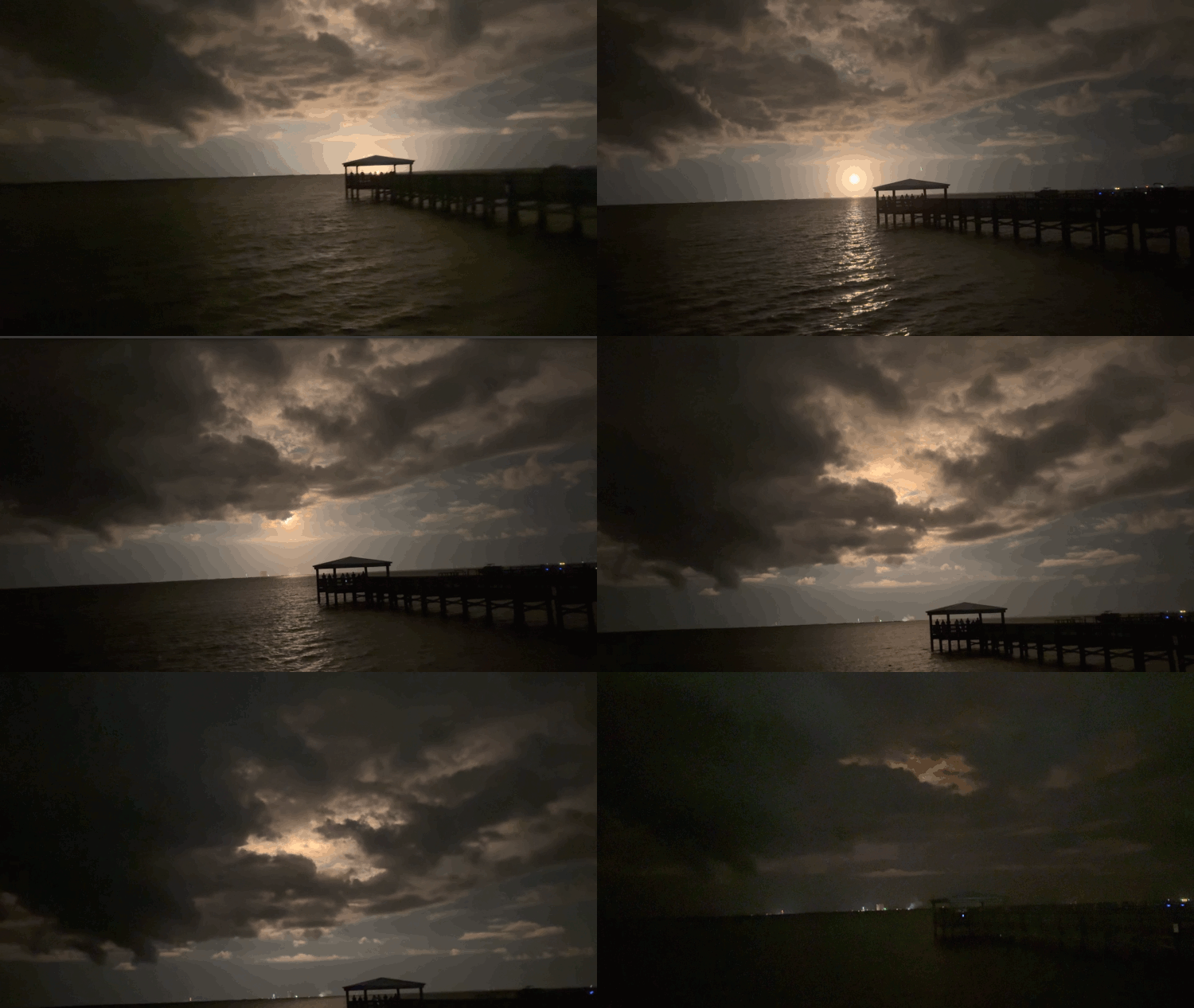
It was as if the sun had crept above the horizon without lighting the whole sky. A bright red-orange streak and a surrounding sphere of light spread across the horizon and lit the low hanging clouds, all reflecting on the water of the Indian River! It was spectacular! Ever so slowly the ball of light rose for maybe twenty seconds before being swallowed by the clouds. Then the clouds themselves began to glow and shift as the light tried to burst out from within them. For one more brief moment the rocket appeared to us through a gap in the clouds before diving back in to be lost to our sight for good. About a minute into flight, around the time the rocket was going supersonic, the rumble of the launch reached us. Low and slow at first, it built to a thunderous crescendo with the characteristic crackle of the engines over top. It wasn’t loud enough or close enough that we could feel it in our bones, but it seemed to fill the whole sphere of space in front of us. It went on and on and on and on Even though the light from the escaping rocket was long since lost, the sound went on and on.

Eventually, it settled and quieted. All returned to normal. A wispy vapor trail going up from the (actual) launch pad was all the evidence that remained. But I had seen a launch! Maybe not the most glorious to behold, but glorious nonetheless. To think that we mere mortals can routinely constrain and concentrate that much energy to hurl tons of material into space at 17,500 mph or more is simply remarkable. That I had the opportunity to just go and watch it happen gives me great pleasure and fills me with gratitude. The privilege is not lost on me. And there is much about the modern space age that is troublesome, raising moral and ethical questions about our stewardship of the environment and of space and who gets to decide about such things. But dang, it’s an amazing thing to see a rocket leave the earth.

Launch of the Nusantara Lima satellite as I saw it from Space View Park, Titusville, FL

If you want to see my video of the launch from which the above gif was assembled, it’s posted here on YouTube.

The Western Tour: An Overview

Molly and I have been traveling since July 12 (it being July 25 as I write this), so it’s definitely time for an update. This is a brief summary of what we have been up to. I’ll try to go into more detail in future posts.

July 12 – flew from Washington Dulles to Denver, got our rental car, and stayed overnight near the airport.

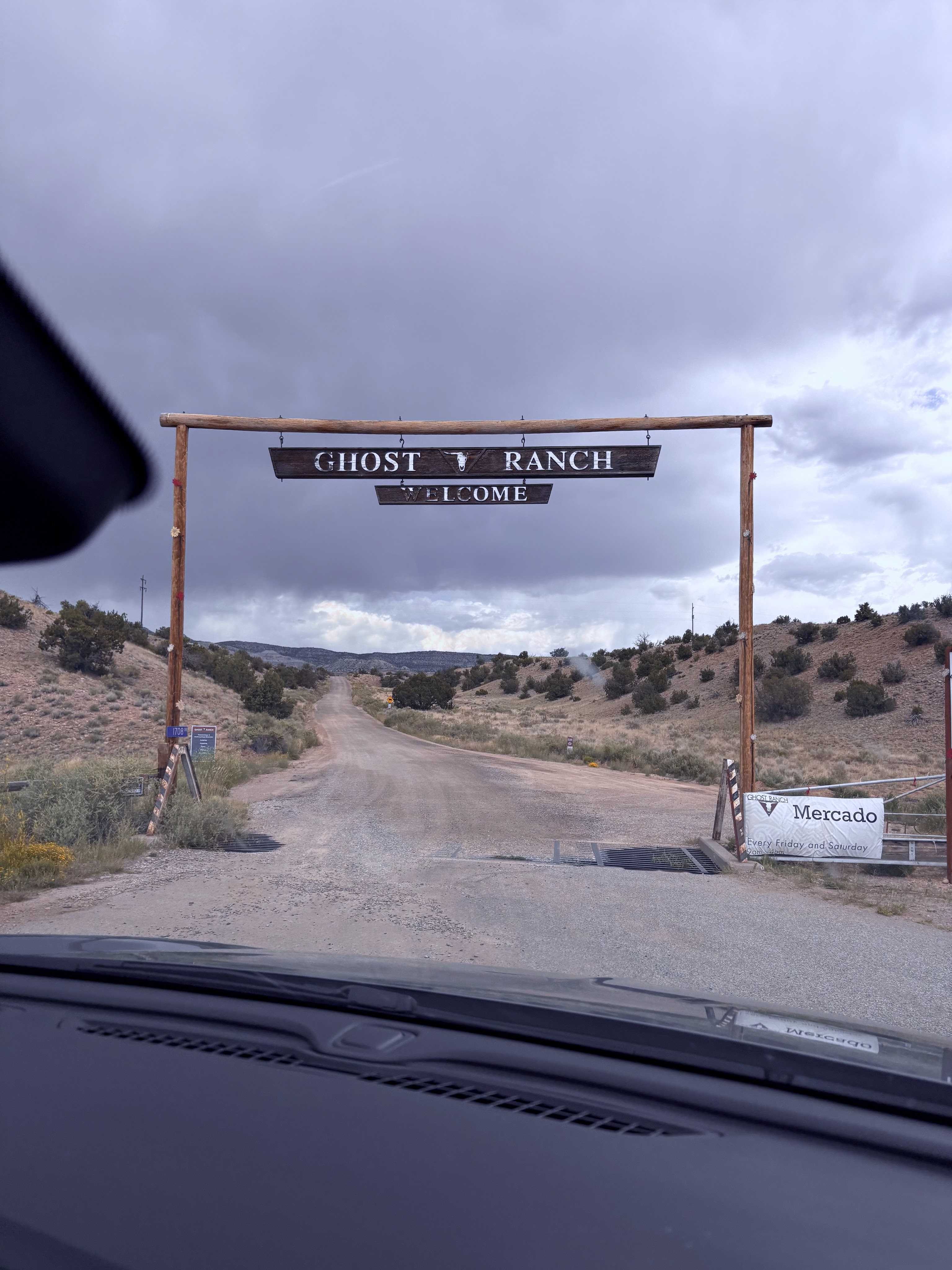
July 13 – Drove to Ghost Ranch near Abiquiu, New Mexico. The weather deteriorated from sunny to spitting rain, but it was a pleasant enough drive. We were very excited to arrive and get checked in. Our room was in Coyote Lodge on top of the mesa, putting us about as far from the dining hall as possible. We’ll be getting our steps in for sure! The room was a simple but pleasant suite with a sitting room with two loveseats and a couple tables, the bedroom, and a full bath. No A/C, but adobe, windows, and fans do a fine job keeping things comfortable. Made our way down for dinner, then orientation in the Agape Center (sort of chapel/community space), got introduced to our class instructors and saw where we would be meeting, then back up the mesa. The sky had cleared and was spectacular! Took some pics of the Milky Way that were amazing.

July 14-19 – Regular routine of breakfast at 7:30 a.m., Morning Light service at 8:30, class at 9:00-noon, lunch at 12:30, more class and/or free time in the afternoon, dinner at 5:30, usually free evenings, and early to bed. Made several friends over the course of the week, which is cool: Joel and Tammy from North Carolina, and Polly and Rigel from Texas, in particular. Hope to stay in touch with them.

My painting class turned out to be really good. I was the only real beginner, and everyone else in the class was very skilled and talented, so I felt a bit awkward knowing nothing, essentially. But everyone was very supportive, and I found my way. More on that later.

The scenery at Ghost Ranch is amazing. Such dramatic views wherever you look, and they change as the light changes through the day, so it’s always different. There’s height with the mesas, depth with the rock layers, and expanse across the valley and sky. More on that later, too.

July 19 – We left Ghost Ranch and drove to the Chaco Culture National Historical Park about 3 hours to the west. It’s three hours because you can’t get there from here. I’ve been wanting to go there since my last sabbatical trip, because it is not just a cultural heritage site but also an archaeo-astronomy site with buildings aligned with the solstices and such. There is a “sun dagger” that passes across a spiral petroglyph in one of the ruins, but that site is closed to the public because it’s gotten pretty unstable. Bummer. Unfortunately, no one made much of that aspect of the place while we were there. The ranger didn’t seem to know too much about it. Nevertheless, it was a remarkable place to see. The roads in and out were pretty … rustic. We went on to stay in Gallup, NM, that night.

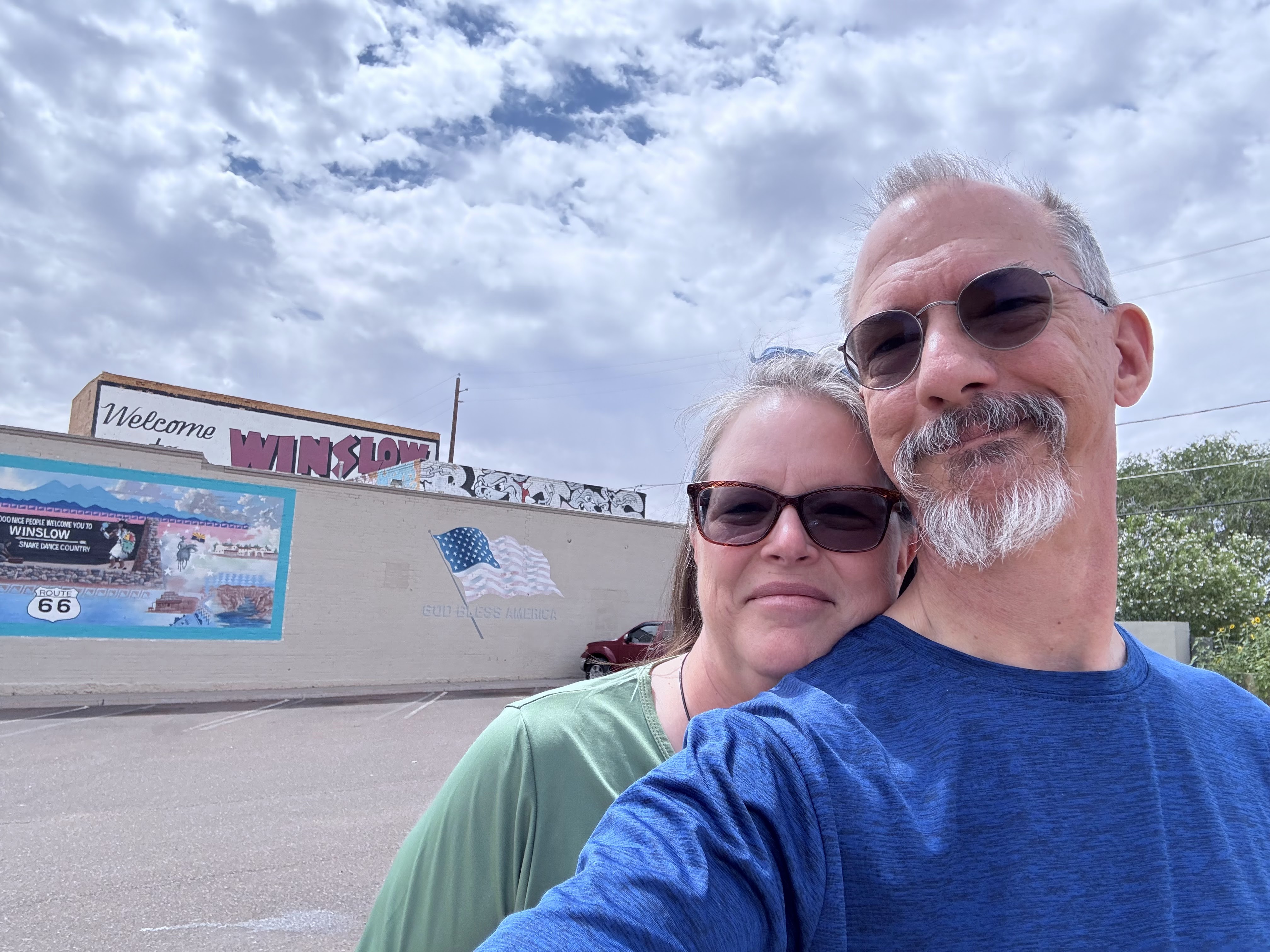
July 20 – Next day we crossed into Arizona. We made a quick stop at Winslow on Route 66 and the “Take It Easy” Park, site of the line from the Eagles’ song of the same name. Kitschy fun! 

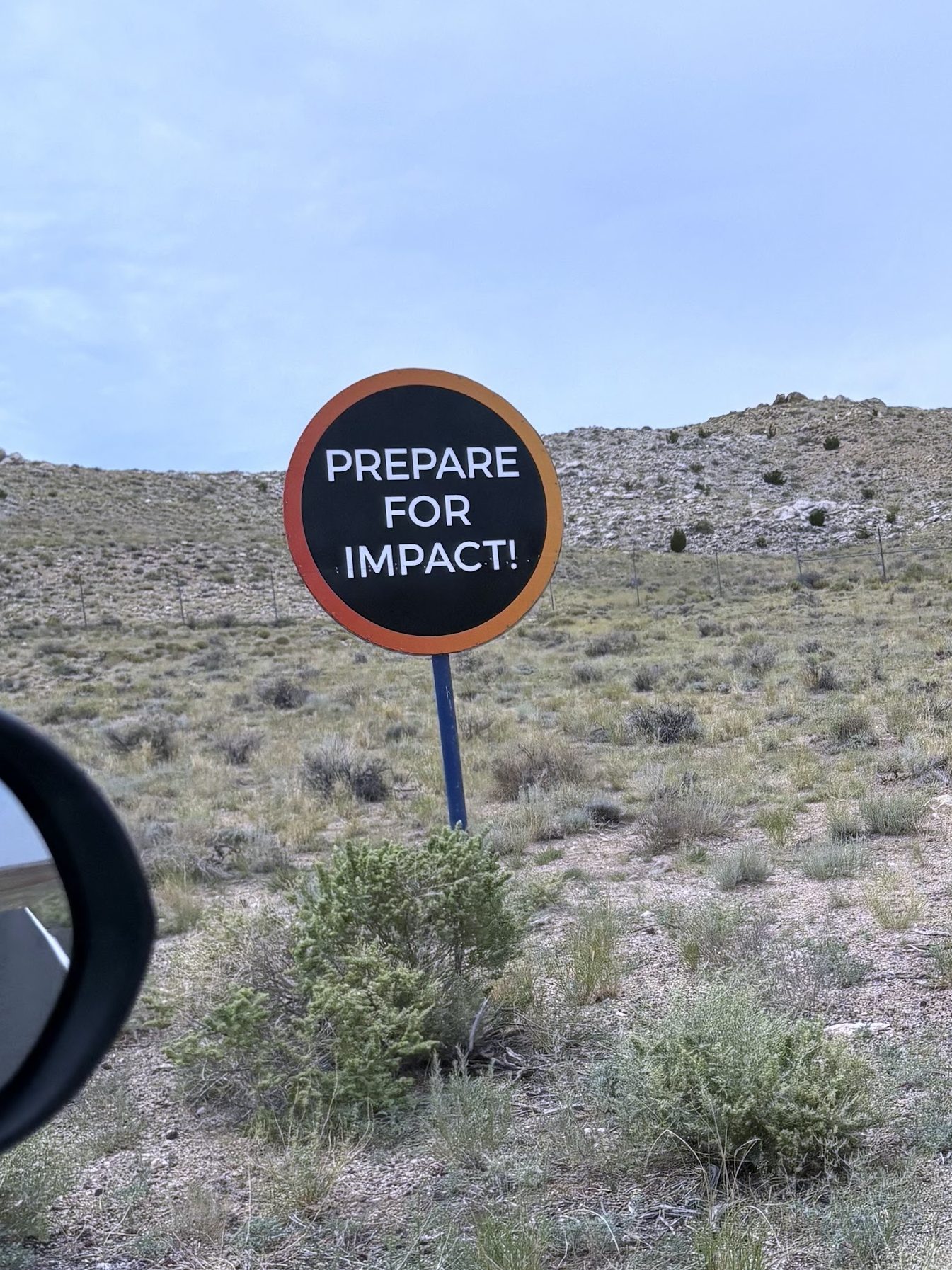
Just down the road a bit then is Meteor Crater, the target for the day’s outing. It is a mile-wide, 550-foot deep crater created by an asteroid strike about 50,000 years ago. Of course there were no humans in the area at the time, and there’s nothing much to recommend that patch of ground now, except the big hole and a nice visitor center with science displays. It’s another remarkable site that gives one a sense of time and the chanciness of existence.

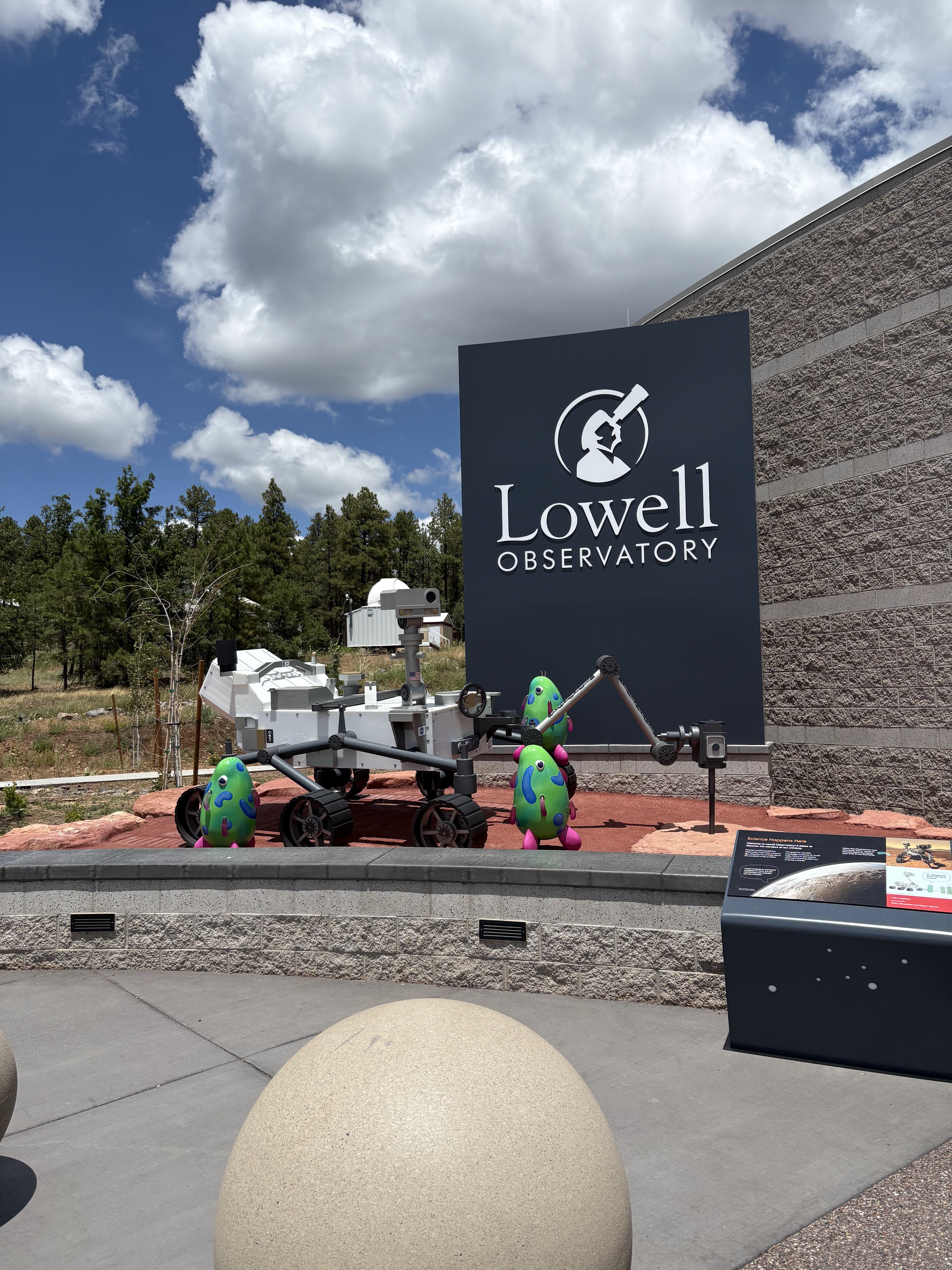
July 21 – We had spent the night in Flagstaff, so we had a nice breakfast, went to pick up a few things at Wally World, and then spent the afternoon at Lowell Observatory. I had been there seven years ago, but they have added a new Discovery Center and telescope patio since then, making an already great science center even better in my opinion. It’s just a beautiful campus anyway.

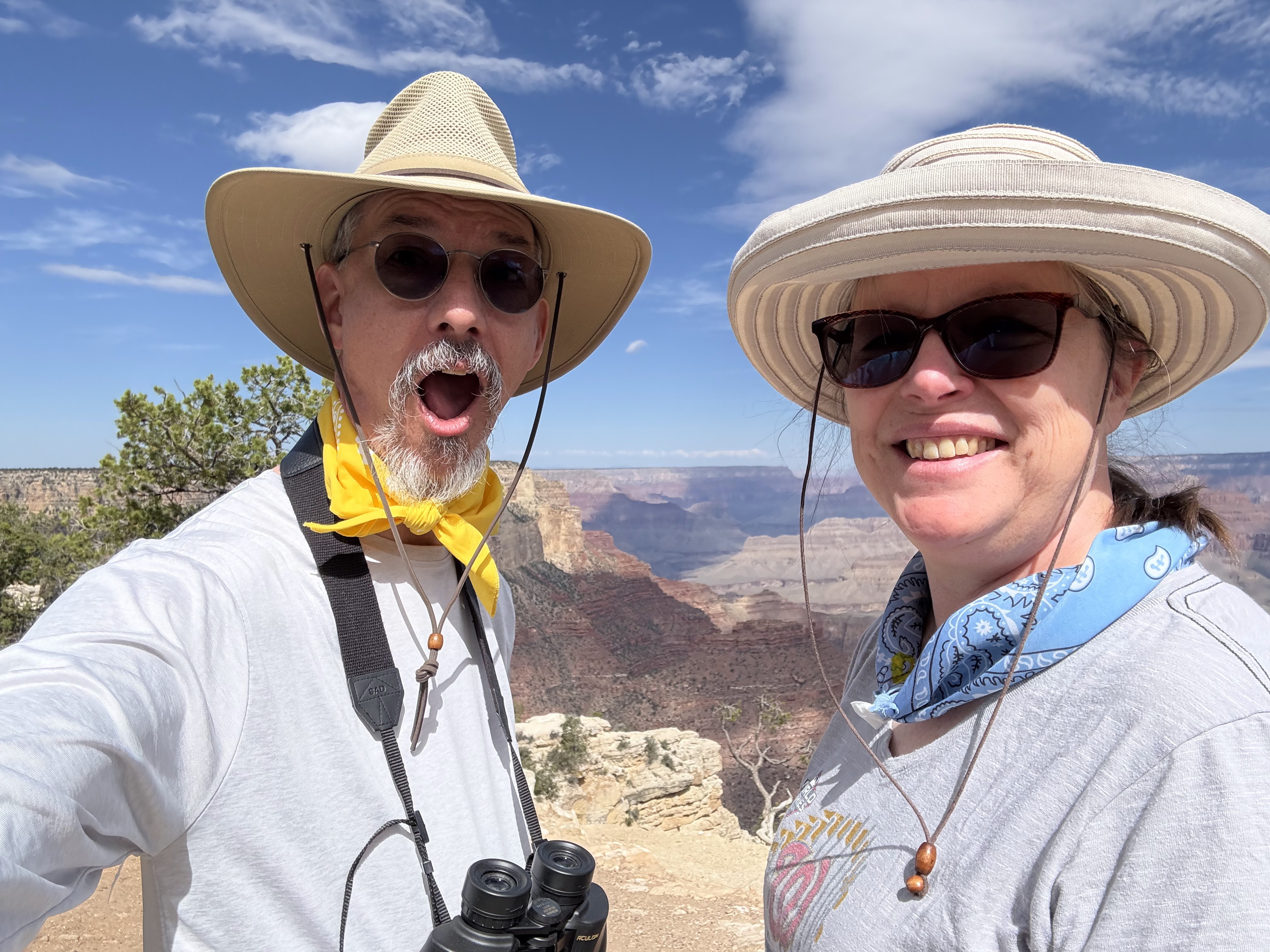
July 22 – We signed up for a tour with Canyon Dave Tours to go to the Grand Canyon and had a great experience! Our tour guide, Keaton, picked us up at the hotel in Flagstaff at 7:45 a.m. and four other folks along the way. Then we spent the whole day at the canyon. Keaton was amazing, very knowledgeable and personable, imparting geology, biology, and history that was just fascinating. The scenery is of course amazing. We could see smoke still on the North Rim, which increased through the day. The weather was beautiful – sunny and upper 70s with nice breezes. We heard so many different languages through the day, too. Keaton delivered us back to the hotel at about 5:30 p.m. Great day! 10 out of 10, would recommend.

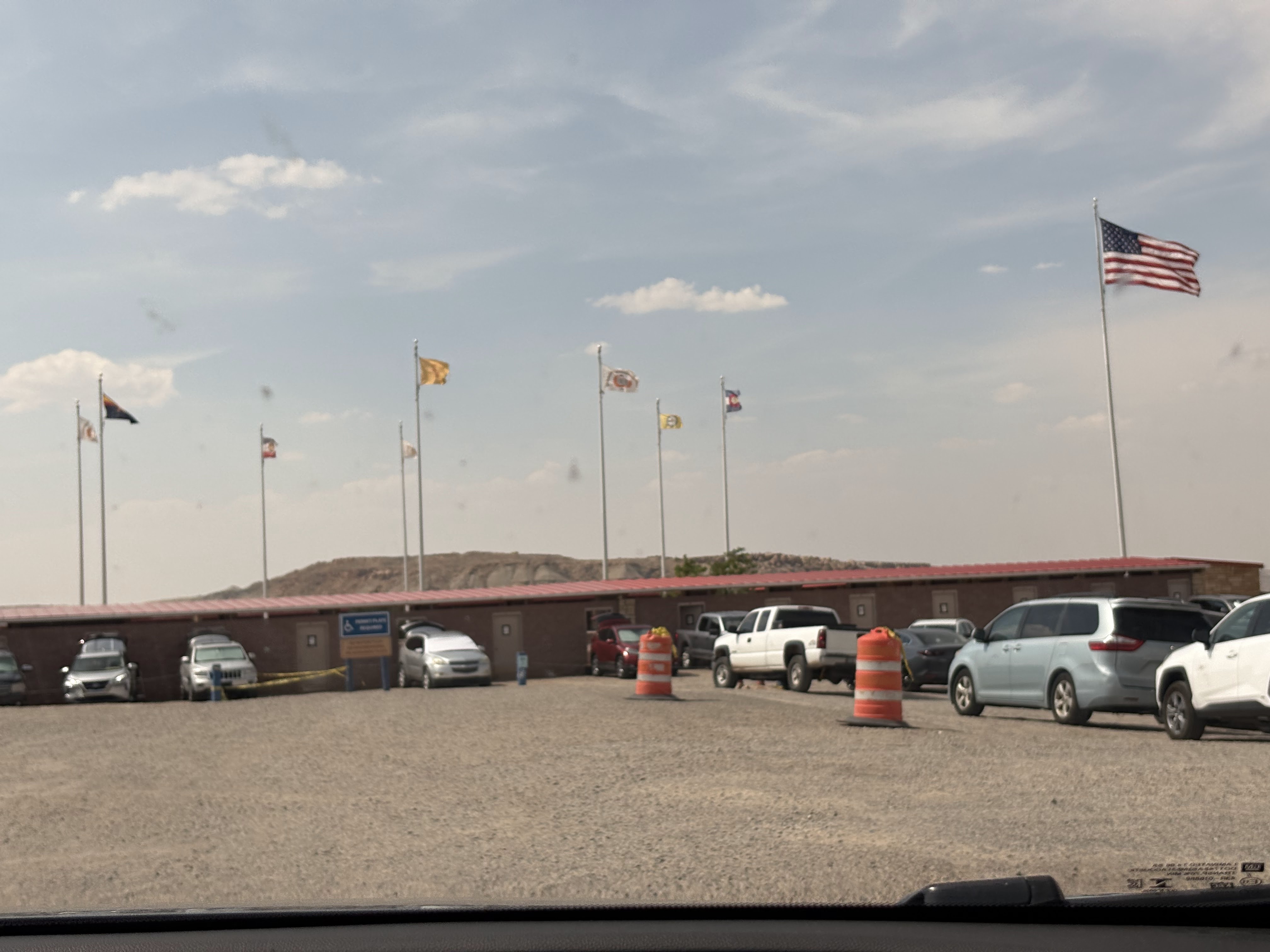
July 23 – Drove from Flagstaff to the Four Corners Monument, the point at which Utah, Arizona, New Mexico, and Colorado meet at right angles. We took the scenic route, US 160, a mostly two-lane road called the Navajo Trail (at least in part anyway). Lots of amazing scenery. The Four Corners Monument is on Navajo land. It’s a fairly simple site with the flags of the four states and the Navajo nation, various informational plaques, and a circle where the borders cross and you can stand in all four states at the same time. People take turns taking pictures. The plaza is surrounded by booths with native folk selling their crafts. We bought a couple really pretty pieces. You could tell the introvert merchants from the extrovert merchants pretty easily.

After that, we continued on Rt. 160, crossing Wolf Creek Pass, and on to Alamosa, CO, for the night. We got a call from the hotel about 9:15 saying that they close their desk and lock the door at 10pm, but if we could say when we were coming they’d have someone to let us in. That’s a local, non-chain hotel for you! And while the room had all the necessaries, it was definitely nonstandard. Not sure if it was a refreshing change or off-putting. It was a little more like staying in someone’s guest room than a Wyndham room (All hotels are Wyndham now, aren’t they?).

July 23 – Long drive from Alamosa to Mom’s house near Loveland, about seven and a half hours. Mostly high traffic on I-25, but otherwise uneventful. We’ll be here for a few days, and then we’ll fly home. As wonderful as this trip has been, I’m looking forward to just sitting and not touristing for a little while.

So those are your headlines from the Western front. Stay tuned for more details to follow, and stay subscribed!

Here We Go Again!

Can you believe it’s been seven years since my Grand Tour that occasioned this blog? Well, if you are among my ones and ones of followers, you might recognize the fact. It hardly seems possible that it was that long ago. At the same time, the world has changed dramatically since 2018, and that Tour seems like a lifetime ago!

If you don’t know, the Grand Tour was the bulk of my 2018 sabbatical in which I visited 17 astronomical observatories and facilities in nine states in under three months. It was an amazing journey of history, cutting edge science, and discovery. I grew to admire the incredibly detailed work of scientists, the remarkable persistence it requires of them, and the ingenuity and cleverness they deploy to make fantastic discoveries about the universe and our place in it. I mean, that’s a lot of superlatives right there, and it barely scratches the surface of what they do. To learn more about it, just go through my blog posts about it.

Now, it’s 2025, seven years later, and time for another sabbatical. This time, I got it in my mind to work on a book about time and eternity from scientific and theological points of view. This came to me last year when we were on our way across Texas to see the solar eclipse. I was thinking about a summer preaching series, and the eclipse put me in mind of the timing of the movements of the spheres. We happen to live in an era when the moon is just the right distance from the earth to match the apparent size of the sun to create a total eclipse. This doesn’t happen just everywhere in the universe, and it doesn’t happen forever. in a few million years the moon will have moved further from earth and won’t be able to cover the whole solar disk. So we live in a remarkable time. That’s what got me thinking about time as a sermon series theme. Then I realized I could make it into a book during this sabbatical! So that’s been the plan.

As it happens, I now suspect that it is impossible to write a book of much substance in three months. So I’ve scaled back my expectations a bit but still plan to work on the project. I’m thinking about questions like: What is the nature of time? Why do we bother with it at all? Does the past persist? Where does the future come from? What is eternity, and how long is it really? Would humans actually enjoy living forever? Does our view of eternity affect how we behave in this life? I have so many questions! The idea is to consider them scientifically and from a particular Christian framework in a way that is accessible, thought provoking, and maybe even fun. We’ll see how that all turns out. At this point I’m imagining a collection of essays that could be the basis for sermons, lessons, and a deeper book in the future.

Meanwhile, Molly and I have just celebrated our 35th wedding anniversary – hurray! So as part of the sabbatical and as a celebratory trip, we are going out west. We will spend a week at Ghost Ranch, a Presbyterian conference center in northern New Mexico. Each of us is taking a class – Molly on writing children’s books and me on painting still-life and landscapes. Then we’re going to Chaco Canyon National Historical Park, a Native American heritage site that I had hoped to get to on the Grand Tour of ’18. The site includes a number of archaeo-astronomical installations to mark solstices and equinoxes and such. It would have been the oldest observatory on my previous tour. Now it will be a stepping stone in considering deep time for life on earth. And the stepping stones get older and deeper! After Chaco, we will visit Meteor Crater near Winslow, AZ, and then the Grand Canyon. I hope these big holes in the ground will give me a richer sense of the passage of geological time that might just make it into the book.

So there you go! That’s what I’m going to be up to for the next few weeks and months. I hope to keep the updates coming here, and I hope you’ll come along for the ride. It’s going to be a fun time!

Observatory 14: Mount Wilson

Prelude

September 2, 2018, was a cloudy Sunday morning in Los Angeles. I was really tired. I had been on the road for close to five weeks, a personal record, and it was taking a toll. As an introvert I might expect to have been energized by so much time alone, but that isn’t really how it always works. In particular, I had never been away from my wife for so long, and I missed her terribly. I had seen none of the folks I usually engage with for all that time, too, and I was kind of lonely. I was on a great adventure to see some of the greatest American observatories ever, but I got up thinking, “If I have to go look at another damn telescope today, I’m gonna scream.”

That wasn’t anything I had expected for this trip. It was a sabbatical, after all, and it was supposed to be rejuvenating and energizing and whatnot. The trip was designed around my favorite hobby, one that I regularly turn to when I want to experience a sense of awe, and for the most part it was delivering that. At the same time, I was really feeling homesick and overstimulated. So I gave serious thought to skipping my scheduled trip to Mount Wilson.

This is how I recorded it in my journal a few days later:

I actually gave thought to blowing off Mt. Wilson. I’ve seen a LOT of telescopes and I was tired and whelmed. But this is what I had come so far to see and do! So I went, and glad I did.

My journal, September 5, 2018

One of the things that helped me get over the hump, as it were, was watching the worship service from Catoctin Presbyterian Church, the congregation I serve as pastor. We had been doing a live stream for about a year before I went on sabbatical, and that continued a little sporadically while I was away (as I was the primary tech driver for the project). This particular Sunday, they did have a broadcast. Being the first Sunday of the month, there was communion, and my wonderful wife and colleague Molly was the preacher and celebrant (the minister leading the sacrament). It’s hard to remember that we haven’t always been savvy with videoconferencing, but watching the service was about the first time I’d seen Molly since I’d been traveling, and it did my heart good. So, too, to see and hear my church family. When it came to the sacrament, I recorded in my journal:

I dipped my bagel in my coffee as they did communion.

My journal, September 5, 2018

Again, at the time virtual communion was entirely unknown and to some extent unthinkable, so I didn’t count it as fully communing, but it was the next best thing, and it made me feel connected again. This, I think, as much as anything, gave me the stillness of soul and clarity of purpose to make the trip to Mount Wilson that day.

Up the Hill

I was surprised when I mapped the drive up to Mount Wilson from my flat in Glendale, as it’s about 10 miles as the crow flies, but 27 miles driving and, according to Google Maps, 48 minutes travel time. You might think that after ascending so many mountains I would have figured out that it isn’t quick or easy, but I guess I’m stubborn that way. As I set off, with plenty of time to get to the top before the 1:00 p.m. tour times, it was still pretty overcast. The driving was easy on the broad highways of Los Angeles, until the turnoff to head up into the hills of national forest land, then it was two lanes and switchbacks the rest of the way. Hence, 48 minutes for 10 miles. About two thirds the way up, the weather broke suddenly for the better as the clouds fell away. No, seriously, I drove up out of the clouds and could look over the top of them! It was spectacular.

Not long after, I reached the summit parking area, which is surrounded by antennae of various types. It was not clearly marked where one ought to park for scientific geekiness as opposed to mountain biking or hiking, so I took first available. It was a short walk to the Cosmic Cafe where you buy your parking pass (if you haven’t already done so in the lowlands), regardless of your purpose on the mountain, and also tour passes for the observatory (to say nothing of food). Both passes were pretty reasonably priced. Standing around in the pavilion of the cafe, there were posters declaring the 150th anniversary of George Ellery Hale’s birth, 1868-2018, a point I had not realized in all my preparations and learning. How cool!

Eventually a group of about a dozen other nerds gathered for the 1pm tour, and we set out. Our docent was a retired engineer whose name is now far gone from my memory, but he was very personable and knowledgeable, as you would want in a docent. The campus is very pretty and quite a natural setting, bustling with evergreens and wide views of the valley below. It isn’t as carefully crafted as Lowell Observatory in Flagstaff, which seems to have been designed for visitors, but it is more like walking in a national park that happens to be home to a world class science outpost, which is what it is, of course.

Some of the first knowledge imparted was about how Hale selected the site, and how they built it up, and how they brought the equipment and instruments up the mountain with mules and carts. Not even kidding. The project started in 1904, so cars and trucks weren’t much of a thing yet, and this was pretty remote territory at that point. So naturally it took years before Hale and Co. could get any science done. This really isn’t unusual in the realm of astronomy, the long haul of time and materials in remote places to build a bigger telescope. It’s still happening in the Atacama Desert of Chile and the Australian Outback. There’s even talk of building a telescope on the far side of the moon, which would take the pattern to a whole new level. But I digress.

Starting with the Sun

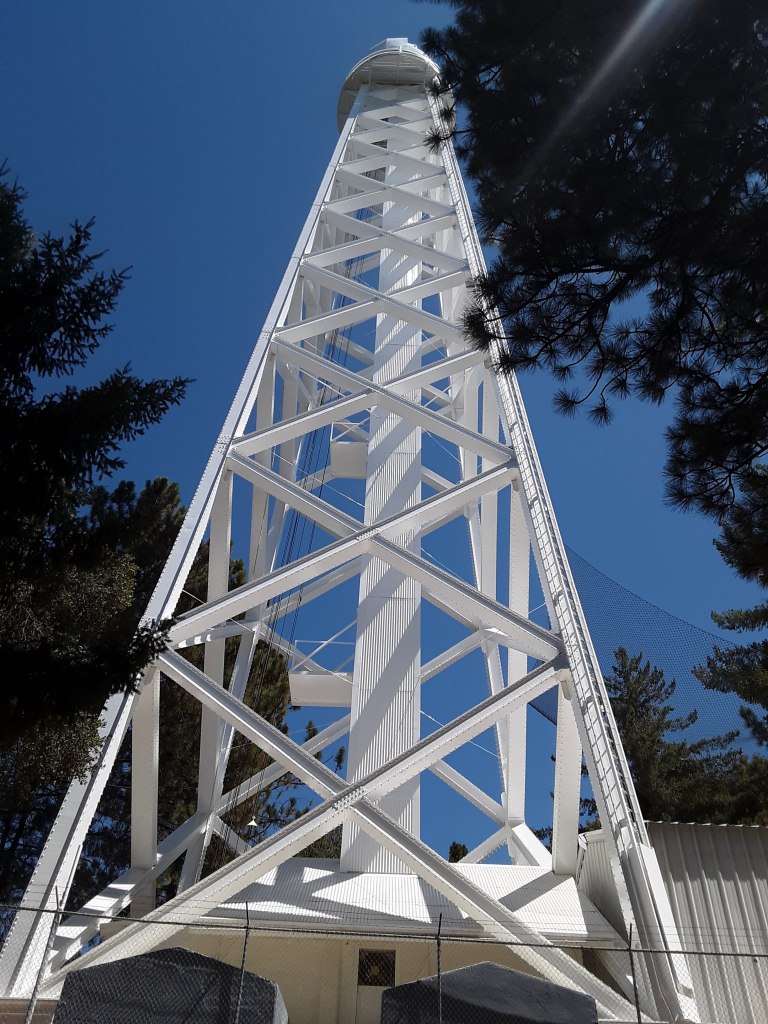
The 150-foot solar observatory tower

There are several observatories on the Mount Wilson campus, actually. The first we saw were the 60-foot and 150-foot solar observatories, the white heads of which both towered above the trees. Hale was himself a solar observer of some renown, so it isn’t surprising that he set up a sun tower at the new site. (If you haven’t been following along, and after two and a half years, there’s no reason for me to expect you would, the old site was the Yerkes Observatory in Williams Bay, Wisconsin, where Hale had organized the construction of the world’s largest telescope of 1897, the 40″ refractor. Before that he had a home observatory outside Chicago. The sky conditions in both places were regularly pretty poor, so this California mountain was a huge upgrade.)

The way the solar towers work is there is a little dome at the top with a mirror and clockwork that tracks the sun. The light is reflected down a central shaft into a control room/laboratory where the image is projected and can be measured and recorded and whatnot. Astronomers could and can take spectra by sending the light through a prism or diffraction grating to spread it out. That gives you data to figure out what elements are present in the sun, among other things.

So we went to the lab of the 150-foot tower (actually the third solar telescope on the mountain) and met Sam, a solar astronomer who works there. They still do science there, recording and measuring sunspots and spectra and such. It’s not real cutting edge work these days, but this lab has some of the longest continuous records of solar observations at a single site in existence, and the early work done there really was groundbreaking. You can read more about it on the Mount Wilson website. It’s worth a read. I just learned some things I had missed or forgotten that raised Mr. Hale some more in my estimation, which was already pretty high.

There is a small museum near the 150-foot tower that we stopped to see. We didn’t spend very long there, though. They have a variety of documents, letters, photos, and a diorama of the observatory campus. It would have been interesting to spend some time there, but we had other fish to fry.

The Big Hooker

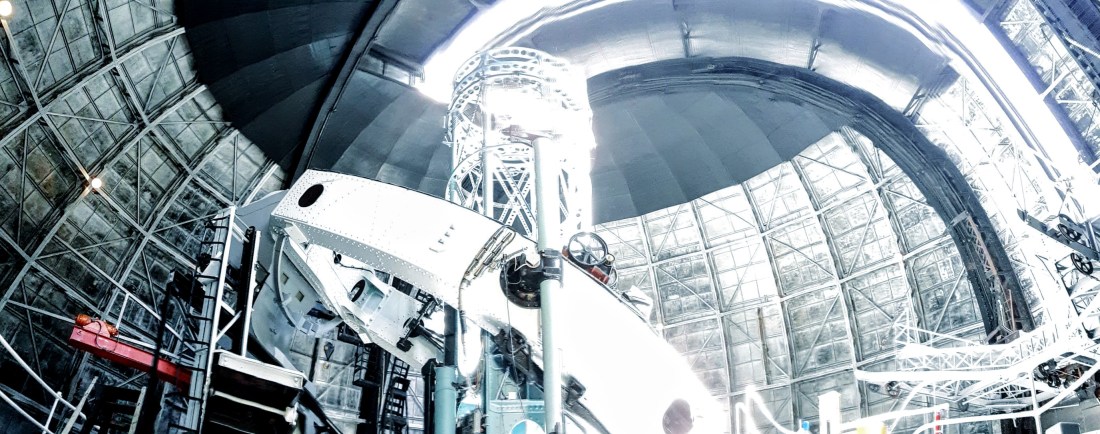
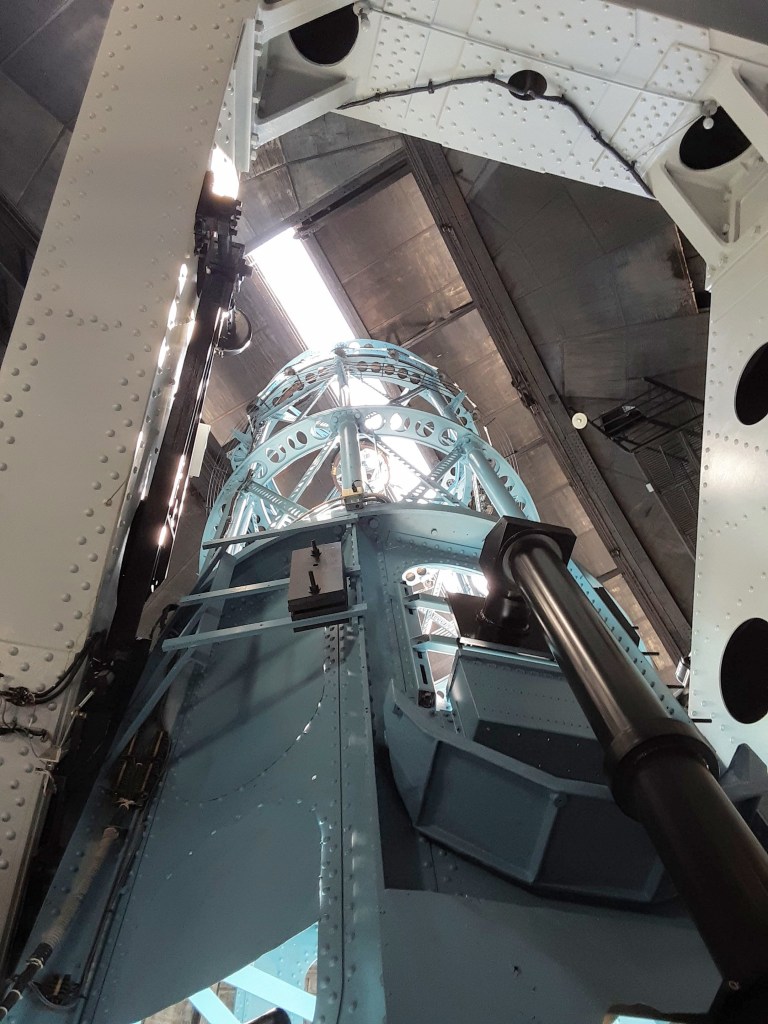
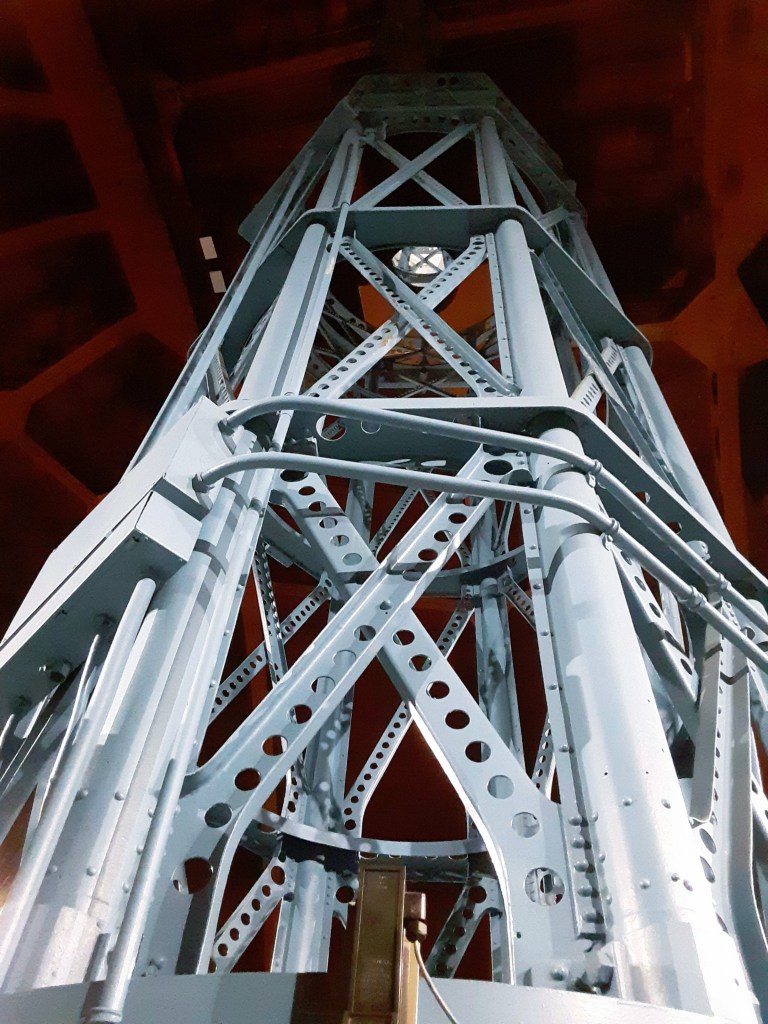
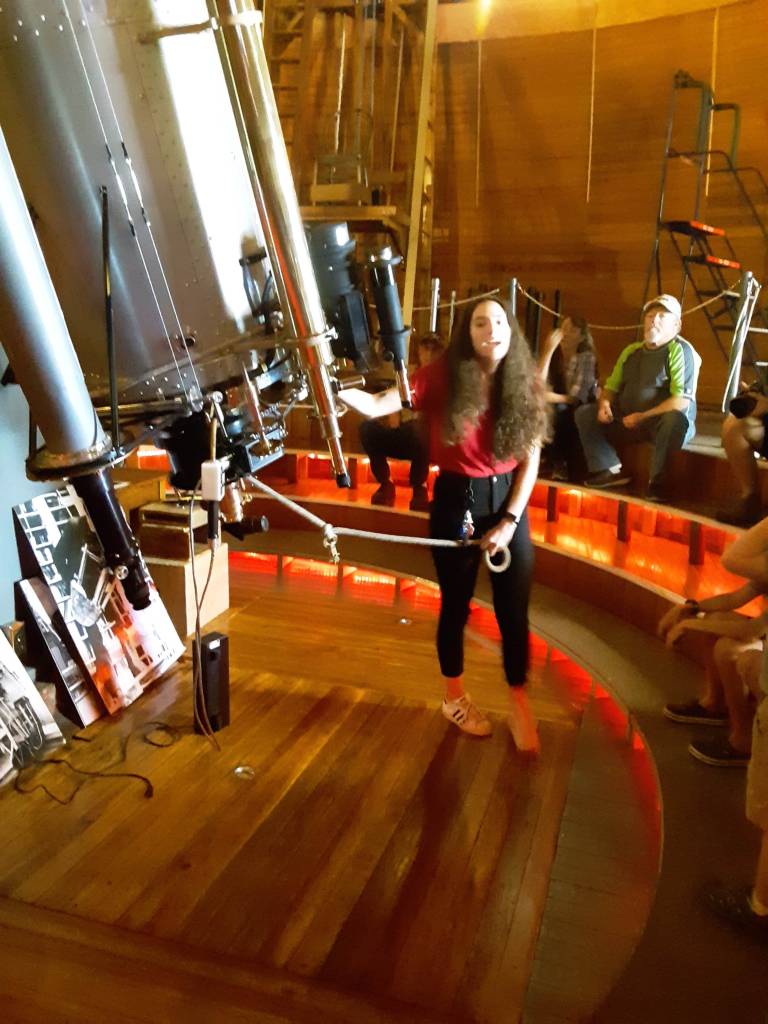
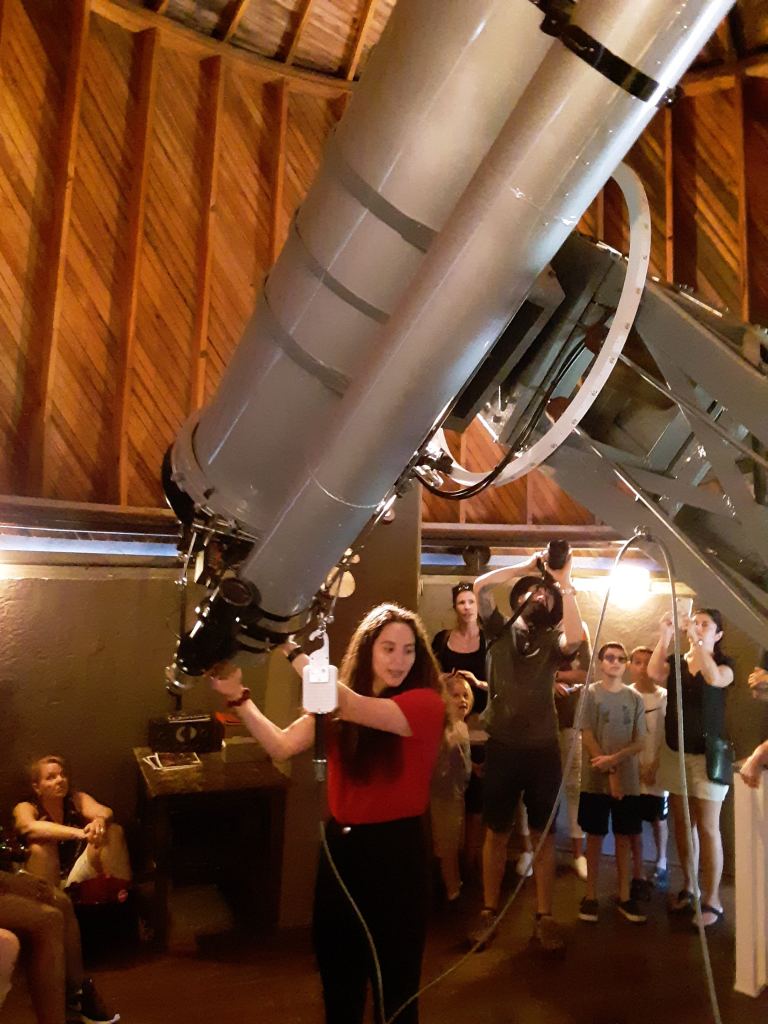
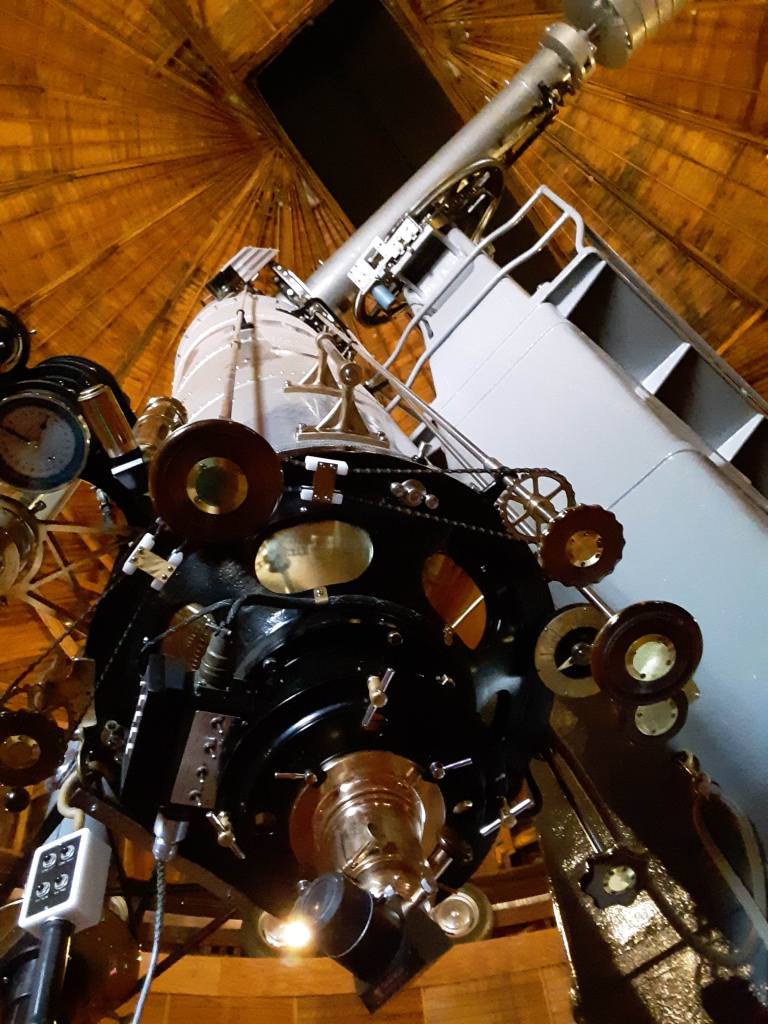
Most of the Hooker optical tube and some of its closed yoke mount.

The centerpiece that I was most eager to see is the 100″ Hooker Reflector Telescope. This was the third “World’s Largest Telescope” that Hale was responsible for bringing into existence and the one that produced some of the most shocking discoveries in modern astronomy. Gaining first light in late 1917, the Hooker Telescope was at the same time a remarkable technological achievement and a remarkably flawed instrument. The closed yoke mount looks like a tank or a battleship (your preference), and the cage of the optical tube is impressively large. Coming as it did early in the industrial age when steam and mules were still major power sources, the mass and precision of the instrument is considerable.

The 100″ primary mirror is its greatest technological advance and also its greatest technological hindrance. No one had ever cast such a large piece of glass successfully, and it took quite a few attempts and several different contractors to actually do it. That they managed it at all was no small feat, but they only just barely managed. The glass is terrible quality, riddled with bubbles. We actually got to see a small section of it, and it’s stunningly bad! Bubbles in your mirror make it extremely difficult to get a smooth polished surface without pits and divots. Bubbles also mean the thermal and strength properties of the mirror are inconsistent, which leads to inconsistent expansion and contraction from warming or cooling, which causes distortions in the surface, which causes distortions in the image. Inconsistent stresses can also lead to things like cracking or shattering, which you don’t generally want for your mirror. Amazingly, the technicians were able to figure and polish the mirror smooth enough to do its job (within a millionth of an inch!), and it hasn’t cracked yet.

The 100″ primary mirror (the green part) is a frothy mess, full of bubbles! Skilled technicians made it work, though.

So they got it to work, and it turned out to be pretty good. Hale did start making plans immediately for a bigger and better telescope (the 200″ at Palomar), but the 100″ didn’t go to waste. This is the telescope used by Edwin Hubble and Milton Humason to discover, first, that the universe is bigger than just our galaxy, that there are in fact many galaxies, and second, that this much-larger-than-imagined universe is expanding. These were both radically revolutionary ideas in the 1930s. Other sites cover this much more thoroughly and intelligently than I can here, so I encourage you to learn about it if you aren’t familiar. My own connection to this is that when my dad passed on to me my grandfather’s homemade 6″ telescope, he told me how Grandpa would observe the Great Andromeda Nebula as a favorite target. This “nebula,” as it was known before Hubble, is now known as the Andromeda Galaxy, a spiral galaxy and bigger neighbor to the Milky Way. It’s the same galaxy that Hubble and Humason observed, discovering it was over 2 million lightyears away, when everything else being observed was on the order of tens of thousands of lightyears distant. So Andromeda is a favorite of mine, too.

Anyway, our docent was telling us about Hubble and the telescope and all while we were under the dome, which was open, and it was awesome. Meanwhile, I want to tell you about three things going on besides the telescope and the lesson, just because I think they were unusual. First, while we were there, they closed the shutters in the dome. This was pretty cool, and I got video of it. It’s faster and quieter than you might imagine. They closed the shutters because the sun was starting to shine on the telescope, which you never want, and the sun was warming up the inside of the dome. Both were unwanted because of item of interest #2, they were preparing to have a soiree in the dome later that evening. There would be jazz music, and guests (donors?) would get to look through the Hooker. So they wanted the dome to be cool and the telescope to be in thermal equilibrium for a good viewing experience. I had never thought of having a jazz party in an observatory dome, but I can’t think of anything much cooler than that. (Nerd!) This was so exciting it must be what led to item of interest #3. While the docent was telling us about Hubble, I looked around a bit. There is a visitors’ gallery half a floor down from the observing floor where we were, with large glass windows so guests can watch what is happening on the observing floor without getting close enough to mess anything up. In a reverse of that, I noticed down in the gallery there was a woman sitting on a man’s lap, and they were making out like crazy. Astronomy is so hot! Definitely not something I expected to see in the hallowed science halls.

We got to mill around in the dome for a while and even to touch the mighty Hooker. The docent showed us the bad mirror glass, leading to the picture above. I took many a selfie in front of this important instrument. Then we made our way outside heading toward the next tour stop. On that way there’s a spot where a famous picture was taken of Albert Einstein when he came to visit Mount Wilson and see (and use?) the great 100″ reflector. So naturally, we all took selfies on the spot. Einstein wasn’t keen on the idea of an expanding universe, and for many years dragged his feet in accepting it as true, although he eventually caved. He would have flipped completely at the discovery in 1997 that the expansion of the universe is accelerating. At any rate, it was kind of exciting to stand where your heroes have trod. It’s part of what made this a pilgrimage for me as opposed to just a big sightseeing trip.

4, 3, 2, …

Our last stop was to see the 60″ reflector. This telescope also was once the “world’s largest,” but now it is more like a forgotten middle child. It doesn’t even have a cool benefactor name, just “the 60-inch.” It was the successor to the Yerkes 40″ refractor and was itself succeeded by the 100″ Hooker. It was also cutting edge technology in its day and is still a formidable instrument for most people on the planet. I, for one, would love to spend a clear night with it. But these days public outreach is its main job as opposed to significant science.

Here’s what I wrote in my journal:

George E. Hale was responsible for the largest telescope in the world four times in a row, and now I’ve seen them all. Two of them are on Mount Wilson. They run Yerkes 40″, Mt. Wilson 60″, Mt. Wilson 100″, Palomar 200″. I saw them Yerkes-Palomar-MW100-Mw60. Consequently, by the time I got to the 60″ – five feet in diameter, mind you – it looked tiny! But the docent was very good and all the scopes in their context are quite impressive.

My journal, September 5, 2018
The venerable but nameless 60″ reflector. It may be obsolete, but I wouldn’t kick it out of bed.

Indeed, the docent acknowledged that seeing the 60″ after the 100″ does a disservice to the smaller scope, which was and is, as I mentioned, a remarkable instrument. We got to see the mirror glass on this one, too, and it is beautiful and clear, as it should have been. One fascinating part of the mounting system for this scope is that it rests in a pool of mercury that holds about 95% of its weight! This is a clever and very stable engineering solution except for the part about mercury being poisonous, which was apparently not well understood at the time. The optical tube for the scope is like steel girders, like an oversized Erector Set, for those old enough to remember such.

When I think of the dome for this one-time champion instrument, it seems kind of homey and rustic, like a cabin in the woods where you might spend a weekend. This is odd, because when I just looked at my photos I see that it is actually a metal framework and not the wood that I was imagining. Still, there was something cozy about the dome, especially after the lofty grandeur of Palomar and Hooker. I imagine that the guys that built it and used the 60″ didn’t think of it in those terms. I suppose for them it was a cutting edge outpost in the wilderness of science and the wilderness of California.

Postlude

That brought the tour to an end. It was a little anticlimactic, but I was satisfied. It had turned out to be a beautiful warm day, and after a few hours of science and fresh air I was tuckered out. I was also pretty hungry, as that bagel was the last thing I’d eaten. So I made my way back to the Cosmic Cafe and got a lovely pastrami panini and a cup of coffee, if I recall, which were very good and not too expensive. They had no swag at all, which was very disappointing. When I got home I ordered a t-shirt of my own design with my own picture (see top of the post) from Cafe Press, and that sufficed.

I am so very glad I dragged myself out that morning. I have seen the four great Hale telescopes and more, and I overcame the lethargy that would have led to regret. In my journal, I wrote this:

I began to realize that I was having an experience like what I would expect had I done the Camino in Spain. Long and far and alone and awesome and exhausting.

My journal, September 5, 2018

Pilgrimage is a challenging road, filled with long slogs, many hardships, and in the best cases moments of brilliance. It is in persevering through the slogs and hardships that we put ourselves in a position to receive the brilliant. Whether it comes or not, we will be stronger and richer for the experience. That’s the theory, and it seems to have paid off this time.

I had a couple other smaller adventures before the end of my time in L.A. I had lunch in Pasadena with a church friend from Catoctin who was on extended stay in the area. I went to visit the headquarters of the Planetary Society, also in Pasadena. And I got to spend some more time with friend Steve Craig who bookmarked my sojourn by getting me back to the train station. Maybe I’ll tell you about those before I’m done with all this. Also, remind me to tell you about the guy at the gas station near LAX. But I was looking forward to the next leg of the sabbatical with great anticipation. Molly was coming to join me in Albuquerque, NM! Stay tuned.

Observatory 13: Palomar

My time in California was very full! I was in Los Angeles for a week and saw the California Science Center, the Griffith Observatory, the Palomar Observatory (about which you are about to read), the Mount Wilson Observatory, and the Planetary Society home office (the latter two about which you will read someday soon). Other than seeing the Hollywood sign from Griffith Observatory, I didn’t really do much in the way of typical tourist sightseeing. Of course, I was a pilgrim and not a tourist, so I’m not really upset about that. I do hope someday to return to LA and engage more in its culture, but for now, let’s get on with Mount Palomar, which I visited on September 1, 2018.

Palomar: The Short Form

The following is what I managed to record in my journal, which, if you are a regular reader you know, is woefully incomplete but helpful as far as it goes.

Two and 1/2 hour drive SE through a couple reservations to Palomar Mtn. It’s still an active research facility so they kick everyone out at 4pm. Conditions are good enough they observe [on] over 300 nights a year. There is a nice little visitor center with lots of posters about the history and science. A few interactive displays. Nice gift shop with lots of swag.

The dome of the mighty 200″ Hale is beautiful Art Deco style, designed as a “cathedral of science,” and you get that in its scale, design, beauty, and acoustics. The mount and scope are epic in proportion. Dwarfed by the next generation coming online but really just massive. It’s like a battleship of astronomy. It has been upgraded with adaptive optics, so it can produce better resolution images that the puny Hubble. A great experience to be there.

– written 9/5/2018 at Albuquerque, NM

That’s it. I’ll try to fill in some gaps here next, and you can also see my pictures with commentary >HERE<.

Palomar: The Long Form

I had been to Griffith on Friday evening, and Saturday was my day for Palomar, which was only offering tours on the weekends. It was a two and a half hour drive southeast from LA to Mount Palomar, and since I planned to attend worship somewhere on Sunday, it seemed like a good idea to make the long drive on Saturday and go to the more local Mt. Wilson on Sunday. The drive down was pleasant enough on a beautiful, warm fall day. It was mostly freeway driving (about 100 miles / 160 km) until it wasn’t, getting off I-15 about 15 miles (24 km) north of Escondido, then heading east on highway 76. This was also a pleasant road which included going through several small towns and at least two Indian reservations, the Pala and La Jolla. Lastly there was the standard narrow, winding road up the mountain to the observatory. I remember a couple of these (Kitt Peak, especially) to be white-knucklers, but I don’t remember that about Palomar, so either it was an easier road or I was getting used to the hairpin switchbacks.

My guess is this is crowd control by scientists and engineers: essential information and warnings only. No frilly welcomes or unnecessary use of color. Someone from the sales department probably added the pretty “Tours Today” poster.

Arriving

When you arrive at the top, there is a midsize parking lot with a couple picnic tables around as I recall. Simple signs indicate when and where to go and warn that the gate is closed at 4pm. The grounds are well kept but not manicured, looking fairly natural in some areas. If you stick to the path (as directed by the signs) you soon come to the visitors center, which is a low, small, simple building. Inside is a guestbook, restrooms, the gift shop, and the display hall. You buy tour tickets at the gift shop, as seems to be the case at most of these facilities. The displays in the hall include a model of the 200″ telescope and its dome, an actual 18″ telescope used for several decades onsite, and mostly illuminated posters full of words on the walls. Having taken the time to read a lot of the words, there is a lot to be learned there. But you have to be willing to take the time to read it all. My guess is a lot of people and kids especially miss most of that information. Kind of a shame, really. I feel like they could update some of the displays to be a little more interactive. The posters have cool color illustrations that are eye catching, so that’s good. Just … there are so many words!

Panorama of the visitors center museum/display hall. Each panel is full of sciency words!

I arrived at about 11:00 a.m., and if I remember correctly, my tour was at 1:00 p.m. There was no cafeteria or food service, and I don’t remember exactly what I did for food. It runs in my mind that I packed my lunch and ate it in the car between reading all the words and going for the tour. Let’s go with that.

A Cathedral of Science

The tour started at the back of the dome for the 200″ Hale telescope (a.k.a. “the Big Eye”), so I wandered over and got there early. (This “early” as you call it is something that happened to me quite often on the Grand Tour and rarely happens to me in real life. Now that I’m admitting that to you, I suppose I have to consider why that is so. Anyway…) The Palomar dome looks like it could be a monument on the Mall in Washington, DC, a beautiful, smooth, bright white dome with art deco ornamentation on the shutters. Against a blue sky with the sun on it, it is absolutely stunning. It is so iconic that many pop culture references to observatories, whether in movies, cartoons, or comics, are based on Palomar. 

We met at the back door, essentially. There were maybe 20 people in the group and a couple docents. The tour started outside there with an overview of some of the history of the site. The 200″ telescope project was a direct result of the 100″ telescope at Mt. Wilson – both from the work being done with it and the fact the its mirror was remarkably poor in its fabrication. But more on that when we get to Mt. Wilson! The 200″ was the brainchild of George Ellery Hale, who conceived it and arranged financing for it in the late 1920s. It was designed in the 1930s during the Great Depression, working to overcome a variety of new technological issues, including how to cast a mirror that big and then how to support its weight. The outbreak of World War II put work on the project on hold so that it wasn’t commissioned until 1948, twenty years after its conception and ten years after Hale’s death. The telescope was then named for Hale, and so he achieved the creation of the world’s largest telescope four times in a row: the Yerkes 40″ refractor, the Mt. Wilson 60″ reflector, the Mt. Wilson 100″ reflector, and the Palomar 200″ reflector, all of which were of course on my list for the Grand Tour.

We entered the observatory building from that back entrance into the downstairs maintenance area. Honestly, after all this time, I don’t remember much about this part of the tour, except that recurring sense that real science smells like oil and steel. There was interesting information delivered to us, but it beats me what it was. Well, there was the massive beams supporting the structure of the dome and the telescope mount on the floor above us. The colossal loads beneath which we stood have been ably held by these Atlas-like foundations for over 80 years so far. So we got that sense of scale before even seeing the Big Eye.

We made our way upstairs to the observing floor. This is very cool, and not everyone gets to do this. If you don’t take the guided tour and come during the week, you can only get to the visitors gallery, which is a room on the side with a glass wall. That would be lame. Meanwhile, being out on the floor didn’t mean we could touch the scope or anything, but we were out under that magnificent dome! They say the building was designed as a “cathedral of science,” and it certainly feels that way! First, it is a vast, soaring, majestic space like a cathedral. Second, on the inside the dome appears to be made of stainless steel panels, and the light under the dome is reflected in rich, warm tones that give it a sense of artistry and beauty, qualities notably lacking in most other similar structures. Third, the acoustics under the dome are very much like a cathedral. It doesn’t take much to be heard from some distance, and all that is said hangs in the air in the reverberations. Last, they have done a lot of holy science in there, as mere mortals stretch out to reach and understand heaven.

“The Big Eye” – the 200″ Hale reflector, a magnificent machine under the “cathedral” dome. This is the upper half. It was once someone’s job to ride at the top, which probably wasn’t as much fun as it sounds.

All Hale the Big Eye!

The telescope itself is simply colossal. I mean, it’s not as big as the Large Binocular Telescope, but that’s really two anyway, so it isn’t a fair comparison. But this has the same feel of just being huge. The mount, a polar-aligned fork mount, is like a big suspension bridge or something on a battleship. The optical tube, an open steel cage, is like a water tower. The mirror is obviously 200″ or five meters or 16 feet 8 inches in diameter. That’s two and 3/4 times my height. Yes, I know I saw several mirrors almost twice that size in Arizona (SML / LBT), and yes, they are phenomenally large. But standing next to the mirror cell for this venerable, world changing and still world class telescope, I was impressed by its size. Sue me! The mirror cell is, I’m pretty sure, bigger than my car… yes, I just checked. Definitely bigger than my car. I think it is actually possible to ride in the cage under the mirror cell. Interestingly, the cage at the other end of the tube, the top, where the secondary mirror sits, originally was designed so someone could sit there and, by observation and manipulation, guide the telescope to stay on its target. That was actually someone’s job, to ride at the top and steer the telescope all night! This got to be pretty cold, as you might imagine, especially if you’ve ever spent a non-summer night out under the stars. Eventually they got their hands on some war surplus electrically heated flight suits (they have one on display), and thus the poor grad students or whomever could avoid frosting over.

I would love to have a chance to see through the Big Eye. Of course, it is still used for real scientific work, so letting tourists use it isn’t really going to happen. Besides, it has been refitted, as virtually all modern scientific instruments are, to be strictly photographic. As far as I know there isn’t a visual eyepiece to look through even if you got the chance. But what a view it would offer if you could see through it! As mentioned above, it also has been fitted with adaptive optics, which means a software system analyzes turbulence in the atmosphere and mechanically deforms the telescope mirrors (generally the secondary mirror) to compensate for that turbulence, effectively removing the effects of the atmosphere from the image. Along with that, as I consider the size of the instrument, I’m aware that it is 25 times larger than my backyard telescope. That means for every one photon hitting my mirror, the Big Eye gets 625. What a remarkable, even transcendent experience it must have been to look through that on a steady night! I wonder if those astronomers in the early days ever got bored or jaded or blasé about what they could see. I suppose they did, but I hope not.

The tour ended with some Q&A, then a walk down a long flight of stairs to the front door of the dome, with a bust of Mr. Hale sitting just inside the door. Outside it was a beautiful, warm fall day, just as it had been when we started, but it seemed like we had traveled through time and space. I mean, technically we did travel through a couple hundred meters and a couple hours, but it felt like cosmic distances and long eras. It was like coming out of a ride at DisneyWorld. It was like coming out of a blockbuster movie. It was like coming out of a really good worship service. That’s the proper effect of a pilgrimage site, or the experience created by interacting with true creativity, to break us out of our ordinary timeline and allow us to imagine a broader universe.

Having had such a broadening experience, I bought a bunch of swag at the gift shop and made my way back to my apartment.

Observatory 12: Griffith

In my last entry I described the day I arrived in Los Angeles, including my visit to the California Science Center. That was a Wednesday, August 29, 2018. The next day, according to my journal and my now vague memories, was spent doing laundry, getting groceries, and watching Netflix, a luxury with which I was pretty unfamiliar at the time. Doing laundry was also a luxury, as I didn’t have the opportunity during my week in Arizona, and my last attempt was that time in New Orleans when the machine flooded the kitchen in my apartment. Good times. This was a much better experience than that, entirely without incident. But that’s not why you’re here reading this! So let me tell you about the next day.

Griffith Observatory – Short Form

Here’s what I wrote in my journal a week after I left L.A., then I’ll add some details after that.

Griffith Observatory [is a] classic science center from the 1930s with a huge underground gallery added in 2003. Saw the sky show and got to look through the 12″ Zeiss refractor at Saturn. View was nominal, expected for look over LA, but still glad to have done. Four moons visible, Cassini Division, disk shadow. Stood in line with Gita, a science teacher from India. She was fairly knowledgeable about many things, some more than me, some less. She had never seen a planet through a telescope. I think she was a little disappointed at 175x, but that’s how it goes. There were a lot of people there, which is heartening. Lots of adults.

My Journal, 9/5/2018

Griffith Observatory – Long Form

The Approach

I’m sad that I didn’t write more in my journal, and I’m sad that I haven’t written up my memories before now, because things are getting pretty foggy after two years. But let’s see what we can do here. I was not really familiar with Griffith before going there, so I didn’t know what I was getting into. Well, that’s not entirely right. I had explored the website, of course, so I knew it wasn’t a research facility. And I knew that they had public telescope viewing every clear night. What more do you need to know? Let’s go! Sundown was about 7:30 p.m. local. Since I wanted to do the viewing, I knew it would be a late evening before getting home. Consequently, I wasn’t in a hurry to get there when the doors opened.

It wasn’t very far from my apartment to Griffith, about six miles, but decided to take a Lyft. It was about 4:00 in the afternoon. My driver was an interesting young man, a musician and song writer, as it turned out (hence a Lyft driver?). When I told him I was a pastor on sabbatical, he said he was a PK (“preacher’s kid”) and had learned his love of music in the church. That was cool. So after that pleasant drive, I was in the parking lot. The Griffith is a beautiful building to begin with, but there’s also the view. Griffith Park is in what I think is the Hollywood hills. One reason I think this is you can see the Hollywood sign just opposite the observatory! It was surprising to me to have these lovely, rugged, sort of wilderness hills overlooking one of the most populous cities in the world.

Art Deco. Very nice!

The observatory itself is, again, the beautiful, white, art deco building with a decorative dome and planetarium dome in the center and observing domes on either end. There is a monument in front, also art deco in style, commemorating six great historical astronomers. The approach to the front door also has markers in the sidewalk showing the scale distances of the orbits of the solar system planets. There were quite a number of people of all ages milling about outside, making their way in or out. I was excited to see the inside, because the outside was such a pleasant start.

Remember the Buhl!

Inside, the Griffith Observatory is a classic planetarium. High ceilings, subdued lighting, two main wings for displays and the planetarium / sky show theatre in the back. It reminds me of the Buhl Planetarium in Pittsburgh that I loved when I was a kid. Another similarity is the Foucault pendulum in the lobby. This is a 19th century experiment in which a pendulum, free to swing in any direction, with a very long cable for its arm and a large bob demonstrates the rotation of the earth. The pendulum thinks it is traveling in a the same plane with each swing and wants to do so, but it is actually moving in a slight arc as the earth turns under the pendulum. This is proven by a circle of little pegs set up on the floor that the pendulum very slowly knocks down every so incrementally.

Anyway, the one wing had a variety of telescope models, replicas, and displays including a replica of Galileo’s telescope and a Faraday cage with a big Tesla coil, and the other had various science-y alcoves, ending with displays about the sun. This part is under the solar observatory/coelostat in one of the two domes on the roof. There is a large screen showing an image of the sun’s surface, which unfortunately was blank because the sun was in the minimum phase of its 11-year activity cycle. I enjoyed exploring all these displays for some time.

I took in the sky show in the Oschin Planetarium at about 6pm, as I recall. It was a pretty standard planetarium show with digital images, star patterns, and whatnot projected on the dome with dulcet narration. I don’t really remember the content, just the pleasant contentment of sitting in the big comfy reclining seat in the dim light, digging on the science, and feeling nostalgic about the whole planetarium experience. I always love the giant spider projectors, again, going back to Buhl Planetarium in my childhood, and more recently in the Hopkins Observatory in Williamstown. This one, like many such, is made by Zeiss.

The Zeiss star projector in the Oschin Planetarium, not quite as buglike as the older ones were.

Space, Underground

Had I visited Griffith in my youth, that is all I might have found. Some years ago (2002-2006), though, they underwent a major renovation by adding an enormous gallery and a second theatre underground! They actually have a movie about this in the underground Leonard Nimoy Event Horizon Theater, which I watched dutifully and enthusiastically. It was a fantastic engineering project! They didn’t want to change the beautiful original art deco building, and since it is perched on the edge of a hill, there was no room to expand outward. Their only option was to go down. So they had to figure out how to dig out a cavernous space under the building while artificially supporting said building so it wouldn’t fall into the new hole. This they did successfully! The result more than doubled the size of the facility. 

The Big Picture in the grand gallery downstairs. It shows a bit of the Virgo Cluster of galaxies.

Much of this space is given to the cosmos beyond earth, so the solar system (displays about each of the planets and whatnot, with scale models hanging from the ceiling) and beyond to far-flung galaxies and discussion of cosmology. The entire back wall is a single photographic reproduction of a section of sky that includes the Virgo Cluster of galaxies. According to my notes and a short film telling about it on the floor of the gallery, it is the largest such astronomic reproduction in the world and includes millions of galaxies and hundreds of thousands of foreground stars. The whole area on the sky can be hidden by your thumb at arm’s length. This is brought home by a sculpture of Einstein sitting on a bench holding up his thumb to do exactly that. It is a remarkable display, and all the more because they have telescopes on the balcony that you can use to look at it as if you were under the night sky. I found this to be very cool, as I have explored that region of sky with my own telescopes.

Into the Night

Sunset was about 7:12 p.m. on September 5, 2018, with astronomical twilight lasting until about 8:30 p.m. I don’t remember if they said when the viewing through the big telescope would begin. I do remember getting something to eat at the Cafe at the End of the Universe (with a tip of the hat to Douglas Adams). I’m not sure if I did this before or after looking through the telescope. I think it must have been before, because the time stamps on my pics shows I was at the telescope at 8:52 p.m., and the cafe closes at 9:00, as does the gift shop. I distinctly remember eating in the cafe and then going to the gift shop for some time. I also remember that there was not much available at the cafe other than grab-and-go stuff like microwave hotdogs, which I think is what I had. This was somewhat disappointing as meals go, especially since the cafe is listed under WolfgangPuck.com. I also remember that some staff person was mopping the floor and putting chairs up. My reconstruction is that I was eating at around 8:00, well after the dinner rush. It was a disappointing meal, as I said, also because I was really hungry. It had been pretty long since lunch, and I had been burning a lot of calories in walking and braining. Afterward, as I said, I went to the gift shop where I bought some refrigerator magnets and not much more. At this point I was still thinking I didn’t want to get too many t-shirts, because I had very limited carrying space. Eventually, I gave up on that, as I was able to pack more and more efficiently with every move. But really, this isn’t very important, is it? Let’s get on with it, shall we?

It was in fact dark by 8:30 p.m. when I emerged on the roof. The sky was clear and full of light pollution from the remarkable lights of Los Angeles. The city (at least its downtown) is like a lonely mountain in the middle of plain. Just a flat grid of lights all leading to a central peak of skyscrapers. It is kind of pretty, but of course it blots out all but the brightest stars and planets. The line for viewing through the 12″ Zeiss refractor was long enough but not depressingly so. I fell in, and it took about 20 minutes. As I mentioned above in my journal entry, I got to talking with a science teacher from India named Gita who was ahead of me in line. It took me quite a while to realize she was from India, because she had virtually no discernible accent. I don’t remember much of what we talked about, except that she was well versed in earth sciences but had never seen a planet through a telescope. I remember being eager to engage and encourage her about astronomy, and also feeling somewhat rebuffed. I wish I’d written more down at the time. Otherwise, there were quite a lot of people in line or milling about on the roof. It was a very pleasant night weather-wise, and there was a pleasant atmosphere among the museum patrons, with lots of lighthearted banter and the murmur of many energetic conversations going on at once.

The target for the evening was Saturn, which was high in the southern sky. Venus and Jupiter were low in the west and close to setting if not already set by 8:30. Mars was rising over the city. As you may recall, it was near its close approach but had been covered by a global dust storm since the end of spring. That left Saturn as the best candidate, and let’s face it, Saturn is always a good candidate. The line made its way into the observatory dome and wrapped around and up a narrow wooden staircase to the eyepiece. Staff were stationed here and there to direct and assist, and while I seem to remember someone being at the top of the steps, my pictures show that wasn’t the case. Huh. Anyway, one would go up to the eyepiece, get in a good look, then come back down and head to the exit, and then the next person would go.

The Zeiss 12″ refractor, looking as much like an antiaircraft gun or laser turret as weapon of scientific inquiry.

The Zeiss refractor is a 12″ diameter tube, about 16 feet long (f/16, I guess). It has a variety of other scopes mounted with it for guiding, spotting, and additional views, whatnot. The whole lot is on an equatorial fork mount, kind of. As noted above, the view of Saturn was, well, standard and adequate. Since Yerkes I had been tempering my expectations, and what would one expect of heavily light-polluted skies over a major metropolis? So, the seeing wasn’t great, kind of wavy. The magnification was 175x, which I can often beat at home. On the other hand, it is a 12″ refractor, so lots of photons to look at, which makes for a brighter image, which probably counters the light pollution some. Plus, it’s the Griffith Observatory Zeiss refractor, which is said to have had more humans look through it than any other telescope in the world. That makes it worth being on my list.

After admiring the view of Saturn for a minute or so and then the view of Los Angeles for a while, I decided to call it a night. I made my way to the parking lot and called for a Lyft, which was also true of about a few hundred of my close Griffith friends, or so it seemed. Anyway, it was pretty crowded. While I waited for my ride, I could hear the sounds of baseball from the valley below, which was I guess coming from Dodgers Stadium, about 5 miles away. It sounded like it was just over the hill from me. My Lyft driver had to make a couple passes, as I didn’t see him on the first one. We eventually connected, though, and had a quiet ride back to my abode, as he was pretty much the opposite of the driver I had on the way to Griffith. Well, it takes all kinds.

Conclusion

My trip to Griffith was a delight. I thoroughly enjoyed the blend of old and new, nostalgia and innovation on display there, as well as just soaking up the astronomical goodness of it all. I was very pleased to see how many people, and particularly adults, were there, not just for the displays but for the nighttime observing, on a Wednesday. Although I hadn’t been familiar with Griffith before, I am really glad I put it on my list and that I got to look through their historic Zeiss refractor. With the possible exception of those hot dogs for dinner, it was a wonderful experience.

To see the rest my pictures from the Griffith, click >HERE<.

California, Here I Come!

It has been a ridiculously long time since I’ve written, and I still have so much to tell you about my sabbatical, which itself is now ridiculously long ago. Closing in on two years. That’s … ridiculous. Nevertheless, I now find myself in the midst of the COVID-19 pandemic quarantine, and as I have been out of the house three times in eight weeks, my heart and mind are turning to thoughts of travel. So let’s get back to that epic journey of yesteryear!

When last we met, I was on my way out of Arizona and heading for Los Angeles. The train from Tucson to LA was about 10 hours overnight, as I recall. (There was a great deal that happened on this leg of the trip – LA, that is – that I never recorded in my journal, so I am hoping to rebuild as many memories as accurately as possible here now.)

Assistance from an Old Friend

I had been in touch with my dear friend and seminary roommate Steve Craig, who is pastor of the >St. John’s Presbyterian Church< in Los Angeles. Steve and I hadn’t seen each other for about 30 years – again, ridiculous – but had been in touch on and off through social media and such.

Looking just like we did in 1988. More or less.

Steve graciously offered to pick me up at the train station and get me to my rental car to start my Cali adventure. I was eager to see him after all these years. The train arrived at about 6:30-something, and I was on the street just after 7:00 a.m. Sure enough, there was Steve, waiting for me, God bless him. He honestly has barely aged a day. Just like me! And still the kind, gentle, funny, friendly, and faithful guy I knew so long ago. He took me to breakfast … somewhere.. I have no idea where we were, but it was a fun place with great food and coffee. Then off to LAX neighborhood to get my car, which we accomplished without too much trouble.

Never having been in LA for any length of time and never having driven there, I was a little anxious about getting around on my own. I also had no place to be until mid-afternoon when my AirBnB place would be ready. Steve was kind enough to take some extra time to help me get oriented. I wanted to see his church, too, so we made our way there in separate cars, me following him. In this way, I quickly learned that driving in LA is pretty much like driving anywhere and better than I imagined.

We got to St. John’s, and Steve gave me the tour. He’d been there for 17 years at that point, a good long run. The buildings are in the modern-just-slightly-postmodern style from the 1960s or 70s. Steve told me of the congregation’s life and struggles and strivings, a story like many Presbyterian churches of our day. They are doing some good work with Steve at the helm. No surprise.

I can’t overstate how this time with Steve helped me. At this point, I had been a month on the road with no direct contact with anyone I know. Sure, I’d talked with Molly on the phone, and I’d made some friends at the Siena Center. But here was a familiar face in the flesh! I don’t think I realized at the time how much I was missing that. And while I could certainly have managed to pick up my car and get across town on my own, as I had done in several cities already, it was just a relief to have that help from someone local who happened to be a good friend. I’m not sure why I was so anxious about getting around Los Angeles. I’ve driven in Washington, DC, and New York City. Well, any way, spending a couple hours with Steve really helped me get settled and ready for the week.

Going Solo for Some Science

The other thing Steve did for me was to suggest a way to kill some time until I could check in to my apartment. The California Science Center was not far away and was right up my alley. It turns out to be right next to the LA Coliseum, although I didn’t know that until I was leaving. Any way, that puts it about 10 miles from St. John’s, and not quite as far from where I would be staying, but that isn’t important right now. Point is, I found it without much difficulty, thanks to modern GPS technology.

California Science Center

The CSC is a great museum with lots and lots of science (as you’d hope) – space and aeronautics, physics and mechanics, physiology and psychology, biology and ecology, to name a few. There are a couple advanced-for-their-day-and-still-not-too-shabby aircraft outside on your way in, like the A-12 trainer for the SR-71 Blackbird. It makes sense they’d have such a thing, but I’d never heard of it. It’s like a short, two-seater Blackbird. Pretty cool way to start. Inside I spent a lot of time with the space artifacts, including a Mercury capsule, an Apollo command module, and mockups of the great space telescopes, like Hubble and Spitzer. (They’re just mockups, so I didn’t count them on my list of observatories I visited, but it’s still cool to have a selfie with the Hubble!) The CSC is also home to Endeavor, the last space shuttle to enter service as a replacement for Challenger. Before I got anywhere near it, there is a display telling some of its history and a mockup of the STS mission control room. There’s a video running with all the STS launches simultaneously, which is cool, until the Challenger explosion, and when that comes up, all the rest start to click off, so that’s the only one running. I about wept right there in front of God and everyone. It’s an important part of the shuttle story, of course, and it’s the reason Endeavor got built, so they have to tell it.

Simulator

Also in that gallery, there is a simulator with a 3 minute shuttle mission from launch to landing. I don’t usually go in for the extra expense, but I figured, I’m in LA on sabbatical. It’s six bucks. DO IT! So I did. And the video was misaligned, so half of it was offscreen! I mentioned it to the staff when I and the other two patrons on the ride got out. They offered to refund my money, and I accepted. The other guys blew it off, but I took the refund, and they also gave me a ticket for one of the other simulators in the museum. Sure! Let’s do it! That one turned out to be an air race with motion control in three dimensions. Turns out I’m a terrible pilot, and I spent half the time upside down! Fortunately, they have you put all the stuff in your pockets in a locker before you get in. Man, I was so bad at flying that thing, but I had a ball any way.

Psych

Among the other displays and galleries at the museum there is a sizable exhibit on psychology. I’ve been to quite a few science museums in my day, and this is the first time I recall seeing such an extensive coverage of the topic. Some displays were about perception and memory (if I recall correctly). Another was about crowd interactions. The one that really caught my attention was about fear and anxiety. It seemed a little intense for young museum goers, but then, it was presented in a format that might not hold their attention – a retro style TV with a couple of couches, and a video talking about how and why we experience different kinds of anxiety. It’s a topic that doesn’t get a lot of play in polite conversation, so upon reflection, I think it was one of the most interesting and potentially helpful exhibits in the place.

Endeavor

Eventually I made my way to the hangar where the space shuttle Endeavor resides. As you walk in you face the starboard nose of the ship, which towers over one’s head. The ship is suspended high enough that its belly is out of reach, but close enough that you can make out the ID numbers printed on the heat shield tiles.

The good ship Endeavor, last created of the U.S. space shuttle fleet

It’s hard to get a sense of how big these craft are from tv coverage or on your laptop, but standing underneath one, it’s pretty impressive! It takes quite a while to walk around Endeavor, especially if you read the interesting interpretive material under and around her. Also in the hangar is the SpaceHab, a laboratory that flew inside the shuttle cargo bay. It’s both bigger and smaller than I would have imagined. I found the display on the RS-25 engines to be of particular interest. This is the third space shuttle I’ve seen on display, the others being Enterprise and Discovery (having seen both of them at the Udvar-Hazy Center of the Smithsonian National Air and Space Museum in Chantilly, VA.). Enterprise had no engines as a prototype, but I was always drawn to Discovery‘s engines. When I studied aerospace engineering, we never really got into propulsion systems, and I was more interested in the structures and materials side. But just imagining those engines blazing is a bit of a thrill. Ironically, it turns out that Endeavor currently has no engines! According to one display board, its RS-25s were removed to be used in the Space Launch System (SLS), the giant rocket that will hopefully some day take NASA back to deep space. The nozzles that appear are just nozzles with no plumbing, one of which flew in space and the other two of which were used for test firings. Hmm. Oh well.

Once around the back and returning to the front on the port side, there is a model of the planned new exhibit hall for Endeavor that will display the ship mounted to an external fuel tank and standing upright as if ready for launch. The CSC has on display the last existing external fuel tank, which is just outside the shuttle hangar, and which I saw on my way out. These tanks were considered expendable and were dropped into the ocean when emptied during flight. This certainly contributed to the high cost of each launch. Had these tanks been recovered and reused (don’t know if that would even be possible) it would have been a huge savings. At the time, though, it was entirely impractical. Any way, the CSC has one, and so the planned new display. The model shows that there will be a gantry, which is presumably how visitors will be able to see and inspect the craft and its tank. I’m not sure how I feel about this. I like being able to walk around the shuttle and see its underside. As I said, just being next to it gives it a sense of grandeur. Upright, it will lose some intimacy, I think, but perhaps gain in scale and grandeur. It will certainly be better for the tank than having it sitting on the back lot, as it were. Well, they didn’t ask me, and that’s fine. I hope I get to see it one day when it’s done so I can compare the experiences.

Plan to put Endeavor into launch position. Could be cool.

There were many other things that I saw and took in at the museum, but these are the highlights. It was a satisfying way to spend the day. You can see my pictures >HERE<.

Heading for “Home”

About mid-afternoon I headed out in hope of missing rush hour traffic on my way to my home for the week, an AirBnB apartment on the north side, somewhere between Dodgers Stadium and Glendale. I was unsuccessful in my hope, or perhaps it’s just always like that. I followed my GPS directions, which were a bit this way and that, avoiding the heaviest traffic and accidents, and going pretty much through downtown LA. It took about 45 minutes to go 8 miles, but I wasn’t on a schedule, so who cares, and I got to see some interesting neighborhoods at low speed. Eventually, the high rises gave way to urban residential, close set houses with small yards on narrow cross streets. I had explored the area as best as I could virtually on Google maps, so I thought I had a pretty good idea where I was going. That turned out to be mostly true until I got right to the place. My target was an apartment in a building at the back of a larger lot with several other apartments on a common driveway. The problems that appeared when I got there: (1) There were a couple such setups on the street (2) none of the street numbers visible matched what I was looking for (3) the apartments I was looking for had been painted a different color between the G-maps street view picture and my arrival.

This is my AirBnB apartment complex. Mine is the one at the far end of the driveway. When I did my research on the internet, all these were painted tan.

Missed it by >| |< that much

Now, I tend to be a pretty intuitive person. That’s my Myers-Briggs score, and that’s how I generally operate. Unfortunately, my intuition is often wrong. Rather than use the nearest street number as a guide, I went with the nearest color compared to what I was expecting. This led me to pull into a driveway that ran up past a house to a structure in the back. Sounds sort of right…. The structure turned out to be more a garage or shed, though, than apartment. There were several cars parked in the driveway, and several people standing out in the front yard of the house having a beer who had watched me as I pulled in with a sort of “Now, what’s that guy think he’s doing?” look. I got out of the car and walked back to … what, check in? … with these folks. As I approached one of the men asked, “Can I help you?” in a sort of “You obviously need some help, and I’m not sure I’m gonna be the one that gives it” kind of way. I said I was looking for an AirBnB. They all looked at each other and said it wasn’t here. I apologized and asked if they knew where it might be. They did not. I apologized again and made my back to the car, turned it around, and slowly drove out under their sort of “On your way, you dumb tourist” kind of glare.

That’ll do

I sat at the curb across the street wondering what to do next – try another random driveway or try to contact the host or what. I checked the numbers again, tried to recall what the pictures had looked like, and decided to try again on the next driveway down. This turned out to be correct. I had an assigned parking place, which was made for efficient packing, because there was barely room to squeeze in my rented Hyundai. Walk up a long flight of steep stairs to a duplex apartment. You enter at the kitchen with washer/dryer behind the door. The kitchen is open to the living room with a small balcony patio. Down the hall is the bathroom and one good-sized bedroom with a queen bed and large window looking out on the back lawn. Very adequate! All nicely appointed. The kitchen has a full size fridge, dishwasher, and gas stove. The view from the balcony is very pleasant, looking to the Verdugo Mountains to the north. The neighborhood has a definite working class vibe that reminded me of our neighborhood in Dayton.

View from my balcony on my first evening in LA.

Spending Time in LA

My adventures in LA were mostly astronomical. Other than my observatory trips I didn’t venture out too much. I went to the Super A Foods to get groceries, and I went to Patra’s Charbroiled Burgers for some local flavor. Even then, I chickened out and ordered my meal to go and ate at the apartment. This was in part because Patra’s tables were a mess of grease, to be honest. And there was hardly anyone else there, so I wouldn’t be gaining any local experience from people watching and would end up with grease stains on my clothes. The burger I got there, though, was FANTASTIC! So it was well worth the trip, even if it was shorter than I’d planned. So I cooked most of my own meals again and spent a lot of time planning my observatory outings and the next leg of the journey after LA. I did watch the worship service at >Catoctin Presbyterian< that Sunday, which included communion. I participated with bagel and coffee. Does that count? Molly and I also produced an episode of our podcast, >More Than Hearing.< It was a challenge we hadn’t tried together while I’d been on the road. I think our bicoastal episode turned out pretty well, all things considered.

So that was a pretty eventful first day in the big city. Watch for my coming write ups of my three observatory tours from that week – Griffith Observatory, Palomar Observatory, and Mt. Wilson Observatory – the latter two of which were among those that I was most anticipating on the Grand Tour.

Observatory 11: Lowell

The Lowell Observatory in Flagstaff, AZ, was oddly not originally on my list of places to go. I’m not sure how I had missed it, but when I was preparing for the sabbatical, one of my support team, Paul, noticed it wasn’t listed. Since he had been there, he asked about it and insisted that I go there. I’m really glad he did, because Lowell is one of my favorite observatories now!

Because it is sort off by itself in north-central Arizona and not very near to the other Arizona sites I was planning on, it became somewhat problematic figuring out how I could get there. Flagstaff is on an Amtrak line, but there is no line connecting Flagstaff and Tucson, my primary base in the state. What I had figured to do was spend the week in Tucson (see previous entries), go on to California for a week, then stop in Flagstaff on the way back to Albuquerque, NM. The problem there was that the train arrived once a day in Flagstaff at 4:00 a.m. So I’d have to get off then and kill six hours until the observatory opened at 10 a.m., hang around until it closed at 10 p.m., and kill another six hours before catching the train again at 4 a.m. the next day. This did not sound like a good plan, but I couldn’t quite figure another way.

And this is the way things went through the entire trip. I spent a lot of time sorting out how I was going to get from here to there and where to stay and all, but in the end things just fell together. So here’s what happened. After making my trips to Kitt Peak and Mount Graham, I was planning on the following Monday to go south from Tucson to the Fred Lawrence Whipple VERITAS Gamma Ray Observatory. I was pretty psyched about it, as it was one of the few non-optical observatories on my list, plus my wife’s maiden name is Whipple. So just to be sure, I called the visitor center to see about tour details and such, and I learned that they were closed for the week because of road construction. It’s a pretty remote site in the mountains about an hour or more south of Tucson, so if the road needs some work, there aren’t a lot of options. Well, that put the kibosh on gamma rays. So I had a couple empty days to kill in Tucson. Eventually, it hit me that I could drive to Flagstaff to see Lowell Observatory and back and easily make my train to California on Tuesday night. Then I wouldn’t have to do the convoluted nonsense stop I had imagined! It was like a dream come true, except without any gamma rays.

Driving to Flagstaff

I made a hotel reservation for Monday night in Flagstaff and got in touch with my friend Jelena from Kitt Peak who works at Lowell to tell her I was coming up and would be there Monday afternoon. She said she’d meet me when I got there. Tours run all day, and they also have observing every clear night. This was going to be great!

I set out relatively early in the morning Monday for the 4+ hour drive. From Tucson to Phoenix was pretty easy with little traffic and wide open vistas. Phoenix is an impressive, sprawling city in the desert to drive around. Eventually, it gives way to the open vistas again. I stopped at a rest stop about an hour from Phoenix and from Flagstaff, and it was one of the most picturesque views at a rest stop I’ve ever seen. Took a bunch of pictures, but they don’t do it any justice. Rolled into Flagstaff around noon and grabbed a quick lunch at Wendy’s. Not great, but it was the first thing I saw that I recognized.

Sunset Point Rest Stop on I-17 between Phoenix and Flagstaff

The Lowell Observatory

Flagstaff is a pretty town, at least what I saw of it, with a cool college-town vibe (University of Northern Arizona is there), plus it has the observatory where Pluto was discovered, which pushes the cool factor to 11. It’s also got some ski resort vibe, although probably less of that in August when I was there. Still, pine trees on jutting and rolling hills – it’s nice!

And the observatory campus is beautiful! You wind up a hill (Mars Hill, I think) through treelined neighborhoods, and then you come to this place that looks like summer camp. The visitor center is a modern building with lots of lecture rooms and exhibit space and gift shop (of course!). It serves as the gateway to the rest of the campus, which has a variety of old and new buildings, observatory domes, offices, labs, and lecture halls, with long, broad, winding pathways and trees and flowers everywhere. This is a space designed for people to enjoy, not just a utilitarian scientific site. Many of the buildings are made of stone and several of the historic domes are made of local pine, shaped like an upside-down stave bucket. It turns out the strength characteristics of the soft pine wood doesn’t allow for making a traditional dome. It’s okay. The bucket shapes are unique, functional, and fit the campus. On the inside they are homey and rustic, which I really liked.

The Pluto Finder Dome

Tours

I started in the museum lecture room where our docent Liza (“Lisa with a Z”) was talking about Percival Lowell, his quest to find Planet X, and his study of Mars. The museum includes several of Lowell’s notebooks with sketches of Mars. You can see how he believed he was seeing alien structures – canals – on the surface. It was probably a feedback loop where the way he interpreted what he was seeing affected what he was seeing that supported his interpretation. We know now, of course, that there are no canals on Mars, but at the turn of the 20th century Lowell had some of the best views of the planet available, and nobody knew any better.

Lowell’s sketches from the 24″ Clark refractor, c. 1905

Pluto Finder

Docent Liza wrangling the Pluto Finder

After the introductory lecture, we made our way the Pluto Finder dome. This is where Clyde Tombaugh did the grunt work observing to find Planet X. Along the path to get there are markers for the planets of the solar system at scale distances so you get an idea of how far Pluto really is from us. (Spoiler: REALLY FAR!) The dome is two stories with a wee museum downstairs, which we did not investigate, and the telescope up a narrow staircase running along the curved wall. The scope is a 16″ refractor astrograph, that is a telescope specifically designed for astrophotography and not optical observing, designed by Alvan Clark. Tombaugh would take photos on glass plates of small sections of the sky and develop them. Then after several days or weeks he would take more pictures of the same sections and develop those. Then he would compare the two plates, which were about a foot square, side by side, inch by inch, with magnifying lenses and a “blinker.” With the two plates side by side, the blinker had a lever or switch that would close off the view of one plate, and then with a flip of the lever it would block the other plate, so the viewer could compare the two. It was painstaking work! Eventually, he happened to notice one small dot that moved between two plates. That was Pluto! According to Liza, Tombaugh was looking at that piece of sky because some mathematical calculations suggested that an object in that region could account for a discrepancy found in the orbit of Neptune. It turns out that (1) the calculated discrepancy was an error and didn’t really exist, (2) Pluto has no significant effect on Neptune’s orbit, and (3) Pluto just happened to be in that part of the sky. It was lucky happenstance that it was found.

Clark 24″ Refractor

By now if you’ve been following my blog you should be familiar with the name Clark. Alvan Clark was the premier telescope maker in America in the late 19th century. After his 7″ refractor at Williams College, his 40″ refractor at Yerkes, and the refigured Fitz refractor at Allegheny, the Pluto Finder and the 24″ refractor at Lowell were the fourth and fifth Clark telescopes that I got my hands on. That’s pretty cool!

The 24″ refractor is pretty much what you would expect at this point, then: a big, beautiful, well-balanced scientific instrument that has been in use for about 125 years. Lowell used it, as noted above, for his observations of Mars, but it was also used for early observations that led to the discovery of the expansion of the universe. Like the Yerkes scope, it has been modified with various electronics and such, but most of the equipment attached is original. The multi-ton assembly is balanced so well that Liza (probably every bit of 100 lbs.) was able to slew it around without difficulty. Again, the pine dome, walls, and floor give the observatory a cozy feel. I like my science to be homey. Nowadays the 24″ is used primarily for public outreach. While Flagstaff’s light pollution isn’t as bad as a lot of places because it is the world’s first International Dark Sky Place, there is a highway and a train track that point headlights right at the Clark dome, which is enough to trash a lot of science. Plus, the instrument is not really up to leading edge science in an age of giant reflecting telescopes. (The Lowell Observatory owns and operates several large research telescopes, including the 4.3-meter Discovery Channel telescope which live on other campuses.) I mean, I’d take it to do some science, but they aren’t selling.

The Afternoon

The rest of the afternoon was less structured. I spent some time just walking around the campus, which as I’ve mentioned, I found to be just a beautiful place. The weather was perfect, so that helped, but the lodge pole pine trees smell really good, and the wind makes a lovely sound blowing through them. I took a video to catch that sound, but now I can’t find it. I also took in a presentation on Mars exploration, its history, present, and future plans, that was good. I was pretty familiar with most of the material, as I recall, but it was still fun and informative. Mars was in the public eye at that point because it was just past its close approach and it was undergoing a global dust storm. This combination was very frustrating to most astrogeeks! It was one of the closest approaches since 2003, which promised better viewing opportunities than usual, but the dust storm obliterated all detail visible from Earth. For the average non-astrogeek citizen, the fuss about Mars was probably more about whether or not it would be the size of a full moon. (Spoiler: It was not.) After the presentation, I spent some time watching a few movie loops and shopping in the gift store. It being about suppertime, I went in to town to find some food. I happened upon the Beaver Street Brewery, where I had a nice brown ale and a roasted garlic pizza. Very nice.

The Evening Program

Every clear night the Lowell Observatory opens to the public for sky viewing. This was very pleasant on a very pleasant evening! The sky was clear, temperature was warm, and there was waning moon. Several local volunteers bring their equipment for people to look through, and staff members are available to run some of the official scopes, give informative presentations, and answer questions. For example, one fellow was telling star lore from some of the ancient cultures, mostly Greek and some Native American, about the characters that ended up as constellations. He was really hamming it up, but it was interesting and fun.

A woman had her 20×80 binoculars set on M7, an open cluster. A man had his classic orange Celestron 8″ SCT lined up on Jupiter and later on Mars. The aforementioned Martian dust storm was beginning to subside, and I was able to make out a little bit of detail on the planet, with some patience. Another fellow had a 16″ Dobsonian pointed at globular cluster M13, which was beautiful. The official Lowell scopes were a 16″ Cassegrain reflector (The McAllister telescope) through which I saw open cluster M11, and of course, the 24″ Clark refractor.

The Clark was trained on Saturn, and there was a line to take a look. The sky was clear but seeing was wavy. The magnification was 175x, which is about what I use at home on a bumpy night. So you could see the Cassini division and some color on the disk, and a bit of ring shadow and shadow on the rings (it was close to opposition). Not bad, but of course it wasn’t what I was hoping for. Again. I asked the docent what magnification the Clark could take, and he said, “It might start to break a sweat at 1250x on a good night!” Wow! That would be something to see. Maybe someday I’ll get to one of these places on a good night. As it was, 175x would have to do, and it did well enough that I got back in line for a second go.

Load out

The program went until maybe 9:30 p.m. It having been a full day, I made my way across town to my hotel for the night. I kind of took my time leaving in the morning and made the four hour drive back to Tucson. Somehow I got confused about time in this unexpected side trip. I got back to the apartment at midday and thought I had plenty of time to get to the train station by 6:00 p.m., but what I forgot was that I was supposed to have checked out of the apartment at 11:00 a.m.! I was just about to get into the shower when there was a knock at the door. It was the cleaning crew! I threw some clothes on and went out to tell them I’d be out in just a few minutes. Took a super-fast shower and packed all my stuff and was out the door in about 15 minutes! I left a bigger tip than I would have otherwise and apologized to the guys on my way out.

Now I had several hours to kill and no place to be. I went to the Himmel Park Library, where I had spent some time before going to the UA mirror lab a week before. Killed those hours, took my car back to the airport, got Lyft to the train station, waited the extra hours the train was late (of course), and set out for California.


If you’d like to see my full set of photos from Lowell Observatory, click here.