On our recent tour through New Mexico and Arizona, my wife Molly and I found ourselves in the presence of some deep time. And by “found ourselves” I mean “planned our trip to be.” The trip included Ghost Ranch, a Presbyterian camp and conference center near Abiquiu in northern New Mexico, the Chaco Culture National Historical Park a couple hours west, Meteor Crater near Winslow, Arizona (which has its own little time loop), and the Grand Canyon in northern Arizona. An unscheduled but anticipated stop at Lowell Observatory in Flagstaff, AZ, fit into the scheme as well. Each site confronted us with history on scales from human generations to older than human civilization, to a significant fraction of the age of Planet Earth.
Ghost Ranch
Taking our tour in order, let’s begin at Ghost Ranch. This first stop wasn’t planned for its time connection but as a site for spiritual retreat to begin my sabbatical. Spiritual retreats have their own time bubbles in our experience, standing outside the usual flow of chronos, the chronological time of schedules and calendars and time management. Instead, they tend to flow, in church lingo, in kairos, the timeless time of the eternal. That’s a special experience where time seems to lose its strict meaning and moments of inspiration seem to last forever while still being just now. While retreats aren’t all made up of kairos, they still tend to have a rhythm of their own outside our usual experience of time. I’ll get into all that more in another chapter. The thing here is we wanted to set the sabbatical time apart and a weeklong retreat seemed like a good way to do it.
What I didn’t realize was how beautiful and remarkable a place Ghost Ranch is. While the retreat program itself turned out not to be specifically spiritual, Ghost Ranch created an experience of a God-blessedness just for being at Ghost Ranch.
For me, the landscape carried much of the blessing. The geology of the area has created a system of mesas, flat-topped hills or ridges with steep sides that rise above a plain. They are refugees of erosion, having an area of denser rock at the top that protected the sedimentary layers below from washing away as quickly as surrounding areas. As a result, the sedimentary layers are laid bare for all to see and for geologists to study, date, and catalogue, and for artists and poets to gaze on in wonder, to capture in color and language. Being one with a love of science and a penchant for art, I was enthralled.
Ghost Ranch has two museums, one anthropological about the Native cultures of the area and one paleontological about the geology and dinosaurs of the area. What I learned about the geology blew my mind. You can look up the details yourself, but the two things that really grabbed me were that the bottom layers of the mesas date back to the time before dinosaurs appeared on earth, and that several of the layers of the mesas were laid down when New Mexico was under an inland sea and all the continents were still all mashed together. In a culture where 50 years is considered historic, walking on 250-million-year-old ground and being conscious of continental drift is shocking.
I wonder what would happen if we carried this awareness with us more consciously in our daily lives. No matter where you stand on the planet, you can have this sort of experience if you let your mind go there. Would we be more humble about our endeavors, less anxious about our mistakes and failures, more careful about how we spend our tiny slice of time, if it were in the context of millions of years instead of hours, minutes, and seconds? Would it be a step toward experiencing eternal life to frame our existence in the midst of such deep time instead of the urgent now?
In my last entry I wrote about choosing a painting class at Ghost Ranch, about my lack of experience, training, and skill in painting, about the teacher’s fairly non-directive teaching style, about the first project – painting a landscape plein air – and about the initial results of my first attempt. Of particular interest for me about this first endeavor was overcoming my neurosis about needing to master a thing before I can try it. Right next door to that neurosis is a saying from Aunt Marty (a family friend kind of aunt) that I think I internalized as a child. She would often say, “I seldom fail! But then, I seldom try.” The fear of failure is a remarkable hindrance to living an adventurous life. In fact, although Aunt Marty (and I) seldom failed, there are many ways in which a non-failing life is not successful.
Keep Going
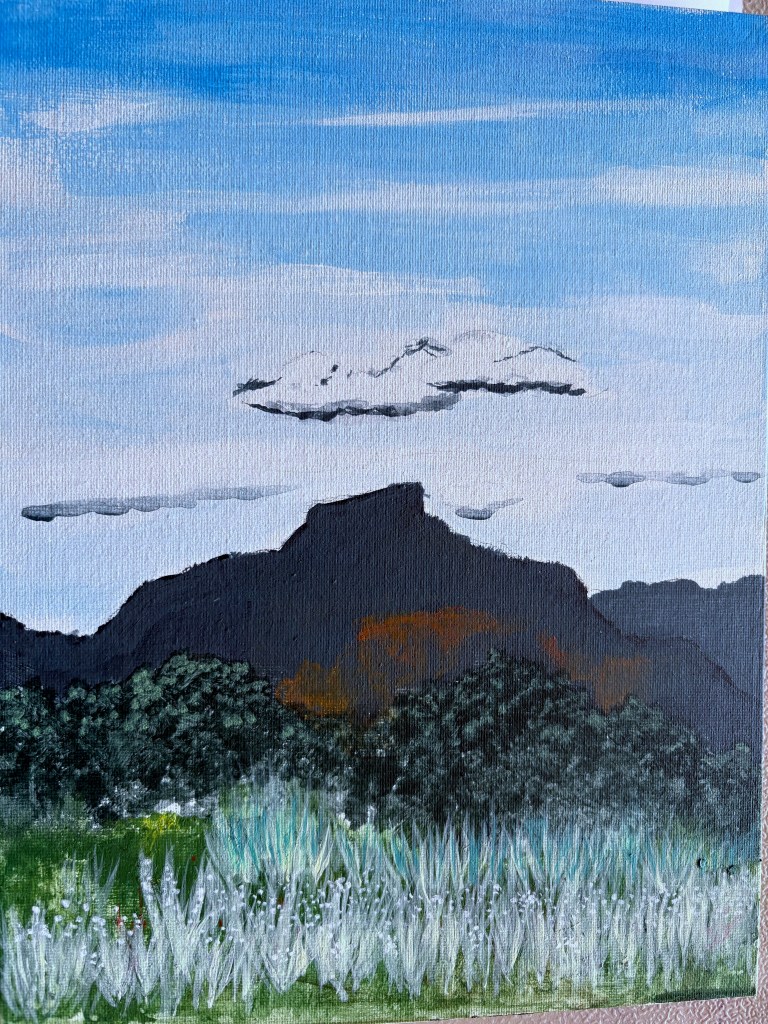
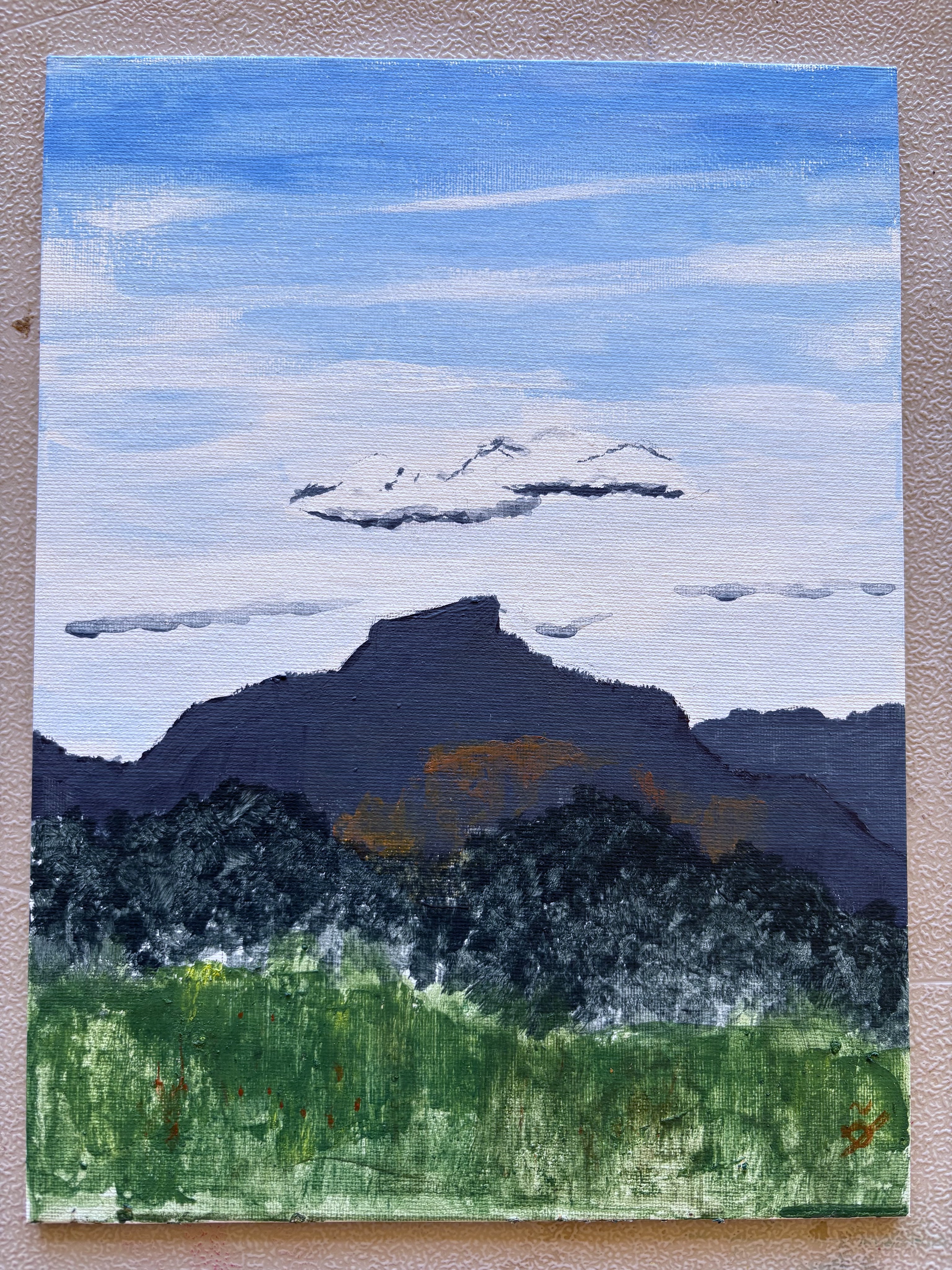
So, as I said previously, I made up my mind to try with this painting business. In the course of the week, I worked on three paintings. Some of my classmates produced that many in a day! While I am somewhat envious of their skill and capacity, I am not they, and that is not where I am. See how good I’m getting at giving myself grace and not comparing myself to others? Anyway, my three were that first landscape of Pedernal, another of Kitchen Mesa, and a still life. At the end of that first plein air session, I thought I was done with my painting. I even put a “D2” in the corner, my signature. Well, when we had a round-robin discussion in the class where we looked at everyone else’s work and offered comments, I got supportive comments of how they liked this or that about it, and several questions and suggestions of what I might do with it next. Next? Isn’t it done? Perhaps not. That one could continue working on a painting may seem obvious, but I guess I have watched too many episodes of Bob Ross’s Joy of Painting wherein he completes a work every half-hour show. So this was another point of my growth as an artist. I allowed as how perhaps I could continue working on my Pedernal, if only I could figure out how.
Another Target
I had a similar issue with my second painting, Kitchen Mesa. I was working on it from a photo I had taken so I could be inside. On a 9×12″ canvas board I penciled in the structures of clouds, mountain, and trees, and started in on the painting, working from top down. Calling on my experience with painting icons, I started a section with a dark base color and added progressively lighter colors on top of it. In iconography, this is a theological decision as much as artistic, to move from the darkness to the light. I still have no idea if that is what is ordinarily done in other styles of painting, but after watching my classmates working, I’d say not. Further, when KB, the instructor, came around to look at what I was doing, she was curious about my progression in that manner. Being a firm practitioner of the non-directive school, she offered suggestions of other possible methods, but insisted that if it worked for me, I should follow my path. I appreciated the permission giving, but the truth is I didn’t know if it was working or not.
The mesa has several distinct zones of different geology. There is a fairly dark, apparently dense rock that makes a kind of cap on the mesa. Maybe it isn’t actually dense, as there isn’t that much of it, either in width or depth. The next layer down is a pale yellow sandstone, and below that is an orange-red zone, almost salmon colored. There is an area of loose rock fall down the face of the red, and then, from where I was standing taking the picture, the trees take over the foreground. I’ll try to write about the geology in another post. As for my painting of these zones, as I said, I started at the top and I worked from dark to light. So that top cap came first. It has a number of vertical divisions. I overheard one of my classmates talking about trying to paint them in an earlier class, and she referred to them as the “teeth,” so that’s how I thought of them and referred to them. It turns out that wasn’t an official name as I imagined, but too bad. Now they’re called the Teeth of Kitchen Mesa. Anyway, using the iconographic approach, I actually got them to look pretty good! It took a lot of close, very detailed work. Usually I’m not a fan of details, but I kind of got into it with my icon painting, and I found it strangely engaging here, too.
I worked down to the sandstone zone. Here I ran into my lack of expertise with mixing paint to make the color you want. I couldn’t quite get the right tones or hues or values. I thought I could with layering, but my layers weren’t right either. I kept at it and got something blocked in, but I didn’t like it. Wrong color, wrong brush strokes, wrong texture to the sandstone, wrong, wrong, wrong. Again, in our review discussions, lots of positive comments on the sky and the “teeth”, and then encouragement to block in the rest of the colors and keep going. No one said, “that looks like crap,” or made me feel totally gross or morally bankrupt. I was encouraged, but I was also getting frustrated with the chasm between my desire and my product. I set the project aside until I could figure out what I was doing.
All this was on the first day of class.
Still Life Walking
On Tuesday, we started with a hike into the “back country” behind the art center toward the box canyon, if you know Ghost Ranch at all. If you don’t that’s okay. Suffice it to say it’s beautiful country, and it was a beautiful morning, and it was pretty flat walking. More views of more mesas and some of the beings that live on and around them, like lizards, bugs, and vultures. The goal of the expedition was to collect natural items from which to compose a still life. Again, KB, not wanting to make anyone do something that felt unnatural, wanted us each to compose our own items rather than her setting up one arrangement for all of us to paint. So not only don’t I know how to paint, I don’t know anything about arranging a still life, either. This was going to be great.
I found a handful of objects: two rocks, some yellow flowers, a stem of juniper, and a piece of …. wood? Yeah, I think it was wood. It had a lot of texture and a weird sage green color, and it was very crumbly. Let’s say it was wood. That was the easy part. Then, returning to the art center, I started trying to imagine how to arrange these things. All I can think of is the Dutch masters’ still life paintings, so I figure I need a table, some linen, a bowl, and maybe a skull? I don’t have nearly enough dark brown paint. Before long, KB came by, and I told her I was at a loss. She suggested just picking maybe three items, and then arrange them individually. Not so much an arrangement as a composition. That was a huge relief, really. I imagined being able to paint three items on their own much easier than trying to figure how to show them interacting. KB also recommended doing a neutral tone color wash on the canvas to 1) reduce the tyranny of the white canvas, 2) provide a background that would make the items stand out, and 3) I forget what 3 was. That seemed like a good idea, too, except I didn’t know how to do a neutral wash or what neutral tone meant. I took her recommendation under advisement for future consideration.
As I mentioned in the previous post, pencil drawing has always been more my thing. Since I felt like I was floundering with the paint, I decided to start this still life project by drawing the items in my sketchbook first. This would give me a sense of what I was looking at in terms of proportion and texture, it would focus my attention so I would “get to know” the items a little better, and it would give me a way to do art in a way I was comfortable with, just for a break. Well, if I’m honest, I was starting to doubt that I could actually do the painting. Drawing was a way to keep participating in the class without …. oh, what’s the word… trying. Or failing. Gosh, that runs deep. Nevertheless, drawing was comforting and productive and just what I needed to do at that point. KB wanted me to find my process. Drawing was going to be part of my process, one way or another.
Try. Fail. Learn. Keep Going.
Having completed sketches of my five items, I narrowed the field to three, as KB had suggested: the yellow flowers, the juniper branch, and the smaller, rounder, striped rock. Part of our class fees went to providing things to paint on, canvases, canvas boards, paper of different sorts, and so on. Somehow, all the 9×12″ canvas boards were gone already. I guess there weren’t that many to start with. That’s a pretty comfortable size for me, so I was disappointed. I didn’t feel like I was up to using an actual stretched canvas. So of the various options that remained, I went with a 12×16″ canvas board. This is so much bigger than I wanted. It’s a lot of white space for a beginner to fill. My already shaky confidence blanched before this white monolith. But come on, now, David. This is what you came for. Just go for it. I did. I sketched where I wanted my three items, and I started on the one I thought would be easiest, the yellow flowers. I started trying to mix the right shade of green for the stem and leaves. It’s a war between what nature has lain before me, the paints I have, my ineptitude, and my frugality that won’t let me waste anything. Nature loses. My green is far too bright, too blue, but again, I hope I can bring it down to where it “should” be in future applications. Besides, I don’t even know how to paint stems and leaves, so what difference does the color make? And you can’t just throw the paint away and not use it!
The painting itself doesn’t go any better. Even with my thinnest liner brush, my lines are fat, crude, uneven, overflowing. This is a disaster, a nightmare. What am I even doing here? What made me think I could paint? What a waste of time and money! I should just stop right now.
And yet…
Remember that you are a beginner. No one is here to judge you. This isn’t a competition. You are here because you wanted to learn and to grow. It doesn’t have to be perfect. It doesn’t even have to be good. It just has to be yours. You have talent. You can learn skills. Keep going.
So I did.
I went back to my sketchbook and practiced some ideas about how to do different kinds of strokes, using the extra bright green paint I didn’t want to waste. I practiced how I might make the petals of the flowers, and it looked good. I practiced some ideas for my Pedernal foreground. It didn’t take very long, and some of what I tried didn’t work, and some of it did.
I worked on Pedernal again, adding highlights to the mid-ground trees and adding grasses and flowers in the foreground. It was better.
I mixed some yellow that matched my flowers pretty well and added the petals to my painting. They got lost on the white canvas so I diluted some red paint and washed over them. It didn’t help! So I tried again with blue over the red. It didn’t help either! I took straight cobalt blue and very carefully painted around the petals and around the stems, and they all just popped! I practiced drawing my rock in my sketchbook with colored pencils, and then I painted it to look just like that, and it looked good. I painted around the rock with the cobalt blue, and it popped! I noticed that the boundary between where I stopped with the red wash (right in the middle of the canvas) and where it was just blue wash (at the top of the canvas) looked like the shape of Pedernal against the sky. I painted a thick, cobalt-blue, Pedernal-shaped line over that boundary. I connected the pools of blue around the two objects to the horizon line and to each other. I practiced and then painted the cow skull Ghost Ranch logo (originally be Georgia O’Keeffe!) at the top of the canvas, in place of the juniper branch.
And it was good.
What I Learned
I ended up really enjoying my painting class. I still don’t have much knowledge or skill, but I found a process, a path for doing art. As I spoke with classmates about my experience of nearly despairing and quitting before giving myself permission to just go ahead and ending up with something I really liked, several said they have had similar experiences. We even speculated that it is the nature of art to emerge with a push through the place of failure.
I learned about myself, of course, that I still wrestle with my perfectionism, and that I’m getting healthier about it. To offer grace to oneself to be less than “ideal” (whatever that is) is a gift of grace itself that comes, I believe, from a higher source. For that I am deeply grateful.
In planning for this year’s sabbatical, it worked out that it would begin on Molly’s and my 35th wedding anniversary. So wanting to do something to mark that milestone, we decided to go to Ghost Ranch near Abiquiu, New Mexico. Ghost Ranch is owned by the Presbyterian Church (USA) and has served as a retreat and conference center for the church since the 1950s or so. I’ve heard about Ghost Ranch for years and decades, but it was always so far away as to be somewhere between a mythological place or just not on my radar. Molly, having grown up in Colorado, had also heard much about GR but had never been there, either. In more recent years, particularly as my interest in astronomy led me to New Mexico a couple times, I started to think that going to Ghost Ranch could actually happen, but I never found the programming to match with my interests. They always seemed very arty, in many cases not especially religious, and kind of pricey on top of it. Well, since we weren’t looking for continuing education or professional development but sabbath and celebration time, and since we had funds for the sabbatical, we decided to check it out.
My initial interest was in an archaeology-paleontology course they were offering wherein guests would get to work an actual active archaeological site and dig for fossils. This sounded really interesting and fit with my sabbatical theme of time and eternity. I did wonder about how much fun it would be to be digging in the desert for 8 hours a day in July. Ultimately, it turned out that all the nice suites and single rooms with their own bathrooms were booked for that week, and we would have ended up in more of a dorm situation. That was a deal breaker. The week before that, they offered a class on how to put together a children’s book. That got Molly very excited, as she’s had an idea for years. I found a class on landscape and still life painting that I thought would be fun. So we signed up.
I will try to say more about Ghost Ranch itself and my experience of it in another post, and I’ll let Molly tell about her class where she will. For now, let me tell you about my painting class. I chose it because on my last sabbatical seven years ago I took a class on painting icons at the Siena Retreat Center near Racine, WI. I really enjoyed the work and turned out to be not bad at it for a first-timer. I haven’t done much painting since, and what I have done was working on a couple icons. So a class on the more traditional endeavors of landscapes and still-lifes offered a way to expand my artistic horizons, be creative, and try something I’ve always kind of wanted to do but was afraid to try. This last is actually a recurring theme in my life. I have had a weird neurosis that I feel like I have to have mastered a thing before I can try doing it. I’m getting better, but I’m still easily intimidated by new things. Thus, I guess this painting class was really a spiritual exercise for me, even if no explicit spirituality ever came up.
As with my icon class, I was in the minority here. I was the only man in the class of nine, and I was the only raw beginner. So much of a beginner that I had to ask my artist daughter about what some of the items on the list of supplies we were suppose to bring were and where I could get them. Daughter was very helpful, and I spent a bunch of money buying these mysterious tools. I did not spend any on paint, as I had bought some after the icon class, most of which seemed to be okay still, and also a box of eight 8-oz. bottles of basic colors that I got during the pandemic when I thought I’d be doing a lot more icon painting. Ha, ha, ha. Anyway, I arrived with my brand new unopened palettes and palette knives and my tiny old skanky paints and my “high quality” brushes (the fact that it says “High Quality” on the package is a dead giveaway that they are not, I discovered), and no idea what to do with any of them. Meanwhile, my classmates were all well equipped with piles of paints in well-worn cases with obviously proper brushes and tons of talent and experience, as would soon become obvious.
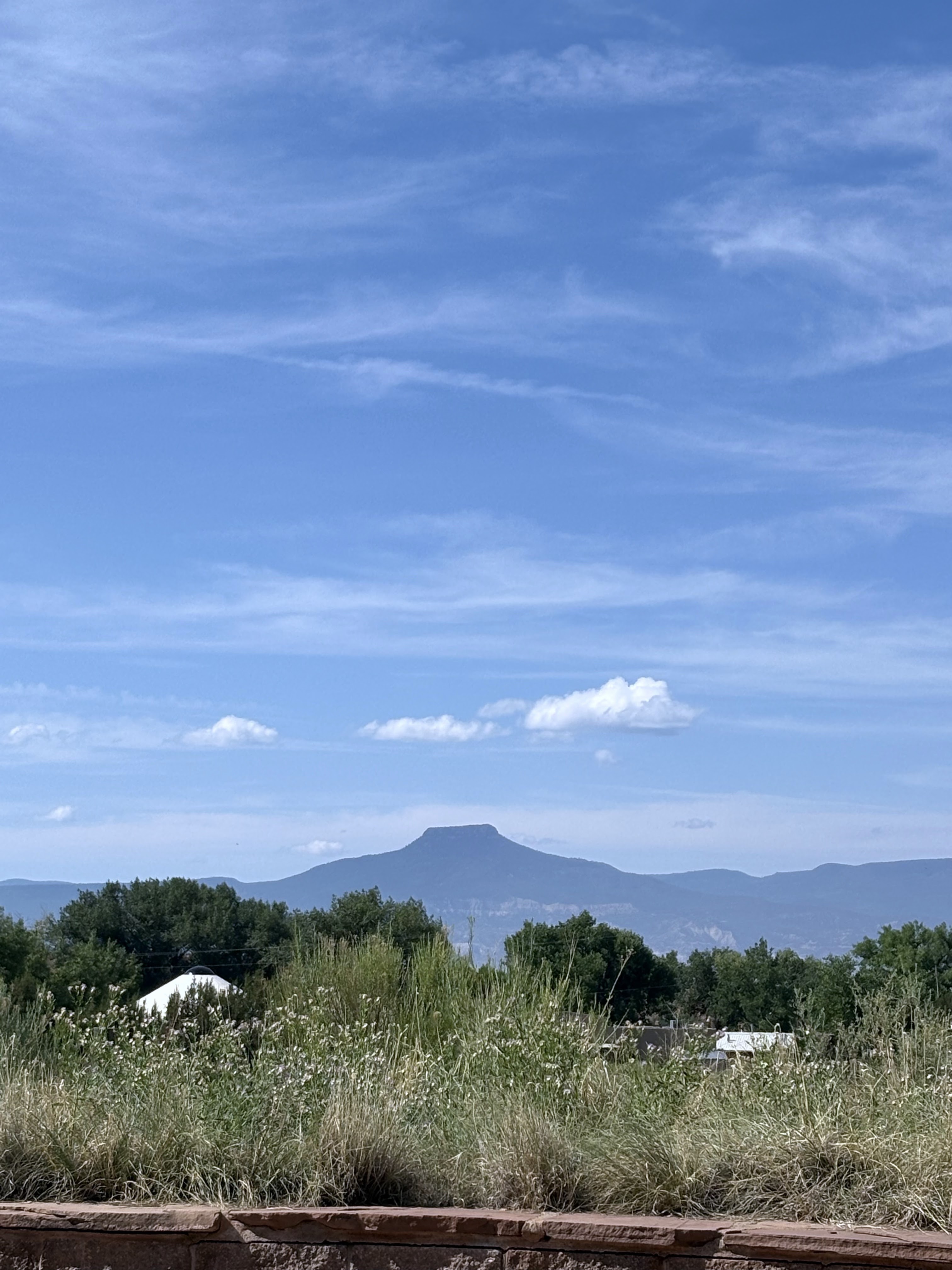
I thought KB, our instructor, would give us some lessons at the beginning of the day, and we would work out our artistic vision through the day, or something like that. It turns out that (1) most of the class knew what they were doing, and (2) KB is not that kind of a teacher. So we started by going outside on the patio of the art center to just start painting a landscape plein air (in the plain air, or outside). KB did give us a little demonstration of how she would begin, which was very helpful, because otherwise I was quite in the dark. Now, I’ve been drawing since I was a child, and I’m not bad at it. I have a good eye, I think, and can translate what I see to a page with a pencil. What I discovered quickly about painting (most of which I already knew) was that I knew nothing about technique, nothing about what sort of brush to use for what, nothing about how to mix paint to get a color you want, and nothing about how acrylic paints perform on a canvas. Well, that’s not entirely true. I had done those couple of icons, so I’ve mixed a little bit of paint, and I know that on an icon you thin the paint a lot an put on many, many layers to get the desired result. I have also watched a lot of Bob Ross, but he always worked with oils. So that’s what I had to draw from, as it were, as I started trying to paint the Ghost Ranch landscape.
Surprisingly, after 45 minutes I had covered most of a 9″x12″ canvas board with something that very generally resembled the scene before me. Somehow I had managed to overcome the tyranny of the white canvas and my fear of failure to produce…. something. Yeah, the really amazing part to me is that I consciously gave myself permission to do it wrong. Which, just to be clear, I did. Well, no, that’s not really fair. When it comes to art, what is right and what is wrong? My classmates and I all produced paintings of the same mountain in the distance, and not one of them looked like any other. I was certainly frustrated with mine not being “perfect” and a bit embarrassed that it wasn’t better than it was, but it was, after all, my first landscape painting ever. What do you want?



 A Pilgrim of Earth and Heavens