
Yes, this intro is the same as in Part 1 and Part 2, but the rest is different, so read them all.
On our recent tour through New Mexico and Arizona, my wife Molly and I found ourselves in the presence of some deep time. And by “found ourselves” I mean “planned our trip to be.” The trip included Ghost Ranch, a Presbyterian camp and conference center near Abiquiu in northern New Mexico, the Chaco Culture National Historical Park a couple hours west, Meteor Crater near Winslow, Arizona (which has its own little time loop), and the Grand Canyon in northern Arizona. An unscheduled but anticipated stop at Lowell Observatory in Flagstaff, AZ, fit into the scheme as well. Each site confronted us with history on scales from human generations to older than human civilization, to a significant fraction of the age of Planet Earth.
Meteor Crater (via Winslow)
Winslow
The next day we headed to Meteor Crater, but first we stopped in Winslow, Arizona. People of a certain age and/or musical taste will recognize the reference immediately as coming from the song “Take It Easy” by the Eagles:
“I was standing on a corner in Winslow, Arizona,
Such a fine sight to see.
It’s a girl, my Lord, in a flatbed Ford
Slowin’ down to take a look at me.”
In the great tradition of American kitsch, there is a roadway attraction commemorating this song. Take It Easy Park, on a street corner in Winslow, on historic U.S. Route 66, has statues of Don Henley and Glenn Frey, the leaders of the Eagles. There is a mural of a store window reflecting a flatbed Ford truck with a blonde woman looking out the side, while an actual matching Ford truck is parked on the street. People cycle through taking pictures and selfies with the statues and the truck and all, and we took our turn as well. Winslow looks like it would be a pleasant enough place to live. There were plenty of restaurants, shops, and souvenir places in the area, although we didn’t indulge. Still, it carried me back to my youth. The song was released in 1972 and was a classic by the time I was coming of age. Funny how nostalgia can make you feel young, if only for a few minutes at a time.
Meteor Crater
On we went to the main event for the day. Just about half an hour west down the highway is the exit for Meteor Crater, which is another five miles down the road to the south. It turns out there really isn’t much else anywhere around there. Clever signs appear every half mile or so, building the anticipation with announcements like, “3 Miles to Impact!”
The land is flat enough that when you are still those three miles out, you can make out a ridge in the distance that turns out to be the rim of the crater! It was just a suspicion at first, but the closer we got the more obvious it became. This was surprising and exciting! I’ve actually wanted to see the crater for years since I learned about it, so my anticipation was already running pretty high, even without the fun signs.
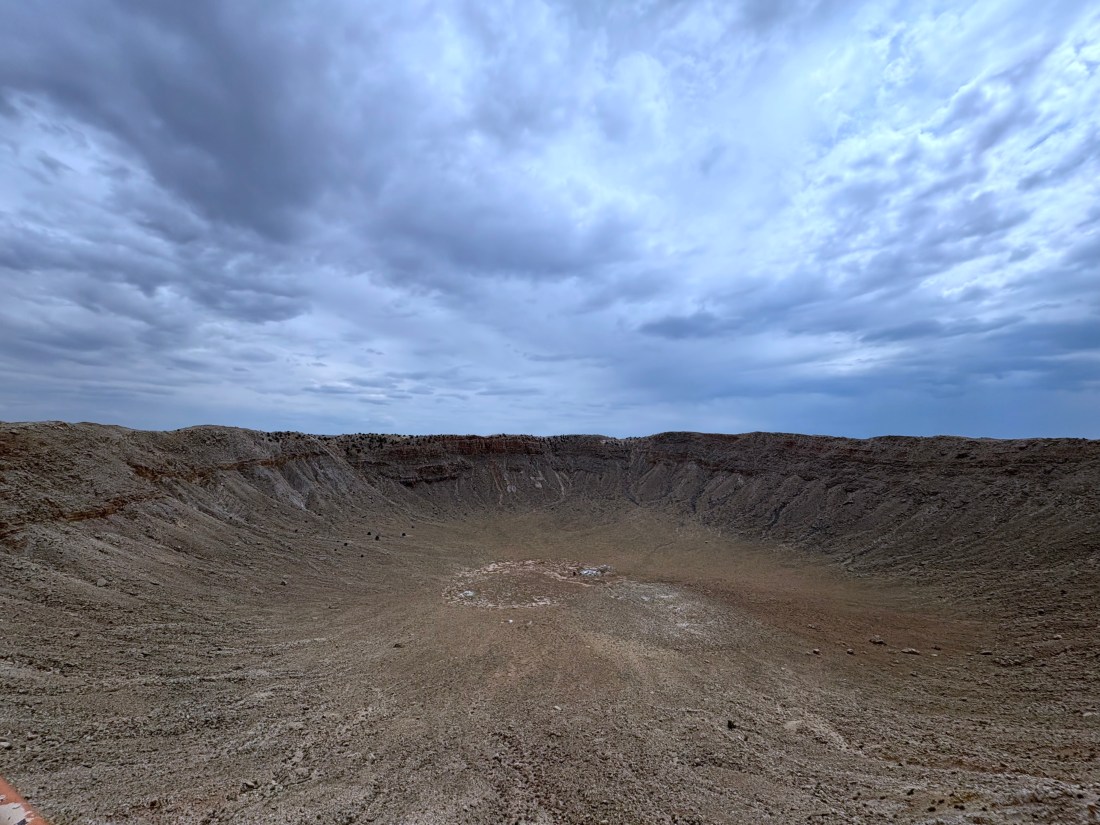
The crater did not disappoint. As the name suggests, this is the impact crater of a large meteor that struck the earth 50,000 years ago. The visitor center has an introductory film, a variety of interpretive and interactive scientific displays, a cheesy but fun “4-D” theatre experience, a fairly extensive gift shop, and an overpriced snack bar. All of that is pretty good, but the main attraction, of course, is the crater and the rim tours.
The crater is about a mile across, three miles around the rim, and 550 feet deep. It is a big, old hole in the ground! We took the rim tour, and our guide, Hayden, was very knowledgeable and engaging. Between his talk, the introductory film, and the displays, we learned that, although the crater was long known to people in the area, it wasn’t until the early 20th century that anyone got the idea that it might be an impact crater and not volcanic. To that point, no impact craters were known to exist on earth. The discovery of a large iron meteorite (about two feet long) nearby triggered a decades-long failed mining exploration of the crater, but it also became the smoking gun that led to the impact conclusion. This became the start of a whole line of scientific inquiry into the process of meteor impacts, both here and on other worlds, so that scientists have been able to determine the history of the crater. About 50,000 years ago, an asteroid measuring about 150 feet (45 meters) across came in at a high angle (80º), traveling at 26,000 mph. It buried itself in the ground and exploded, creating the symmetrical crater 550 feet deep and a mile wide in about ten seconds. Other than pretty total local destruction for about 75 miles in any direction and the scar of the crater, they say it had no significant lasting effect on the planet.
Because of the extremely dry and reasonably stable climate in northern Arizona, the crater has suffered little erosion and remains in excellent condition, mining shafts notwithstanding. It continues to provide insight into the potential for asteroid impacts on earth. Because this crater was identified as an impact, we have learned that the Earth has been hit many times and by much larger impactors, many of which caused global environmental disasters and mass extinctions. Consequently, we now have active scientific programs to identify potentially dangerous asteroids in the solar system. Scientists and governments around the world hold regular conferences to examine the state of affairs and to practice what to do if/when we find an inbound asteroid on its way. NASA has even sent a successful mission (DART) to impact an asteroid to see what it would take to divert a potentially hazardous one. As Bill Nye, CEO of the Planetary Society, is fond of saying, “The dinosaurs were wiped out because they didn’t have a space program.” Meteor impact is one of the few natural disasters that we now have the growing capacity to prevent.
All that from a big, old hole in the ground.
 A Pilgrim of Earth and Heavens