
The intro is the same because, as I said at the end of Part 3, it’s series, you know? So be sure to read the previous episodes, Parts 1, 2, and 3.
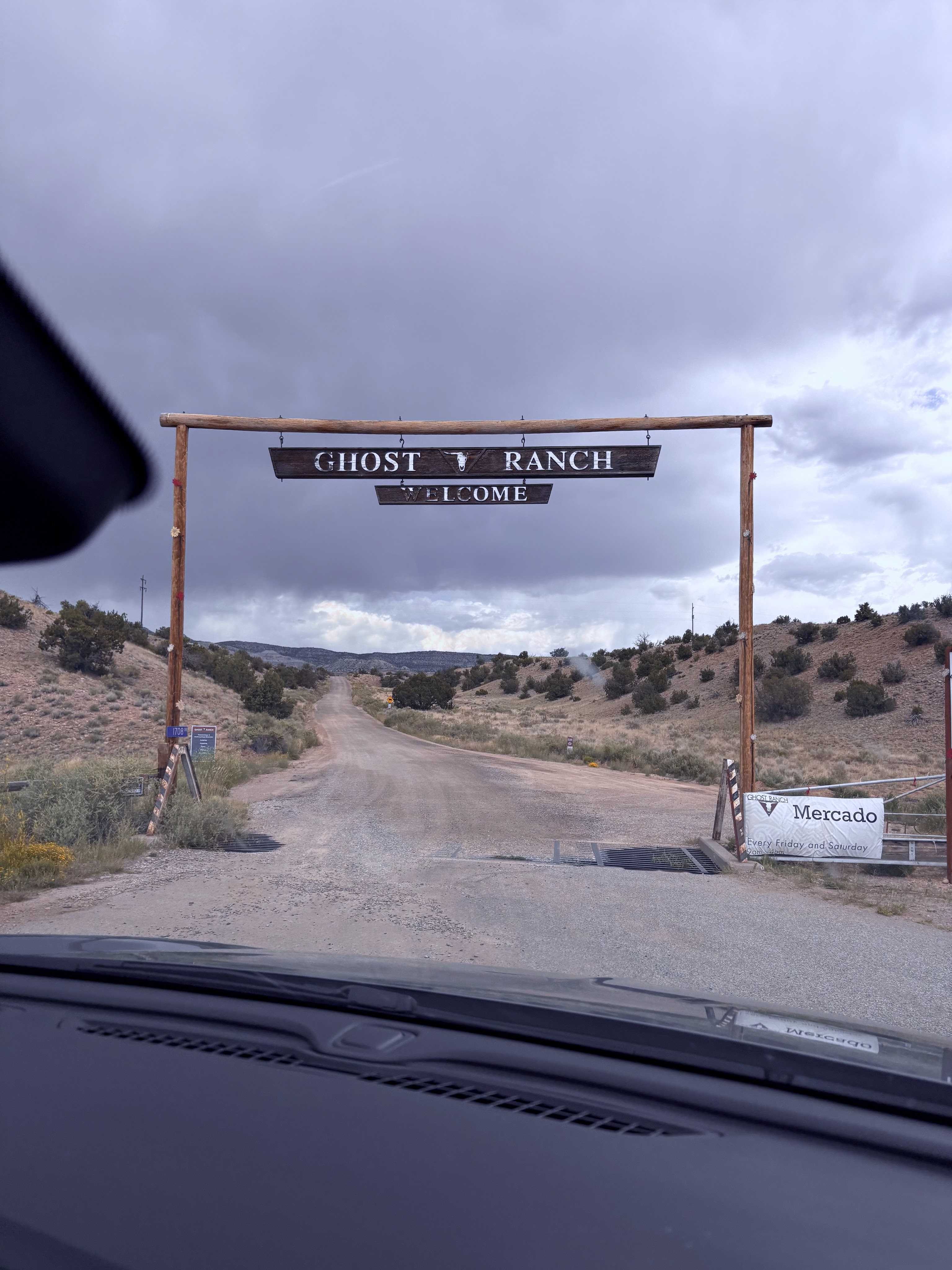
On our recent tour through New Mexico and Arizona, my wife Molly and I found ourselves in the presence of some deep time. And by “found ourselves” I mean “planned our trip to be.” The trip included Ghost Ranch, a Presbyterian camp and conference center near Abiquiu in northern New Mexico, the Chaco Culture National Historical Park a couple hours west, Meteor Crater near Winslow, Arizona (which has its own little time loop), and the Grand Canyon in northern Arizona. An unscheduled but anticipated stop at Lowell Observatory in Flagstaff, AZ, fit into the scheme as well. Each site confronted us with history on scales from human generations to older than human civilization, to a significant fraction of the age of Planet Earth.
Grand Canyon
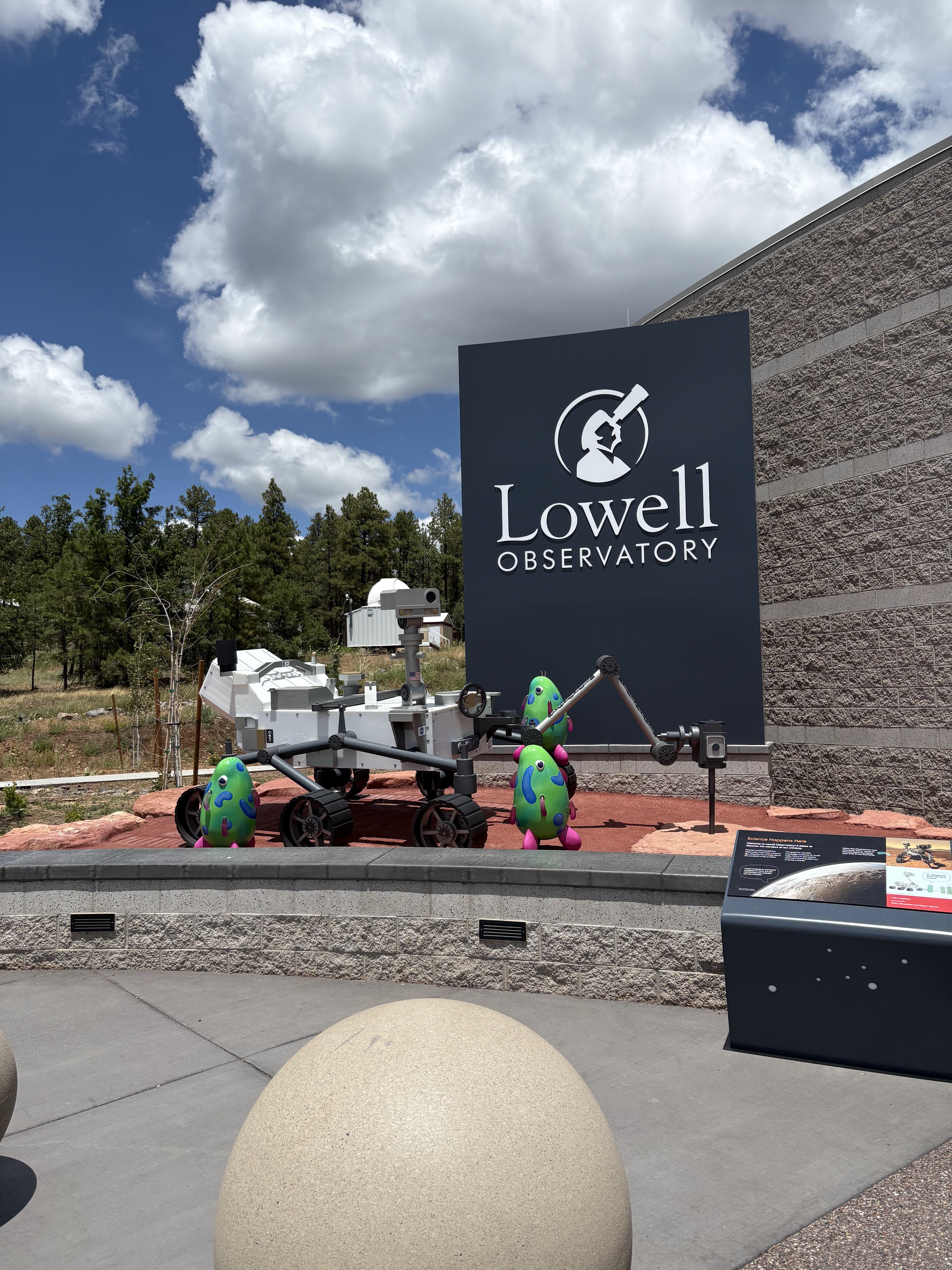
Our tour continued through deep time with a slight detour. On Monday we were in Flagstaff, AZ, which is the home of the Lowell Observatory. This had been one of my favorite stops in 2018, and while we didn’t have it scheduled, I was pleased that Molly wanted to see it. Certainly an observatory with instruments that helped identify the expansion of the universe, besides the discovery of Pluto and investigations of Mars and such, could be considered as part of our exploration of deep time. But I’m going to skip over it and stick to terrestrial and geological targets. Suffice it to say we had an enjoyable day of exploration at Lowell.
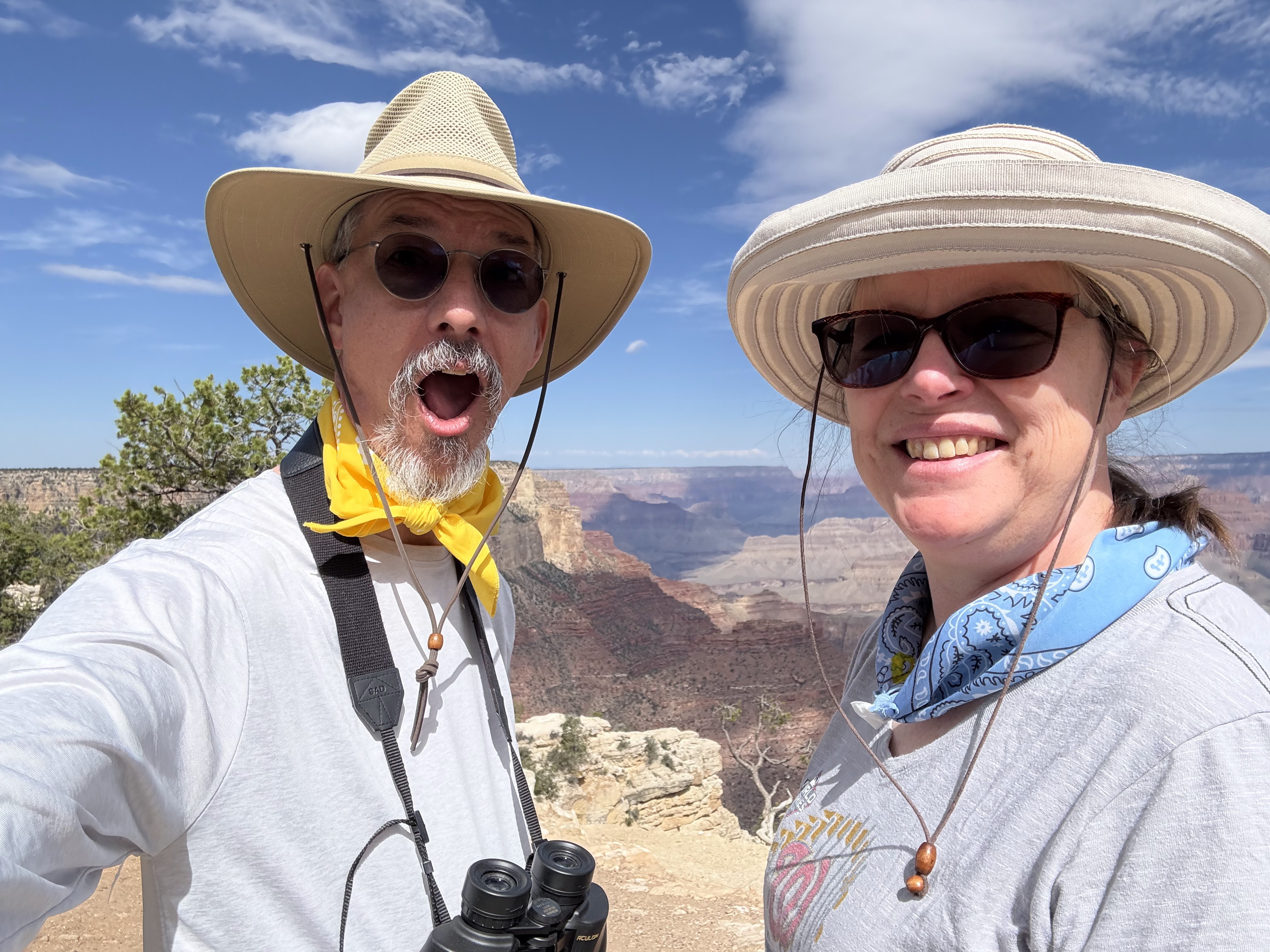
Tuesday morning started bright and early, a bit brighter and earlier than usual, as we were heading for the Big Ditch, the Grand Canyon. I had reserved spaces for us on an all-day tour with Canyon Dave Tours, a company that comes highly recommended for good reason. Our guide, Keaton, picked us up at our hotel in Flagstaff at 7:45 a.m. in a 10-(or so)-passenger van with the plan to pick up another couple in Wilson and another in the Grand Canyon National Park. That would be our entire tour group! We would see vistas and historically significant buildings and points of interest all along the South Rim, working our way around to the East Rim. Lunch was included. Keaton turned out to be a perfect tour guide with a wealth of knowledge on the canyon’s geology, flora and fauna, Native American habitations, and National Park history. Pretty much anything you would want to know about the Grand Canyon, Keaton had an answer. Plus, he was genuine and engaging with a good sense of when to jump in and when to leave space. At day’s end, Keaton drove us all back to where we belonged to the strains of Carlos Nakai, famed Native American flute virtuoso. Of our landmark tours, this was the most expensive, but it was also worth every dollar. But enough about the process. Let’s talk about the Canyon.
The Canyon
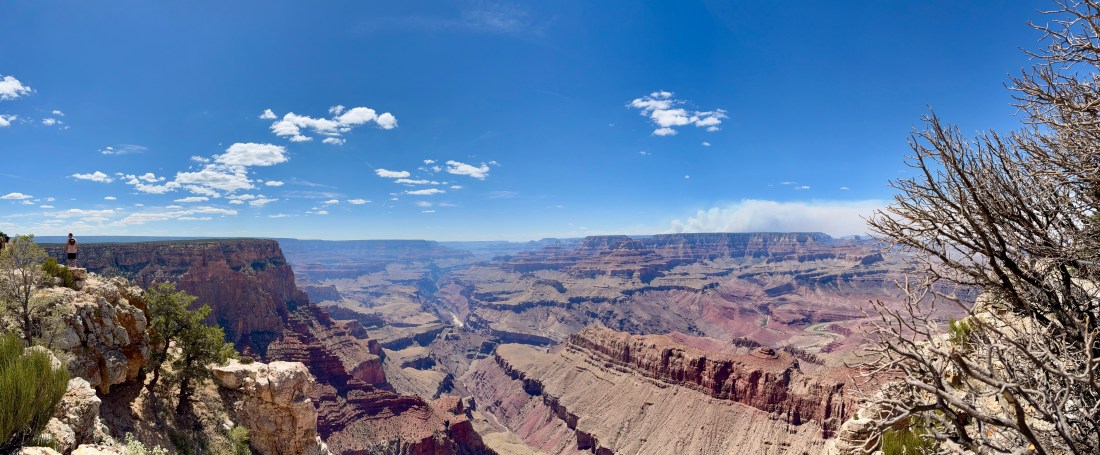
They always say that pictures don’t do it justice, and that turns out to be true. The Grand Canyon overwhelms one’s sense of scale at first sight. Standing between ten and 18 miles across from the South Rim to the North, between .75 and 1.25 miles in vertical depth, and 277 miles from end to end, this is the biggest canyon on Earth, at least on land. The Colorado River runs through the heart of it, having carved the canyon’s root over millenia. But as we learned, it is not the Colorado alone (averaging 300 ft. wide in the canyon) that made the canyon so wide. That was the work of various tributaries and erosion all along the length of the canyon on either side of the Colorado. The result is a spectacular display of revealed geologic layers in multiple shades of red, brown, green, gray, yellow, brown, and more.
Just as the layers of the mesas at Ghost Ranch revealed the ancient building and erosion of the landscape over millions of years, so the layers of the Grand Canyon reveal the same sort of processes, but going back much farther in time. In fact, the top of the canyon is about as old as the bottom of Ghost Ranch, about 270 million years. Think about that for just a moment. Standing at the rim of the Grand Canyon, you are starting at a point 1000X older than the modern human species of homo sapiens. You are starting at a time before dinosaurs appeared. You are starting in the era when all the continents were mashed together into a single landmass called Pangaea. The deeper you go, the older things get, and as we’ve seen, it gets pretty deep.
At the bottom of the canyon, the Colorado is currently cutting through layers called the Vishnu schist, or the Vishnu Basement, and beyond. These rocks are about 1.7 BILLION years old. That is about a third of the age of the planet. This is an era when the only life on the planet was single-celled, mostly bacteria and eventually some algae. Fungus was still a thing of the future. The atmosphere was still in the process of becoming oxygenated for the first time. There was only one supercontinent, but it is called Nuna, the great-grandparent of Pangaea. (Nuna would break up and recombine twice before Pangaea formed.)
In between the Vishnu Basement and the rim of the canyon are multiple layers of sandstone, shale, and limestone, each representing a different geologic era. They represent times when the canyon site was variously under an inland ocean or a dense forest or some other environment. The layers tell us of millions of years of deposits pressed down into solid rock. Think of the eons it would take to build up and compress enough sand, plants, and seashells to make a mile-deep mountain. Then think of the eons it would take to erode it all away so we can see it again.
Short Attention Span Eternity
The human mind is not adequately equipped to exist in timescapes that deep. So we can enjoy the glorious beauty of the Grand Canyon, and we can try to fathom its depth of time. But I think in the latter, we will ultimately fail. This is one of the reasons I wonder about God’s intention for us to live in eternity. Not that I don’t believe it. Not that I think God can’t make us fit for it. But as we are now, we can hardly process millions of years, much less billions. I mean, we get impatient waiting 30 seconds for the microwave to reheat our leftovers, or even a couple of seconds for a webpage to load. (Sorry about that big image at the top of the page.) If eternity is an infinitely-long linear time, we just aren’t ready. I believe we need to rethink how we talk about eternity and how we prepare people to live eternal life in this age, so we will be better prepared for the age to come.


 A Pilgrim of Earth and Heavens