
As I mentioned in my previous post, I’m on a trip to Florida to see if I could catch a rocket launch, and in fact I’ve caught two! There’s no limit, so I don’t even have to throw one back. In that previous post I told about seeing the first one, a night launch on a cloudy night. While that was a wonderful experience, the second was even better.
A Day at Kennedy Space Center
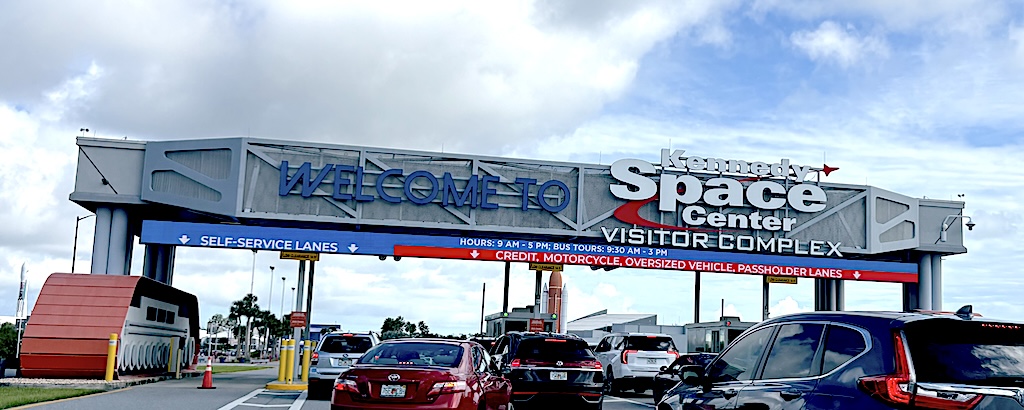
First, let me tell you about my day. [I’ve included some headings if you want to get right to the business. Otherwise,…] It was Sunday, September 14, and the rocket launch I’ll tell you about in a bit was scheduled for 6:11 p.m. EDT from Space Launch Complex (SLC) 40 at Cape Canaveral. While it was lovely to see a launch from Titusville the other evening, seeing one from Kennedy Space Center (KSC) would be about five miles closer and infinitely cooler. Admission to the KSC Visitor Complex isn’t cheap, but it’s probably a lot less than most of the other theme parks and attractions up the road. But once you get in, seeing a launch is included (if there is one to be seen during or close to regular operating hours). This one was going to have an official viewing in the bleachers. I mean, like I wasn’t going to go to KSC anyway, whether there was a launch or not, right? Of course I was going.
There are lots of displays, presentations, and attractions going on at the Visitor Complex, which, by the way, is not funded by NASA or your tax dollars at all. It is all funded by admission, parking fees, and food and merchandise sales. Who knew? Anyway, I bought a two-day pass, so I could get around to seeing everything eventually, but I picked out the things I most wanted to see for day one in case I didn’t come for day two for some reason. So that meant the Rocket Garden, the bus tour to the Gantry at LC-39 and the Apollo-Saturn V center, and the Space Shuttle Atlantis.
The Rocket Garden is a collection of early U.S. rockets that served in the Mercury, Gemini, and Apollo campaigns and launched some of the first U.S. satellites and such. They are actual rockets although none has actually flown. Among the most notable are the Redstone, Atlas, Titan II, and Saturn 1B. Except for the last, they all look pretty modest. Like, how is that thing going to get someone to space? But they did, in part because the capsules were so small! My car is bigger than a Mercury capsule and fits four to five times as many people. It gives one a great appreciation for the courage of those early astronauts.
It turned out that because of the scheduled launch, the Gantry exhibit was closed. That was a bummer. It is, as I understand it, a refit or reconstruction of part of an actual gantry at LC-39 where all the Apollo rockets went up. Now it has displays and exhibits about ground systems and rocket testing and things like that, plus it has panoramic views of several active launch pads from only about a mile and half away. So that would have been pretty cool to see.
Who Weeps for Apollo and Saturn?
Back in 1997, Molly and the kids and I spent a week in Orlando and took a side trip to KSC, but I don’t remember most of what we saw then. I do remember that we went to the Apollo-Saturn V center, and that it was an emotional experience for me. The space program was very formative in my early years. The moon landings happened when I was six to ten years old. The astronauts were all heroes. I remember getting up late at night or getting up extra early to watch moon walks. I used to draw the command/service module and the lunar lander endlessly. I was never much of a model builder, but I had a LEM. My toys were astronauts. It was a big deal to me and undoubtedly why I went to college to be an aerospace engineer. When I first walked into the hall where the Saturn V is on display, I nearly wept.
Nothing has changed in twenty-eight years. After the introductory movie about the moon landing campaign, you go into a mockup of the launch control center for Apollo 8, the first crewed mission to fly the Saturn V rocket, to leave Earth orbit, and to reach the moon. They reenact the last two minutes of the countdown and launch, and the whole room shakes with the power of the rocket, just as it did back in 1968. Then you walk out into the exhibit hall where the last Saturn V lays in repose, extending over the length of a football field. And I just about wept. It is a staggering machine for a staggering mission. For me it represents not just the hope and idealism of years past but also the reality of what humans can do through science, cooperation, and a shared vision. It also represents the power of cynicism to put the brakes on such achievements. It’s been 53 years since anyone went to the moon. Awash in mixed emotions, I gazed once more in wonder at this colossus and then spent a good bit of time with all the other exhibits in the hall.
Meanwhile, Back at Atlantis
Upon returning to the main complex, I found myself right outside the building where the space shuttle Atlantis is on display. There were six shuttles built: Enterprise, the prototype used for atmospheric testing, and the five that flew to orbit, Columbia, Challenger, Discovery, Atlantis, and Endeavor. As you surely know, Columbia and Challenger both were lost with all hands aboard. I have now seen all the other four. I actually saw a shuttle launching in March 1989. It was STS-29, I think. Discovery, I think. A couple seminary friends and I were visiting my brother Bill in Fort Lauderdale for our spring break. We drove up as far as West Palm Beach and watched it go from there, about 100 miles from the Cape. It was just a little, bright, red-orange streak in the sky. I’ve always wanted to get closer.
Anyway, as with the Saturn V, you are introduced to Atlantis with a couple of movies before entering the hall where the ship awaits you. They do a really nice job with this. If you get the chance, you should see it. Atlantis rests at an angle, its payload bay doors open, its robotic arm extended, all as if it were still on the job in orbit, yet it seems almost close enough to touch. The shuttle is surrounded by many, many fascinating displays and activities, several of which are designed for children, which is excellent. You can examine the underside of the craft with its myriad of ceramic heat shield tiles. There is a memorial room for the two lost shuttle crews. And there is a gift shop, of course.
Um, what about the boldly going?
Right. By this time it was after 4:00, and I was getting anxious and eager, so I made my way outside and found the sign for “Rocket Launch Viewing This Way” conveniently just around the corner. The bleachers are on the north lawn just behind the Atlantis building. Handy! Even two hours before launch and forty-five minutes before they opened the seating there was a pretty good line forming, so I joined it. The line continued to grow past where I could see. Everyone was pretty well behaved and mostly quiet until they opened the gate at 4:45.
I might mention here that probably 9 out of 10 people I heard speaking through the day were speaking something other than American English. NASA is the best international brand the United States has going. Too bad the current administration doesn’t seem to see its value, but that’s another story. I found it tremendously hopeful and encouraging to hear languages from around the world and global travelers who are interested in space just as I am. The three or four sets of bleachers, set in an L, filled with these space tourists quickly, and then people started to fill the yard that was about the size of a tennis court or more. It eventually filled up, too. Must have been, I don’t know, a thousand people? The couple in front of me were, I think, from Brazil. The family behind me were maybe Ukrainian or in that neighborhood. The couple beside me spoke Spanish, and there was a Chinese family just across from them. Sorry I keep getting distracted from the main event, but it made an impression.
Bart, our launch commentator representing NASA, welcomed everyone, “worked the room” some, and let us know what the mission was all about, what to expect in terms of the launch, and how to best enjoy the experience. On that last point, he recommended not trying to video record the launch, especially if it was the first you’d ever seen, which was true for at least 90% of the crowd. Naturally, being a pro now that I’d seen one, I felt confident trying to do both enjoy and record.
The mission
The mission was designated CRS2 NG-23, a Commercial Resupply Services (CRS) mission to the International Space Station (ISS). The cargo vessel being launched would be carrying equipment, scientific experiments, and the like, Built by Northrup Grumman (NG) and the 23rd of its kind, this one is called the S.S. William “Willie” McCool, named for the pilot of the lost space shuttle Columbia. The launch vehicle was a SpaceX Falcon 9, going from the same pad SLC-40 as the one I saw on Thursday night. It’s amazing how fast they can turn over missions these days! We were about 7 miles from the launch pad, almost half the distance from my previous experience. We would have to wait a few seconds after liftoff for the rocket to clear the tree line before we could see it, but as Bart explained several times, “when it comes up, you’ll know!” One more cool thing about this flight was the first stage booster would be returning to land at Cape Canaveral Space Force Station instead of landing on a barge at sea, so we would hopefully be able to see it on its way back, although we were too far away to see it actually touch down.
Because the S.S. Willie McCool would be docking with the ISS, which orbits the earth every 90 minutes in such a way that its ground track (if you traced its orbit onto the earth’s surface) moves several degrees with each pass, the folks who plan the trajectory tend to choose the shortest path from launch to rendezvous rather than trying to chase it around the globe a few times. Like firing a bullet at another bullet already in flight, that means there is only one flight solution. So whereas the satellite launch on Thursday night to an independent orbit of its own had a two-hour launch window, this mission had an “instantaneous launch window.” It would launch at 6:11 p.m. EDT, or it would have to wait for another day. Fortunately, in spite of a few odd sprinkles, the weather was looking really good, and the Next Space Flight app was showing 75% chance of GO for flight. Much better than the 40% from Thursday.
We had the benefit of a huge screen that was showing the live stream from Next Space Flight on YouTube. That offered us live views of the rocket and a countdown clock, and occasionally we were treated to bits of the SpaceX live stream once it came on, complete with talking heads going on about this or that and how wonderful SpaceX is blah blah blah.
The flight director called for “prop load,” that is propellant loading, right on schedule at T-38:00. About that point the app showed 90% GO for flight. Bart popped on the mike about every five or ten minutes to make sure we were paying attention and to tell us what was going on, for those who don’t regularly follow rocket launches like some of us do. I noticed the anticipation building with about 20:00 to go. Whether it was the whole crowd getting excited or just me I can’t really say. I would guess the former but would be satisfied with the latter. Bart reminded us once again of the two pieces of advice for getting the most out of the experience: (1) Look up, (2) Put your phone in your pocket. Some people even listened to him, I think.
With about ten minutes to go, Bart said, “I know what’s going to happen when we get to just a couple minutes in the countdown. Y’all are going to want to stand up. I get it, it’s very exciting and all. But let me tell you, first of all it won’t make any difference because the thing you want to see is going to be in the sky. You will see it just as well sitting as you would standing. But more importantly, if all you adults stand up you will be blocking the view for the children. They won’t get to see anything but your backs. So please, for the kids’ sake, just fight that urge and stay seated, okay?” There was great applause for this, and I think it was the best thing he said all day. And everyone listened and kept their seats through the launch. Makes me a little weepy again. Don’t know why.
The Launch
With a couple minutes to go, Bart invited the kids to help him do the countdown, which we would see on the big screen. Several youngsters joined him to fulfill this critical duty. He also allowed as how the adults could join in, too, if they could count backwards as well as kids can do.
At T-00:40, the flight director gave the call, “GO for launch.” Everyone got their cellphones ready and pointed in the direction of launchpad. Sorry, Bart, we just can’t help it. Bart and the kids started counting down at T-00:15, and most of the crowd joined in.
10-9-8-7-6-5-4-3-2-1!
On screen we could see the burst of cloud at the bottom of the Falcon 9, indicating engine start, then the rocket started to move. Almost immediately a narrow, bright orange stream appeared above the trees, although I didn’t see it right off. (I know it was almost immediately from the video.) It took me a few seconds to find it and lock in on it because it was rising right beside a utility pole in my line of sight. But Bart was right, that once it’s up, you’ll know. In the video the flame looks mostly white with orange hues around the edges, but in real life it was vivid red-orange against the blue of the sky, and it was incredibly bright! Like, hard-to-look-right-at-it bright, another effect that doesn’t come through on the video. The plume of flame was longer than the white and grey rocket was tall. Within 30 seconds the rumble of the engines’ thunder started to wash over us, mildly at first and building, building, building. At T+00:45 the characteristic crackle started in. The roar was impressively loud, though not quite enough to feel it thump in your chest.
At that point the rocket was noticeably pitching down range so that it appeared to be at an angle and the flamey end was more visible. (This was not connected to the crackle sound of the engines, which was about 30 seconds delayed in getting to us, as mentioned.) About a minute into flight, the rocket itself was hard to see, and the bright orange flame cone was becoming more of a spot than a line as we were looking more or less along its axis. Also around a minute and change, the rocket was going transonic, that is it was approaching the speed of sound. This produces condensation effects with the atmosphere so a vapor trail appears in the rocket’s wake. This part of the flight path is called Max Q, which stands for maximum dynamic pressure. The rocket is basically moving so fast that the air can’t get out of the way fast enough and starts pushing back harder and harder and with more turbulence. This puts the most stress on the vehicle structure in the flight. At the same time, as the rocket gains altitude, the atmosphere around it is getting thinner, and at a particular balance point the rocket punches through and goes supersonic, that is it exceeds the speed of sound, after which the air flow becomes smooth again on either side of a leading shock wave. The rocket is then free to pick up speed more easily. This is why we talk about the “sound barrier” and why it took until 1947 before anyone broke it (Chuck Yeager in the Bell X-1, a plane shaped like a .38 bullet). The vapor trail leaves off at that point, too. For reasons I may once have known but know no longer, the maximum dynamic pressure actually happens after the rocket goes supersonic, but they happen pretty close together.
Higher it went and further down range. Because of the geometry of curved space, it started looking like the rocket was heading back down. Some of the people around me were concerned. Nothing to fear, friends! It’s just an illusion.
The majority of the mass of a rocket launch, up to 95%, is fuel and something to hold it in. In order to maximize efficiency and not carry the weight of a lot of empty fuel tanks, rockets will have multiple stages that come apart during flight. Around T+2:00 the first stage booster ran out of fuel, and the rocket reached MECO, main engine cut off, followed pretty shortly by stage separation. The mostly empty booster drops off the back, and the second stage engine starts up to push the payload further “uphill” to orbit. That one second stage engine wasn’t bright enough to see from the ground with naked eyes, but we could see some clouds of vapor associated with MECO, staging, and the second stage startup. That was about the last evidence of the rocket we could see. Until….
Falcon 9: The Return
SpaceX has become successful in no small part because they have mastered the art of reusability. They routinely land their first stage boosters so they can be refit and reused over and over. This is an obvious advantage over just throwing away that extremely expensive and complicated piece of machinery. Most often they will land the booster on a barge out in the ocean along the flight path. That’s remarkable in its own right, and it is easier than turning the booster around to make it come back to land. However, sometimes the flight characteristics are such that they do in fact return the booster to land at Cape Canaveral, and as I mentioned, we were fortunate to be watching one such flight.
The returning booster makes three burns: the “boost-back” burn, the reentry burn, and the landing burn. “Boost back” is what redirects the booster away from the initial flight path and back in the direction of the launch/landing complex. The reentry burn slows the booster so it won’t burn up in the atmosphere and can also help with navigation. This uses three of the nine engines. The booster then glides down with guidance from its “grid fins,” specially designed appendages that redirect the airflow, like holding your hand out the window of a moving car, to navigate toward the landing site. The landing burn, also using three engines, is the final phase of slowing and steering to bring the booster down gently to the ground.
Just over six minutes into the flight the booster made its reappearance, lighting up during the reentry burn. Again, the intensely bright red-orange glow of the engine flame was easy to spot against the deep blue of the sky. It only lasted about 20 seconds. After that I could actually see the booster, although it doesn’t show up at all in the video. It was coming in at a steep angle and was obviously hauling butt! Man, it was moving fast! Indeed, it was still supersonic, so as it got lower and was pushing into more and more atmosphere it again went transonic, but the other way, going from supersonic to subsonic. Another vapor trail told the tale. I lost it behind some palm trees, but we could see it on the big screen. The landing burn started almost right after I lost sight of it and, as designed, its landing legs deployed, it settled gently on the ground, and the engines shut down.
The last bit of fun for the day was listening, right after touchdown, as Bart hushed the crowd. BaBOOM! A double sonic boom reverberated across the sky, to the delight of all! This is the crack of that last transition from supersonic to subsonic, I think it’s first from the base of the booster and then from top.
With that, Bart wrapped up the commentary with “Did you have a good time?” (thunderous yelling and applause) and “Thanks for being here, and be careful on your way home!” All that remained was waiting for a thousand people to get out of my way. I was in no hurry, though, as I savored the experience. What a thrill! What a remarkable day! What a world that has such wonders in it.
Now you can watch to find out if I told the story correctly and if I succeeded in capturing the video while I was taking in the experience. Enjoy!
 A Pilgrim of Earth and Heavens